

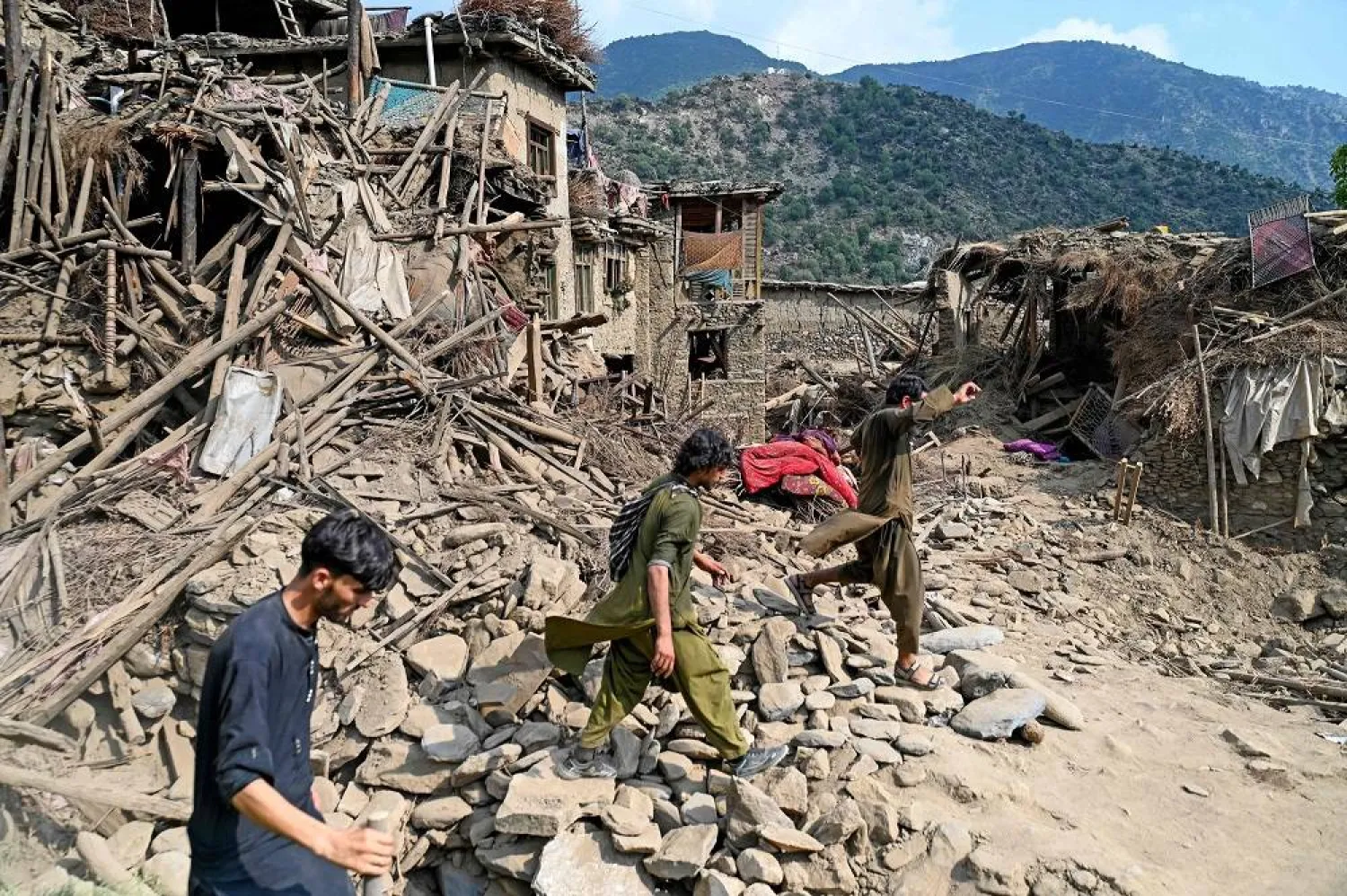

New Quake Shakes Devastated Afghan Region as Death Toll Exceeds 1,400

Afghans walk past damaged houses, after earthquakes at Mazar Dara village in Nurgal district, Kunar province, in Eastern Afghanistan, on September 1, 2025. (AFP)
TT

New Quake Shakes Devastated Afghan Region as Death Toll Exceeds 1,400

Afghans walk past damaged houses, after earthquakes at Mazar Dara village in Nurgal district, Kunar province, in Eastern Afghanistan, on September 1, 2025. (AFP)

An earthquake of magnitude 5.5 shook southeastern Afghanistan on Tuesday, sparking fears of further damage and destruction almost two days after a large quake in the same region killed more than 1,400 people and injured thousands more. 

Tuesday's quake occurred at a relatively shallow depth of 10 km (6 miles), the same level as the one that struck at midnight on Sunday with a magnitude of 6. That was one of Afghanistan's worst quakes in years, flattening houses in remote villages. 

The aftershock caused panic and halted rescue efforts as it sent rocks sliding down mountains, cutting off roads further and making it dangerous to dig through rubble, said Safiullah Noorzai, who works with Aseel, a humanitarian tech platform with networks around Afghanistan. 

Noorzai, whose organization has sent teams to the mountainous region, said more people had been injured, likely pushing the death toll higher. 

The difficult terrain has badly hindered rescue workers' relief efforts in the isolated villages. 

A Reuters journalist who reached the area on Tuesday, before the latest tremors, saw every home had been damaged or destroyed, with locals still digging through the rubble for survivors. A lot of people were still trapped. Some partially damaged homes were destroyed by the second earthquake, according to residents. 

At least 1,411 people are known to have died so far, 3,124 have been injured and more than 5,400 houses destroyed, Taliban administration spokesperson Zabihullah Mujahid said. 

The UN coordinator in Afghanistan said the death toll was sure to rise further. 

Aid group Save the Children called on the international community to urgently release emergency funds. The earthquake has disrupted sources of clean water, raising fears of disease, and restricted access to food, it said. 

"This is now a race against time to save lives – to get injured people out of remote villages cut off by massive rock falls and to get clean water, food, and shelter in," said Samira Sayed Rahman, Programs and Advocacy Director at Save the Children. 

Afghanistan is prone to deadly earthquakes, particularly in the Hindu Kush mountain range, where the Indian and Eurasian tectonic plates meet. 

The eastern provinces of Kunar and Nangarhar were worst hit in Sunday night's earthquake. 

On Tuesday, a line of ambulances was on the damaged mountain road trying to reach Kunar villages, as helicopters flew in, bringing aid supplies and taking the injured to hospitals, according to a Reuters reporter. 

Thousands of children were at risk, the United Nations Children's Fund warned on Tuesday. 

UNICEF said it was sending medicines, warm clothing, tents and tarpaulins for shelter, and hygiene items such as soap, detergent, towels, sanitary pads, and water buckets. 

Taliban soldiers were deployed in the area, providing help and security. The disaster has further stretched the war-torn nation's Taliban administration, already grappling with a sharp drop in foreign aid and deportations of hundreds of thousands of Afghans by neighboring countries. 

"Damaged roads, ongoing aftershocks, and remote locations of many villages severely impede the delivery of aid," the World Health Organization said, adding that over 12,000 people had been affected by the quake. 

"The pre-earthquake fragility of the health system means local capacity is overwhelmed, creating total dependence on external actors," it said. 

Food and tents were desperately needed, said Aseel's Noorzai. With their houses in ruins, many people were living in the open amid a fear of aftershocks, Noorzai added. 

AID CUTS 

The rescue and relief work has struggled in the face of tight resources in the impoverished nation of 42 million people and limited global help in the aftermath of the tragedy. 

So far, Britain has allocated 1 million pounds ($1.35 million) to support the efforts of the UN and the International Red Cross. 

India delivered 1,000 tents and was moving 15 tons of food supplies to Kunar, with more relief to be sent on Tuesday. 

Other nations such as China, the United Arab Emirates, the European Union, Pakistan and Iran have pledged help, but aid is yet to arrive. 

Afghanistan has been badly hit by US President Donald Trump's decision in January to cut funding to its humanitarian arm USAID and reductions in other foreign aid programs. 

Crises elsewhere in the world, along with donor frustration over the Taliban's policies toward women and curbs on aid workers have been a factor in funding cuts, according to diplomats and aid officials. 


Spokesman for Iran’s Armed Forces Warns Trump Against Taking Action Against Khamenei

 The state bank building burned during Iran's protests, on a street in Tehran, Iran, January 19, 2026. Majid Asgaripour/WANA (West Asia News Agency) via Reuters
The state bank building burned during Iran's protests, on a street in Tehran, Iran, January 19, 2026. Majid Asgaripour/WANA (West Asia News Agency) via Reuters
TT

Spokesman for Iran’s Armed Forces Warns Trump Against Taking Action Against Khamenei

 The state bank building burned during Iran's protests, on a street in Tehran, Iran, January 19, 2026. Majid Asgaripour/WANA (West Asia News Agency) via Reuters
The state bank building burned during Iran's protests, on a street in Tehran, Iran, January 19, 2026. Majid Asgaripour/WANA (West Asia News Agency) via Reuters

A spokesman for Iran’s armed forces on Tuesday warned US President Donald Trump not to take any action against the country’s Supreme Leader Ali Khamenei, days after Trump called for an end to Khamenei’s nearly 40-year reign.

“Trump knows that if any hand of aggression is extended toward our leader, we not only cut that hand but also we will set fire to their world,” Gen. Abolfazl Shekarchi said.

His comments came after Trump, in an interview with Politico Saturday, described Khamenei as “a sick man who should run his country properly and stop killing people” and added that “it’s time to look for new leadership in Iran.”

Tension between the US and Iran has been high since a violent crackdown by authorities on protests that began over Iran’s ailing economy on Dec. 28. Trump has drawn two red lines for the countyr — the killing of peaceful protesters and Tehran conducting mass executions in the wake of the demonstrations.

A US aircraft carrier, the USS Abraham Lincoln, which had been in the South China Sea in recent days had passed through the Strait of Malacca by Tuesday, ship-tracking data showed. Multiple US media reports quoting anonymous officials have said the Lincoln was on its way to the Middle East. It likely would still need several days of travel before its aircraft would be in range of the region.

The death toll from the protests has reached at least 4,484 people, the US-based Human Rights Activists News Agency said Tuesday. The agency has been accurate throughout the years of demonstrations and unrest in Iran, relying on a network of activists inside the country that confirms all reported fatalities. The AP has been unable to independently confirm the figure.

The death toll exceeds that of any other round of protest or unrest in Iran in decades, and recalls the chaos surrounding the 1979 revolution. Although there have been no protests for days, there are fears the number could increase significantly as information gradually emerges from a country still under a government-imposed shutdown of the internet since Jan. 8.

Iranian officials have not given a clear casualty figure, although on Saturday, Khamenei said the protests had left “several thousand” people dead and blamed the United States. It was the first indication from an Iranian leader of the extent of the casualties.

A further 26,127 people have been arrested, according to the Human Rights Activists News Agency. Comments from officials have led to fears of some of those detained being put to death in Iran, one of the world’s top executioners.

Iran’s national police chief, Gen. Ahmad Reza Radan, said Monday that people turning themselves in would receive more lenient treatment than those who don’t.

“Those who were deceived by foreign intelligence services, and became their soldiers in practice, have a chance to turn themselves in,” he said in an interview carried by Iran’s state television Monday. “In case of surrender, definitely there will be a reduction in punishment. They have three days to turn themselves in.”

He did not elaborate on what would happen after the three days.


Europe’s Leaders Stand Firm in Davos as CEOs Warn on Emotions

 France's President Emmanuel Macron attends the 56th annual World Economic Forum (WEF) meeting in Davos, Switzerland, January 20, 2026. (Reuters)
France's President Emmanuel Macron attends the 56th annual World Economic Forum (WEF) meeting in Davos, Switzerland, January 20, 2026. (Reuters)
TT

Europe’s Leaders Stand Firm in Davos as CEOs Warn on Emotions

 France's President Emmanuel Macron attends the 56th annual World Economic Forum (WEF) meeting in Davos, Switzerland, January 20, 2026. (Reuters)
France's President Emmanuel Macron attends the 56th annual World Economic Forum (WEF) meeting in Davos, Switzerland, January 20, 2026. (Reuters)

European leaders, rattled by Donald Trump's latest global gambit, are looking to present a united front in Davos, as CEOs warned against an emotional response to the US president's ambition to take over Greenland.

French President Emmanuel Macron said the European Union should not bend to "the law of the strongest", adding that it was "crazy" that the bloc was having to contemplate using its "anti-coercion instrument" against the United States.

"We do believe that we need more growth, we need more stability in this world, but we do prefer respect to bullies," Macron told the World Economic Forum's annual meeting, the day before Trump's arrival in Switzerland.

Without referring directly to Trump, European Commission President Ursula von der Leyen highlighted a need to respond to seismic shifts in the world and said the speed and scale of change had driven a consensus in Europe on independence.

"It is time to seize this opportunity and build a new independent Europe," she said in a speech.

Belgium's Prime Minister Bart De Wever said the ‌27-member bloc was "at a ‌crossroads" where it must decide on how to get out of a "very bad position" ‌after ⁠trying to appease ‌Trump to get his support for the Ukraine war.

"So, we should unite and we should say to Donald Trump ... 'You're crossing red lines here.' We either stand together or we will stand divided," De Wever said on a panel discussion.

EUROPEANS AT ODDS OVER HOW TO RESPOND TO TRUMP

Trump announced tariffs on Saturday on imports from European allies that oppose the US acquiring Greenland, an autonomous part of Denmark.

European governments, which are facing growing challenges from populist, nationalist parties, have been at odds over how to respond to the tariff threat while maintaining US support for Ukraine.

Macron said Europe should not accept a world where might was right and called for bold moves to defend ⁠European industries.

"Let's not be shy. Let's not be divided. Let's not accept a global order, which will be divided by those who claim to have the bigger voice," ‌Macron said.

Macron also appeared to see an opportunity for Europe in Trump's chaotic ‍policies.

"We have a place where the rule of law ‍and predictability is still the rule of the game, and my guess is that it is under-priced by the market," he ‍said in his speech.

However, some senior bankers and executives in Davos, who spoke on condition of anonymity, said they saw the response from European leaders to Trump's moves as emotional rather than pragmatic. Two suggested the continent needed to look beyond the way the US president delivers his message and have a negotiation.

"But they won't even want to have that conversation, because they're so offended by the style. And so, what you have in Europe is a very, very, delicate balance of a continent that cannot move together," one senior banker told Reuters.

European countries say Trump's threat of new tariffs would violate a trade deal reached with ⁠the US last year, and EU leaders are set to discuss possible retaliation at an emergency summit in Brussels on Thursday.

US Treasury Secretary Scott Bessent, however, voiced confidence that the United States and European countries would find a solution and avoid what some have warned could become a prolonged trade war.

"Why are we jumping there? Why are you taking it to the worst case? ... Calm down the hysteria. Take a deep breath," he said.

UKRAINE PUSHES FOR SECURITY GUARANTEES, RECONSTRUCTION PLAN

Meanwhile, Ukrainian President Volodymyr Zelenskiy said on Tuesday that he was ready to join other global leaders in Davos, but only if the US was ready to sign documents on security guarantees for Ukraine and a post-war prosperity plan.

"Ukraine is ready for meetings ... if those meetings are actually effective," he wrote on X.

His comments came as CEOs, including finance industry executives, are expected to meet on Wednesday to discuss post-war reconstruction, a source familiar with the matter said.

But any decisions were unlikely, the source told Reuters, adding: "You need peace in order to reconstruct the place."

Zelenskiy urged the US to pile more ‌pressure on Russia after its latest massive air attack on Ukraine cut heating to half of the capital and affected substations the United Nations' atomic watchdog said are vital for nuclear safety.


Trump Says Agreed to Greenland Meeting in Davos

United States President Donald Trump waves as he arrives at the White House in Washington, DC, USA, 20 January 2026. (EPA)
TT

Trump Says Agreed to Greenland Meeting in Davos

United States President Donald Trump waves as he arrives at the White House in Washington, DC, USA, 20 January 2026. (EPA)

US President Donald Trump said Tuesday he had agreed to a meeting of "various parties" at the Davos gathering of global elites about his bid to seize Greenland.

Trump's attempt to buy the Danish autonomous territory has rocked the global order, with the US president stepping up pressure on European leaders over their pushback against his plan to seize the strategic Arctic island.

"I agreed to a meeting of the various parties in Davos, Switzerland," Trump posted on his Truth Social platform.

"As I expressed to everyone, very plainly, Greenland is imperative for National and World Security. There can be no going back - On that, everyone agrees!"

Trump has insisted that the United States needs Greenland's vast territory, with Russia and China increasing military activities nearby and Arctic ice melting due to climate change.

In a separate post, the US president shared an AI-generated image of himself holding an American flag next to a sign that read "Greenland - US territory est. 2026," flanked by his Vice President JD Vance and Secretary of State Marco Rubio.

Trump, who is due in Davos on Wednesday, shared another AI-generated image of world leaders at a meeting at which he presents a map with the American flag covering the United States, Canada, Greenland and Venezuela.

An emboldened Trump has ramped up threats to Greenland after sending US forces to remove Venezuela's leftist president Nicolas Maduro.

He has also vowed to annex Canada and routinely refers to country as the 51st US state.
Trump also wrote on Truth Social that he had a "very good telephone call" on Greenland with NATO chief Mark Rutte.

The US president posted a screenshot he claimed showed a message from Rutte saying he was "committed to finding a way forward on Greenland."

Trump said he did not think European leaders would "push back too much" on his attempt to seize the territory, telling reporters on Monday: "They can't protect it."
