

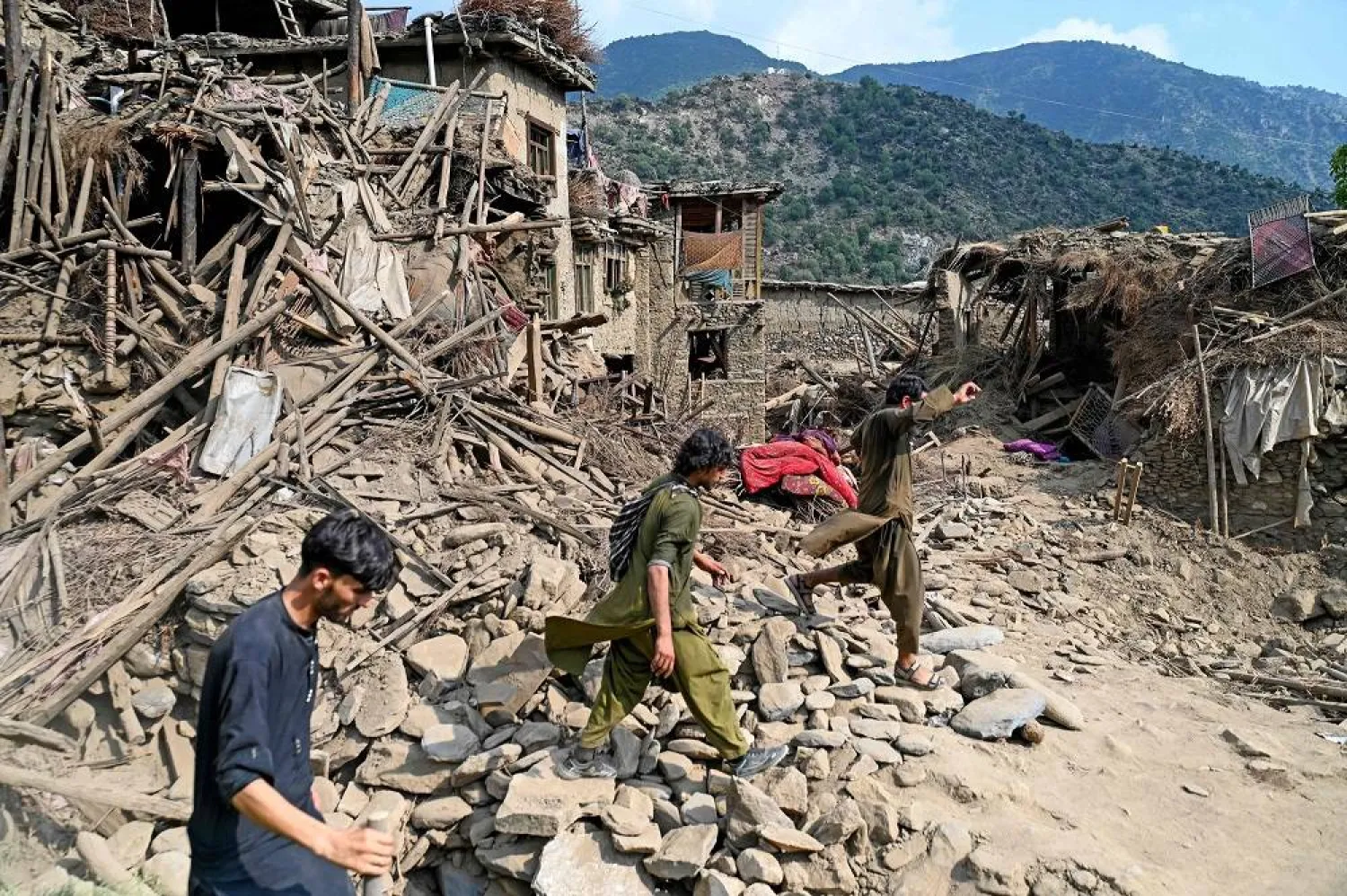

New Quake Shakes Devastated Afghan Region as Death Toll Exceeds 1,400

Afghans walk past damaged houses, after earthquakes at Mazar Dara village in Nurgal district, Kunar province, in Eastern Afghanistan, on September 1, 2025. (AFP)
TT

New Quake Shakes Devastated Afghan Region as Death Toll Exceeds 1,400

Afghans walk past damaged houses, after earthquakes at Mazar Dara village in Nurgal district, Kunar province, in Eastern Afghanistan, on September 1, 2025. (AFP)

An earthquake of magnitude 5.5 shook southeastern Afghanistan on Tuesday, sparking fears of further damage and destruction almost two days after a large quake in the same region killed more than 1,400 people and injured thousands more. 

Tuesday's quake occurred at a relatively shallow depth of 10 km (6 miles), the same level as the one that struck at midnight on Sunday with a magnitude of 6. That was one of Afghanistan's worst quakes in years, flattening houses in remote villages. 

The aftershock caused panic and halted rescue efforts as it sent rocks sliding down mountains, cutting off roads further and making it dangerous to dig through rubble, said Safiullah Noorzai, who works with Aseel, a humanitarian tech platform with networks around Afghanistan. 

Noorzai, whose organization has sent teams to the mountainous region, said more people had been injured, likely pushing the death toll higher. 

The difficult terrain has badly hindered rescue workers' relief efforts in the isolated villages. 

A Reuters journalist who reached the area on Tuesday, before the latest tremors, saw every home had been damaged or destroyed, with locals still digging through the rubble for survivors. A lot of people were still trapped. Some partially damaged homes were destroyed by the second earthquake, according to residents. 

At least 1,411 people are known to have died so far, 3,124 have been injured and more than 5,400 houses destroyed, Taliban administration spokesperson Zabihullah Mujahid said. 

The UN coordinator in Afghanistan said the death toll was sure to rise further. 

Aid group Save the Children called on the international community to urgently release emergency funds. The earthquake has disrupted sources of clean water, raising fears of disease, and restricted access to food, it said. 

"This is now a race against time to save lives – to get injured people out of remote villages cut off by massive rock falls and to get clean water, food, and shelter in," said Samira Sayed Rahman, Programs and Advocacy Director at Save the Children. 

Afghanistan is prone to deadly earthquakes, particularly in the Hindu Kush mountain range, where the Indian and Eurasian tectonic plates meet. 

The eastern provinces of Kunar and Nangarhar were worst hit in Sunday night's earthquake. 

On Tuesday, a line of ambulances was on the damaged mountain road trying to reach Kunar villages, as helicopters flew in, bringing aid supplies and taking the injured to hospitals, according to a Reuters reporter. 

Thousands of children were at risk, the United Nations Children's Fund warned on Tuesday. 

UNICEF said it was sending medicines, warm clothing, tents and tarpaulins for shelter, and hygiene items such as soap, detergent, towels, sanitary pads, and water buckets. 

Taliban soldiers were deployed in the area, providing help and security. The disaster has further stretched the war-torn nation's Taliban administration, already grappling with a sharp drop in foreign aid and deportations of hundreds of thousands of Afghans by neighboring countries. 

"Damaged roads, ongoing aftershocks, and remote locations of many villages severely impede the delivery of aid," the World Health Organization said, adding that over 12,000 people had been affected by the quake. 

"The pre-earthquake fragility of the health system means local capacity is overwhelmed, creating total dependence on external actors," it said. 

Food and tents were desperately needed, said Aseel's Noorzai. With their houses in ruins, many people were living in the open amid a fear of aftershocks, Noorzai added. 

AID CUTS 

The rescue and relief work has struggled in the face of tight resources in the impoverished nation of 42 million people and limited global help in the aftermath of the tragedy. 

So far, Britain has allocated 1 million pounds ($1.35 million) to support the efforts of the UN and the International Red Cross. 

India delivered 1,000 tents and was moving 15 tons of food supplies to Kunar, with more relief to be sent on Tuesday. 

Other nations such as China, the United Arab Emirates, the European Union, Pakistan and Iran have pledged help, but aid is yet to arrive. 

Afghanistan has been badly hit by US President Donald Trump's decision in January to cut funding to its humanitarian arm USAID and reductions in other foreign aid programs. 

Crises elsewhere in the world, along with donor frustration over the Taliban's policies toward women and curbs on aid workers have been a factor in funding cuts, according to diplomats and aid officials. 


Iran Warns Protesters Who Joined ‘Riots’ to Surrender

Iranians drive near an anti-US mural in street in Tehran, Iran, 19 January 2026. (EPA)
TT

Iran Warns Protesters Who Joined ‘Riots’ to Surrender

Iranians drive near an anti-US mural in street in Tehran, Iran, 19 January 2026. (EPA)

Iran's top police officer issued an ultimatum on Monday to protesters who joined what authorities have deemed "riots", saying they must hand themselves in within three days or face the full force of the law.

But the government also pledged to tackle economic hardships that sparked the demonstrations, which were met with a crackdown that rights groups say has left thousands dead.

The protests constituted the biggest challenge to the Iranian leadership in years, with the full scale of the violence yet to emerge amid an internet blackout.

National police chief Ahmad-Reza Radan on Monday urged young people "deceived" into joining the "riots" to turn themselves in and receive lighter punishment.

Those "who became unwittingly involved in the riots are considered to be deceived individuals, not enemy soldiers", and "will be treated with leniency", he told state television.

Officials have said the demonstrations were peaceful before descending into chaos fueled by Iran's arch-foes the United States and Israel in an effort to destabilize the nation.

The heads of the country's executive, legislative and judicial branches on Monday all pledged to work "around the clock" in "resolving livelihood and economic problems", according to a joint statement published by state television.

But they would also "decisively punish" the instigators of "terrorist incidents", said the statement from President Masoud Pezeshkian, parliament speaker Mohammad Bagher Ghalibaf and judiciary chief Gholamhossein Mohseni Ejei.

Alarm has grown over the possibility that authorities will use capital punishment against protesters.

The United Nations on Monday warned the country was using executions as "a tool of state intimidation".

Iran -- the world's most prolific executioner after China, according to rights groups -- reportedly executed 1,500 people last year, UN rights chief Volker Turk said in a statement.

Security officials cited by Iran's Tasnim news agency said late last week that around 3,000 people have been arrested in connection with the demonstrations, but rights groups say the number could be as high as 20,000.

Supreme leader Ali Khamenei said on Saturday that authorities "must break the back of the seditionists".

The scale of the crackdown has emerged piecemeal as Iran remains under an unprecedented internet shutdown that is now in its 11th day.

Despite difficulty accessing information, the Iran Human Rights NGO says it has verified that 3,428 protesters were killed by security forces, warning the actual toll could be far higher.

Internet access would "gradually" return to normal this week, Hossein Afshin, Iran's vice president for science, technology and the knowledge economy, said Monday on state television, after limited access briefly returned the day before.

Images from the capital Tehran showed buildings and billboards destroyed during the rallies.

In Iran's second-largest city of Masshad, damage to public infrastructure exceeded $15 million, Mayor Mohammadreza Qalandar Sharif told state television.


Türkiye’s Erdogan Hopes Iran Unrest Will Be Resolved Through Diplomacy

 An Iranian woman walks on a street in Tehran, Iran, January 19, 2026. Majid Asgaripour/WANA (West Asia News Agency) via Reuters
An Iranian woman walks on a street in Tehran, Iran, January 19, 2026. Majid Asgaripour/WANA (West Asia News Agency) via Reuters
TT

Türkiye’s Erdogan Hopes Iran Unrest Will Be Resolved Through Diplomacy

 An Iranian woman walks on a street in Tehran, Iran, January 19, 2026. Majid Asgaripour/WANA (West Asia News Agency) via Reuters
An Iranian woman walks on a street in Tehran, Iran, January 19, 2026. Majid Asgaripour/WANA (West Asia News Agency) via Reuters

Turkish President Recep Tayyip Erdogan on Monday described the unrest in Iran as a "new test" for Tehran, pledging Türkiye would "stand against any initiative" that would drag the region into chaos. 

"We believe that, with a ... policy prioritizing dialogue and diplomacy, our Iranian brothers will, God willing, get through this trap-filled period," Erdogan said in a televised speech after the weekly cabinet meeting. 

That was the first time Erdogan spoke about the protests gripping the country, during which thousands of people have been killed. 

Before the latest bout of unrest, the Iranian government was already battling an economic crisis after years of sanctions, as well as recovering from the June war against Israel. 

"Our neighbor Iran, following the Israeli attacks, is now facing a new test that targets its social peace and stability," Erdogan said. 

"We are all watching the scenarios that are being attempted to be written through the streets," he added. 

"With our foreign policy centered on peace and stability, we will continue to stand against any initiative that risks dragging our region into uncertainty." 

Türkiye’s Foreign Minister Hakan Fidan on Thursday said Ankara opposed a military operation against Iran, a strategy US President Donald Trump has repeatedly discussed as a way of aiding the Iranian people over the crackdown on protests. 


EU Executive Arm, Russia and Thailand Asked to Join Trump's Board of Peace for Gaza

US President Donald Trump - The AP news.
TT

EU Executive Arm, Russia and Thailand Asked to Join Trump's Board of Peace for Gaza

US President Donald Trump - The AP news.

The European Union's executive arm, Russia and Thailand on Monday were the latest to be asked to join US President Donald Trump's new Board of Peace that will supervise the next phase of the Gaza peace plan, as a top Israeli official said the initiative is “bad for Israel” and should be scrapped, The AP news reported.

Kremlin spokesman Dmitry Peskov said Russian President Vladimir Putin received the invitation and that the Kremlin is now "studying the details" and would seek clarity of “all the nuances” in contacts with the US. The Thai Foreign Ministry said it was also invited and that it was reviewing the details.

European Commission spokesperson Olof Gill confirmed that Ursula von der Leyen, the president of the commission, received an invitation and would be speaking to other EU leaders about Gaza. Gill didn't say whether the invitation has been accepted, but that the commission wants "to contribute to a comprehensive plan to end the Gaza conflict.”

It's unclear how many leaders have been invited to join the board. But a Trump reference in the invitation letters that the body would “embark on a bold new approach to resolving global conflict" suggested it could act as a rival to the UN Security Council, the most powerful body of the global organization created in the wake of World War II.

Israeli far-right Finance Minister Bezalel Smotrich on Monday dismissed the Board of Peace as a raw deal for Israel and called for its dissolution.

“It is time to explain to the president that his plan is bad for the State of Israel and to cancel it," Smotrich said at a ceremony inaugurating the new Yatziv settlement in the occupied West Bank. "Gaza is ours, its future will affect our future more than anyone else’s. We will take responsibility for what happens there, impose military administration, and complete the mission.”

Smotrich even suggested that Israel renew a full-scale offensive on Gaza to destroy Hamas if it doesn't abide by a “short ultimatum for real disarmament and exile.”

On Saturday, the office of Israeli Prime Minister Benjamin Netanyahu said the formation of the committee wasn’t coordinated with the Israeli government and “is contrary to its policy.”

The US is expected to announce its official list of members in the coming days, likely during the World Economic Forum meeting in Davos, Switzerland.

Board members will oversee an executive committee that will be in charge of implementing the tough second phase of the Gaza peace plan that includes the deployment of an international security force, disarmament of Hamas and reconstruction of the war-devastated territory.

A $1 billion contribution secures permanent membership on the board with the money going to rebuild Gaza, according to a US official who spoke on condition of anonymity about the charter, which hasn't been made public. A three-year appointment has no contribution requirement.

But details of how this will also work remain murky. British Prime Minister Keir Starmer said Monday the UK is talking to allies about the Board of Peace. Although the UK hasn't said whether Starmer has been formally invited to join, he said it's necessary to proceed with the Gaza peace plan's second phase and that his country has "indicated willingness, to play our part, and we will.”

Running Gaza Egypt’s top diplomat on Monday met with the leader of the newly appointed committee of Palestinian technocrats who will be running Gaza’s day-to-day affairs during the second phase of the peace plan.

Foreign Minister Bader Abdelatty met with Ali Shaath, a Palestinian engineer and former official with the Western-backed Palestinian Authority, who was named last week as chief commissioner of the National Committee for the Administration of Gaza

Abdelatty expressed the Egyptian government’s “complete support” to the committee and affirmed its role in running Gaza’s daily affairs until the Palestinian Authority takes over the territory, a statement from the Egyptian ministry said following the meeting.

He also underscored “the importance of preserving the unity of the Palestinian territories, ensuring geographical and administrative continuity between the Gaza Strip and the West Bank.”

More aid getting through but situation still fragile The UN World Food Program on Monday said it has “significantly expanded” its operations across Gaza 100 days into the ceasefire, reaching more than a million people each month with hot meals, bread bundles and food parcels. But it warned the situation remains “extremely fragile” even as critical progress has been made in pushing back famine.

It noted that malnutrition has been prevented for 200,000 pregnant and breastfeeding women, as well as children under 5, while school snacks are reaching 235,000 children in 250 temporary schools.

Still, the most recent Integrated Food Security Phase Classification (IPC) analysis in December indicates that 77% the population is facing crisis levels food insecurity with over 100,000 people experiencing catastrophic levels of hunger.

The WFP said access to nutritious food such as fresh fruit, vegetables and dairy is limited with most families still can't afford more commercial goods entering Gaza.

Palestinian teen shot dead Israeli forces killed a Palestinian teenager in southern Gaza, hospital authorities said Monday.

Hussein Tawfiq Abu Sabalah, 17, was shot in the Muwasi area of Rafah Monday morning, according to Nasser Hospital. It wasn’t immediately clear whether he crossed into or came close to an Israeli-controlled area.

More than 460 people have been killed by Israeli fire and their bodies brought to hospitals since the ceasefire went into effect, according to Gaza's Health Ministry. The ministry, which is part of Hamas-led government, maintains detailed casualty records that are seen as generally reliable by UN agencies and independent experts.
