Türkiye Bans French Singer's Concert after Protest Calls over His Pro-Israeli Stance

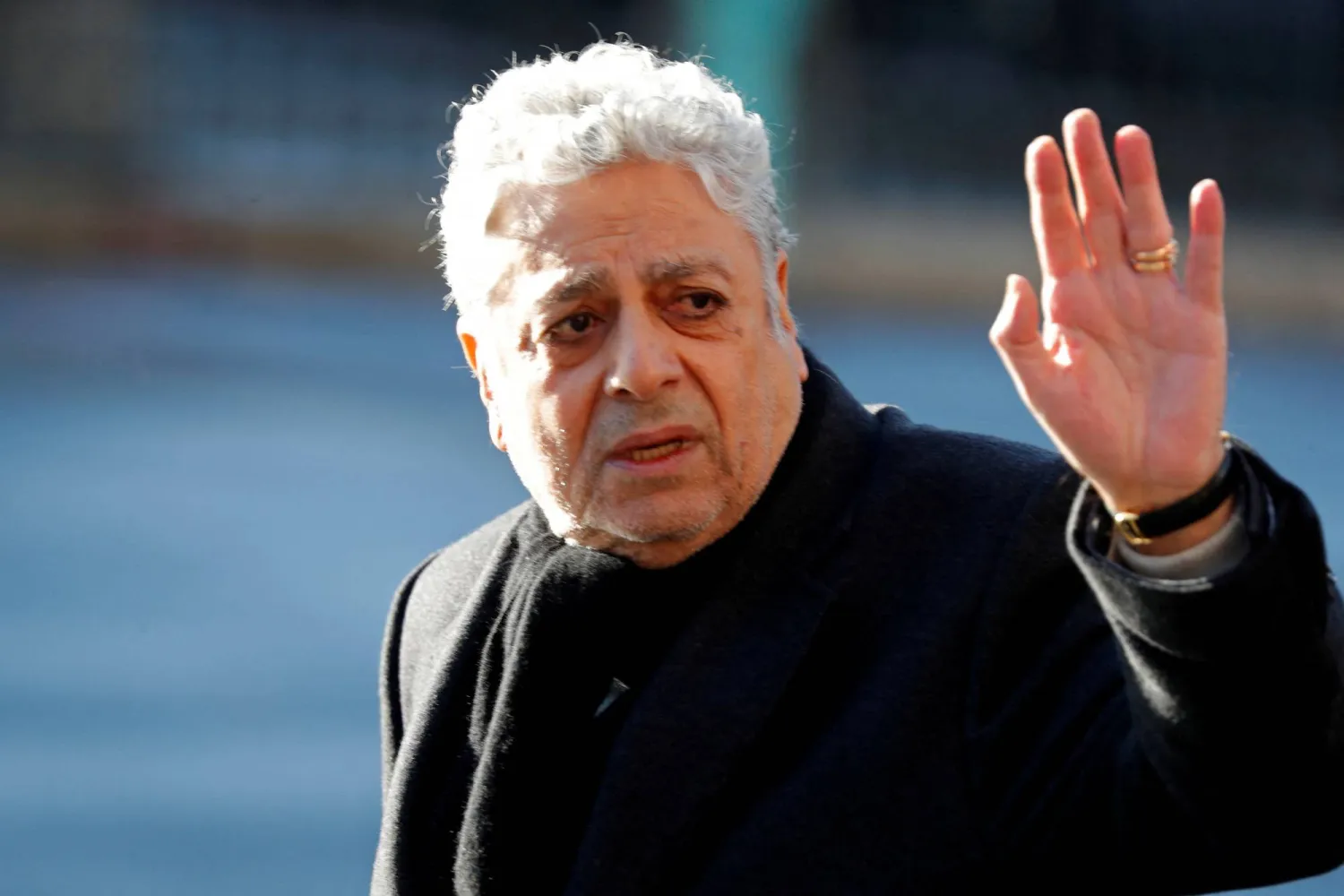
FILE PHOTO: Singer Enrico Macias arrives at the Madeleine Church to attend a ceremony during a 'popular tribute' to late French singer and actor Johnny Hallyday in Paris, France, December 9, 2017.  REUTERS/Charles Platiau/File Photo
FILE PHOTO: Singer Enrico Macias arrives at the Madeleine Church to attend a ceremony during a 'popular tribute' to late French singer and actor Johnny Hallyday in Paris, France, December 9, 2017. REUTERS/Charles Platiau/File Photo
TT

Türkiye Bans French Singer's Concert after Protest Calls over His Pro-Israeli Stance

FILE PHOTO: Singer Enrico Macias arrives at the Madeleine Church to attend a ceremony during a 'popular tribute' to late French singer and actor Johnny Hallyday in Paris, France, December 9, 2017.  REUTERS/Charles Platiau/File Photo
FILE PHOTO: Singer Enrico Macias arrives at the Madeleine Church to attend a ceremony during a 'popular tribute' to late French singer and actor Johnny Hallyday in Paris, France, December 9, 2017. REUTERS/Charles Platiau/File Photo

Turkish authorities have banned a concert of Enrico Macias, a French singer of Algerian-Jewish origin, after calls for protest over his pro-Israeli stance. The Istanbul governor's office late on Wednesday said that Macias' performance scheduled for Friday evening in the city has been banned "after intense calls for protests against the concert." Such protests would place protesters "in an unjust position legally, and cause grievances," the office said in a statement.

Any protests around the concert venue in Istanbul's Sisli district on Friday were also banned by the governor.

NATO member Türkiye has fiercely criticized Israel over its actions in Gaza and says it is committing genocide there. It has halted all trade with Israel, called for international measures against it, and has repeatedly urged world powers to stop supporting Israel.

Israel has strongly denied that its actions in Gaza, where its offensive has killed more than 63,000, amount to genocide.


Iran FM Says Davos Appearance Cancellation Based on ‘Lies’

Iranian Foreign Minister Abbas Araqchi adjusts glasses during a press conference following talks with Russian Foreign Minister Sergei Lavrov in Moscow, Russia, December 17, 2025. (Reuters)
TT

Iran FM Says Davos Appearance Cancellation Based on ‘Lies’

Iranian Foreign Minister Abbas Araqchi adjusts glasses during a press conference following talks with Russian Foreign Minister Sergei Lavrov in Moscow, Russia, December 17, 2025. (Reuters)

Iran's foreign minister hit out at the World Economic Forum in Davos for cancelling his appearance over a crackdown on recent protests, saying the decision was based on "lies and political pressure".

Protests in Iran sparked by economic strain in late December exploded into the biggest challenge to the Iranian leadership in years, with the full scale of the violent crackdown yet to emerge due to an internet blackout.

Iranian Foreign Minister Abbas Araghchi was slated to speak on Tuesday at the annual gathering of global elites in Switzerland, but was disinvited after the WEF said it would not be "right" due to the "loss of lives of civilians in Iran over the past few weeks".

Araghchi said his appearance was cancelled "on the basis of lies and political pressure from Israel and its US-based proxies and apologists", in an X post late Monday.

He called it a "blatant double standard" to disinvite him while inviting Israel after its war in Gaza, saying it "conveys moral depravity and intellectual bankruptcy".

Iranian officials have said the recent demonstrations were peaceful before descending into "riots" fueled by Iran's arch-foes the United States and Israel in an effort to destabilize the nation.

Araghchi's post on X was accompanied by a video saying the demonstrations were a "terror operation" spurred by Israel's Mossad spy agency.

Rights groups say they have verified at least several thousand protesters killed by Iranian security forces, with some estimates putting the true figure as high as 20,000 dead.

The Norway-based NGO Iran Human Rights, which has verified the deaths of at least 3,428 protesters, said on Monday that "all indications are that this massacre was planned and carried out with full coordination" by the country.


Bessent Says US-Europe Relations Have ‘Never Been Closer’ Despite Greenland Crisis

Scott Bessent, US Secretary of the Treasury, holds a speech at the USA House during the Annual Meeting of the World Economic Forum in Davos, Switzerland, Tuesday, Jan. 20, 2026. (AP)
TT

Bessent Says US-Europe Relations Have ‘Never Been Closer’ Despite Greenland Crisis

Scott Bessent, US Secretary of the Treasury, holds a speech at the USA House during the Annual Meeting of the World Economic Forum in Davos, Switzerland, Tuesday, Jan. 20, 2026. (AP)

US Treasury Secretary Scott Bessent on Tuesday said America’s relations with Europe remain strong and urged trading partners to “take a deep breath” and let tensions driven by the Trump administration's new tariff threats over Greenland “play out.”

“I think our relations have never been closer,” he said, speaking on the sidelines of the World Economic Forum annual meeting in Davos, Switzerland.

On Saturday, US President Donald Trump announced a 10% import tax starting in February on goods from eight European nations that have rallied around Denmark in the wake of his stepped up calls for the United States to take over the semi-autonomous Danish territory of Greenland.

Trump has insisted the US needs the territory for security reasons against possible threats from China and Russia.

The American leader’s threats have sparked outrage and a flurry of diplomatic activity across Europe, as leaders consider possible countermeasures, including retaliatory tariffs and the first-ever use of the European Union’s anti-coercion instrument.

The EU has three major economic tools it could use to pressure Washington: new tariffs, suspension of the US-EU trade deal, and the “trade bazooka” — the unofficial term for the bloc’s Anti-Coercion Instrument, which could sanction individuals or institutions found to be putting undue pressure on the EU.

Earlier Tuesday, Trump posted on social media that he had spoken with NATO Secretary General Mark Rutte. He said "I agreed to a meeting of the various parties in Davos, Switzerland,” which is hosting the World Economic Forum’s annual meeting this week.

France's Macron suggests G7 meeting

Trump also posted a text message from Emmanuel Macron in which the French president suggested a meeting of members of the Group of Seven industrialized democracies in Paris after the Davos gathering.

Later, however, Trump posted some provocatively doctored images. One showed him planting the US flag next to a sign reading “Greenland, US Territory, Est. 2026.” The other showed Trump in the Oval Office next to a map that showed Greenland and Canada covered with the US Stars and Stripes.

In a sign of how tensions have increased in recent days, thousands of Greenlanders marched over the weekend in protest of any effort to take over their island. Greenland Prime Minister Jens-Frederik Nielsen said in a Facebook post Monday that the tariff threats would not change their stance.

“We will not be pressured,” he wrote.

In his latest threat of tariffs, Trump indicated that the import taxes would be retaliation for last week’s deployment of symbolic numbers of troops from the European countries to Greenland — though he also suggested that he was using the tariffs as leverage to negotiate with Denmark.

Danish minister called for a stronger Europe

Denmark's minister for European affairs called Trump's tariff threats “deeply unfair." He said that Europe needs to become even stronger and more independent, while stressing there is "no interest in escalating a trade war."

"You just have to note that we are on the edge of a new world order, where having power has unfortunately become crucial, and we see a United States with an enormous condescending rhetoric towards Europe,” Marie Bjerre told Danish public broadcaster DK on Tuesday.

European markets opened sharply lower on Tuesday and US futures fell further as tensions rose over Greenland. Benchmarks in Germany, France and Britain fell about 1%. The future for the S&P 500 lost 1.5% and the Dow future was down 1.4%.

With US trading closed Monday for a holiday, financial markets had a relatively muted response to Trump’s threat to put a 10% extra tariff on exports from eight European countries that have opposed his push to exert control over Greenland. Jonas Golterman of Capital Economics described the situation as a lose-lose one for both the US and the targets of Trump’s anger. He said, “It certainly fells like the kind of situation that could get worse before it gets better.”

In another sign of tension between allies, the British government on Tuesday defended its decision to hand sovereignty of the Chagos Islands to Mauritius after Trump attacked the plan, which his administration previously supported.

Trump said that relinquishing the remote Indian Ocean archipelago, home to a strategically important American naval and bomber base, was an act of stupidity that shows why he needs to take over Greenland.

The United Kingdom signed a deal in May to give Mauritius sovereignty over the islands, though the UK will lease back the island of Diego Garcia, where the US base is located, for at least 99 years.


Australian Lawmakers Back Stricter Gun, Hate Crime Laws

A visitor places a pebble at a memorial site in remembrance to the lives lost during the Bondi Beach mass shooting on December 14, 2025, in Sydney, Australia, January 16, 2026. (Reuters)
TT

Australian Lawmakers Back Stricter Gun, Hate Crime Laws

A visitor places a pebble at a memorial site in remembrance to the lives lost during the Bondi Beach mass shooting on December 14, 2025, in Sydney, Australia, January 16, 2026. (Reuters)

Australian politicians voted in favor of tougher hate crime and gun laws Tuesday, weeks after gunmen targeting Jewish people on Bondi Beach killed 15 people.

Lawmakers in the House of Representatives backed the legislation in response to the December 14 shooting at the famous Sydney beach.

Sajid Akram and his son Naveed allegedly targeted a Jewish Hanukkah celebration in the nation's worst mass shooting for 30 years.

The attack has sparked national soul-searching about antisemitism, anger over the failure to shield Jewish Australians from harm, and promises to protect the country with stiffer legislation.

The hate crime and gun control legislation must still be approved by the upper house Senate, which was expected to vote later in the day.

"The terrorists had hate in their hearts, but they also had high-powered rifles in their hands," Prime Minister Anthony Albanese told parliament.

"We're taking action on both -- tackling antisemitism, tackling hate, and getting dangerous guns off our streets."

Legislative reforms on guns and hate speech were voted on separately.

The hate speech legislation would toughen laws and penalties for people seeking to spread hate and radicalization, or to promote violence.

It creates aggravated offences for offenders who are preachers, other leaders, or adults seeking to radicalize children.

The reform would also make it easier to reject or cancel visas for people suspected of terrorism or espousing hatred on the basis of race, color, or origin.

On firearms, Australia would set up a national gun buyback scheme, tighten rules on imports of firearms and expand background checking for gun permits to allow input from intelligence services.

The legislation was debated in a special session of parliament, ahead of a national day of mourning on Thursday for the Bondi Beach victims.

Gunman Sajid Akram, 50, was shot and killed by police during the Bondi Beach attack. An Indian national, he entered Australia on a visa in 1998.

His 24-year-old son Naveed, an Australian-born citizen who remains in prison, has been charged with terrorism and 15 murders.

Police and intelligence agencies are facing difficult questions about whether they could have acted earlier.

Naveed Akram was flagged by Australia's intelligence agency in 2019, but he slipped off the radar after it was decided that he posed no imminent threat.