
European Countries Near Russia Puzzled by US Plans to Cut Defense Funding

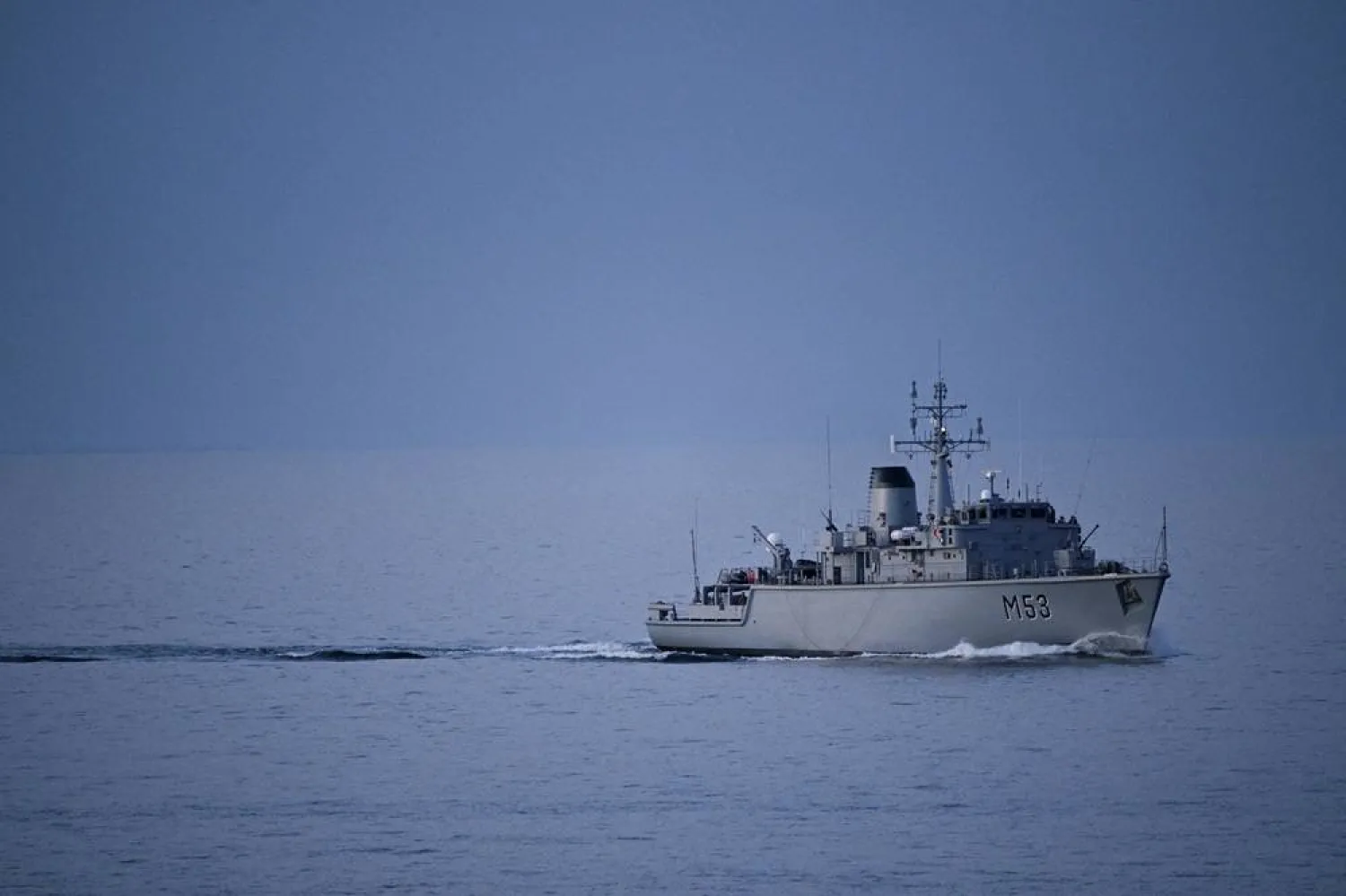
Lithuanian's minhunter Skalvis (M53) moves through the water, as seen from the German Navy supply tender Donau, during the multinational naval maneuver Northern Coasts, part of the Quadriga 2025 exercise led by the Bundeswehr and NATO partners to strengthen defense readiness under realistic conditions in the Baltic Sea, off the coast of Kiel, Germany September 2, 2025. (Reuters)
TT

European Countries Near Russia Puzzled by US Plans to Cut Defense Funding

Lithuanian's minhunter Skalvis (M53) moves through the water, as seen from the German Navy supply tender Donau, during the multinational naval maneuver Northern Coasts, part of the Quadriga 2025 exercise led by the Bundeswehr and NATO partners to strengthen defense readiness under realistic conditions in the Baltic Sea, off the coast of Kiel, Germany September 2, 2025. (Reuters)

Confusion emerged Friday over Trump administration plans to halt some security assistance funding to European countries along the border with Russia, with some Baltic defense leaders saying they have not received official notification.

Pentagon funding for programs that provide training and equipment to reinforce security would be cut, according to a person familiar with the discussions and a congressional aide, who spoke on condition of anonymity because they were not authorized to discuss the matter. It wasn't clear exactly how much money would be affected, though it could be hundreds of millions of dollars.

It includes funding under Section 333 and the Baltic Security Initiative, which helps finance weapons purchases by countries on NATO’s eastern flank, including of US systems, as well as ammunition, special forces training and intelligence support.

A White House official, who was not authorized to speak publicly so spoke on condition of anonymity, said the action has been coordinated with European countries and is part of President Donald Trump’s plan to ensure “Europe takes more responsibility for its own defense.”

The Trump administration has pushed NATO countries to step up their defense spending and slashed foreign assistance across the board. As Trump remakes the American approach to foreign policy, allies have tried to decipher often murky proposals, from tariffs to troop numbers. It was not clear whether US lawmakers would approve of some of the reductions, which were inconsistent with the Pentagon’s most recent allocations notified to Congress, the congressional aide said.

Baltic countries express confusion and concern

Former Lithuanian Foreign Minister Gabrielius Landsbergis said any cuts to American military support to the Baltic states — part of NATO's border with Russia — would “only weaken the credibility of NATO’s attempts at deterrence” as Moscow's war in Ukraine drags on.

Vaidotas Urbelis, Lithuania's Defense Ministry policy director, said there had been “discussions and certain indications” from the US but that the country had received no official information about any reduction in support and was talking to the Pentagon about “which programs will be continued and which may be postponed.”

Latvia's Defense Ministry also said it had not received any “official notification of concrete decisions” and said it would continue discussions on reaffirming the importance of the support.

The Estonian Defense Ministry said in a statement that it was clear the “current administration’s direction is to significantly cut foreign aid,” but added that US assistance increasingly makes up a smaller proportion of the country’s defense budget because Estonia has ramped up its own spending.

The three Baltic states, as well as Poland, are the NATO countries that spend the most on defense, promising to spend 5% of gross domestic product from 2026.

Members of Congress are also in the dark

Congressional offices also were waiting for details on what programs would be cut under the Pentagon’s proposal, but lawmakers from both political parties who have been supportive of US support to the region were alarmed.

Rep. Don Bacon, a Republican who is retiring next year, said on social media that it would be “a disastrous and shameful decision.”

“This Administration continues to be WEAK towards Putin and a WEAK leader of the Free World,” he added. “This will read as an ugly chapter in US history if the President does not reverse course.”

Sen. Jeanne Shaheen, the top Democrat on the Senate Foreign Relations Committee, said in a statement that “this is a misguided move that sends exactly the wrong signal as we try to force Putin to the negotiating table and deter Russian aggression.”

Sen. Dick Durbin, an Illinois Democrat, joined with Sen. Chuck Grassley, an Iowa Republican, to propose that Congress’ annual defense authorization bill include language to codify the Baltic Security Initiative, which established military cooperation between the US, Estonia, Latvia and Lithuania.

The Pentagon said it has reviewed foreign assistance programs under Trump's orders and that he has been "unequivocal in asserting that allies and partners must assume greater responsibility for funding their own security."

The plans to cut the security funds were first reported by the Financial Times.

Where the funding goes

That initiative allocated about $377 million from 2018 to 2024, Estonia’s Defense Ministry said. It helped fund Estonia's purchase of critical capabilities, including US-made HIMARS multiple-launch rocket systems.

Also affected is Section 333 funding from the Defense Department, which totaled nearly $1.6 billion to Europe from 2018 to 2022, according to the Government Accountability Office.

However, State Department funding to Latvia, Lithuania and Estonia is unaffected as of yet. It provides roughly $7 billion a year in military assistance to the Baltic states, almost $6 billion of which is foreign military financing used by those countries to purchase US-made munitions and other materiel, according to an official who spoke on condition of anonymity due to the sensitivity of the matter.

The Estonian Defense Ministry suggested that funding cuts would still have to be approved by Congress.

Congress previously included the Baltic Security Initiative in the budget even though the Pentagon “has never been a huge fan of it,” said Helga Kalm, deputy director at the International Centre for Defense and Security in Tallinn, Estonia.

“It's too soon” to know if the funding will be pulled or not, she said.

Because the Baltic nations now have ramped up their defense spending and cooperate extensively, “it wouldn't be the end of the world" if it were cut, Kalm said.

The move came as military drills to train US military personnel to rapidly deploy forces and prepare for operations on NATO’s eastern flank started Friday in Latvia, Lithuania, Estonia and Poland.

Trump’s ambassador to NATO had said earlier this year that the US would start discussions later in the year about reducing troops in Europe, but the proposal has not moved forward. Trump suggested Thursday that he could send “more” troops to Poland.


Australian Lawmakers Back Stricter Gun, Hate Crime Laws

A visitor places a pebble at a memorial site in remembrance to the lives lost during the Bondi Beach mass shooting on December 14, 2025, in Sydney, Australia, January 16, 2026. (Reuters)
TT

Australian Lawmakers Back Stricter Gun, Hate Crime Laws

A visitor places a pebble at a memorial site in remembrance to the lives lost during the Bondi Beach mass shooting on December 14, 2025, in Sydney, Australia, January 16, 2026. (Reuters)

Australian politicians voted in favor of tougher hate crime and gun laws Tuesday, weeks after gunmen targeting Jewish people on Bondi Beach killed 15 people.

Lawmakers in the House of Representatives backed the legislation in response to the December 14 shooting at the famous Sydney beach.

Sajid Akram and his son Naveed allegedly targeted a Jewish Hanukkah celebration in the nation's worst mass shooting for 30 years.

The attack has sparked national soul-searching about antisemitism, anger over the failure to shield Jewish Australians from harm, and promises to protect the country with stiffer legislation.

The hate crime and gun control legislation must still be approved by the upper house Senate, which was expected to vote later in the day.

"The terrorists had hate in their hearts, but they also had high-powered rifles in their hands," Prime Minister Anthony Albanese told parliament.

"We're taking action on both -- tackling antisemitism, tackling hate, and getting dangerous guns off our streets."

Legislative reforms on guns and hate speech were voted on separately.

The hate speech legislation would toughen laws and penalties for people seeking to spread hate and radicalization, or to promote violence.

It creates aggravated offences for offenders who are preachers, other leaders, or adults seeking to radicalize children.

The reform would also make it easier to reject or cancel visas for people suspected of terrorism or espousing hatred on the basis of race, color, or origin.

On firearms, Australia would set up a national gun buyback scheme, tighten rules on imports of firearms and expand background checking for gun permits to allow input from intelligence services.

The legislation was debated in a special session of parliament, ahead of a national day of mourning on Thursday for the Bondi Beach victims.

Gunman Sajid Akram, 50, was shot and killed by police during the Bondi Beach attack. An Indian national, he entered Australia on a visa in 1998.

His 24-year-old son Naveed, an Australian-born citizen who remains in prison, has been charged with terrorism and 15 murders.

Police and intelligence agencies are facing difficult questions about whether they could have acted earlier.

Naveed Akram was flagged by Australia's intelligence agency in 2019, but he slipped off the radar after it was decided that he posed no imminent threat.


Macron Sent Message to Trump Offering to Host G7 Meeting in Paris Thursday

French President Emmanuel Macron wears sunglasses as he speaks as he leads a meeting on New-Caledonia at the Elysee Palace in Paris, France, 19 January 2026. EPA/STEPHANE DE SAKUTIN / POOL MAXPPP OUT
TT

Macron Sent Message to Trump Offering to Host G7 Meeting in Paris Thursday

French President Emmanuel Macron wears sunglasses as he speaks as he leads a meeting on New-Caledonia at the Elysee Palace in Paris, France, 19 January 2026. EPA/STEPHANE DE SAKUTIN / POOL MAXPPP OUT

Emmanuel Macron has sent a "private message" to Donald Trump offering to organize a G7 summit in Paris on Thursday in which Russia could be invited on the sidelines, the French president's entourage confirmed.

Trump posted this message on his Truth Social network in which Macron also proposes inviting Ukraine to the meeting as well as Denmark to discuss disagreements over Greenland.

The offer comes as Europe is weighing countermeasures after Trump threatened to impose tariffs on eight European countries in a bid to pressure the EU over Greenland.

"My friend, we are completely aligned on Syria. We can do great things in Iran. I don't understand what you are doing in Greenland," Macron said in his message.

"I can organize a G7 meeting in Paris on Thursday afternoon after Davos," Macron wrote, referring to the gathering of global elites in Switzerland where the US president is set to be in attendance.

"I can invite the Ukrainians, the Danes, the Syrians and the Russians on the sidelines" of the meeting, he added.

Trump's relations with Macron hit a new low Monday when the US president threatened 200 percent tariffs on French wine over France's intention to decline an invitation to join his "Board of Peace".

"Tariff threats to influence our foreign policy are unacceptable and ineffective," a source close to Macron told AFP on Tuesday.


ISIS Claims Deadly Blast at Chinese-run Restaurant in Afghan Capital

Security forces stand at the site of an explosion in Kabul, Afghanistan, 19 January 2026. EPA/SAMIULLAH POPAL
TT

ISIS Claims Deadly Blast at Chinese-run Restaurant in Afghan Capital

Security forces stand at the site of an explosion in Kabul, Afghanistan, 19 January 2026. EPA/SAMIULLAH POPAL

ISIS claimed an explosion that officials said killed a Chinese national and six Afghans, while injuring several more as it tore through a Chinese-run restaurant in a heavily guarded part of Afghanistan's capital.

Monday's blast took place in the commercial Shahr-e-Naw area that is home to offices, shopping complexes and embassies, police spokesperson Khalid Zadran said.

It is considered one of the safest neighborhoods in the city.

According to Reuters, the Afghan branch of ISIS claimed responsibility, saying in a statement it ‌was carried out ‌by a suicide bomber.

The restaurant serving the Chinese ‌Muslim ⁠community was jointly run ‌by a Chinese Muslim man, Abdul Majid, his wife, and an Afghan partner, Abdul Jabbar Mahmood, Zadran said.

"The nature of the explosion is unknown so far and is being investigated," he said.

A Chinese national, identified only as Ayub, and six Afghans were killed in the blast near the restaurant's kitchen, while several others were injured, Zadran added.

The Amaq news agency said the domestic arm of ISIS had put Chinese citizens on its list of targets, citing "growing crimes by the Chinese government against ‌Uyghurs".

Rights groups accuse Beijing of widespread abuses of Uyghurs, ‍a mainly Muslim ethnic minority group ‍numbering about 10 million who live in China's far western region of ‍Xinjiang.

Beijing denies any abuse and has accused Western countries of interference and peddling lies.

The blast injured five Chinese nationals, and China has requested that Afghanistan spare no effort to treat the injured, Guo Jiakun, a spokesperson for China's foreign ministry, said at a press briefing on Tuesday.

China also requested that Afghanistan take effective measures to protect the safety of ⁠its citizens and investments, and investigate, Guo said.

On Monday, videos shared on social media showed smoke billowing from a large hole torn in the facade of the restaurant building, while debris littered the street outside.

"We have received 20 people at our hospital," Dejan Panic, the Afghanistan director of humanitarian group EMERGENCY, said in a statement, adding that seven were dead on arrival. "Among the wounded are four women and a child."