

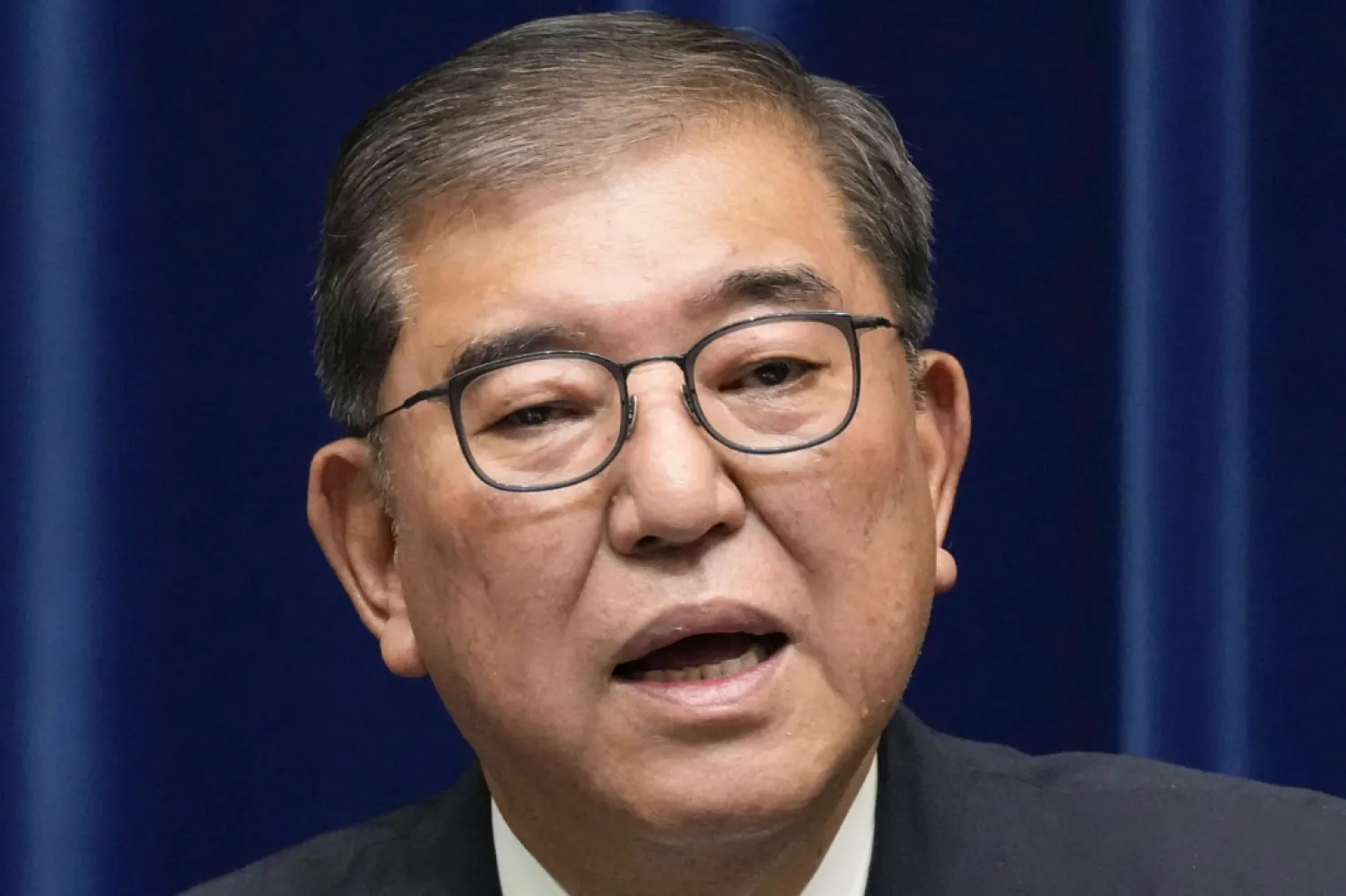

Japan's Prime Minister Resigns after His Party Suffered a Historic Defeat in a Summer Election

Japanese Prime Minister Shigeru Ishiba speaks during a press conference at the prime minister's office in Tokyo, Japan, Sunday, Sept. 7, 2025. (Kyodo News via AP)
TT

Japan's Prime Minister Resigns after His Party Suffered a Historic Defeat in a Summer Election

Japanese Prime Minister Shigeru Ishiba speaks during a press conference at the prime minister's office in Tokyo, Japan, Sunday, Sept. 7, 2025. (Kyodo News via AP)

Japan’s Prime Minister Shigeru Ishiba announced Sunday that he will resign, following growing calls from within his party to take responsibility for a historic defeat in July’s parliamentary election.

Ishiba, who took office in October, said he was stepping down as prime minister and as the head of his conservative Liberal Democratic Party.

Ishiba, a 68-year-old centrist, had resisted demands from opponents further to the right within his own party to resign. He argued that he wanted to avoid a political vacuum at a time when Japan faces key domestic and international challenges, including US tariffs, rising prices and growing tensions in the Asia-Pacific, The AP news reported.

Ishiba explained at a news conference Sunday night that he had intended for some time to take responsibility for his party's summer election loss, but was first determined to make progress in tariff negotiations with the United States. He described it as matter of the national interest.

“Who would seriously negotiate with a government whose leader says he is stepping down?" Ishiba said.

He said the moment had arrived with an order by US President Donald Trump on Friday to lower tariffs on Japanese cars and other products from 25% to 15%.

“Having reached a milestone in the US tariff negotiations, I decided now is the time to make way for a successor," Ishiba said.

Pressure from the party The resignation came one day before Ishiba's party was to decide whether to hold an early leadership election, which would have amounted to a virtual no-confidence motion against him if approved.

He said he made the “painful decision to resign” to avert that step because “it would cause a critical division within the party, and that is absolutely not my intention.”

Ishiba said he would instead start a process to hold a party leadership vote to choose his replacement, which is expected to be held in October. He is to remain as prime minister until a new leader is elected and endorsed by the parliament.

Ishiba’s leadership that lasted only one year underscores the instability of Japan’s minority government.

A maverick who won the leadership in his fifth attempts, Ishiba said he regrets he could not live up to voters' expectations for change. “As a result, I failed to go my own way, and I wonder how I could have done better,” he said.

He said he is not going to run in the next leadership race, even though he regrets leaving behind unfinished business, such as measures for salary increases, agricultural reforms and further strengthening Japan's security. He asked his future successor to tackle the issues he cherished.

Loss after loss In July, Ishiba’s ruling coalition failed to secure a majority in the 248-seat upper house in a crucial parliamentary election, weakening his government. The loss followed a defeat in the more powerful lower house, where the party-led coalition lost its majority in October, only two weeks after Ishiba took over.

Liberal Democratic lawmakers who support the prime minister said those who lost seats were largely ultra-conservatives who were linked to corruption scandals before Ishiba took office. Public polling showed that pressure on Ishiba to resign had the reverse effect and caused his support to grow.

Calls for Ishiba to step down grew after the Liberal Democratic Party last week called for a “complete overhaul” of the party following its losses.

Taro Aso, a conservative heavyweight known for his anti-Ishiba stance, and a minister and several deputy ministers in the Ishiba Cabinet requested an early vote, prompting others to follow suit.

Former Health Minister Norihisa Tamura said on a talk show of the public broadcaster NHK earlier Sunday that the best way to heal party divisions and move forward is for Ishiba “to settle” the dispute before Monday’s vote. The party has already been distracted from necessary work on economic measures and on figuring out ways to gain opposition support in the next parliamentary session, Tamura said.

Possible candidates to replace Ishiba include Agriculture Minister Shinjiro Koizumi, as well as ultra-conservative former economic security minister Sanae Takaichi and Chief Cabinet Secretary Yoshimasa Hayashi, a moderate and the protege of former Prime Minister Fumio Kishida.

Lacking a majority in both houses, the next party leader will have to work with the main opposition parties to get bills passed, experts say, or else face constant risks of no-confidence motions.

The opposition parties, however, are too splintered to form a coalition to topple the government.



US to Leave Iran 'Pretty Quickly' and Return if Needed, Trump Tells Reuters

03 March 2026, US, Washington: US President Donald Trump speaks during a meeting in the White House. Photo: Kay Nietfeld/dpa
TT

US to Leave Iran 'Pretty Quickly' and Return if Needed, Trump Tells Reuters

03 March 2026, US, Washington: US President Donald Trump speaks during a meeting in the White House. Photo: Kay Nietfeld/dpa

The United States will be "out of Iran pretty quickly" and could return for "spot hits" if needed, President Donald Trump told Reuters on Wednesday, hours before he was scheduled to make a primetime address to the nation. Trump also said he would express his disgust with NATO for what he considers the alliance's lack of support for US objectives in Iran.
He said he is "absolutely" considering an attempt to withdraw the United States from NATO, Reuters reported.

Asked when the United States would consider the Iran war over, Trump said: "I can't tell you exactly .... we're going to be out pretty quickly."

He said US action has ensured Iran will not have a nuclear weapon.

"They won't have a nuclear weapon because they are incapable of that now, and then I'll leave, and I'll take everybody with me, and if we have to we'll come back to do spot hits," Trump said.


Starmer Says UK to Host Multi-nation Meeting on Hormuz Shipping

British Prime Minister Keir Starmer speaks during a press conference to update on the latest situation in the Middle East and how the government is supporting families at home at 10 Downing Street in London, on April 1, 2026. (Photo by Frank Augstein / POOL / AFP)
TT

Starmer Says UK to Host Multi-nation Meeting on Hormuz Shipping

British Prime Minister Keir Starmer speaks during a press conference to update on the latest situation in the Middle East and how the government is supporting families at home at 10 Downing Street in London, on April 1, 2026. (Photo by Frank Augstein / POOL / AFP)

Britain will this week hold a meeting of about 35 countries to discuss how to reopen the strategic Strait of Hormuz which has been crippled by the Middle East war, Prime Minister Keir Starmer announced Wednesday.

UK Foreign Secretary Yvette Cooper will host the discussions, Starmer told reporters during a Downing Street press conference, without specifying the day of the talks.

The meeting will "assess all viable diplomatic and political measures that we can take to restore freedom of navigation, guarantee the safety of trapped ships and seafarers and resume the movement of vital commodities", Starmer said.

"Following that meeting, we will also convene our military planners to look at how we can marshal our capabilities and make the strait accessible and safe after the fighting has stopped," he added.

The discussions will include countries who recently signed a statement saying they were ready "to contribute to appropriate efforts to ensure safe passage through the Strait of Hormuz", Starmer said.

Britain, France, Germany, Italy, Japan and the Netherlands are among those to have signed it.

Iran has virtually closed the vital strait since the US-Israeli strikes that started the war on February 28, causing global oil and gas prices to soar.

A fifth of the world's oil and liquefied natural gas passes through the strait in peacetime.

"I do have to level with people on this. This (reopening) will not be easy," Starmer said.

The UK leader also backed NATO following renewed criticism of the eight-decade-old alliance by US President Donald Trump.

"NATO is the single most effective military alliance the world has ever seen, and it has kept us safe for many decades, and we are fully committed to NATO," Starmer said.

Trump told Britain's Telegraph newspaper in an article published Wednesday that NATO was a "paper tiger".

Asked whether he would reconsider US membership, he replied: "Oh yes, I would say (it's) beyond reconsideration," the paper reported.

Last month, Trump told the Financial Times that it would be "very bad for the future of NATO" if members fail to help reopen the vital waterway.

On Tuesday, he said that countries which have not joined the war but are struggling with fuel shortages should "go get your own oil" in the Strait of Hormuz, adding that the US would not help them.


France: NATO is Not Designed to Carry Out Operations in Strait of Hormuz

France's junior Minister for Veterans affairs Alice Rufo delivers remarks during the Paris Defense Strategy Forum at the Ecole Militaire (military school) in Paris on March 24, 2026. (Photo by STEPHANE DE SAKUTIN / AFP)
TT

France: NATO is Not Designed to Carry Out Operations in Strait of Hormuz

France's junior Minister for Veterans affairs Alice Rufo delivers remarks during the Paris Defense Strategy Forum at the Ecole Militaire (military school) in Paris on March 24, 2026. (Photo by STEPHANE DE SAKUTIN / AFP)

NATO is a military alliance that ensures the security of the Euro-atlantic area and is not designed to carry out operations in the Strait of Hormuz that would breach international law, France's junior army minister said on Wednesday.

"Let me remind you what NATO is. It is a military alliance concerned with the security of the Euro-Atlantic region. It is not designed to carry out operations in the Strait of Hormuz, which would be a breach of international law," Alice Rufo said at the War & Peace conference in Paris, Reuters reported.

US President Donald Trump said he was strongly considering pulling the United States out of NATO after allies failed to back US military action against Iran, according to an interview with Britain's Daily Telegraph.