

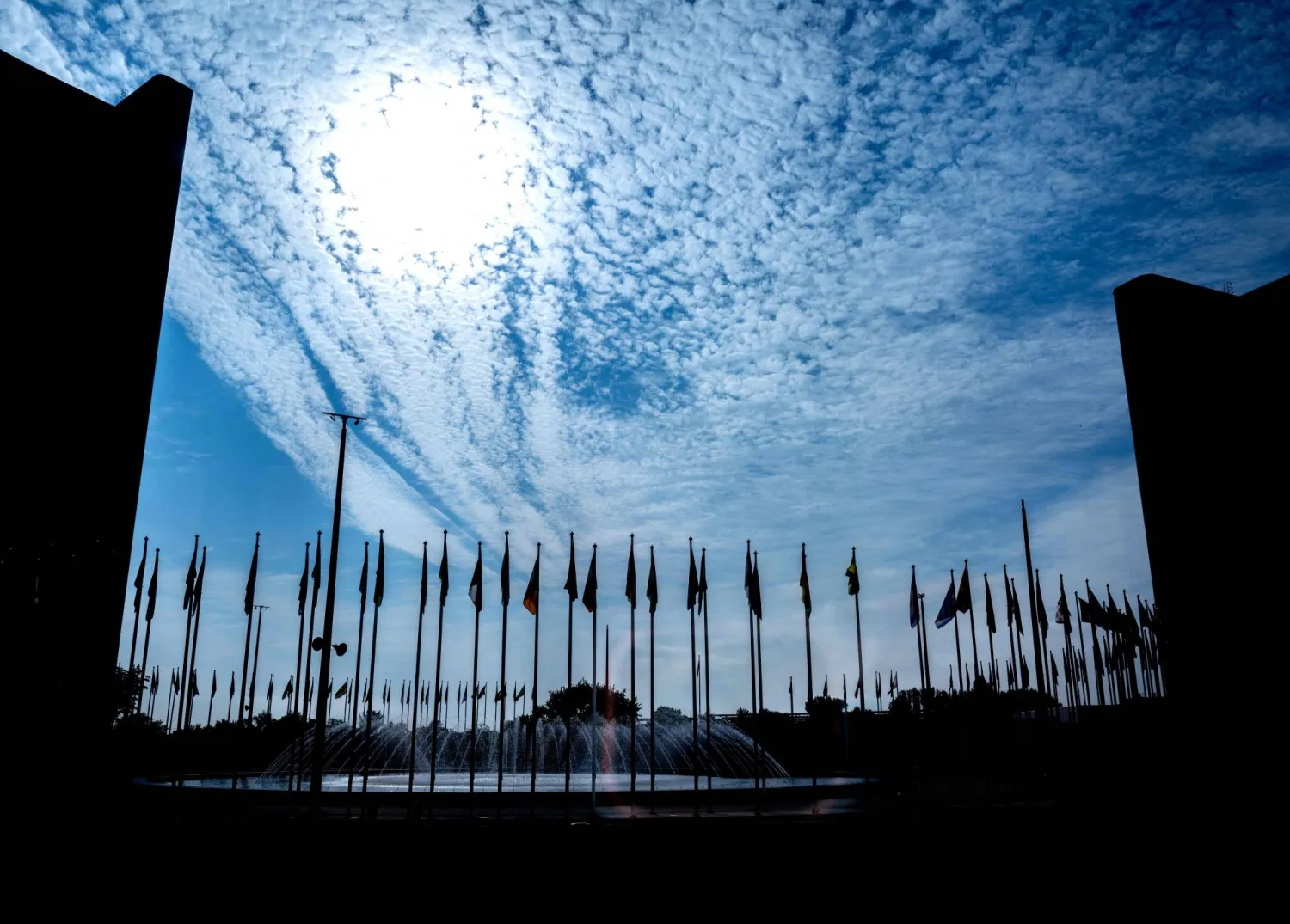

E3: Iran Must Fully Implement Its Obligations Under Comprehensive Safeguards Agreement

Shiloutted flags are seen in the courtyard of the UN district during the Board of Governors meeting of the International Atomic Energy Agency (IAEA) at its headquarters in Vienna, Austria on September 8, 2025. (Photo by Joe Klamar / AFP)
TT

E3: Iran Must Fully Implement Its Obligations Under Comprehensive Safeguards Agreement

Shiloutted flags are seen in the courtyard of the UN district during the Board of Governors meeting of the International Atomic Energy Agency (IAEA) at its headquarters in Vienna, Austria on September 8, 2025. (Photo by Joe Klamar / AFP)

The EU on Thursday called on Iran to immediately return to the full implementation of its obligations under the Comprehensive Safeguards Agreement (CSA) and to fully cooperate with the UN atomic watchdog by allowing inspections to resume in all its nuclear facilities.

In a statement delivered in Vienna at the International Atomic Energy Agency (IAEA) Board of Governors meeting, France, Germany and the UK, known as the E3, commended IAEA Director General Rafael Grossi for his efforts to restore the full implementation of Iran’s Comprehensive Safeguards Agreement, despite Iran’s serious curtailing of its cooperation with the Agency since June 2025.

The E3 countries said Grossi’s report pointed out that in June 2025, a number of Iran’s nuclear facilities were the target of military attacks. “We have been clear that France, Germany, and the United Kingdom were not involved,” they said.

Their statement noted that for the entire reporting period, Iran practically ended cooperation with the IAEA.

On July 2, it said, an Iranian law suspending IAEA inspector access was brought into force.

Since 13 June, the Agency has had no access to any of the safeguarded nuclear facilities in Iran, except for Bushehr Nuclear Power Plant, nor has it received any of the legally required reports from Iran on its nuclear program.

On Tuesday, Egyptian Foreign Minister Badr Abdelatty announced that the IAEA and Iran agreed on a new cooperation framework, after Tehran suspended cooperation with the agency following the 12-day war with Israel, which saw Israeli and US strikes on Iranian nuclear facilities.

Tuesday’s agreement comes against the backdrop of an ongoing threat by European powers to re-impose wide-ranging sanctions against Iran that were lifted under a 2015 nuclear deal between Iran and major powers.

The process — termed a “snapback” — was designed to be veto-proof at the UN and could take effect in a month.

The move set a 30-day clock ticking for the resumption of sanctions unless the West and Iran reach a diplomatic agreement.

European nations have said they would be willing to extend the deadline if Iran resumes direct negotiations with the US over its nuclear program, allows UN nuclear inspectors access to its nuclear sites, and accounts for the more than 400 kilograms of highly enriched uranium the UN watchdog says it has.

The agreement between Tehran and the United Nations' atomic watchdog should in principle pave the way for a full resumption of inspections interrupted by the military strikes on Iran's nuclear facilities in June.

Diplomats warned, however, that the devil was in the detail and neither Grossi not Araqchi provided any at a joint press conference on their agreement covering what the IAEA has been calling “modalities” on how inspections can resume.

On Wednesday, no further details were provided about the agreement, but Grossi said at a joint news conference after the signing that it was technical in nature and highlighted the “indispensable” inspection work that needs to resume in Iran under the treaty of non-proliferation of nuclear weapons.

Later, Iranian Foreign Minister Abbas Araqchi told state TV in an interview, “I have to reiterate the agreement does not currently provide access to IAEA inspectors, apart from the Bushehr nuclear plant.”

In its statement, the E3 on Thursday said there was never a reason for Iran not to allow inspections to resume at all unaffected facilities or to withhold legally required reports.
Instead of upholding its obligations, for several months Iran demanded “separate” and “new” arrangements with the IAEA with conditions outside the IAEA’s verification mandate, the three countries noted.

They added that Iran does not need a separate arrangement as Iran’s Comprehensive Safeguards Agreement has provisions for the implementation of safeguards under special circumstances, and the IAEA is well equipped to conduct its work in difficult conditions.

The E3 said they were updated on the agreement in Cairo on modalities for the full reimplementation of Iran’s Safeguards Agreement, including all necessary accesses, inspections and reporting at all nuclear facilities and installations of Iran.

“We take note of Grossi’s statement that this agreement will neither amend nor modify Iran’s NPT Safeguards Agreement. Now is the time to see action from Iran, not words,” the three European countries said.

Therefore, the E3 said they hope that Iran will seize this opportunity to urgently implement the measures requested by the Director General, including: preparation by Iran of special reports for high and low enriched uranium for the affected facilities, updated Design Information Questionnaires, and full resumption of Agency inspections at all safeguarded nuclear sites and facilities in Iran, affected or unaffected.

Also, at the IAEA Board of Governors Meeting, US Chargé d’Affaires, ad interim, Howard Solomon said his country extends its deep gratitude to Grossi and to his team for their continued efforts to verify Iran’s implementation of its CSA, especially as Iran has, of its own accord, adopted legislation placing undue conditions on its cooperation with the Agency.



China FM Tells Iran Beijing Supports ‘Momentum of Peace Talks’

Members of the media raise hands to ask questions as Chinese Foreign Minister Wang Yi holds a press conference on the sidelines of the National People's Congress (NPC), in Beijing, China, March 8, 2026. (Reuters)
TT

China FM Tells Iran Beijing Supports ‘Momentum of Peace Talks’

Members of the media raise hands to ask questions as Chinese Foreign Minister Wang Yi holds a press conference on the sidelines of the National People's Congress (NPC), in Beijing, China, March 8, 2026. (Reuters)

China's top diplomat told his Iranian counterpart that Beijing "supports maintaining the momentum of the ceasefire and peace talks" in a phone call on Wednesday, as negotiators from Pakistan landed in Tehran to discuss a second round of US-Iran talks.

Peace talks are "in the fundamental interests of the Iranian people and are also the shared hope of regional countries and the international community," Wang Yi said, according to a Chinese foreign ministry statement.

He said China was willing to continue to play a "constructive role" towards peace in the Middle East after a first round of Iran-US talks in Islamabad at the weekend failed to reach an agreement.


Toll from Türkiye School Shooting Rises to Nine

Turkish security forces and emergency staff stand at the courtyard of a high school where an assailant opened fire, in Siverek, south east Türkiye, Tuesday, April 14, 2026, (Mevlut Bayraktar/IHA via AP)
TT

Toll from Türkiye School Shooting Rises to Nine

Turkish security forces and emergency staff stand at the courtyard of a high school where an assailant opened fire, in Siverek, south east Türkiye, Tuesday, April 14, 2026, (Mevlut Bayraktar/IHA via AP)

The toll from Türkiye's second school shooting in as many days now stands at nine people dead, the interior minister said on Wednesday.

"We regret to report nine deaths (...) and 13 wounded. Six of them are currently in intensive care, three of whom are in critical condition," Mustafa Ciftci said in a statement from the city of Kahramanmaras in the center of the country, where a 13-year-old student opened fire earlier in the day.

It marked the second school shooting in Türkiye in two days. On Tuesday, an ex-student opened fire with a shotgun at his former high school in Siverek district of Sanliurfa province, wounding 16 people before killing himself in a showdown with police.

Until this week, such school shootings were rare in Türkiye.

State-run broadcaster, TRT, identified the shooter as Isa Aras Mersinli, and said his father was detained for questioning.

Turkish authorities imposed a ban on the broadcast of “traumatic” images from the shooting, warning media organizations to limit coverage to statements from officials.

Earlier, media reports said that authorities sent police and ambulances to the school in the Kahramanmaras' Onikisubat district, after gunfire was heard there. Images from the scene showed at least two people being put into ambulances.

Parents rushed to the school after hearing reports of an armed attack, NTV television reported, adding that police took security measures around the school.


Top Israel Court Hears Petitions to Oust Far-Right Minister

Israeli Supreme Court judges assemble on the day of the hearing for a petition to force Israeli Prime Minister Benjamin Netanyahu to oust Israeli National Security Minister Itamar Ben-Gvir from his position, following allegations Ben-Gvir used his role to intervene in investigations and operational matters, at the Supreme Court in Jerusalem April 15, 2026. (Reuters)
TT

Top Israel Court Hears Petitions to Oust Far-Right Minister

Israeli Supreme Court judges assemble on the day of the hearing for a petition to force Israeli Prime Minister Benjamin Netanyahu to oust Israeli National Security Minister Itamar Ben-Gvir from his position, following allegations Ben-Gvir used his role to intervene in investigations and operational matters, at the Supreme Court in Jerusalem April 15, 2026. (Reuters)

Israel's High Court was on Wednesday hearing four petitions backed by the country's attorney general that seek to oust hardline National Security Minister Itamar Ben-Gvir.

The case is the latest example of the tension between the judiciary and one of the most right-wing governments in Israel's history, and has been sharply criticized by several other ministers.

The petitions seek Ben-Gvir's removal on the grounds that he has undermined the independence of the police.

The petitions won the support of Attorney General Gali Baharav-Miara, who in January asked the court to order Prime Minister Benjamin Netanyahu to explain why he was not dismissing the cabinet member.

In her request, Baharav-Miara accused Ben-Gvir of "abusing his position to improperly influence the activities of the Israel Police in the most sensitive areas of law enforcement and investigations, and of violating basic democratic principles".

Ahead of the hearing, Ben-Gvir was defiant, calling for the "arrest and investigation" of the attorney general.

"(She) says I set policy and change the police -- she's right. She says I interfere in appointments, and appointed more than 1,000 people in order to implement my policy -- she's right about that too," he said, flanked by supporters.

"Attempts to interfere with a minister's appointment and his powers is dangerous for democracy. Democracy will not fall; the judicial dictatorship will fall," he vowed.

Justice Minister Yariv Levin also weighed in, denouncing the hearing as "illegal" and saying "the judges' decision will have no validity".

And Foreign Minister Gideon Saar, a former justice minister, urged the court "to refrain from harming democracy", saying the case -- which seeks to compel Netanyahu to dismiss Ben-Gvir -- "goes too far," he wrote on Telegram.

On Monday, Netanyahu submitted his 129-page response to the bid to oust Ben-Gvir, arguing it was an "unconstitutional demand" and that the court lacked authority to interfere in government decisions or in the appointment of ministers.

Last month, he described the attorney general's request as "inconceivable... in the midst of an existential war", saying her call to dismiss a senior minister, against whom no criminal investigation had been opened, "harms the foundations of democracy".