


Brazil’s Bolsonaro Sentenced to 27 Years After Landmark Coup Plot Conviction 

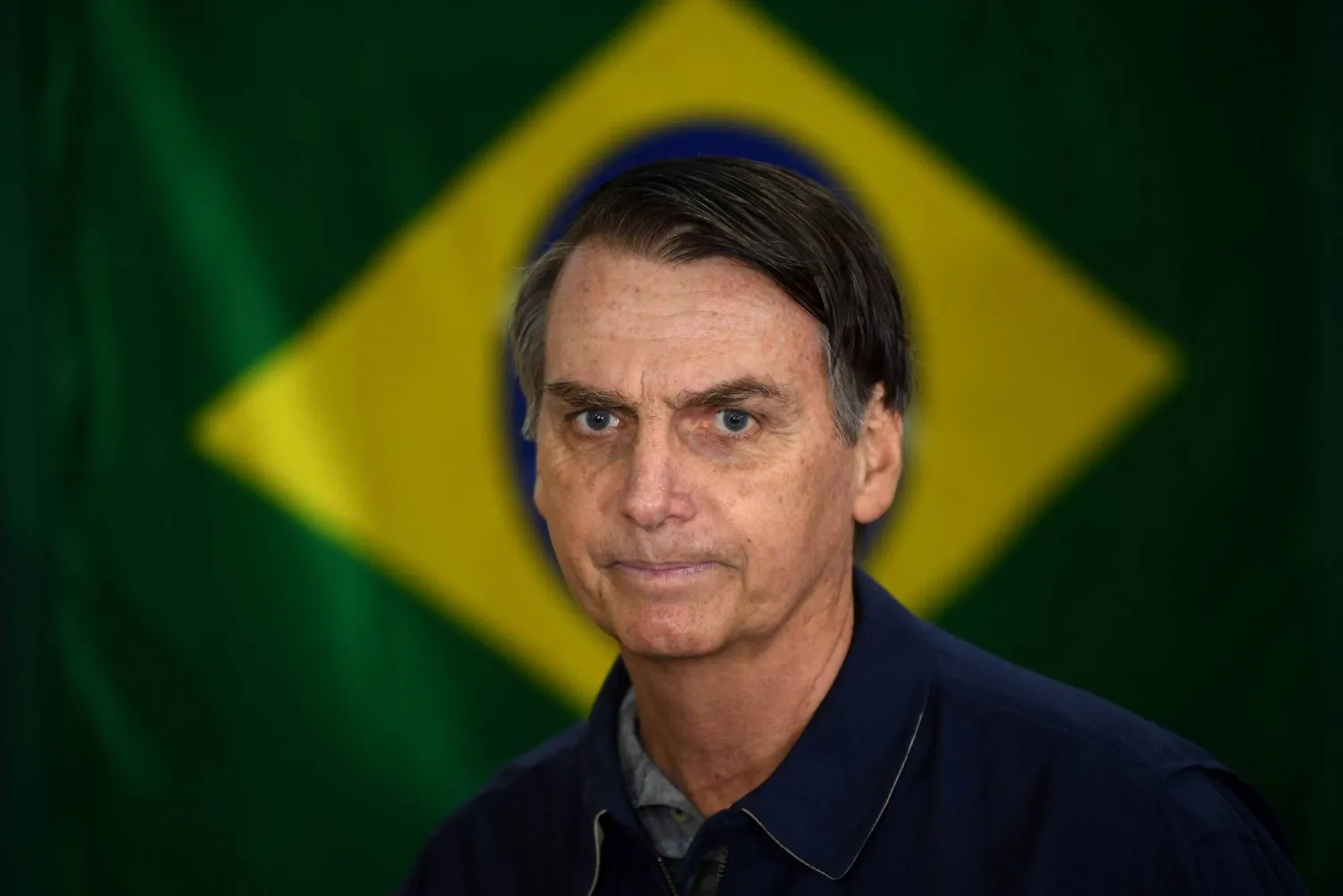
Brazil's right-wing presidential candidate for the Social Liberal Party (PSL) Jair Bolsonaro walks in front of the Brazilian flag as he prepares to cast his vote during the general elections, in Rio de Janeiro, Brazil, on October 7, 2018. (AFP)
TT

Brazil’s Bolsonaro Sentenced to 27 Years After Landmark Coup Plot Conviction 

Brazil's right-wing presidential candidate for the Social Liberal Party (PSL) Jair Bolsonaro walks in front of the Brazilian flag as he prepares to cast his vote during the general elections, in Rio de Janeiro, Brazil, on October 7, 2018. (AFP)

Former Brazilian President Jair Bolsonaro was sentenced on Thursday to 27 years and three months in prison hours after being convicted of plotting a coup to remain in power after losing the 2022 election, dealing a powerful rebuke to one of the world's most prominent far-right populist leaders.

The conviction ruling by a panel of five justices on Brazil's Supreme Court, who also agreed on the sentence, made the 70-year-old Bolsonaro the first former president in the country's history to be convicted for attacking democracy, and drew disapproval from the Trump administration.

"This criminal case is almost a meeting between Brazil and its past, its present and its future," Justice Carmen Lucia said before her vote to convict Bolsonaro, referring to a history checkered with military coups and attempts to overthrow democracy.

There was ample evidence that Bolsonaro, who is currently under house arrest, acted "with the purpose of eroding democracy and institutions," she added.

Four of the five judges voted to convict the former president of five crimes: taking part in an armed criminal organization; attempting to violently abolish democracy; organizing a coup; and damaging government property and protected cultural assets.

The conviction of Bolsonaro, a former army captain who never hid his admiration for the military dictatorship that killed hundreds of Brazilians between 1964 and 1985, follows legal condemnations for other far-right leaders this year, including France's Marine Le Pen and the Philippines' Rodrigo Duterte.

It may further enrage Bolsonaro's close ally US President Donald Trump, who had called the case a "witch hunt" and in retaliation hit Brazil with tariff hikes, sanctions against the presiding judge, and the revocation of visas for most of the high court justices.

Asked about the conviction on Thursday, Trump again praised Bolsonaro, calling the verdict "a terrible thing."

"I think it's very bad for Brazil," he added.

As he watched his father's conviction from the US, Brazilian Congressman Eduardo Bolsonaro told Reuters he expected Trump to consider imposing further sanctions on Brazil and its high court justices.

US Secretary of State Marco Rubio said on X the court had "unjustly ruled," adding: "The United States will respond accordingly to this witch hunt."

Brazil's Foreign Ministry issued a statement calling Rubio's comment a threat that "attacks Brazilian authority and ignores the facts and the compelling evidence in the records." The ministry said that Brazilian democracy would not be intimidated by the US.

President Luiz Inacio Lula da Silva also said he does not fear new sanctions from the US in an interview to local TV channel Band hours before Bolsonaro's conviction was confirmed.

The verdict was not unanimous, with Justice Luiz Fux on Wednesday breaking with his peers by acquitting the former president of all charges and questioning the court's jurisdiction.

That single vote could open a path to challenges to the ruling, which could push the trial's conclusion closer to the October 2026 presidential election. Bolsonaro has repeatedly said he will be a candidate in that election despite being barred from running for office.

Bolsonaro’s lawyers said in a statement that the sentencing “was absurdly excessive” and that it would file the appropriate appeals.

FROM THE BACK BENCHES TO THE PRESIDENCY

The conviction of Bolsonaro marks the nadir in his trajectory from the back benches of Congress to his forging of a powerful conservative coalition that tested the limits of the country's young democratic institutions.

His political journey began in the 1980s on the Rio de Janeiro city council after a brief career as an army paratrooper. He went on to serve nearly three decades as a congressman in Brasilia, where he quickly became known for his defense of authoritarian-era policies.

In one interview, he argued that Brazil would only change "on the day that we break out in civil war here and do the job that the military regime didn't do: killing 30,000."

Long dismissed as a fringe player, he later refined his message to play up anti-corruption and pro-family values themes. He found fertile ground as mass protests erupted across Brazil in 2014 and 2015 amid the sprawling "Car Wash" graft scandal that implicated hundreds of politicians – including President Luiz Inacio Lula da Silva, whose own conviction was later annulled.

Anti-establishment anger opened the path for his successful 2018 presidential run, with dozens of far-right and conservative lawmakers elected on his coattails. They have reshaped Congress into an enduring obstacle to Lula's progressive agenda.

Bolsonaro's presidency was marked by intense skepticism of vaccines during the pandemic and an embrace of illegal mining and cattle ranching in the Amazon rainforest, where deforestation climbed.

As he faced a tough reelection campaign against Lula in 2022 - which Lula went on to win - Bolsonaro's comments took on an increasingly messianic quality, raising concerns about his willingness to accept the results.

"I have three alternatives for my future: being arrested, killed, or victory," he said, in remarks to a meeting of evangelical leaders in 2021. "No man on Earth will threaten me."

In 2023, Brazil's electoral court barred him from public office until 2030 for venting unfounded claims about Brazil's electronic voting system.

Lula's Institutional Relations Minister, Gleisi Hoffmann, said that Bolsonaro's conviction "ensures that no one dares again to attack the rule of law or the will of the people as expressed at the ballot box."

PROTECTING DEMOCRACY

Bolsonaro's conviction and its durability will be a powerful test for the strategy that Brazil's highest-ranking judges have adopted to protect the country's democracy against what they describe as dangerous attacks by the far-right.

Their targets have included social media platforms they accused of spreading disinformation about the electoral system, as well as politicians and activists who have attacked the court. Sending the former president and his allies to jail for planning a coup reflects a culmination of that polarizing strategy.

The cases have largely been led by the commanding figure of Justice Alexandre de Moraes, appointed to the court by a conservative president in 2017, whose hardball approach to Bolsonaro and his allies has been celebrated by the left and denounced by the right as political persecution.

"They want to get me out of the political game next year," Bolsonaro told Reuters in a recent interview, referring to the 2026 election in which Lula is likely to seek a fourth term. "Without me in the race, Lula could beat anyone."

The historic significance of the case goes beyond the former president and his movement, said Carlos Fico, a historian who studies Brazil's military at the Federal University of Rio de Janeiro.

The Supreme Court also ruled to convict seven of Bolsonaro's allies, including five military officers.

The verdict marks the first time since Brazil became a republic almost 140 years ago that military officials have been punished for attempting to overthrow democracy.

"The trial is a wake-up call for the armed forces," Fico said. "They must be realizing that something has changed, given that there was never any punishment before, and now there is."



Four Arrested after Protesters Disrupt Israeli Concert in Paris

A view shows streets Rue Ferdinand Flocon, one of the pedestrianized streets, ahead of the March 23 citywide vote on a proposition from city hall to pedestrianize 500 streets, in Paris, France, March 21, 2025. (Reuters)
TT

Four Arrested after Protesters Disrupt Israeli Concert in Paris

A view shows streets Rue Ferdinand Flocon, one of the pedestrianized streets, ahead of the March 23 citywide vote on a proposition from city hall to pedestrianize 500 streets, in Paris, France, March 21, 2025. (Reuters)

Four people were arrested after protesters used flares to disrupt a concert by the Israeli Philharmonic Orchestra in Paris on Thursday night, the latest in a wave of anti-Israel incidents linked to the Gaza conflict, French officials said on Friday.

In footage posted on social media, protesters were seen lighting flares and chanting pro-Palestinian slogans in La Philharmonie concert hall in northern Paris as some audience members and security personnel tried to remove them.

Despite the chaos and several interruptions, the concert went ahead after the protesters were evacuated, Reuters reported.

"I strongly condemn the actions committed last night during a concert at the Philharmonie de Paris. Nothing can justify them," Interior Minister Laurent Nunez said on X.

"I thank the personnel from the Paris police who enabled the rapid arrest of several perpetrators of serious disturbances inside the venue and contained the demonstrators outside. Four people have been placed in custody," he added.

The Paris prosecutor's office said three women and a man were in custody, on charges ranging from violence, destruction and organising an unauthorised protest.

Culture Minister Rachida Dati on X condemned the disruptions as going against the "fundamental rights of our Republic."

The Philharmonie said it had filed a criminal complaint.


Türkiye Preparing Law to Let PKK Fighters Return under Peace Plan

(FILES) Supporters display a poster depicting jailed leader of the Kurdistan Workers' Party (PKK) Abdullah Ocalan, after he called on the Kurdistan Workers' Party (PKK) to disarm and dissolve itself in Diyarbakir, southeastern Türkiye, on February 27, 2025.(Photo by Yasin AKGUL / AFP)
TT

Türkiye Preparing Law to Let PKK Fighters Return under Peace Plan

(FILES) Supporters display a poster depicting jailed leader of the Kurdistan Workers' Party (PKK) Abdullah Ocalan, after he called on the Kurdistan Workers' Party (PKK) to disarm and dissolve itself in Diyarbakir, southeastern Türkiye, on February 27, 2025.(Photo by Yasin AKGUL / AFP)

Türkiye is preparing a law to let thousands of Kurdistan Workers Party (PKK) fighters and civilians return home from hideouts in northern Iraq under negotiations to end generations of war.

A senior Middle East official and a Kurdish political party source in Türkiye said the proposed law would protect those returning home but stop short of offering a general amnesty for crimes committed by former militants. Some militant leaders could be sent to third countries under the plans.

Bringing PKK guerrillas and their families home from their bases in mountainous northern Iraq is seen as one of the final hurdles in a peace process launched a year ago to end a war that has killed 40,000 people.

While officials have spoken publicly about reconciliation efforts in general terms, the sources disclosed details that have not previously been reported, including proposals for returns to take place in separate waves of civilians and fighters, and for commanders to be sent to third countries.

The Middle East official, describing the sensitive negotiations on condition of anonymity, said legislation to allow the returns could come before the Turkish parliament as soon as this month.

PLAN COULD INCLUDE SEPARATE WAVES OF RETURNS

Türkiye‘s intelligence agency MIT, which has led talks with the PKK, did not immediately comment on the proposal. The PKK did not immediately comment.

Since Kurdish militants launched their insurgency in 1984 - originally with the aim of creating an independent Kurdish state - the conflict has exerted a huge economic and social burden on Türkiye and neighboring countries.

Ending it would boost NATO member Türkiye’s political and economic stability, and ease tensions in Iraq where the PKK is based, and Syria where Kurdish fighters have been allied with US forces.

In a major breakthrough, the PKK announced a decision in May to disarm and disband after a call to end its armed struggle from its jailed leader Abdullah Ocalan.

In July the group symbolically burned weapons, and last month it announced it was withdrawing fighters from Türkiye as part of the disarmament process. It called on Ankara to take steps to let its members participate in "democratic politics".

But the terms of reconciliation have been sensitive, with Türkiye wary of offering a wide amnesty for what it considers past crimes of a terrorist organization.

Numan Kurtulmus, who heads a reconciliation commission set up by Türkiye in August, said last week that any legal steps would come only after Türkiye verifies that the PKK has completed its dissolution process.

"Once Türkiye’s security and intelligence units have verified and confirmed that the organiئation has truly laid down its arms and completed its dissolution process, the country will enter a new phase of legal regulations aimed at building a terror-free Türkiye," he said.

According to the senior Middle East official, the proposal now being discussed would see roughly 1,000 civilians and non-combatants return first, followed by about 8,000 fighters after individual screening.

Beyond that, the official said Türkiye had so far rejected taking back around 1,000 senior and mid-level PKK figures, and wants them relocated to a third country, possibly in Europe.

Talks were ongoing on that issue, with some parties involved in the negotiations concerned that excluding PKK top brass from repatriation could eventually fuel a renewed insurgency, the official said.

Legislation to enable returns could come before the Turkish parliament as early as the end of November, the official added.

Tayip Temel, deputy co-chair of the pro-Kurdish DEM Party - which though an opposition party has worked closely with the government on the peace process - said the ongoing negotiations focused on a formula personally emphasiئed by Ocalan.

"Work is underway on a special law for the PKK to enable the democratic and social reintegration of its members," Temel told Reuters.

"The law will cover everyone returning from the PKK, whether civilian or militant. There is no plan for a phased return. The formula being worked on is comprehensive and applies to all."

He confirmed that Türkiye had raised the idea of some PKK figures being sent to third countries, but said this would have to be discussed with the potential hosts.

DIFFERENT PROCEDURES FOR DIFFERENT GROUPS

Another source at DEM, parliament's third-biggest party, said the commission drafting the proposal was working on a single, PKK-specific law that would avoid the language of a general amnesty.

"Different procedures will apply to different groups of returnees," the source said, adding that some returning PKK members will likely face investigations and trials. "Otherwise it will be hard to reach common ground among parties in the commission."

Once the parliamentary commission completes its work, it is expected to recommend the special PKK law to parliament, paving the way for potential legislation.

Human Rights Watch urged lawmakers to use the peace process to reform laws that have long been used to charge and incarcerate non-violent Kurdish activists.

The commission "has a unique opportunity to help shape a post-conflict society and should make bold recommendations to repeal abusive laws used to silence and marginalize people," said Hugh Williamson, Europe and Central Asia director at HRW.


Russia Urges Trump Administration to Clarify 'Contradictory' Signals on Nuclear Testing

Representation photo: This photograph shows a general view of Kurskaya nuclear power plant taken outside the town of Kurchatov on August 27, 2024. (Photo by TATYANA MAKEYEVA / AFP)
TT

Russia Urges Trump Administration to Clarify 'Contradictory' Signals on Nuclear Testing

Representation photo: This photograph shows a general view of Kurskaya nuclear power plant taken outside the town of Kurchatov on August 27, 2024. (Photo by TATYANA MAKEYEVA / AFP)

Russia urged the United States on Friday to clarify what it called contradictory signals about a resumption of nuclear testing, saying such a step would trigger responses from Russia and other countries.

President Donald Trump last week ordered the US military to immediately restart the process for testing nuclear weapons. But he did not make clear if he meant flight-testing of nuclear-capable missiles or a resumption of tests involving nuclear explosions - something neither the US nor Russia has done for more than three decades.

"If it is the latter, then this will create negative dynamics and trigger steps from other states, including Russia, in response," Russian Foreign Ministry spokeswoman Maria Zakharova told reporters.

"For now, we note that the signals emanating from Washington, which are causing justified concern in all corners of the world, remain contradictory, and, of course, the real state of affairs must be clarified."

Citing the lack of clarity around US plans, President Vladimir Putin on Wednesday instructed top officials to prepare proposals for Russia to carry out its own potential nuclear test in response to any US test.

Security analysts say a resumption of testing by any of the world's nuclear powers would be a destabilizing step at a time of acute geopolitical tension, notably over the war in Ukraine, and would likely prompt other countries to follow suit.

Russia and the US possess the world's largest nuclear arsenals.

The last remaining treaty between them that limits the number of strategic nuclear warheads on both sides is due to expire in three months, potentially fueling an arms race that is already in progress.

Putin has proposed that both sides continue to observe the treaty limits for another year, but Trump has yet to respond formally to the idea.