


DNA Evidence Found Near Scene of Charlie Kirk’s Shooting Matches Suspect, FBI Director Says

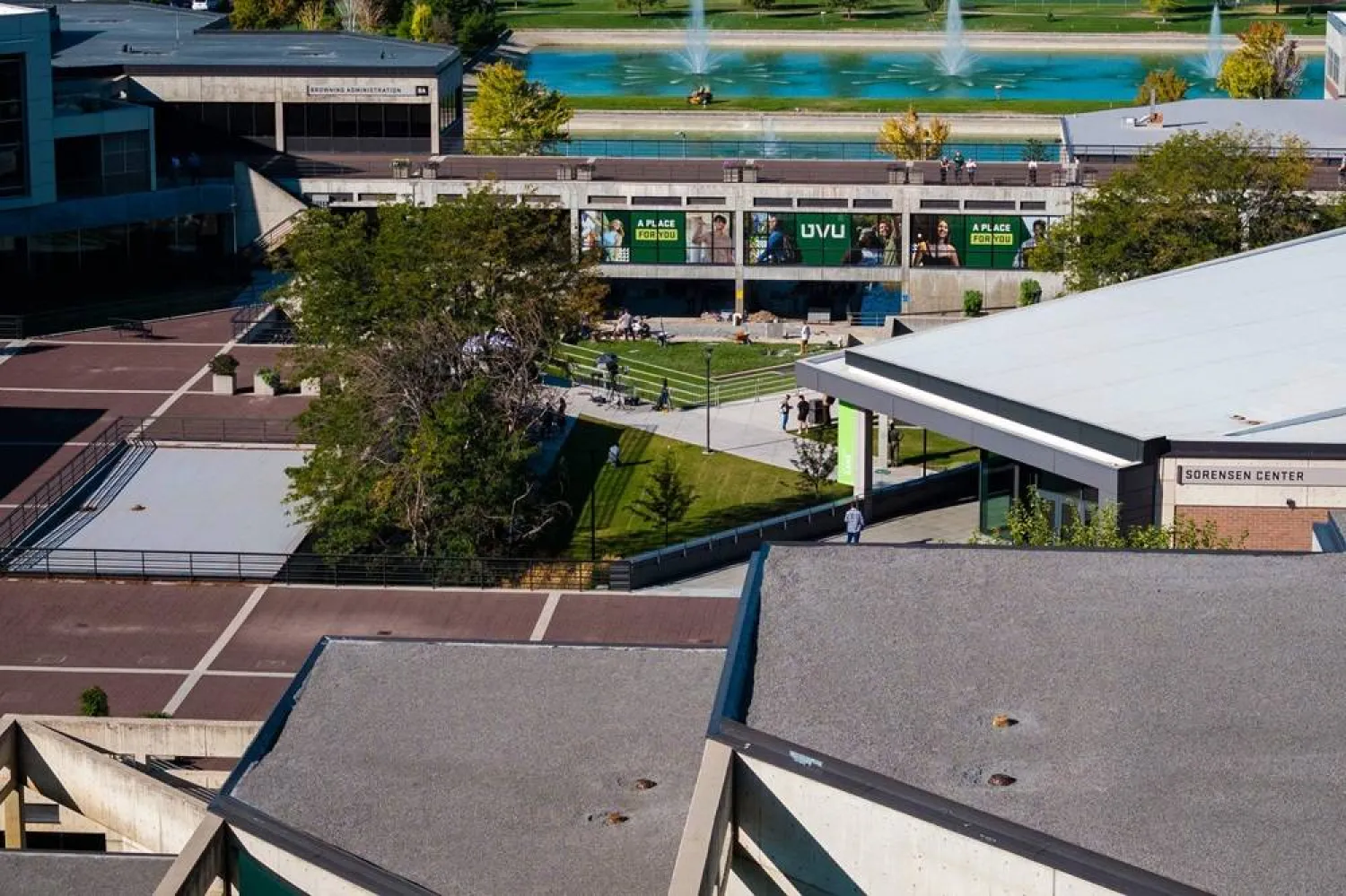
In this aerial view, the Utah Valley University courtyard where political activist Charlie Kirk was shot, on September 15, 2025 in Orem, Utah. (Getty Images/AFP)
TT

DNA Evidence Found Near Scene of Charlie Kirk’s Shooting Matches Suspect, FBI Director Says

In this aerial view, the Utah Valley University courtyard where political activist Charlie Kirk was shot, on September 15, 2025 in Orem, Utah. (Getty Images/AFP)

DNA on a towel wrapped around a rifle found near where conservative activist Charlie Kirk was assassinated matched that of the 22-year-old accused in the killing, FBI Director Kash Patel said on Monday.

Investigators also have used DNA evidence to link the suspect, Tyler Robinson, with a screwdriver recovered from the rooftop where the fatal shot was fired, Patel told Fox News Channel on Monday.

Authorities in Utah are preparing to file capital murder charges against Robinson as early as Tuesday in the killing of Kirk, a dominant figure in conservative politics who became a confidant of President Donald Trump after founding Arizona-based Turning Point USA, one of the nation's largest political organizations.

Kirk, who brought young, conservative evangelical Christians into politics, was shot Wednesday while speaking at Utah Valley University during one of his many campus stops. The shooting raised fears about increasing political violence in a deeply polarized United States.

Officials have said Robinson carried a hatred for Kirk and ascribed to a “leftist ideology” that had grown in recent years. Robinson’s family and friends said he spent large amounts of time scrolling the "dark corners of the internet,” Utah Gov. Spencer Cox said Sunday.

Patel told Fox News that Robinson had written in a note before the shooting that he had an opportunity to take out Kirk and was going to do it. Investigators were able to recover the note's contents after it had been destroyed, the FBI director said, paraphrasing from the note without revealing more details.

Authorities said Robinson has not been cooperating with law enforcement. They say that he may have been “radicalized” online and that ammunition found in the gun used to kill Kirk included anti-fascist and meme-culture language engravings. Court records show that one bullet casing had the message, “Hey, fascist! Catch!”

Robinson was arrested late Thursday near where he grew up around St. George, in the southwestern corner of Utah between Las Vegas and Bryce Canyon and Zion National Parks. It's unclear whether he has an attorney who could speak on his behalf.

Tributes to Kirk continue across the country. A line of mourners wrapped around the Kennedy Center in Washington for a vigil on Sunday, and there were moments of silence at several professional sporting events.

Vice President JD Vance, who counted Kirk as a close friend, planned to serve as a substitute host on Monday for Kirk's talk show on Rumble, a streaming platform.

“Please join me as I pay tribute to my friend,” Vance wrote on social media.


Japan Rejects 'New Militarism,’ Accuses China of Rapidly Arming

Shinjiro Koizumi, Japan's defense minister, speaks at the Shangri-La Dialogue security summit in Singapore, May 31, 2026. REUTERS/Caroline Chia
TT

Japan Rejects 'New Militarism,’ Accuses China of Rapidly Arming

Shinjiro Koizumi, Japan's defense minister, speaks at the Shangri-La Dialogue security summit in Singapore, May 31, 2026. REUTERS/Caroline Chia

Japan's Defense Minister Shinjiro Koizumi on Sunday rejected accusations of "new militarism" by Tokyo and criticized China for rapidly expanding its military with little transparency, underscoring mounting tensions between the two countries.

China continues to increase its defense spending at a high level, Koizumi said at the Shangri-La Dialogue in Singapore, adding: "China's external approach and military activities are matters of serious concern for Japan and the international community at the same time."

Rebutting criticism that Japan was embracing new militarism, he said: "Think about it. There's a country that has a huge arsenal of nuclear weapons and strategic bombers. Japan has neither of such ⁠weapons, and yet ⁠Japan is labelled 'new militarism'?"

Koizumi said Japan's record since World War Two "speaks for itself", citing its adherence to international law and commitment to the United Nations Charter, alongside efforts to uphold a "free and open international order."

In May, China's foreign ministry called on Asia-Pacific countries to be vigilant and "jointly resist the reckless actions of Japan's neo-militarism".

At the Singapore forum, Chinese delegate Major General Meng Xiangqing also criticized Japan.

"I deeply doubt whether ⁠a country that has not thoroughly eradicated the toxic legacy of militarism is qualified to talk extensively about defense cooperation on international occasions, and whether it can win the trust of the international community, especially the Asian countries it once invaded," he said.

Ties between Japan and China sank to their worst level in years after Japanese Prime Minister Sanae Takaichi warned in November that a hypothetical Chinese attack on Taiwan could draw a Japanese military response.

China claims Taiwan as its own territory, over the objections of Taipei's government.

Koizumi said he was "sad" he could not meet his Chinese counterpart at the dialogue, Asia's premier defense forum, but insisted Japan remains open to ⁠engagement. "We keep ⁠the door open," he said, reaffirming Japan's commitment to dialogue with China and other regional players to foster stability.

For the second year running, Chinese Defense Minister Dong Jun has given the free-wheeling Singapore security meeting a miss, skipping opportunities to meet his counterparts.

Koizumi said Japan is "determined" to play a new role in defense equipment cooperation in the Asia-Pacific and aims to tangibly strengthen deterrence in the region.

"We seek a region that can stand against coercion. We seek a region that is not misled by falsehoods. We seek a region that is not influenced by pressure," he said.

In April, Tokyo unveiled its biggest overhaul of defense export rules in decades, scrapping restrictions on overseas arms sales and opening the way for exports of warships, missiles and other weapons.


IAEA: Turbine Building at Ukrainian Nuclear Plant Attacked

An image showing part of the Russian-controlled Zaporizhzhia nuclear power plant in southeastern Ukraine (Reuters file photo)
TT

IAEA: Turbine Building at Ukrainian Nuclear Plant Attacked

An image showing part of the Russian-controlled Zaporizhzhia nuclear power plant in southeastern Ukraine (Reuters file photo)

The International Atomic Energy Agency (IAEA) on Saturday said it has been informed by the Zaporizhzhia nuclear power plant in southeastern Ukraine that a drone struck ⁠a turbine building ⁠at the site, reportedly causing a hole in its wall.

IAEA chief ⁠Rafael Grossi expressed serious concern about the reported incident and said "Attacking nuclear sites is like playing with fire."

The IAEA’s team at the Russian-held power ⁠plant ⁠has requested access to examine the affected turbine building first-hand, the agency said in an X post.


Did Iran Use Chinese Missile to Shoot Down a US Fighter Jet Last Month?

This handout photo provided by Iran's Revolutionary Guard Corps (IRGC) official website Sepah News on April 5, 2026 reportedly shows the wreckage and remains of targeted and crashed aircraft in central Iran. (Photo by SEPAH NEWS / AFP)
TT

Did Iran Use Chinese Missile to Shoot Down a US Fighter Jet Last Month?

This handout photo provided by Iran's Revolutionary Guard Corps (IRGC) official website Sepah News on April 5, 2026 reportedly shows the wreckage and remains of targeted and crashed aircraft in central Iran. (Photo by SEPAH NEWS / AFP)

The F-15 fighter that was shot down over southwestern Iran last month and set off a dangerous rescue mission was probably struck by a Chinese-made shoulder-launched missile, three people with knowledge of the matter told NBC News on Saturday.

In the early days of the conflict, China also may have provided Iran with a long-range early-warning radar that spots stealth aircraft that are meant to evade detection, according to one of the people and a US official with knowledge of the matter.

US officials are still investigating the circumstances around the shootdown of the American F-15E Strike Eagle in April, the sources said. It was the first time in decades that a US fighter was downed by enemy fire.

It’s not clear when the military equipment was handed over.

But Iran’s use of weapons made in China complicates Americans’ relationship with Beijing at a time when President Donald Trump has sought China’s help in ending the conflict.

At the time the plane was downed last month, Trump said it was struck by a shoulder-launched missile.

About 2.1 meter-long and weighing around 18 kilograms, the weapons, also known as “man-portable air defense weapons,” or “Manpads,” provide an inexpensive, effective way to take down low-flying aircraft.

The two-man crew of the F-15 jet safely ejected from the aircraft over Iran. The pilot was rescued within seven hours, but it took two days to locate and rescue the weapons systems officer, who hid in the foothills of the Zagros Mountains, according to the Pentagon.

Asked about the shootdown of the F-15, a spokesperson for the Chinese Embassy said in a statement: “China always acts prudently and responsibly on the export of military products, and exercises strict control in accordance with China’s laws and regulations on export control and due international obligations. China opposes groundless smear and ill-intentioned association.”

US intelligence reporting suggests China was planning to provide new air defense weaponry to Iran in coming weeks, NBC News reported previously.

US officials may have leaked the intelligence in a possible bid to expose China’s plans, according to former national security officials, a tactic used by previous administrations.

Earlier this month, the Trump administration accused China of allowing Iran access to Chinese satellites to help Tehran target US forces in the region.

The State Department imposed sanctions on three Chinese satellite companies that it said were providing imagery and data to enable Iran to launch attacks against US forces in the Middle East. China denied the accusation.

The US is aware of everything that China is doing to support Iran, according to the US official who had knowledge of the discussions, who said that China supported Iran before the war and any assistance during the ongoing conflict has not made a difference on the battlefield.

“It was not significant support. There was no decisive operational impact to it,” the US official said.

China once sold large quantities of weapons to Iran in the 1980s and 1990s, including ballistic missiles, anti-ship missiles, tanks, artillery and fighter jets.

But after a UN arms embargo against Iran was introduced in 2006, China backed away from major weapons sales and instead provided components and other technology to Iran that had both civilian and military uses, according to experts and the Stockholm International Peace Research Institute.
