


Two British MPs Denied Entry to Israel

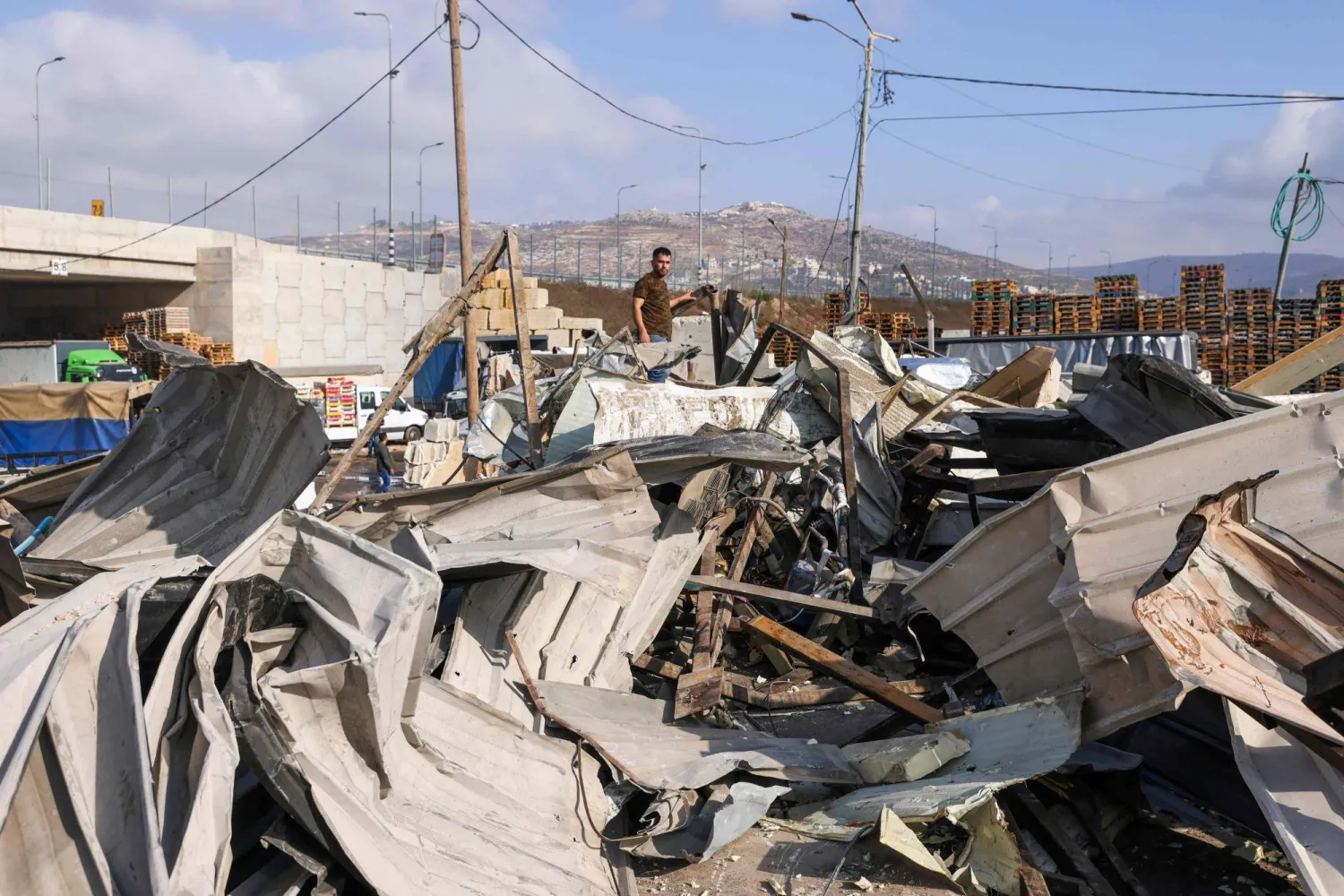
A Palestinian vendor inspects the rubble after the Israeli army demolished sixteen shops at the produce market in Beita village south of Nablus in the occupied West Bank on September 8, 2025. (Photo by JAAFAR ASHTIYEH / AFP)
TT

Two British MPs Denied Entry to Israel

A Palestinian vendor inspects the rubble after the Israeli army demolished sixteen shops at the produce market in Beita village south of Nablus in the occupied West Bank on September 8, 2025. (Photo by JAAFAR ASHTIYEH / AFP)

Two British Labour MPs who were travelling to the occupied West Bank say they have been denied entry into Israel, BBC reported on Wednesday.

Simon Opher and Peter Prinsley were travelling in a parliamentary delegation to see medical and humanitarian work being carried out by organizations including Medical Aid for Palestinians, the news channel reported on its website.

In a joint statement the two MPs said it was “deeply regrettable” that Israeli authorities had “prevented them from seeing first-hand the grave challenges facing medical facilities in the region.”

A spokesperson for the UK Foreign Office said: “It is totally unacceptable and deeply concerning that yet again two British MPs have been denied entry to the occupied Palestinian territories by Israel.”

“Minister [Hamish] Falconer and officials have remained in contact with the MPs affected throughout. We are clear with Israel that this is no way to treat British Parliamentarians,” the spokesperson added.

The two MPs were crossing into Israel from Jordan on Monday on a three-day visit organized by the Council for Arab-British Understanding (CAABU) when they were stopped by Israeli authorities.

Opher told the BBC they were held in a passport office before being handed a “legal form insisting that we leave the country” and then “escorted to a bus” back to Jordan.

The Stroud MP said he was told they were not being admitted on “public order” grounds and that representations from the Foreign Office to Israeli authorities had been rejected.

He added: “It's very disappointing. We are both doctors and we were really just going to look at healthcare facilities in the West Bank to see if there was anything we could do to support them.”

“We weren't in any way trying to undermine the Israelis, just trying to see what we could do in the West Bank” where, he said, “they had been told healthcare was getting increasingly difficult.”

They had also been due to meet the British Consul General in Jerusalem as part of the visit, as well as meeting Palestinian and Israeli human rights organizations.

Chris Doyle, the Director of CAABU, told the BBC that it had been organizing trips for parliamentarians for many years and that recent denials of entry were “regrettable.”

He said it was “important that British politicians get to see the situation on the ground at a very serious time to determine what's going on. It allows them to assess that situation and British policy towards it.”

Earlier this year, two other Labor MPs, Abtisam Mohamed and Yuan Yang, were denied entry to Israel in April on another visit organized by the same organization.

At the time Israeli authorities said the two MPs had “accused Israel of false claims” and were “actively involved in promoting sanctions against Israeli ministers.”

Mohamed and Yang said: “Parliamentarians should feel free to speak truthful in the House of Commons, without fear of being targeted.”

The then-Foreign Secretary David Lammy described the move by Israel as “unacceptable, counterproductive and deeply concerning.”

Meanwhile, the first group of severely ill children have arrived in the UK from Gaza for urgent specialist medical care, the UK government has confirmed on Wednesday.

It said a cross-government taskforce has been working over recent weeks to co-ordinate the evacuation of these children.

The World Health Organization (WHO) said that it had supported the medical evacuations of 10 “critical” children from Gaza to the UK. These children were evacuated with 50 companions, the WHO said.

Foreign Secretary Yvette Cooper said on Wednesday the healthcare system in Gaza had been “decimated and hospitals are no longer functioning” with severely ill children “unable to get the medical care they need to survive.”

She called for the protection of medical infrastructure and health workers in Gaza, as well as a huge increase in medicines and supplies to be allowed in.

Officials said the children and their immediate family had been evacuated from Gaza to Jordan, where they were supported by British Embassy staff as they underwent security checks before their arrival in the UK.



Thousands March in US to Back Iranian Anti-government Protesters

Protesters participate in a demonstration in support of the nationwide mass protests in Iran against the government, in Berlin, Germany, Sunday, Jan. 18, 2026. (AP Photo/Ebrahim Noroozi)
TT

Thousands March in US to Back Iranian Anti-government Protesters

Protesters participate in a demonstration in support of the nationwide mass protests in Iran against the government, in Berlin, Germany, Sunday, Jan. 18, 2026. (AP Photo/Ebrahim Noroozi)

Thousands in the United States staged large demonstrations Sunday denouncing the Iranian government's deadly crackdown on anti-government protesters in Iran.

Several thousand people marched in Los Angeles, home to the world's largest Iranian diaspora, while several hundred others gathered in New York, AFP journalist's in both cities reported.

US protesters could be seen carrying signs condemning a "New Holocaust," a "genocide in the making," and the "terror" of the Iranian government.

"My heart is heavy and my soul is crushed, I'm at loss for words to describe how angry I am," said Perry Faraz at the demonstration in Los Angeles, the second-largest city in the US.

The 62-year-old payroll manager, who fled Iran in 2006, learned this week that one of her young cousins had been killed during the overseas rallies held in her native country.

"He wasn't even 10 years old, that's horrible," she said.

Demonstrations sparked by anger over economic hardship exploded into protests late December in what has been widely seen as the biggest challenge to the Iranian leadership in recent years.

The rallies subsided after a government crackdown in Iran that rights groups have called a "massacre" carried out by security forces under the cover of a communications blackout that started on January 8.

Norway-based Iran Human Rights says it has verified the deaths of 3,428 protesters killed by security forces, confirming cases through sources within Iran’s health and medical system, witnesses and independent sources.

The NGO warned that the true toll is likely to be far higher. Media cannot independently confirm the figure and Iranian officials have not given an exact death toll.

- Calls for US intervention -

"This mass murdering of the population is terribly upsetting," Ali Parvaneh, a 65-year-old lawyer protesting in LA said.

Like many protesters, Parvaneh carried a "Make Iran Great Again" sign and said he wanted US President Donald Trump to intervene by targeting the country's powerful Iranian Revolutionary Guard Corps (IRGC).

Some in the crowd in LA went as far as to call for the assassination of Iranian Supreme Leader Ali Khamenei, who has been in power for more than 25 years.

After having attacked Iranian nuclear sites in June, Trump sent mixed signals on possible US intervention this week.

The Republican first threatened to intervene if Iranian protesters were killed, but then said he was satisfied by Iranian assurances that demonstrators would not be executed.

"I really hope that Trump will go one step beyond just voicing support," Parvaneh said.

Many protesting in the Californian city chanted slogans in support of the US president and Reza Pahlavi, the son of the former Shah of Iran who was deposed by the popular uprising in 1979.

- 'Don't need a puppet' -

Parvaneh echoed Pahlavi's popularity among some segments of Iran's exiled and expatriate population.

"Had the monarchy stayed in place, it would be much different and Iran would be in a much better situation," he said.

Pahlavi's support base is concentrated abroad while his political sway within Iran is limited.

The former Shah's son, who lives in exile near Washington, said this week he would be ready to return to Iran -- but it is unclear if most Iranians want this.

The Iranian opposition remains divided, and memories of the Shah's brutal repression of his left-wing opponents remain vivid.

Last week, a man caused minor injuries when he drove a truck into a demonstration held by Iranians in Los Angeles, carrying a sign that read: "No Shah. No Regime. USA: Don't Repeat 1953. No Mullah."

The sign was referring to the 1953 coup that saw Iran's government overthrown in a US- and UK-backed operation that had seen Pahlavi installed as the country's leader.

In Los Angeles's Westwood neighborhood, nicknamed "Tehrangeles," Roozbeh Farahanipour believes the diaspora must support Iranians without infringing on their "right to decide their own future."

"They don't need a puppet implanted by the West," said the 54-year-old restaurant owner.

Others in California also share that view.

"Trump is playing the Iranian people," said poet Karim Farsis, a resident of the San Francisco Bay area.

Farsis, an academic, stresses that it is US sanctions -- including those imposed by Trump -- and the Republican's ripping up of a nuclear deal that have contributed in large part to the suffering of the Iranian people.

She also criticized the almost complete ban on Iranians entering the US since June.

"We're living in a really twisted moment," she said. "Trump is saying to Iranians: 'Keep protesting, take over your institutions.'

"But if they find themselves in danger, they can't even find refuge in the United States."


Iran President Says Any Attack on Supreme Leader Would Be Declaration of War

 In this photo released by an official website of the office of the Iranian supreme leader, Supreme Leader Ali Khamenei speaks in a meeting, in Tehran, Iran, Saturday, Jan. 17, 2026. (Office of the Iranian Supreme Leader via AP)
In this photo released by an official website of the office of the Iranian supreme leader, Supreme Leader Ali Khamenei speaks in a meeting, in Tehran, Iran, Saturday, Jan. 17, 2026. (Office of the Iranian Supreme Leader via AP)
TT

Iran President Says Any Attack on Supreme Leader Would Be Declaration of War

 In this photo released by an official website of the office of the Iranian supreme leader, Supreme Leader Ali Khamenei speaks in a meeting, in Tehran, Iran, Saturday, Jan. 17, 2026. (Office of the Iranian Supreme Leader via AP)
In this photo released by an official website of the office of the Iranian supreme leader, Supreme Leader Ali Khamenei speaks in a meeting, in Tehran, Iran, Saturday, Jan. 17, 2026. (Office of the Iranian Supreme Leader via AP)

Iranian President Masoud Pezeshkian warned on Sunday that any attack on the country's supreme leader Ali Khamenei would mean a declaration of war.

"An attack on the great leader of our country is tantamount to a full-scale war with the Iranian nation," Pezeshkian said in a post on X in an apparent response to US President Donald Trump saying it was time to look for a new leader in Iran.


Quake Hits Northeast Sicily, No Damage Reported

 A man feeds seagulls in Syracuse, Sicily, southern Italy on January 10, 2026. (AFP)
A man feeds seagulls in Syracuse, Sicily, southern Italy on January 10, 2026. (AFP)
TT

Quake Hits Northeast Sicily, No Damage Reported

 A man feeds seagulls in Syracuse, Sicily, southern Italy on January 10, 2026. (AFP)
A man feeds seagulls in Syracuse, Sicily, southern Italy on January 10, 2026. (AFP)

A light earthquake hit the northeastern corner of Sicily on Sunday, authorities said, but no damage was immediately reported.

The quake registering 4.0 on the Richter and Moment Magnitude scales was centered two kilometers (just over a mile) from Militello Rosmarino in the northeastern province of Messina, according to the National Institute of Geophysics and Vulcanology (INGV).

It occurred at 2:54 pm local time (1354 GMT) and had a depth of eight kilometers, INGV said.

Il Mattino newspaper said the earthquake was felt throughout the Messina area but no damage to people or buildings had been reported.

The town of approximately 1,200 inhabitants is located just north of the Nebrodi park, Sicily's largest protected area.

Tremors occur frequently in the northeast of Sicily, with a 2.5 magnitude quake occurring at Piraino, to the east, on Saturday.