


United Nations Arms Embargo, Other Sanctions Reimposed on Iran

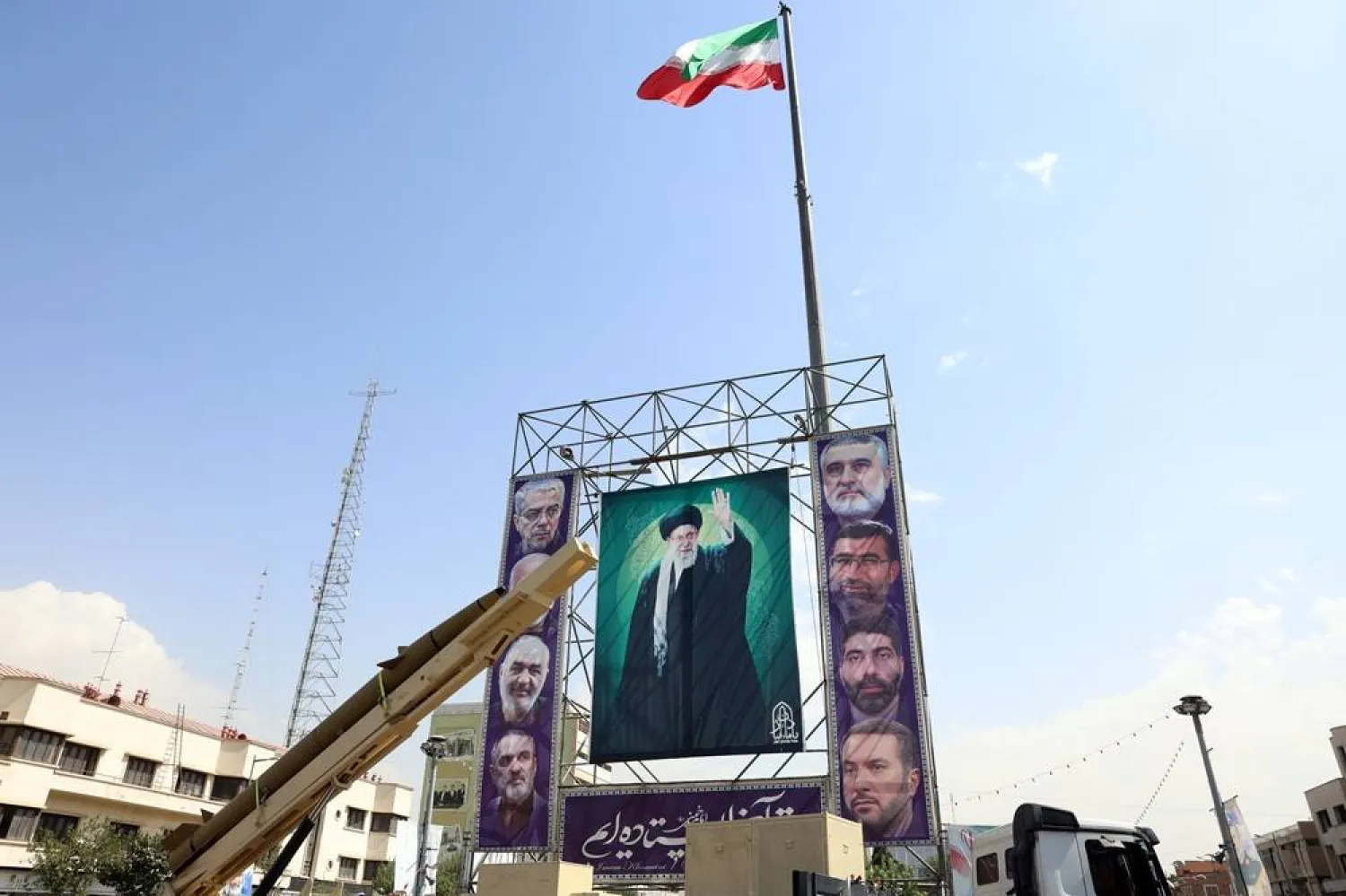
An Iranian Kheibar-Shekan medium-range ballistic missile (MRBM) placed next to a large banner depicting Iranian supreme leader Ali Khamenei (C) in Baharestan Square in Tehran, Iran, 27 September 2025. (EPA)
TT

United Nations Arms Embargo, Other Sanctions Reimposed on Iran

An Iranian Kheibar-Shekan medium-range ballistic missile (MRBM) placed next to a large banner depicting Iranian supreme leader Ali Khamenei (C) in Baharestan Square in Tehran, Iran, 27 September 2025. (EPA)

The United Nations reinstated an arms embargo and other sanctions on Iran on Saturday following a process triggered by key European powers that Tehran has warned will be met with a harsh response.

Britain, France and Germany triggered the return of sanctions on Iran at the UN Security Council over accusations the country has violated a 2015 deal that aimed to stop it developing a nuclear bomb. Iran denies seeking nuclear weapons.

The end of the decade-long nuclear deal originally agreed by Iran, Britain, Germany, France, the United States, Russia and China is likely to exacerbate tensions in the Middle East, just months after Israel and the US bombed Iranian nuclear sites.

UN sanctions imposed by the Security Council in resolutions adopted between 2006 and 2010 were reinstated at 8 p.m. EDT Saturday (0000 GMT). Attempts to delay the return of all sanctions on Iran failed on the sidelines of the annual gathering of world leaders at the UN this week.

"We urge Iran and all states to abide fully by these resolutions," the foreign ministers of France, Britain and Germany said in a joint statement after the deadline passed.

Tehran has warned of a harsh response. But Iranian President Masoud Pezeshkian said on Friday that Iran had no intention of leaving the Non-Proliferation Treaty.

Iran said on Saturday it was recalling its ambassadors to Britain, France and Germany for consultations.

Russia has disputed the return of UN sanctions on Iran.

"It is unlawful, and it cannot be implemented," Russian Foreign Minister Sergei Lavrov told reporters at the UN earlier on Saturday, adding that he had written to UN Secretary-General Antonio Guterres warning that it would be "a major mistake" for him to acknowledge a return of UN sanctions on Iran.

The UN Security Council website was swiftly updated on Saturday evening to reflect the return to sanctions.

DIPLOMACY STILL AN OPTION

The European powers had offered to delay reinstating sanctions for up to six months to allow space for talks on a long-term deal if Iran restored access for UN nuclear inspectors, addressed concerns about its stock of enriched uranium, and engaged in talks with the United States.

"Our countries will continue to pursue diplomatic routes and negotiations. The reimposition of UN sanctions is not the end of diplomacy," the foreign ministers of Britain, France and Germany said. "We urge Iran to refrain from any escalatory action and to return to compliance with its legally binding safeguards obligations."

US President Donald Trump has been clear that diplomacy is still an option for Iran and a deal remains the best outcome for the Iranian people and the world, US Secretary of State Marco Rubio said in a statement after the UN sanctions were reimposed.

"For that to happen, Iran must accept direct talks, held in good faith, without stalling or obfuscation," he said, stressing that until there was a new deal it was important that countries implemented sanctions "

immediately in order to pressure Iran's leaders to do what is right for their nation, and best for the safety of the world." Iran's economy is already struggling with crippling US sanctions reimposed since 2018 after Trump ditched the pact during his first term.

Iran's rial currency continued to decline over fears of new sanctions. The rial fell to 1,123,000 per US dollar, a new record low, on Saturday, from about 1,085,000 on Friday, according to foreign exchange websites, including Bon-bast.com.

With the return of UN sanctions, Iran will again be subjected to an arms embargo and a ban on all uranium enrichment and reprocessing activities and any activity related to ballistic missiles capable of delivering nuclear weapons, including launches.

Other sanctions to be reimposed include a travel ban on dozens of Iranian individuals, an asset freeze on dozens of Iranian individuals and entities and a ban on the supply of anything that could be used in Iran's nuclear program.

All countries are authorized to seize and dispose of any items banned under UN sanctions and Iran will be prohibited from acquiring an interest in any commercial activity in another country involving uranium mining, production or use of nuclear materials and technology.



NATO: Ukraine Still Receiving Arms Despite Mideast War

NATO Secretary General Mark Rutte via Reuters/File
TT

NATO: Ukraine Still Receiving Arms Despite Mideast War

NATO Secretary General Mark Rutte via Reuters/File

Ukraine is still getting essential defense equipment despite the war in the Middle East, which is depleting stockpiles in Europe and the United States, NATO Secretary General Mark Rutte said Thursday.

"The good news is that essential equipment into Ukraine continues to flow," he told reporters. That included American-made Patriot missile interceptors, which Ukraine desperately needs, he added, AFP reported.

The PURL program, launched last year, allows Ukraine to receive US equipment financed by European countries.

Some 75 percent of the missiles used by Patriot batteries in Ukraine have been supplied through the program, and 90 percent of the munitions used by other air-defense systems, Rutte added.

Rutte called on European countries to increase their own production capacity.

"They need to produce more extra production lines, extra shifts, opening new factories. The money is there," he said.


Germany FM Says 'Encouraging' if US Speaking Directly to Iran

German Foreign Minister Johann Wadephul. (Reuters: File Photo)
TT

Germany FM Says 'Encouraging' if US Speaking Directly to Iran

German Foreign Minister Johann Wadephul. (Reuters: File Photo)

Germany's foreign minister Thursday said it was encouraging if the United States was talking directly to Iran to end the war in the Middle East, but Washington should make its intentions clear.

"I hear that there are signs that the US is speaking directly to Iran. I think that this is encouraging and this is welcome," Johann Wadephul told reporters before heading into the meeting of G7 foreign ministers outside Paris, AFP reported.

With US Secretary of State Marco Rubio set to join the discussions from Friday, he added: "For the German government it is of great importance to know precisely what our American partners are intending."


US Envoy Witkoff Says Iran is Seeking an Off-ramp

US Special Envoy Steve Witkoff speaks during a cabinet meeting at the White House in Washington, DC, US, March 26, 2026. REUTERS/Evelyn Hockstein
TT

US Envoy Witkoff Says Iran is Seeking an Off-ramp

US Special Envoy Steve Witkoff speaks during a cabinet meeting at the White House in Washington, DC, US, March 26, 2026. REUTERS/Evelyn Hockstein

The United States has sent Iran a "15-point action list" as a basis for negotiations to end the current conflict, US Special Envoy Steve Witkoff said on Thursday, adding that there are signs that Tehran was interested in making a deal.


Witkoff, speaking during a cabinet meeting at the White House, said that the nascent talks could be successful if the Iranians realize there were no good alternatives - a realization Tehran might be coming to, he argued, Reuters reported.


"We will see where things lead, and if we can convince Iran that this is the inflection point with no good alternatives for them other than more death and destruction," Witkoff told reporters.


"We have strong signs that this is a possibility."


Witkoff said Pakistan had been acting as a mediator, confirming statements from Pakistani officials.