

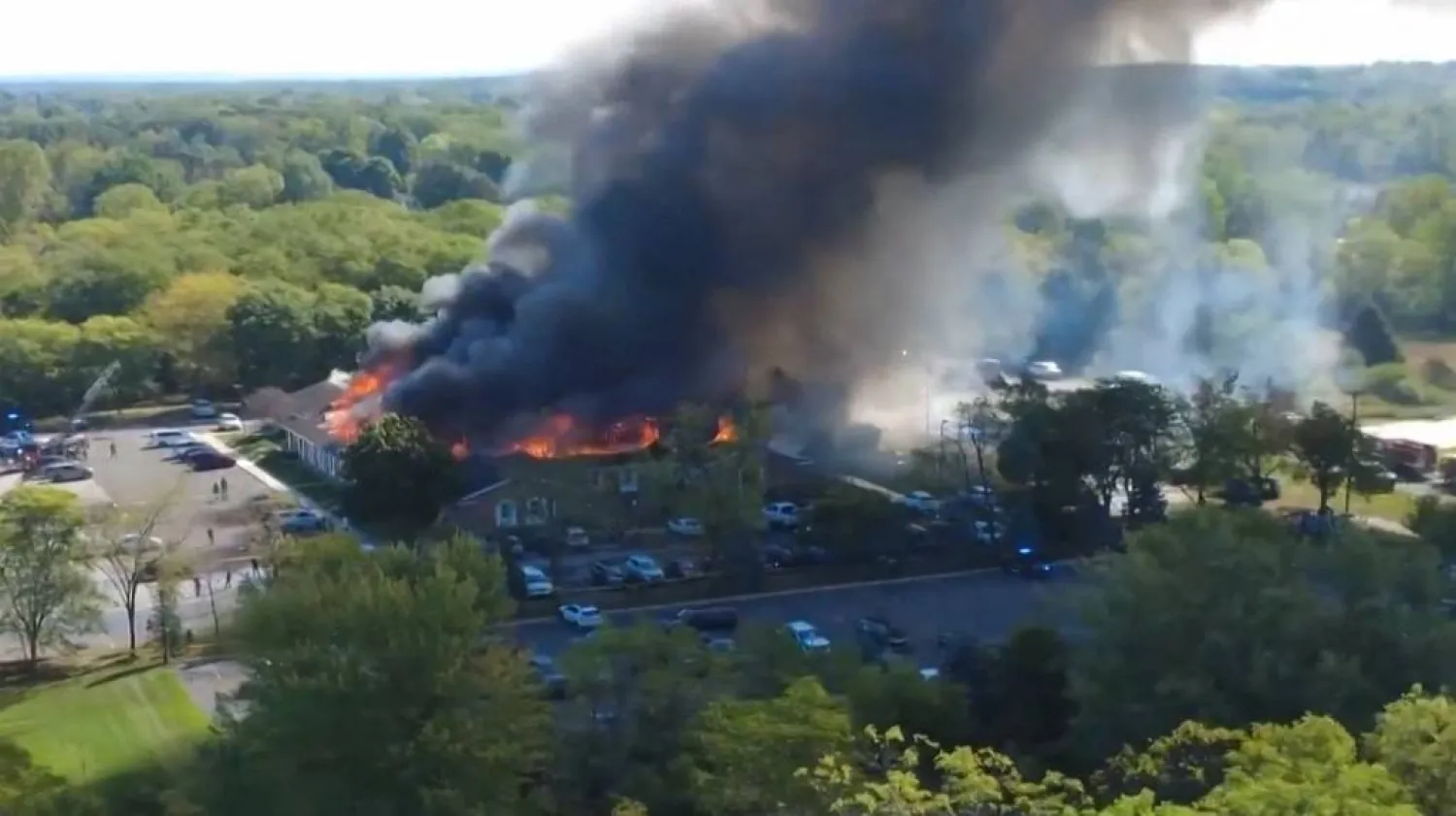

Gunman Opens Fire at Michigan Church and Sets it Ablaze, Killing at Least 4

This frame grab from drone footage obtained from "X/Julie J/@MALKOWSKI6APRIL" shows a fire at a Church of Jesus Christ of Latter-day Saints in Grand Blanc Township, Michigan on September 28, 2025. (Photo by HANDOUT / X/Julie J/@MALKOWSKI6APRIL / AFP)
TT

Gunman Opens Fire at Michigan Church and Sets it Ablaze, Killing at Least 4

This frame grab from drone footage obtained from "X/Julie J/@MALKOWSKI6APRIL" shows a fire at a Church of Jesus Christ of Latter-day Saints in Grand Blanc Township, Michigan on September 28, 2025. (Photo by HANDOUT / X/Julie J/@MALKOWSKI6APRIL / AFP)

An ex-Marine smashed a pickup into a Church of Jesus Christ of Latter-day Saints church in Michigan, opened fire and set the building ablaze during a crowded Sunday service and then was fatally shot by police. At least four people were killed and eight wounded, and authorities were searching the building ruins for more victims.

The attack occurred about 10:25 a.m. while hundreds of people were in the building in Grand Blanc Township, outside Flint.

The man got out of the pickup with two American flags raised in the truck bed and started shooting, Police Chief William Renye told reporters. The attacker apparently used gas to start the fire and also had explosive devices but it wasn’t clear if he used them, said James Dier of the Bureau of Alcohol, Tobacco, Firearms and Explosives.

Authorities identified the shooter as Thomas Jacob Sanford, 40, of the neighboring small town of Burton. The FBI is leading the investigation and considered it an “act of targeted violence,” said Ruben Coleman, a special agent in charge for the bureau.

Officers responding to a 911 call were at the church within 30 seconds, The Associated Press quoted Renye as saying. After the suspect left the church, two officers pursued him and “engaged in gunfire,” killing him about eight minutes later, the chief said.

People inside the church shielded children and moved them to safety during the attack, Renye said.

Flames and smoke poured from the large church for hours before the blaze was extinguished.

Two bodies were found during a search of the debris, and Renye said more victims could be found as searchers made their way though the entire church. One of the wounded people was in critical condition Sunday evening and the seven others were stable.

Renye said “some” people were unaccounted for, but he didn’t have an exact number.

Michigan State Police Lt. Kim Vetter said bomb threats were made at other churches in the area after officers shot and killed Sanford. No bombs were found and police were investigating the threats.

The motive not yet clear Investigators were searching Sanford’s residence but authorities did not say what they found or provide any additional details about him, including whether he was a member of The Church of Jesus Christ of Latter-day Saints, widely known as the Mormon church.

Sanford served in the Marines from June 2004 through June 2008, working as an automotive mechanic and vehicle recovery operator, according to military records obtained by The Detroit News. He was deployed to Iraq from August 2007 through March 2008 and had the rank of sergeant.

It was the latest of many shooting attacks on houses of worship in the US over the past 20 years, including one in August that killed two children during Mass at the Church of the Annunciation in Minneapolis.

It also was the second mass shooting in the US in less than 24 hours. On Saturday night, a man in a boat opened fire on a crowd in Southport, North Carolina, killing three and injuring five.

President Donald Trump applauded the FBI for its response to the Michigan shooting in a social media post. Local authorities said the FBI was sending 100 agents to Grand Blanc Township, a community of roughly 40,000 people.

“PRAY for the victims, and their families. THIS EPIDEMIC OF VIOLENCE IN OUR COUNTRY MUST END, IMMEDIATELY!” Trump wrote.



Iran Rejects Curbs on Its Uranium Enrichment Program

FILE - This satellite image provided by Vantor shows the Natanz nuclear complex in Iran on March 7, 2026, with no new damage seen at the facility or the tunnels. (Satellite image ©2026 Vantor via AP, file)
TT

Iran Rejects Curbs on Its Uranium Enrichment Program

FILE - This satellite image provided by Vantor shows the Natanz nuclear complex in Iran on March 7, 2026, with no new damage seen at the facility or the tunnels. (Satellite image ©2026 Vantor via AP, file)

The head of Iran’s Atomic Energy Organization, Mohammad Eslami, on Thursday ruled out accepting any restrictions on the country’s uranium enrichment program, as demanded by the United States and Israel.

In an interview with the ISNA news agency, Eslami said: “The demands and conditions set by our enemies to restrict Iran’s enrichment program are nothing but daydreams that will be buried,” AFP reported.

The remarks come as talks between Washington and Tehran are expected to be held at the end of the week under Islamabad’s auspices, as part of a ceasefire agreement brokered by Pakistan. The discussions are expected to address Tehran’s nuclear program.

Western powers accuse Iran of seeking to acquire a nuclear weapon and have worked to prevent it from doing so, while Tehran has consistently denied the allegations.

During his first term, US President Donald Trump withdrew from the landmark 2015 agreement that had placed limits on Iran’s nuclear enrichment activities in exchange for sanctions relief, a deal opposed by Israel.


Germany's Merz: We Do Not Want NATO to Split over US-Iran War

Commemorative photo of NATO leaders in The Hague in 2025 (Turkish Presidency).
TT

Germany's Merz: We Do Not Want NATO to Split over US-Iran War

Commemorative photo of NATO leaders in The Hague in 2025 (Turkish Presidency).

German Chancellor Friedrich Merz said on Thursday he did not want US-Iran war to place any further strain on relations between the United States and its European NATO partners.

"We do not want – I do not want – NATO to split. NATO is a guarantor of our security, including and above all in Europe," he said, speaking to journalists.

He added he had encouraged US President Donald Trump in a call to pursue negotiations with Iran with urgency.

Germany was resuming direct talks with Iranian leadership in Tehran, Merz said in Berlin.


Pentagon Leaders Assert Destruction of Iran’s Military Capabilities, Threaten to Resume Operations

Defense Secretary Pete Hegseth speaks to members of the media during a press briefing at the Pentagon in Washington, Wednesday, April 8, 2026. (AP Photo/Manuel Balce Ceneta)
TT

Pentagon Leaders Assert Destruction of Iran’s Military Capabilities, Threaten to Resume Operations

Defense Secretary Pete Hegseth speaks to members of the media during a press briefing at the Pentagon in Washington, Wednesday, April 8, 2026. (AP Photo/Manuel Balce Ceneta)

The US war against Iran has "completely" destroyed the country's ability to build missiles or other sophisticated weaponry, Defense Secretary Pete Hegseth said Wednesday

"We finished completely destroying Iran's defense-industrial base, a core pillar of our mission," Hegseth told reporters.

"They can no longer build missiles."

For his part, Chairman of the Joint Chiefs of Staff Dan Caine said: “We attacked, along with our partners, approximately 90 percent of their weapons factories,” including facilities producing Shahed-type drones, as well as facilities manufacturing guidance systems used by these drones.

Regarding the naval fleet, Caine said that it will take years before Iran can rebuild its surface combatant capabilities.

The general added that approximately 80 percent of Iran’s nuclear industrial base was targeted, significantly undermining its nuclear weapons development efforts.

He warned that US forces remain ready to resume fighting with Iran if the ceasefire ends, stating: “Let’s be clear: the ceasefire is just a temporary pause. The armed forces remain ready, if ordered, to resume combat operations with the same speed and precision demonstrated over the past 38 days.”

Statements by Dan Caine, and his warning about a possible resumption of fighting, suggest that the announcement of a suspension of the war came under US pressure, according to Michael Rubin, a researcher at the American Enterprise Institute.

As for the restoration of freedom of navigation, military officials’ statements did not indicate that it has been fully secured, instead emphasizing the need to “ensure Iran’s compliance” and the safe passage of vessels.

At the same time, there were continued indications that ships received messages from Iranian forces stating that they require permission to transit the strait, suggesting that Tehran is seeking to establish a new equation: keeping Hormuz open on the condition of recognizing a supervisory or sovereign role for itself.

If that is the case, the region and the global economy would be entering a phase that goes beyond a mere ceasefire, as the risk shifts from missiles to the rules governing transit, insurance, pricing, and maritime fees.

Statements by Pentagon leaders, followed by remarks from Donald Trump, reveal that the real dispute is not over the ceasefire itself, but over what comes after it. Washington rejects the continuation of Iranian uranium enrichment and is demanding that the stockpile of highly enriched uranium be handed over, or “taken” by force if necessary.

By contrast, narratives circulating in Iranian media about the “ten points” of the ceasefire agreement point in a completely different direction: recognition of Iran’s right to enrich, the lifting of sanctions, and no clear position on the fate of the enriched stockpile.

This is precisely where the structural contradiction lies, one that could undermine the negotiating round from its very first day, according to Michael Rubin.

The second aspect of the dispute concerns the scope of de-escalation. The United States and Israel have made clear that a ceasefire with Iran does not mean a halt to Israeli operations in Lebanon against Hezbollah, while reports continued of missile and drone attacks on Gulf states in the hours following the truce. This suggests that the region is facing a form of “selective de-escalation,” according to observers: a direct easing between Washington and Tehran, while proxy arenas and exchanges of messages remain active.

Remarks by Hegseth that Washington had been prepared, just hours earlier, to strike power stations, bridges, and oil and energy infrastructure “that Iran cannot rebuild” indicate that the decision to halt hostilities did not stem from a fully realized settlement, but rather from the suspension of a massive escalatory strike against Tehran.

Accordingly, the ceasefire appears more like a testing window: if Tehran complies with conditions related to navigation and the transfer of uranium, the truce could hold and pave the way toward a definitive end to the war. If not, the United States may return to the option of large-scale destruction of infrastructure.