Japan Resumes Sanctions against Iran, Calls for Diplomatic Solution

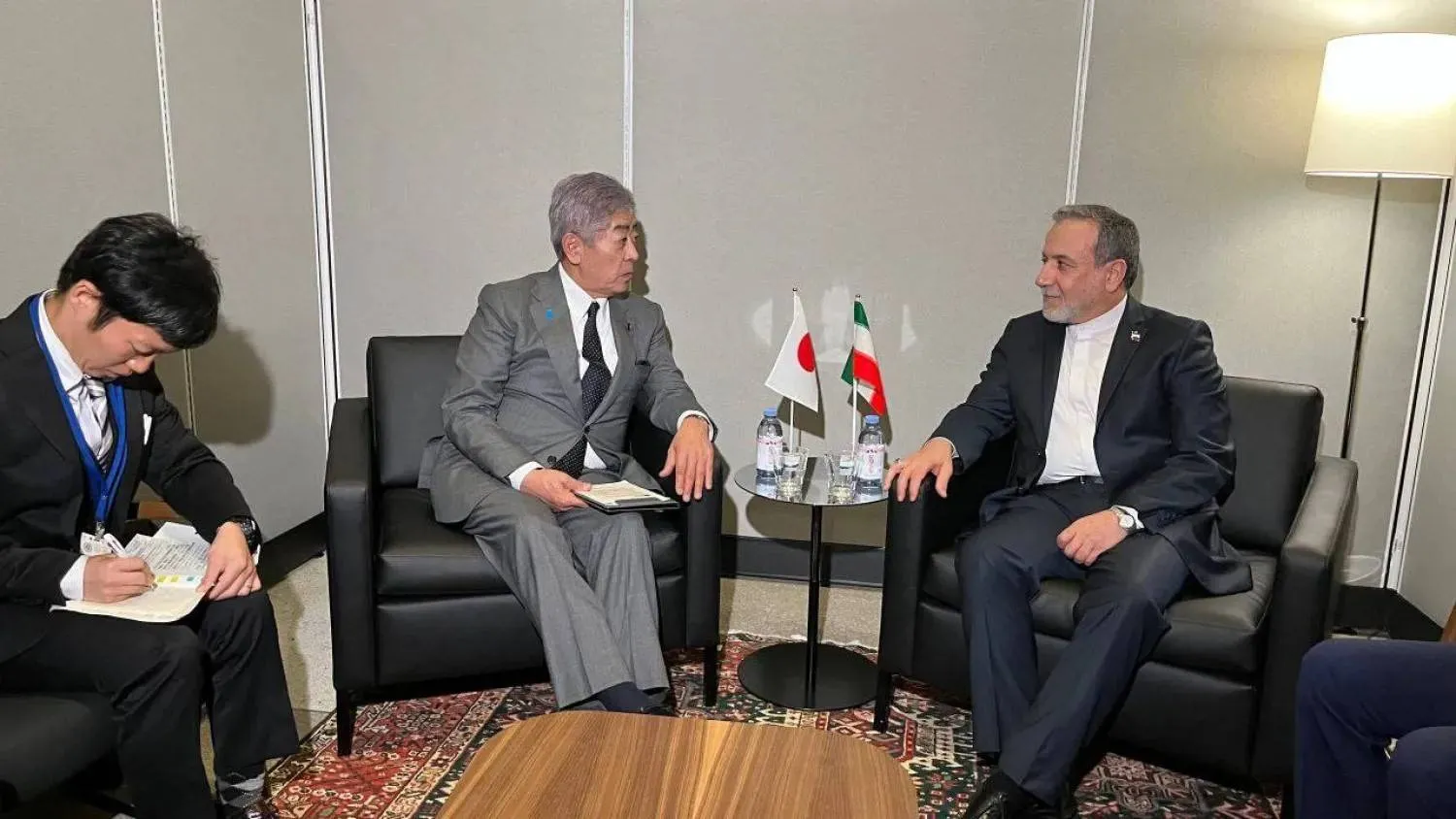
Iranian Foreign Minister Abbas Araghchi and his Japanese counterpart held talks in New York last week on the sidelines of the UN General Assembly annual meeting (Iranian Foreign Ministry) 
TT

Japan Resumes Sanctions against Iran, Calls for Diplomatic Solution

Iranian Foreign Minister Abbas Araghchi and his Japanese counterpart held talks in New York last week on the sidelines of the UN General Assembly annual meeting (Iranian Foreign Ministry) 

The Japanese government announced on Monday the resumption of economic sanctions against Iran, after the United Nations reimposed sanctions on the country over its nuclear development.

But Tokyo underlined the importance of a diplomatic solution to the nuclear issue.

Local media outlets said that based on a UN Security Council resolution, the government designated the assets of 78 organizations and 43 individuals to be frozen.

“The issue is now at a crossroads,” Chief Cabinet Secretary Yoshimasa Hayashi told a news conference, underlining the importance of a diplomatic solution. “We shouldn't lose opportunities for dialogue.”

Hayashi repeatedly stated that Japan's stance of calling for a solution through dialogue remains unchanged. “We will continue necessary diplomatic efforts while following the Security Council's decision,” he emphasized.

On Sunday, Japan has expressed regret as UN sanctions over Iran's nuclear program were reimposed.

“Japan has consistently emphasized the importance of resolving the issue through dialogue...based on the position that Iran's development of nuclear weapons must never be allowed,” Foreign Minister Takeshi Iwaya said in a statement.

“It is regrettable that the parties involved could not reach an agreement,” he added.

The Minister also said that Iran's nuclear issue stands at a crucial juncture.

“Japan's position which places importance on resolving this issue through dialogue remains unchanged, and the momentum for such dialogue must not be lost,” he noted.

Britain, France and Germany initiated the return of sanctions on Iran at the UN Security Council over accusations it had violated a 2015 deal that aimed to stop it developing a nuclear bomb. Iran denies seeking nuclear weapons.

On Sunday, the UN has reinstated an arms embargo and other sanctions on Iran over its nuclear program following the process triggered by European powers that Tehran has warned will be met with a harsh response.


Trump Says Iran 'Better Get Serious' in Mideast War Talks

US President Donald Trump speaks during the National Republican Congressional Committee's annual fundraising dinner at Union Station on March 25, 2026 in Washington, DC. President Trump was this year's keynote speaker at the dinner. AFP
TT

Trump Says Iran 'Better Get Serious' in Mideast War Talks

US President Donald Trump speaks during the National Republican Congressional Committee's annual fundraising dinner at Union Station on March 25, 2026 in Washington, DC. President Trump was this year's keynote speaker at the dinner. AFP

US President Donald Trump warned Iran on Thursday to engage in talks to end the Middle East war "before it is too late", after Tehran publicly spurned US overtures to resolve the nearly four-week conflict.

Trump's warning came as Israel said it had killed the commander of the Iranian Revolutionary Guards' navy, calling him "directly responsible" for throttling the Strait of Hormuz since the war's outbreak.

Hopes for a negotiated end to the US-Israeli war with Iran, which has engulfed much of the region, rose after Washington was said to have put a peace plan to Tehran, only for the Islamic republic to deny the sides were speaking, AFP reported.

But Pakistan confirmed Thursday it was indeed facilitating "US-Iran indirect talks" by relaying messages -- and that a 15-point American plan was being "deliberated upon" by Tehran.

"They better get serious soon, before it is too late, because once that happens, there is NO TURNING BACK, and it won't be pretty!" Trump warned on social media, saying Iran had been "militarily obliterated, with zero chance of a comeback".

Iran's foreign minister flatly denied Wednesday that "negotiations" had been engaged with Trump's administration -- but did concede messages were being exchanged through "friendly countries".

"We seek an end to the war on our own terms," Abbas Araghchi said on state TV.

Islamabad has been touted as a go-between, given its longstanding ties with both neighbouring Iran and the United States, as well as its network of regional contacts.


Russia Says It Hopes for New Round of Ukraine Talks with US as Soon as Conditions Allow

FILE PHOTO: Kremlin spokesman Dmitry Peskov looks on as Russia's President Vladimir Putin (not pictured) and Togo's President of the Council of Ministers Faure Gnassingbe (not pictured) meet at the Kremlin in Moscow, Russia November 19, 2025. REUTERS/Ramil Sitdikov/Pool/File Photo
TT

Russia Says It Hopes for New Round of Ukraine Talks with US as Soon as Conditions Allow

FILE PHOTO: Kremlin spokesman Dmitry Peskov looks on as Russia's President Vladimir Putin (not pictured) and Togo's President of the Council of Ministers Faure Gnassingbe (not pictured) meet at the Kremlin in Moscow, Russia November 19, 2025. REUTERS/Ramil Sitdikov/Pool/File Photo

Russia is in contact with the United States about a new round of talks on a Ukraine peace settlement as soon as conditions allow, the Kremlin said on Thursday.

"We remain open, we are in contact with the Americans, and we are counting on holding the next round of talks as soon ‌as circumstances permit," ‌Kremlin spokesman Dmitry Peskov said.

Peskov rejected ‌the ⁠thesis of a ⁠New York Times opinion piece that said the Iran war had caused President Vladimir Putin to lose interest in negotiating an end to the Ukraine conflict, Reuters reported.

"This is an absolutely false invention that does not correspond to reality. During the rounds of trilateral talks that ⁠have taken place, some progress was made ‌toward a settlement," Peskov told ‌reporters.

Peskov said Russia had not lost interest in peace ‌talks but added that key issues - including territory - had ‌yet to be settled.

The NYT opinion piece, by Russian journalist Mikhail Zygar, said Russia's economy had been faltering earlier this year, prompting Putin at that point to take negotiations on ‌a Ukraine settlement more seriously.

However, Zygar said the Iran war had reversed those dynamics by ⁠boosting ⁠oil prices, easing the economic pressure on Moscow and reducing the US focus on Ukraine, weakening any incentive for the Kremlin to seek a settlement.

Earlier this week, Kremlin aide Yuri Ushakov said the US had briefed Russia about Washington's latest round of talks with a Ukrainian delegation in Florida, which took place last Saturday.

The last three-way peace talks between Russia, Ukraine and the US took place last month, before the Trump administration and Israel began airstrikes against Iran on February 28.


Pentagon Reportedly Weighs Diverting Ukraine Military Aid to the Middle East

FILE - The Pentagon and the surrounding area is seen in this aerial view in Washington, Jan. 26, 2020. (AP Photo/Pablo Martinez Monsivais, File)
TT

Pentagon Reportedly Weighs Diverting Ukraine Military Aid to the Middle East

FILE - The Pentagon and the surrounding area is seen in this aerial view in Washington, Jan. 26, 2020. (AP Photo/Pablo Martinez Monsivais, File)

The Pentagon is weighing whether to redirect weapons originally meant for Ukraine to the Middle East, as the war in Iran strains supplies of some of the US military's most critical munitions, the Washington Post reported Thursday, citing three people familiar with the matter.

The weapons that could be redirected include air defense interceptor missiles purchased through a NATO initiative launched last year, under which ⁠partner countries buy ⁠US arms for Kyiv, the report said.

The consideration comes as US operations in the region intensify. Admiral Brad Cooper, the Central Command chief leading US forces in the Middle East, on Wednesday said the US had hit ⁠over 10,000 targets inside Iran and was on track to limit Iran's ability to project power outside its borders.

A Pentagon spokesperson told the newspaper that the Defense Department would "ensure that US forces and those of our allies and partners have what they need to fight and win."

In response to a query about the report, a NATO official said members of ⁠the ⁠alliance and its partners continue to contribute to its Prioritized Ukraine Requirements List (PURL) program that funds the supply of US arms for Kyiv.

"Equipment is continuously flowing into Ukraine," the official added. "The amount pledged to PURL so far is of several billion US dollars and we expect more contributions to follow."

The Pentagon and the US State Department did not immediately respond to Reuters' requests for comment.