

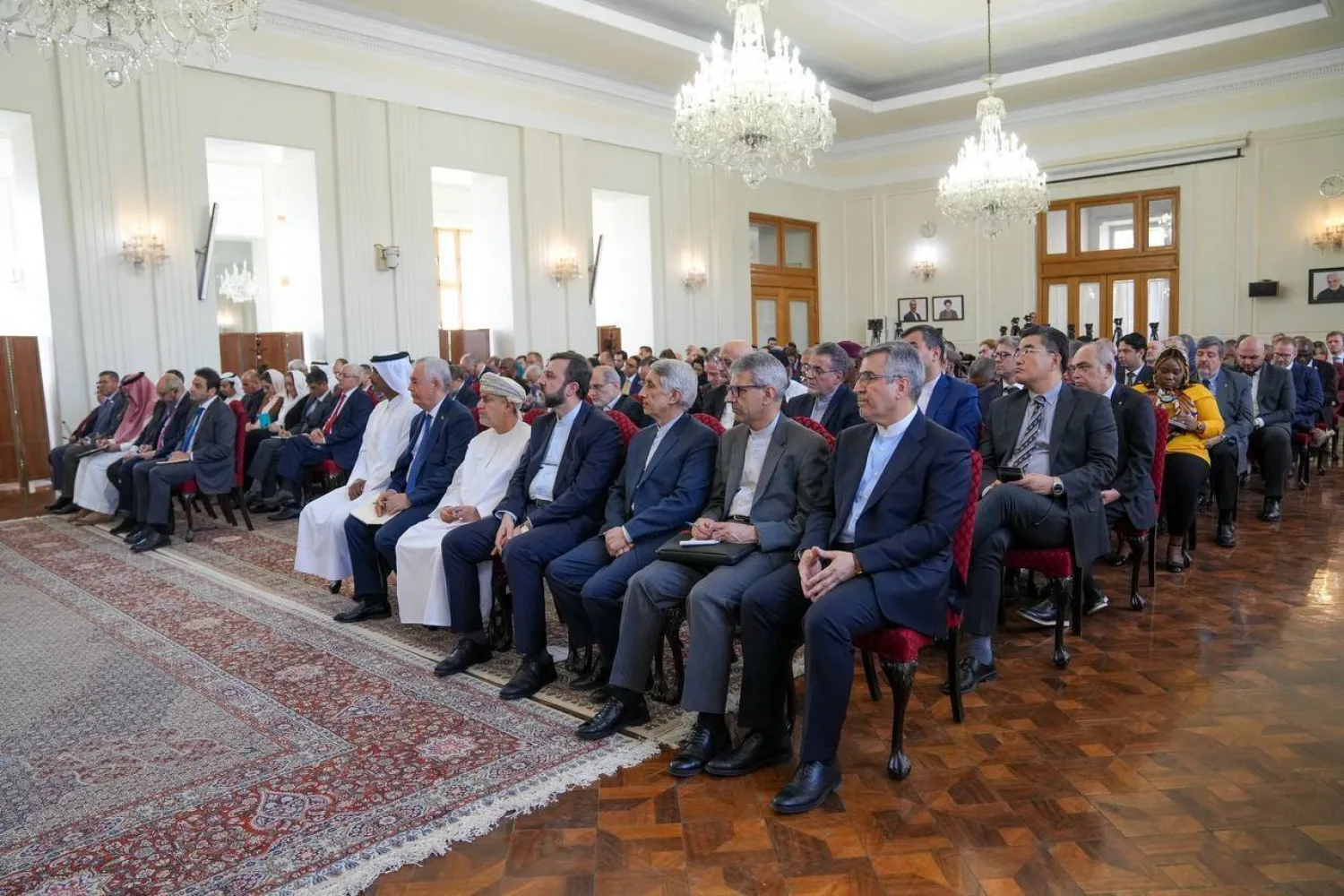

Tehran: Military Threats Complicate Diplomatic Path

Ambassadors, chargés d'affaires, and heads of foreign and international missions based in Tehran, during their meeting on Sunday with Foreign Minister Abbas Araghchi (Iranian Foreign Ministry) 
TT

Tehran: Military Threats Complicate Diplomatic Path

Ambassadors, chargés d'affaires, and heads of foreign and international missions based in Tehran, during their meeting on Sunday with Foreign Minister Abbas Araghchi (Iranian Foreign Ministry) 

Iranian Foreign Minister Abbas Araghchi stressed on Sunday that no solution exists for Iran’s nuclear program other than a diplomatic and negotiated one, also warning that military threats could not resolve crises.

The FM was speaking at a meeting with ambassadors, chargés d'affaires, and heads of foreign and international missions based in Tehran, to discuss the impacts of the UN sanctions re-imposed on Iran in September.

Araghchi said the activation of the Snapback Mechanism has changed the rules of the diplomatic game and made future negotiations with the West more difficult and complex.

The Iranian top diplomat said his meeting with the foreign diplomats aims to present the risks that could result from the move.

The UN sanctions on Iran were reinstated on September 28 after the UK, France, and Germany (the E3) triggered the snapback mechanism under the 2015 nuclear deal known as the Joint Comprehensive Plan of Action (JCPoA).

Tehran has made efforts to reach a fair and balanced negotiated solution, said Araghchi. However, he added, it was the Western countries that responded negatively to the efforts due to their excessive and unreasonable demands.

The FM also noted that it has been proven that there is no solution for Iran’s nuclear program other than a diplomatic and negotiated one.

In recent years, Araghchi said, Iran has been threatened with military action on several occasions, and even at times those threats were attempted, but it became clear that the Iranian issue could not be resolved through military means.

“The three European countries believed they had achieved a new pressure tool and assumed that by threatening to implement it, they could exert influence over Iran,” the top diplomat said. “However, after activating the sanctions, those countries saw that no change occurred. The only result was the weakening of the diplomatic process.”

Commenting on his expectations for the upcoming phase, the foreign minister said diplomacy never ceases and always remains present. However, he affirmed, the current conditions are entirely different from the past and the three European countries have clearly weakened their role in the diplomatic process.

US Conditions

Last Thursday, The Washington Post quoted a US official briefed on the Trump administration policy as saying that Washington’s pressure is intended to encourage Iran to accept four stringent conditions as a baseline for new negotiations.

The official said the talks must be “meaningful” and direct, Tehran must agree to zero enrichment of nuclear material and curbs to its missile program, and it must cease funding its proxy forces.

In response to the Washington Post article, Araghchi said that none of the mentioned conditions had been officially communicated to Tehran.

He said that in recent months, Iran’s talks with the US had been limited to the nuclear issue, conducted indirectly through messages and intermediaries.

In these exchanges, the top diplomat said no other topic had been discussed.

Araghchi noted that his Ministry would continue its efforts to advance diplomacy, adding that, from Iran’s perspective, the role of diplomacy can never be eliminated or ignored.

The End of Cairo Agreement

Commenting on Iran’s agreement with the International Atomic Energy Agency (IAEA) in Cairo last month, Araghchi said Iran had established a new framework for cooperation with the agency.

He explained that this change was necessary due to recent developments, particularly the attack on Iran’s nuclear facilities, which made continued cooperation under the previous framework unfeasible.

Araghchi also said the security threats and safety concerns arising from the attack necessitated a redefinition of the cooperation framework.

He said the IAEA had agreed to this new approach, leading to several rounds of negotiations and ultimately resulting in the Cairo agreement.

One of the three conditions set in the Cairo agreement was to allow inspectors to access Iranian nuclear sites.

Araghchi said under the current circumstances, the Cairo agreement could no longer serve as a viable basis for cooperation with the agency.

He said Iran would soon announce its new decision regarding its relation with the IAEA.


Iran Opens Trial of Dual National Accused of Spying for Israel 

Iranians go shopping in Tajrish Bazaar in Tehran, Iran, 08 December 2025. (EPA)
TT

Iran Opens Trial of Dual National Accused of Spying for Israel 

Iranians go shopping in Tajrish Bazaar in Tehran, Iran, 08 December 2025. (EPA)

The trial of a dual national holding European citizenship has begun in Iran, the semi-official Tasnim news agency reported on Monday, saying they were indicted for "intelligence cooperation and espionage in favor of the Zionist regime (Israel)."

According to the Alborz provincial attorney general, the defendant - whose identity has not been disclosed - entered Iran about a month before the 12-day war in June, during which Israel and the US struck Iranian nuclear facilities.

They were arrested on the fourth day of the conflict by the elite Revolutionary Guards.

"Sophisticated spy and intelligence items and equipment were discovered in their villa in Karaj," the attorney general said, adding that the charges under investigation carry penalties for "waging war against God" and "corruption on earth" - offences often punishable by death.

In recent years, the Revolutionary Guards have detained dozens of dual nationals and foreigners, mostly on espionage and security-related charges.

Rights groups and some Western countries have accused Tehran of using such arrests to gain leverage in negotiations. Tehran denies arresting people for political reasons.


China Vows to Defend Sovereignty Over Taiwan as Trump Unveils Security Strategy 

08 December 2025, China, Beijing: Guo Jiakun, China's Foreign Office spokesperson, speaks to journalists. (dpa)
TT

China Vows to Defend Sovereignty Over Taiwan as Trump Unveils Security Strategy 

08 December 2025, China, Beijing: Guo Jiakun, China's Foreign Office spokesperson, speaks to journalists. (dpa)

China on Monday pledged to defend its sovereignty and warned against "external interference" after the US unveiled a new security strategy aimed at building up military power to deter conflict with Beijing over Taiwan.

Washington laid out its approach to one of the world's most sensitive diplomatic issues in its official National Security Strategy released on Friday.

The document came as Beijing last week deployed a large number of naval and coast guard vessels across East Asian waters in its largest show of maritime force to date.

Taiwan is the first red line that must not be crossed in China-US relations and China brooks no external interference, Guo Jiakun, a spokesperson for the Chinese foreign ministry, told reporters in Beijing when asked about the document.

"The US side should ... handle the Taiwan question with the utmost prudence, and stop indulging and supporting 'Taiwan independence' separatist forces in seeking independence by force or resisting reunification by force," he said.

Guo added that China was willing to work with Washington to promote stable ties while safeguarding its sovereignty, security and development interests.

China, which views democratically governed Taiwan as its own territory, has never renounced the use of force to take control of the island. Taiwan's government rejects Beijing's sovereignty claims.

The new US document has been warmly welcomed in Taiwan, whose President Lai Ching-te wrote on X on Saturday: "Greatly appreciate that the US National Security Strategy prioritizes deterring a conflict over Taiwan."

Taiwan Defense Minister Wellington Koo told reporters on the same day that the United States still regards maintaining peace and stability in the region as its highest core interest.

"The United States is vigorously promoting that the countries in the Indo-Pacific region work together to establish an effective form of collective deterrence," he said.

"We in Taiwan must also strengthen our self-defense capabilities."

Lai has said Taiwan aims to spend 5% of its GDP on defense by 2030 and last month unveiled $40 billion in extra defense spending to run from 2026-2033.


Trump Says Zelenskyy 'Isn't Ready' Yet to Accept US-authored Proposal to End Russia-Ukraine War

US President Donald Trump poses on the red carpet for the 2025 Kennedy Center Honors at the John F. Kennedy Center for the Performing Arts in Washington, D.C., US, December 7, 2025. REUTERS/Jeenah Moon
TT

Trump Says Zelenskyy 'Isn't Ready' Yet to Accept US-authored Proposal to End Russia-Ukraine War

US President Donald Trump poses on the red carpet for the 2025 Kennedy Center Honors at the John F. Kennedy Center for the Performing Arts in Washington, D.C., US, December 7, 2025. REUTERS/Jeenah Moon

President Donald Trump on Sunday claimed Ukrainian President Volodymyr Zelenskyy “isn't ready” to sign off on a US-authored peace proposal aimed at ending the Russia-Ukraine war.

Trump was critical of Zelenskyy after US and Ukrainian negotiators completed three days of talks on Saturday aimed at trying to narrow differences on the US administration's proposal. But in an exchange with reporters on Sunday night, Trump suggested that the Ukrainian leader is holding up the talks from moving forward.

“I’m a little bit disappointed that President Zelenskyy hasn’t yet read the proposal, that was as of a few hours ago. His people love it, but he hasn’t,” Trump claimed in an exchange with reporters before taking part in the Kennedy Center Honors. The president added, "Russia is, I believe, fine with it, but I’m not sure that Zelenskyy’s fine with it. His people love it. But he isn’t ready.”

To be certain, Russian President Vladimir Putin hasn't publicly expressed approval for the White House plan. In fact, Putin last week had said that aspects of Trump's proposal were unworkable, even though the original draft heavily favored Moscow.

Trump has had a hot-and-cold relationship with Zelenskyy since riding into a second White House term insisting that the war was a waste of US taxpayer money. Trump has also repeatedly urged the Ukrainians to cede land to Russia to bring an end to a now nearly four-year conflict he says has cost far too many lives.

Zelenskyy said Saturday he had a “substantive phone call” with the American officials engaged in the talks with a Ukrainian delegation in Florida. He said he had been given an update over the phone by US and Ukrainian officials at the talks.

“Ukraine is determined to keep working in good faith with the American side to genuinely achieve peace,” Zelenskyy wrote on social media.

Trump's criticism of Zelenskyy came as Russia on Sunday welcomed the Trump administration’s new national security strategy in comments by the Kremlin spokesman published by Russia’s Tass news agency.

Dmitry Peskov said the updated strategic document, which spells out the administration's core foreign policy interests, was largely in line with Moscow’s vision.

“There are statements there against confrontation and in favor of dialogue and building good relations,” he said, adding that Russia hopes this would lead to “further constructive cooperation with Washington on the Ukrainian settlement.”

The document released Friday by the White House said the US wants to improve its relationship with Russia after years of Moscow being treated as a global pariah and that ending the war is a core US interest to “reestablish strategic stability with Russia.”

Speaking on Saturday at the Reagan National Defense Forum, Trump’s outgoing Ukraine envoy, Keith Kellogg, said efforts to end the war were in “the last 10 meters.”

He said a deal depended on the two outstanding issues of “terrain, primarily the Donbas,” and the Zaporizhzhia Nuclear Power Plant.

Russia controls most of Donbas, its name for the Donetsk and neighboring Luhansk regions, which, along with two southern regions, it illegally annexed three years ago. The Zaporizhzhia Nuclear Power Plant is in an area that has been under Russian control since early in Moscow’s invasion of Ukraine and is not in service. It needs reliable power to cool its six shutdown reactors and spent fuel, to avoid any catastrophic nuclear incidents.

Kellogg, who is due to leave his post in January, was not present at the talks in Florida.

Separately, officials said the leaders of the United Kingdom, France and Germany would participate in a meeting with Zelenskyy in London on Monday.

As the three days of talks wrapped up, Russian missile, drone and shelling attacks overnight and Sunday killed at least four people in Ukraine.

A man was killed in a drone attack on Ukraine’s northern Chernihiv region Saturday night, local officials said, while a combined missile and drone attack on infrastructure in the central city of Kremenchuk caused power and water outages. Kremenchuk is home to one of Ukraine’s biggest oil refineries and is an industrial hub.

Kyiv and its Western allies say Russia is trying to cripple the Ukrainian power grid and deny civilians access to heat, light and running water for a fourth consecutive winter, in what Ukrainian officials call “weaponizing” the cold.

Three people were killed and 10 others wounded Sunday in shelling by Russian troops in Ukraine’s Kharkiv region, according to the regional prosecutor’s office.
