Putin Says Russian Air Defenses Responsible for Azerbaijani Jet's Crash Last Year, Killing 38

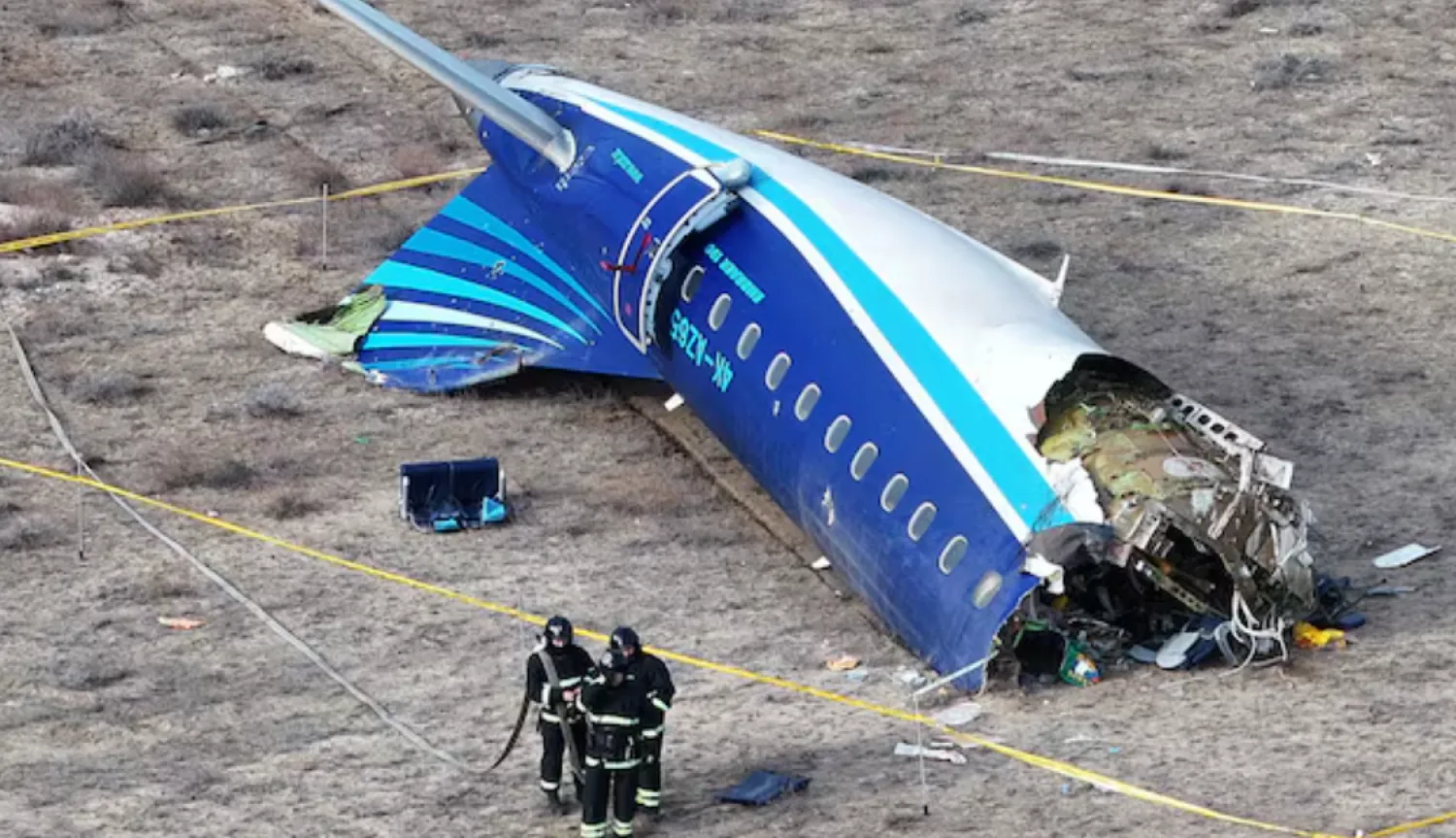
A drone view shows emergency specialists working at the crash site of an Azerbaijan Airlines passenger plane near the city of Aktau, Kazakhstan December 25, 2024. REUTERS/Azamat Sarsenbayev/File Photo
TT

Putin Says Russian Air Defenses Responsible for Azerbaijani Jet's Crash Last Year, Killing 38

A drone view shows emergency specialists working at the crash site of an Azerbaijan Airlines passenger plane near the city of Aktau, Kazakhstan December 25, 2024. REUTERS/Azamat Sarsenbayev/File Photo

Russian President Vladimir Putin on Thursday said that Russia’s air defenses were responsible for shooting down an Azerbaijani airliner in December that killed 38 people in his first admission of blame for the crash.

Putin made the statement at a meeting with Azerbaijan’s President Ilham Aliev in Tajikistan’s capital of Dushanbe, where both are attending a summit of the former Soviet nations, The AP news reported.

The Azerbaijan Airlines passenger jet crashed on Dec. 25, 2024, while on a flight from Baku to Grozny, the regional capital of the Russian republic of Chechnya.

Azerbaijani authorities said the jet was accidentally hit by fire from Russian air defenses, then tried to land in western Kazakhstan when it crashed, killing 38 of 67 people aboard.

Putin has apologized to Azerbaijan’s President Ilham Aliyev for what he called a “tragic incident” but stopped short of acknowledging responsibility. Aliyev, meanwhile, criticized Moscow for trying to “hush up” the incident


Iran Begins Cloud Seeding Operations Amid Severe Drought

A trickle of water flows in the mainly dried-up Kan River, west of Tehran on November 9, 2025. (Photo by ATTA KENARE / AFP)
TT

Iran Begins Cloud Seeding Operations Amid Severe Drought

A trickle of water flows in the mainly dried-up Kan River, west of Tehran on November 9, 2025. (Photo by ATTA KENARE / AFP)

Iranian authorities have launched cloud seeding operations to induce rainfall as the country faces its worst drought in decades, state media reported.

"Today, a cloud seeding flight was conducted in the Urmia Lake basin for the first time in the current water year," which begins in September, the official IRNA news agency said late Saturday.

Urmia, in the northwest, is Iran's largest lake, but has largely dried out and turned into a vast salt bed due to drought.

IRNA added that further operations would be carried out in the provinces of East and West Azerbaijan.

Cloud seeding involves spraying particles such as silver iodide and salt into clouds from aircraft to trigger rain.

Last year, Iran announced it had developed its own technology for the practice.
On Saturday, IRNA reported that rain had fallen in Ilam, Kermanshah, Kurdistan and Lorestan in the west, as well as in the northwestern West Azerbaijan province.

It quoted the country's meteorological organization as saying rainfall had decreased by about 89 percent this year compared with the long-term average.

"We are currently experiencing the driest autumn the country has experienced in 50 years," it added.

State media has shown footage of snow falling on the Tochal mountain and ski resort, located in the Tehran area on the Alborz range, for the first time this year.

Iran, a largely arid country, has for years suffered chronic dry spells and heat waves expected to worsen with climate change.

Rainfall in the capital Tehran has been at its lowest level in a century, according to local officials, and half of Iran's provinces have not seen a drop of rain in months.

Water levels at reservoirs supplying many provinces have fallen to record lows.
Earlier this month, President Masoud Pezeshkian warned that without rain before winter, Tehran could face evacuation, though he did not elaborate.


Iran Warns US, E3 Against New IAEA Resolution

This handout picture made available by the Iranian Atomic Organization (IAEO) office on November 2, 2025, shows the Iranian President Masoud Pezeshkian during a visit to the Atomic Energy Organization of Iran, to meet with senior managers in the nuclear industry in Tehran. (Photo by Handout / Iranian Atomic Organization (IAEO) / AFP)
TT

Iran Warns US, E3 Against New IAEA Resolution

This handout picture made available by the Iranian Atomic Organization (IAEO) office on November 2, 2025, shows the Iranian President Masoud Pezeshkian during a visit to the Atomic Energy Organization of Iran, to meet with senior managers in the nuclear industry in Tehran. (Photo by Handout / Iranian Atomic Organization (IAEO) / AFP)

Iran’s permanent representative to the International Atomic Energy Agency (IAEA) has warned the United States and three European countries against submitting a new draft resolution to the IAEA Board of Governors, saying the move would only complicate the current situation without affecting Iran’s safeguards implementation.

Iran’s IRNA news agency said Tehran’s mission made the remark in a post on X late on Friday, ahead of the Board of Governors (BoG) meeting scheduled for November 19-21.

In a confidential report last Wednesday, the UN atomic watchdog said Iran still has not let inspectors into the nuclear sites Israel and the United States bombed in June, adding that accounting for Iran's enriched uranium stock is “long overdue.”

“It is critical that the Agency is able to verify the inventories of previously declared nuclear material in Iran as soon as possible in order to allay its concerns ... regarding the possible diversion of declared nuclear material from peaceful use,” the Agency said in the report to member states.

On Saturday, Iran’s representative to the IAEA, Reza Najafi, said: “Forcing the (IAEA) Director General to report on the basis of expired UN Security Council resolutions is not only entirely unlawful and unjustified, but in practice, will also add to the existing complexities and deliver yet another blow to diplomacy.”

The Mission accused the United States and Britain, France, and Germany, known as the E3, of intending to table a resolution against Iran at next week’s meeting of the IAEA BoG.

Najafi said that Washington and the E3 are once again attempting to “exploit international mechanisms to impose their illogical and coercive positions on the Iranian people.”

He affirmed that the push by the US and the E3 would not alter the current status of safeguards implementation in Iran, which the envoy said had been affected by the US-Israeli war of aggression against Iran in June this year.

The Iranian envoy called on all member states of the BoG to oppose what he described as destructive unilateral actions of the US and its European partners.
He also reaffirmed Iran’s right to take appropriate measures in response to any “illegal and unjustified” moves.

The IAEA Board of Governors will convene its regular November meeting at the Agency's headquarters in Vienna starting Wednesday to discuss a Western resolution against Iran.

The draft resolution against Iran cites a recent report by IAEA Director General Rafael Grossi, stressing the need for immediate verification of Iran’s declared nuclear material stocks under the Nuclear Non-Proliferation Treaty (NPT).

It requires Iran to suspend enrichment, reprocessing, and heavy water projects, including research and development activities, under UN non proliferation measures reinstated on Sept. 28, 2025.

The draft resolution also calls on Iran to fully implement the Additional Protocol and modified safeguards.

In its latest report, Grossi said the IAEA has now lost so-called continuity of knowledge of Iran’s enriched uranium stocks at the facilities that were damaged during the June airstrikes.

Diplomats said Iran is ignoring international calls to cooperate with the United Nations atomic watchdog and restart nuclear talks with the US, months into a tense stand-off following Israeli-led airstrikes on Iran.

Iran’s nuclear program, including the state and unknown location of its near-bomb-grade uranium stockpile, is the subject of a meeting next week at the International Atomic Energy Agency in Vienna.

Western nations represented there are due to draft new orders for IAEA inspectors to determine the status of Tehran’s nuclear inventory, according to three officials who asked not to be identified in return for discussing restricted information, Bloomberg said on Friday.

The IAEA is prepared to resume inspections of Iran's nuclear sites immediately, but Iran insists they're still too dangerous after airstrikes by Israel and the US five months ago, one senior western diplomat told Bloomberg.

Tehran may be gambling that an information blackout will deter any follow up strikes, the person said, while adding that those countries could equally call the bluff and bomb due to a lack of communication. IAEA Director General Rafael Mariano Grossi said in September that cooperation with his inspectors was crucial to diminish the threat of renewed military strikes.

Consensus is fraying over what to do next, with some western countries seeking to apply additional pressure on Iran by stripping scientists of access to IAEA technical cooperation in areas like nuclear medicine, the diplomats said.

Other nations caution that cutting all Iranian support could backfire and increase the chance of the country withdrawing from the Treaty on the Non-Proliferation of Nuclear weapons.

Iran’s nuclear work has concerned the West for decades and tensions over the nature of its atomic program, which dates back to the 1950s, have frequently shaken oil markets and spurred fits of both conciliation and conflict with the US.

Iran has always denied harboring intentions to develop a nuclear weapon and says it’s accelerated its uranium enrichment in response to US President Donald Trump’s first-term decision to quit the landmark 2015 nuclear deal and heavily sanction its economy.

Iran possessed sufficient highly-enriched uranium reserves to quickly craft about a dozen nuclear warheads before the June attacks. Since then, the IAEA has lost track of the material and Grossi says the lack of knowledge is a serious concern.

Recent satellite imagery shows Iranian activity around the bombed sites in Fordow, Natanz and Isfahan. Agency inspectors aren’t certain whether the activities are restricted to clean-up efforts or potentially include relocating uranium inventories.

A statement issued by Group of Seven nations earlier this week called on Iran to resume full cooperation with the IAEA and engage in direct talks with the Trump administration.

An Iranian foreign ministry spokesman rejected that call because it failed to condemn the Israeli and US attacks on its facilities, the state-backed Mehr News Agency reported.

“No new message has been conveyed to the US,” Iranian Security Council Secretary Ali Larijani said in a statement earlier this week. “The reason no new message has been sent is that previous negotiations had already taken place, and the other side showed no willingness to reach an agreement.”

Even if Iran immediately submitted to inspections and fully cooperated with the IAEA, it could take years to re-establish certainty over the fate of Iran’s nuclear stockpile, a second diplomat said.

Containment vessels where the material is stored may have been destroyed, releasing kilograms-worth of uranium into the environment. The June attacks didn’t end concerns over country’s nuclear program, they just opened a new chapter, the person said.


Clashes Erupt in Mexico City Anti-crime Protests, Scores Injured

15 November 2025, Mexico, Mexico City: People riot during a demonstration against the Mexican government following the murder of Uruapan Mayor Carlos Manzola. Photo: Carlos Santiago/eyepix via ZUMA Press Wire/dpa
TT

Clashes Erupt in Mexico City Anti-crime Protests, Scores Injured

15 November 2025, Mexico, Mexico City: People riot during a demonstration against the Mexican government following the murder of Uruapan Mayor Carlos Manzola. Photo: Carlos Santiago/eyepix via ZUMA Press Wire/dpa

More than 100 people were injured and 20 arrested during a massive protest on Saturday in Mexico City against the president's handling of violent crime, local government officials said.

Thousands marched on the capital's historic main public square, the Zocalo, in a demonstration fueled by young Mexicans with ties to a global wave of Generation Z protests as well as supporters of the domestic "Sombrero Movement," which emerged after the recent assassination of a mayor known for his fight against organized crime.

AFP observed participants of all ages taking part in the rally in front of the National Palace, where President Claudia Sheinbaum lives and works.

Several protesters, some wearing balaclavas, toppled the metal barriers protecting the palace and threw paving stones at riot police, who responded with tear gas, according to AFP journalists.

"For many hours, this mobilization proceeded and developed peacefully, until a group of hooded individuals began to commit acts of violence," Pablo Vazquez, Mexico City's security chief, told reporters.

Twenty protestors and 100 police were injured, with 40 officers hospitalized for cuts and bruises, he added.

Police arrested 20 people for theft and assault, Vazquez said, and had also launched an investigation into the assault of a journalist from La Jornada newspaper, which alleged police officers were behind the incident.

Sheinbaum, in power since October 2024, maintained approval ratings above 70 percent in her first year in office but faced growing criticism of her security policies in the wake of several high-profile murders.

"This is one of the most corrupt governments we've ever had," said Valentina Ramirez, a student interviewed by AFP. "It's a corrupt narco-government that wants to defend the corrupt and the cartels instead of the people."

On Saturday, several protesters wore sombreros similar to the style of hat made famous by Carlos Manzo, a mayor in western Michoacan state who was assassinated on November 1. He had been known for his crusade against drug-trafficking gangs in his hometown Uruapan.

The assassinated mayor's widow, however, distanced her husband's movement from the demonstration on Saturday.

Bernardo Bravo, a leader of lime producers in the same region, had also been shot dead in late October.

Earlier this week, Sheinbaum questioned the motivations for the demonstration and said at her regular morning news conference that the protest was "inorganic" and "paid for."

"It is a movement promoted from abroad against the government," she said.

Demonstrators displayed banners bearing messages such as "We are all Carlos Manzo" alongside the iconic pirate flag from the Japanese manga One Piece, which has become a symbol of youth protest around the world, from Madagascar to the Philippines and Peru.

"You should have protected Carlos Manzo like this!" some protesters shouted at security forces, who responded with fire extinguishers and tear gas.