

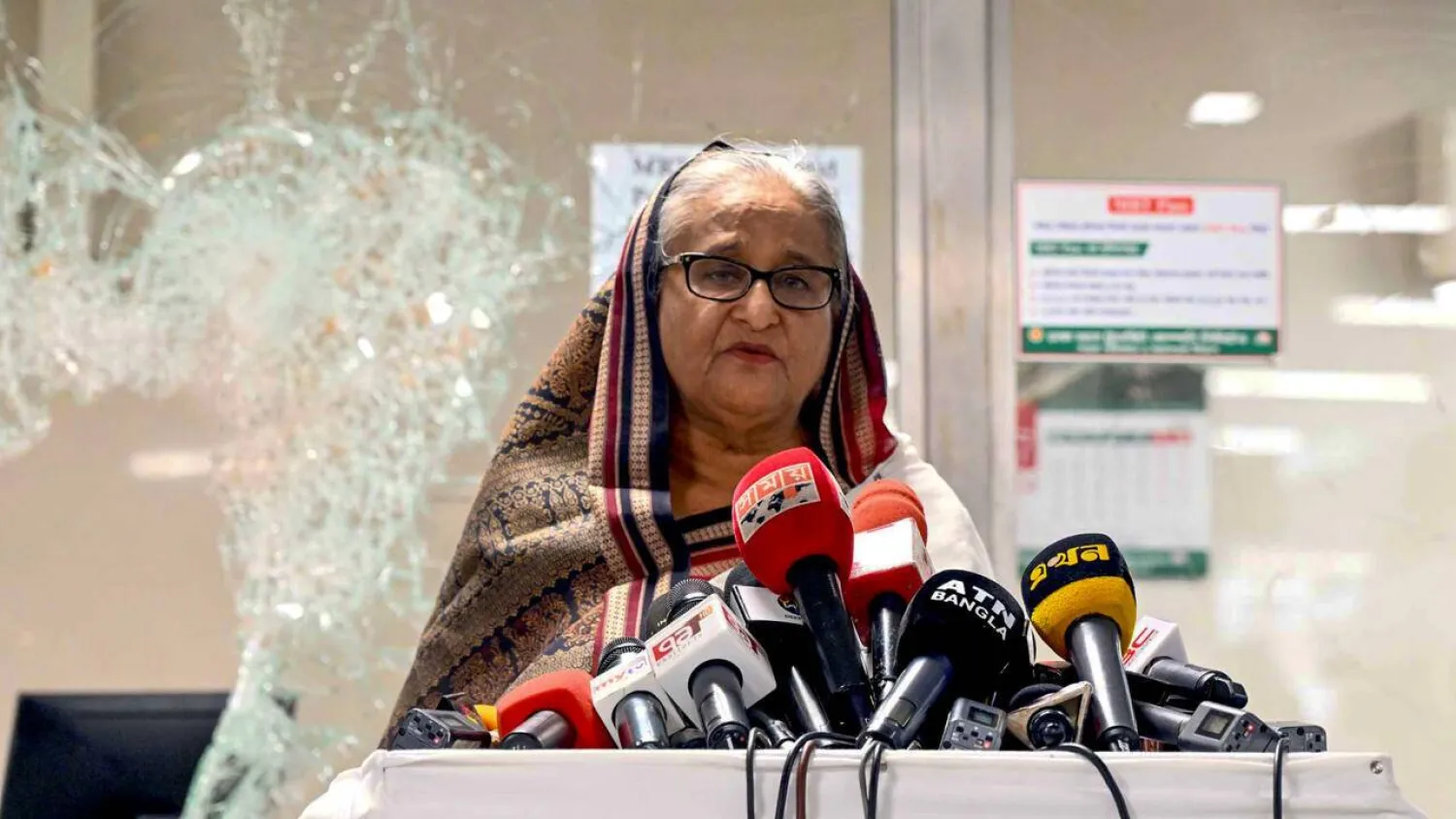

Banned Bangladesh Party Turns to Flash Protests ahead of Polls

Bangladesh's largest political party, the Awami League has been outlawed since its leader Sheikh Hasina was overthrown in a mass uprising in August 2024. Bangladesh Prime Minister's Office/AFP/File
TT

Banned Bangladesh Party Turns to Flash Protests ahead of Polls

Bangladesh's largest political party, the Awami League has been outlawed since its leader Sheikh Hasina was overthrown in a mass uprising in August 2024. Bangladesh Prime Minister's Office/AFP/File

Once Bangladesh's largest political party, the Awami League has been outlawed since its leader Sheikh Hasina was overthrown in a mass uprising last year.

Now, its supporters -- encouraged by Hasina's social media calls to "resist" -- are staging flash mob protests defying the ban as the country prepares for elections from which the party is barred.

In the capital Dhaka, 45-year-old cleaner Mohammad Kashem described witnessing around 25 Awami League loyalists being chased, beaten and detained by police at one such rally.

"It's happening all over Dhaka," Kashem told AFP, saying videos of such spontaneous demonstrations appear constantly on social media.

"We see it every day on Facebook."

The elections, expected in February 2026, will be the first since Hasina fled into exile in India as crowds stormed her palace, ending her 15-year rule.

She has since defied court orders to attend her ongoing trial on charges amounting to crimes against humanity for allegedly ordering a deadly crackdown during the revolt.

Her party and its supporters have since been pushed underground.

More than 800 have been arrested in connection with the flash mobs, officials say, which have rattled the interim government of Nobel laureate Muhammad Yunus as he oversees the South Asian nation of 170 million until the polls.

'Abandoned'

Still, they protest.

Some rallies consist of only a handful of young men. Others draw more than 100, chanting slogans.

"Sheikh Hasina is coming!" they shout, waving small placards or unfurling banners. "Bangladesh is smiling!"

They gather for a few minutes before vanishing into the crowds.

Sometimes, multiple flash protests erupt simultaneously in different parts of Dhaka. On one day, police arrested 244 people, authorities said.

The risks are high. In the rally Kashem witnessed, several protesters were badly beaten.

"Stupid boys," Kashem said. "The heavyweight leaders abandoned them... yet they're risking their lives."

The protests have unnerved Yunus's government.

"The fascists have turned reckless, as they can see that the country is heading towards an election and the trial process (of Hasina) is progressing fast," Yunus's press secretary Shafiqul Alam told reporters last month.

"The government has decided to strengthen the monitoring of flash processions and other illegal gatherings."

Hasina remains vocal on social media, issuing broadsides against Yunus and urging loyalists to "resist".

Bangladeshi newspapers, quoting a senior party leader in hiding, reported at least 20 flash processions in the past month.

Dhaka police spokesman Md Talebur Rahman could not confirm the number of protests, but said "more than 800 people" had been arrested in connection with them.

Political analyst Zahed Ur Rahman, a member of the government's electoral reform commission, said Hasina was risking protesters' safety to maintain relevance.

"She is trying to earn sympathy by widely sharing the beatings, chases, dispersals and arrests of her party members," Zahed told AFP.

'Proper action'

Human Rights Watch has condemned the "draconian" ban on the Awami League.

"The interim government should not be engaging in the same partisan behavior that Bangladeshis had to endure under Sheikh Hasina, whether it is stuffing the prisons with political opponents or shutting down peaceful dissent," HRW's Meenakshi Ganguly said.

But analysts say the protests could complicate election preparations.

Inspector General of Police Baharul Alam said "different interest groups" were trying to derail the election, including the "defeated axis".

Tajul Islam, chief prosecutor in Hasina's trial in absentia, said that a judicial probe was underway into the Awami League.

"Once the investigation report is ready, proper action will be taken," Islam said.

The Awami League remains defiant.

He told AFP that he reveled in the trouble they have caused.

"Have you noticed how these activities have robbed the government of sleep?"


Israeli Air Force Deploys First Laser Interception System

FILED - 26 March 2024, Israel, Jerusalem: Israel Katz attends a meeting at a hotel in Jerusalem. Photo: Christoph Soeder/dpa
TT

Israeli Air Force Deploys First Laser Interception System

FILED - 26 March 2024, Israel, Jerusalem: Israel Katz attends a meeting at a hotel in Jerusalem. Photo: Christoph Soeder/dpa

Israel's defense ministry said on Sunday it had deployed a new "Iron Beam" laser system for the air force to intercept aerial threats.

The laser system's main developers, the ministry's research and development department and defense contractor Rafael, delivered it to the air force at a ceremony in northern Israel.

"For the first time globally, a high-power laser interception system has achieved full operational maturity, successfully executing multiple interceptions," Defense Minister Israel Katz said at the ceremony, according to a statement.

"This monumental achievement... delivers a critical message to our enemies, near and far alike: do not challenge us, or face severe consequences," AFP quoted him as saying.

The handover marks a major milestone in a project more than a decade old.
"Israel has become the first country in the world to field an operational laser system for the interception of aerial threats, including rockets and missiles," said Yuval Steinitz, chairman of Rafael.

The laser system seeks to enhance and slash the cost of Israel's interception of projectiles, and will supplement other aerial defense capacities such as the more well-known Iron Dome.

Iron Dome offers short-range protection against missiles and rockets. The David's Sling system and successive generations of Arrow missiles are Israeli-American technology built to bring down ballistic missiles.

The defense ministry announced in early December that the laser system was complete, and would be deployed by the end of the month.

During the 12-day war launched by Israel against Iran in June, the country's missile defense system failed to intercept all the projectiles fired by Tehran toward Israeli territory.

Israel has since acknowledged being hit by more than 50 missiles during the war with Iran, resulting in 28 deaths.


Trump Says Had 'Productive' Call with Putin Ahead of Zelensky Meeting

US President Donald Trump takes part in a Christmas Eve dinner in the ballroom of his Mar-a-Lago club in Palm Beach, Florida, US, December 24, 2025. REUTERS/Jessica Koscielniak
TT

Trump Says Had 'Productive' Call with Putin Ahead of Zelensky Meeting

US President Donald Trump takes part in a Christmas Eve dinner in the ballroom of his Mar-a-Lago club in Palm Beach, Florida, US, December 24, 2025. REUTERS/Jessica Koscielniak

US President Donald Trump said he had a productive telephone call with his Russian counterpart Vladimir Putin on Sunday ahead of a planned meeting in Florida with Ukraine's leader Volodymyr Zelensky.

"I just had a very good and productive telephone call with President Putin of Russia" before the planned talks with Zelensky at Trump's Florida estate at 1:00 pm local time (1800 GMT), the US leader said on Truth Social.

Putin said Ukraine was in no hurry for peace and if it did not want to resolve their conflict peacefully, Moscow would accomplish all its goals by force.

Putin's remarks on Saturday, carried by state news agency TASS, followed a vast Russian drone and missile attack that prompted Zelensky to say Russia was demonstrating its wish to continue the war while Kyiv wanted peace.


Russia Sends 3 Iranian Satellites into Orbit, Report Says

In this photo released by Roscosmos space corporation on Thursday, Feb. 29, 2024, the Soyuz-2.1b rocket blasts off at the Vostochny cosmodrome outside the city of Tsiolkovsky, about 200 kilometers (125 miles) from the city of Blagoveshchensk in the far eastern Amur region, Russia. A Russian Soyuz rocket successfully put an Iranian satellite into orbit along with 18 Russian satellites on Thursday. (Roscosmos space corporation via AP)
TT

Russia Sends 3 Iranian Satellites into Orbit, Report Says

In this photo released by Roscosmos space corporation on Thursday, Feb. 29, 2024, the Soyuz-2.1b rocket blasts off at the Vostochny cosmodrome outside the city of Tsiolkovsky, about 200 kilometers (125 miles) from the city of Blagoveshchensk in the far eastern Amur region, Russia. A Russian Soyuz rocket successfully put an Iranian satellite into orbit along with 18 Russian satellites on Thursday. (Roscosmos space corporation via AP)

Russia on Sunday sent three Iranian communications satellites into orbit, the second such launch since July, Iranian state television reported.

The report said that a Russian rocket sent the satellites to circle the Earth on a 500-kilometer (310-mile) orbit from the Vostochny launchpad in eastern Russia. The three satellites are dubbed Paya, Kowsar and Zafar-2.

The report said that Paya, weighing 150 kilograms (330 pounds), is the heaviest satellite that Iran has ever deployed into orbit. Kowsar weighs 35 kilograms (77 pounds), but the report didn't specify how heavy Zafar-2 is.

The satellites feature up to 3-meter resolution images, applicable in the management of water resources, agriculture and the environment. Their life span is up to five years.

Russia occasionally sends Iran's satellites into orbit, highlighting the strong ties between the two countries. In July, a Russian rocket sent Iranian communications satellite Nahid-2 into orbit.

Russia, which signed a “strategic partnership” treaty with Iran in January, strongly condemned the Israeli and US strikes on Iran that came during a 12-day air war in June and killed nearly 1,100 Iranians, including military commanders and nuclear scientists. Retaliatory missile barrages by Iran killed 28 people in Israel.

As a long-standing project, Iran from time-to-time launches satellite carriers to send its satellites into space.

The United States has said that Iran’s satellite launches defy a UN Security Council resolution and called on Tehran to undertake no activity involving ballistic missiles capable of delivering nuclear weapons. UN sanctions related to Iran’s ballistic missile program expired in 2023.
