


Trump Says Modi Assured Him India Will Stop Buying Russian Oil

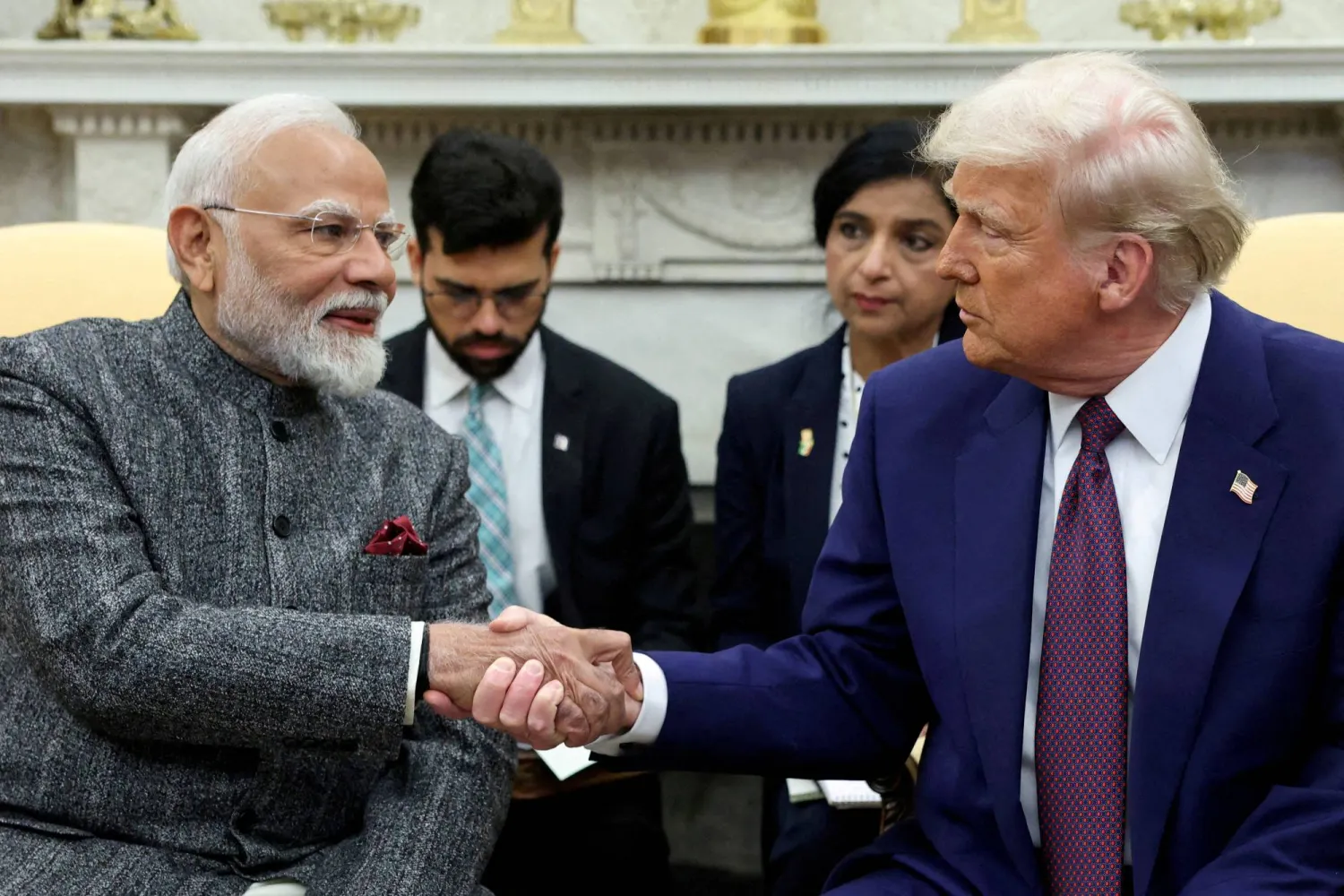
FILE PHOTO: US President Donald Trump and Indian Prime Minister Narendra Modi shake hands, at the White House in Washington, D.C., US, February 13, 2025. REUTERS/Kevin Lamarque/File Photo
TT

Trump Says Modi Assured Him India Will Stop Buying Russian Oil

FILE PHOTO: US President Donald Trump and Indian Prime Minister Narendra Modi shake hands, at the White House in Washington, D.C., US, February 13, 2025. REUTERS/Kevin Lamarque/File Photo

US President Donald Trump said on Wednesday that Indian Prime Minister Narendra Modi has pledged to stop buying oil from Russia, and Trump said he would next try to get China to do the same as Washington intensifies efforts to cut off Moscow’s energy revenues.

India and China are the two top buyers of Russian seaborne crude exports, taking advantage of the discounted prices Russia has been forced to accept after European buyers shunned purchases and the US and the European Union imposed sanctions on Moscow for its invasion of Ukraine in February 2022, Reuters said.

Trump has recently targeted India for its Russian oil purchases, imposing tariffs on Indian exports to the US to discourage the country's crude buying as he seeks pressure Moscow to negotiate a peace deal in Ukraine.

“So I was not happy that India was buying oil, and he (Modi)assured me today that they will not be buying oil from Russia,” Trump told reporters during a White House event.

“That’s a big step. Now we’re going to get China to do the same thing.”

The Indian embassy in Washington did not immediately respond to emailed questions about whether Modi had made such a commitment to Trump.

Later on Wednesday, US Treasury Secretary Scott Bessent said he told Japanese Finance Minister Katsunobu Kato at a meeting in Washington that the Trump administration expects Japan to stop importing Russian energy.

"Minister Kato and I also discussed important issues pertaining to the US-Japan economic relationship and the Administration's expectation that Japan stop importing Russian energy," Bessent said on X.

The Japanese government did not immediately respond to a request for comment.

Russia is India's top oil supplier. Moscow exported 1.62 million barrels per day to India in September, roughly one third of the country's oil imports. For months, Modi resisted US pressure, with Indian officials defending the purchases as vital to national energy security.

While imports from other producers would likely cost India more, lower oil prices would temper the impact. Benchmark Brent crude futures hit a five-month low on Wednesday on concerns about a growing surplus in the market.

A move by India to stop imports would signal a major shift by one of Moscow’s top energy customers and could reshape the calculus for other nations still importing Russian crude. Trump wants to leverage bilateral relationships to enforce economic isolation on Russia, rather than relying solely on multilateral sanctions.

The announcement comes just days after Trump’s new pick for Indian ambassador, Sergio Gor, met with Modi. The two discussed defense, trade and technology issues. The appointment of Gor, a close confidant to Trump, was widely seen as a positive move for the US-India bilateral relationship.

During his comments to reporters, Trump added that India could not "immediately" halt shipments, calling it "a little bit of a process, but that process will be over soon."

Despite his push on India, Trump has largely avoided placing similar pressure on China. The US trade war with Beijing has complicated diplomatic efforts, with Trump reluctant to risk further escalation by demanding a halt to Chinese energy imports from Russia.

Trump imposed a 25% tariff on India this summer after the two countries failed to reach an initial trade agreement. He followed up with an additional 25% because of the country’s purchases of Russian oil.

India chafed at the move because no other top purchasers of Russian oil, like China or Turkey, were hit with similar tariffs.



NATO: Ukraine Still Receiving Arms Despite Mideast War

NATO Secretary General Mark Rutte via Reuters/File
TT

NATO: Ukraine Still Receiving Arms Despite Mideast War

NATO Secretary General Mark Rutte via Reuters/File

Ukraine is still getting essential defense equipment despite the war in the Middle East, which is depleting stockpiles in Europe and the United States, NATO Secretary General Mark Rutte said Thursday.

"The good news is that essential equipment into Ukraine continues to flow," he told reporters. That included American-made Patriot missile interceptors, which Ukraine desperately needs, he added, AFP reported.

The PURL program, launched last year, allows Ukraine to receive US equipment financed by European countries.

Some 75 percent of the missiles used by Patriot batteries in Ukraine have been supplied through the program, and 90 percent of the munitions used by other air-defense systems, Rutte added.

Rutte called on European countries to increase their own production capacity.

"They need to produce more extra production lines, extra shifts, opening new factories. The money is there," he said.


Germany FM Says 'Encouraging' if US Speaking Directly to Iran

German Foreign Minister Johann Wadephul. (Reuters: File Photo)
TT

Germany FM Says 'Encouraging' if US Speaking Directly to Iran

German Foreign Minister Johann Wadephul. (Reuters: File Photo)

Germany's foreign minister Thursday said it was encouraging if the United States was talking directly to Iran to end the war in the Middle East, but Washington should make its intentions clear.

"I hear that there are signs that the US is speaking directly to Iran. I think that this is encouraging and this is welcome," Johann Wadephul told reporters before heading into the meeting of G7 foreign ministers outside Paris, AFP reported.

With US Secretary of State Marco Rubio set to join the discussions from Friday, he added: "For the German government it is of great importance to know precisely what our American partners are intending."


US Envoy Witkoff Says Iran is Seeking an Off-ramp

US Special Envoy Steve Witkoff speaks during a cabinet meeting at the White House in Washington, DC, US, March 26, 2026. REUTERS/Evelyn Hockstein
TT

US Envoy Witkoff Says Iran is Seeking an Off-ramp

US Special Envoy Steve Witkoff speaks during a cabinet meeting at the White House in Washington, DC, US, March 26, 2026. REUTERS/Evelyn Hockstein

The United States has sent Iran a "15-point action list" as a basis for negotiations to end the current conflict, US Special Envoy Steve Witkoff said on Thursday, adding that there are signs that Tehran was interested in making a deal.


Witkoff, speaking during a cabinet meeting at the White House, said that the nascent talks could be successful if the Iranians realize there were no good alternatives - a realization Tehran might be coming to, he argued, Reuters reported.


"We will see where things lead, and if we can convince Iran that this is the inflection point with no good alternatives for them other than more death and destruction," Witkoff told reporters.


"We have strong signs that this is a possibility."


Witkoff said Pakistan had been acting as a mediator, confirming statements from Pakistani officials.