


MI5 Chief Says China is a Daily Threat to UK Security

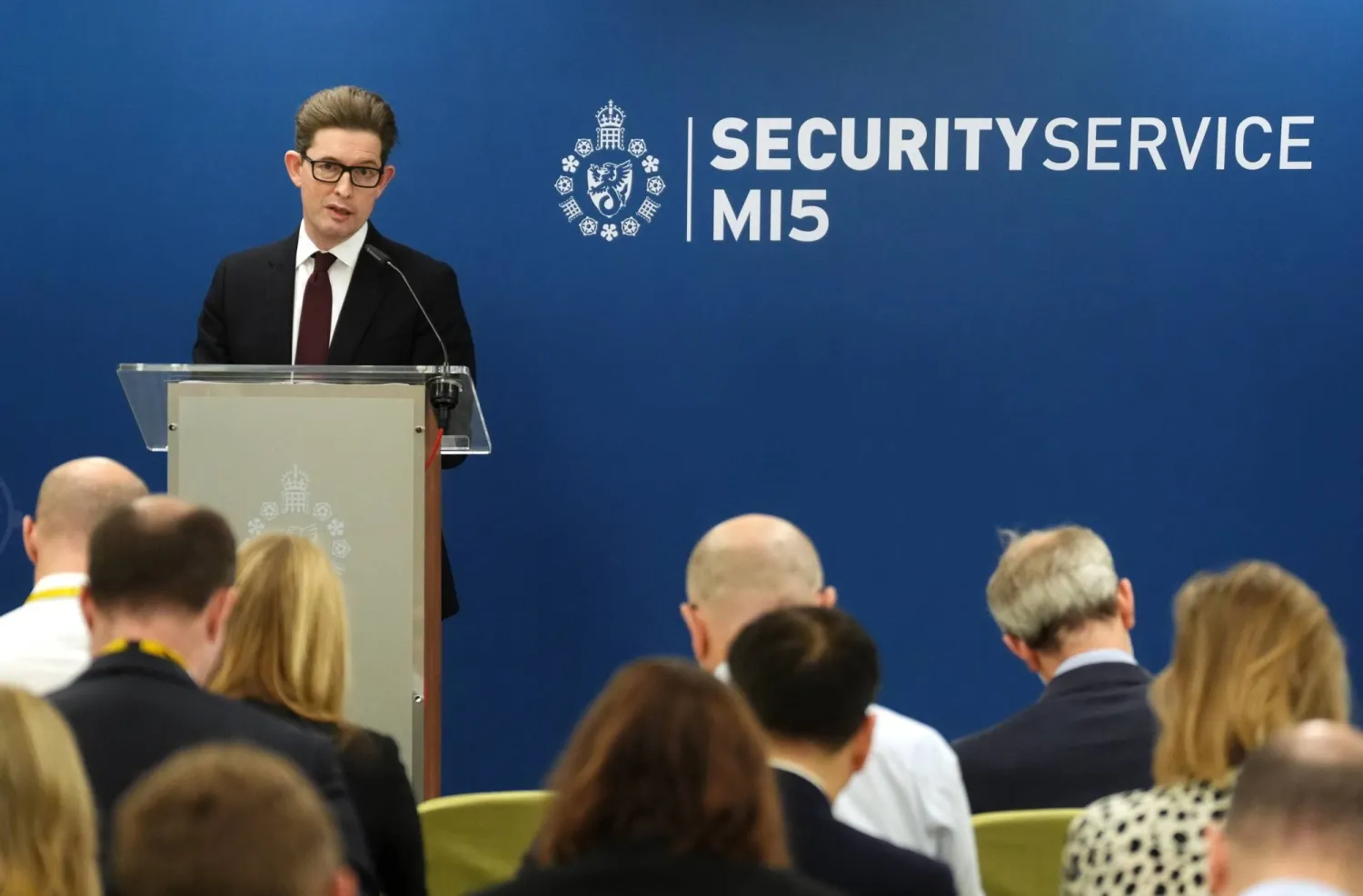
Director General of MI5 Sir Ken McCallum delivers the annual Director General's Speech at Thames House, the headquarters of the UK's Security Service in London, Thursday Oct. 16, 2025. (Jonathan Brady/Pool Photo via AP)
TT

MI5 Chief Says China is a Daily Threat to UK Security

Director General of MI5 Sir Ken McCallum delivers the annual Director General's Speech at Thames House, the headquarters of the UK's Security Service in London, Thursday Oct. 16, 2025. (Jonathan Brady/Pool Photo via AP)

China poses a daily threat to Britain’s security, the head of the country's domestic intelligence agency said Thursday, remarks that step up pressure on authorities to explain why the prosecution of two men charged with spying for Beijing collapsed just before they were due to stand trial.

The government, prosecutors and opposition politicians, who were in power until last year, have traded blame over the failed criminal case as the United Kingdom tries to balance between challenging and engaging with the Asian superpower.

“Do Chinese state actors present a UK national security threat? The answer is of course yes they do, every day,” MI5 Director-General Ken McCallum told reporters during a rare public appearance. He said his agency had intervened to stop a threat from Beijing as recently as the past week.

According to The Associated Press, McCallum said Beijing-backed meddling has included cyberespionage, stealing technology secrets and “efforts to interfere covertly in UK public life.”

China spying allegations Academic Christopher Berry and parliamentary researcher Christopher Cash were charged last year with providing information or documents to China that could be “prejudicial to the safety or interests” of the UK.

Then, last month, prosecutors dropped the charges.

Director of Public Prosecutions Stephen Parkinson pointed at the government, saying officials refused to testify under oath that China was a threat to national security at the time of the alleged offenses, between 2021 and 2023.

Prime Minister Keir Starmer denies interfering, and late Wednesday the government published witness statements submitted by Deputy National Security Adviser Matthew Collins describing China as “the biggest state-based threat to the UK’s economic security” and saying Beijing’s espionage activities “harm the interests and security of the UK.”

McCallum called Britain’s relationship with China a “complex” mix of risk and opportunity, and said MI5 agents “detect and deal, robustly, with activity threatening UK national security.”

“Of course I am frustrated when opportunities to prosecute national security-threatening activity are not followed through for whatever reason,” he said, but added that prosecution decisions were out of MI5’s hands.

Cash and Berry were charged under the Official Secrets Act, a century-old statute that covers spying for countries deemed enemies of the UK. It has since been replaced by new national security legislation.

The two men deny wrongdoing, and the Chinese Embassy on Thursday called the allegations “pure fabrication and malicious slander.”

“China never interferes in other countries’ internal affairs,” an embassy spokesperson said.

British intelligence authorities have ratcheted up warnings about Beijing’s covert activities, and Parliament’s Intelligence and Security Committee labeled Beijing a “strategic threat” in 2023.

Starmer's center-left Labour Party government has tried cautiously to reset ties with Beijing after years of frosty relations over spying allegations, human rights concerns, China’s support for Russia in the Ukraine war and a crackdown on civil liberties in Hong Kong.

The spying controversy erupted as British officials consider China's application to build a huge new embassy near the Tower of London that would be the biggest diplomatic complex in Europe. Critics say its scale and central location bring heightened risks of spying and sabotage.

On Thursday the government postponed the deadline for a final decision from Oct. 21 until Dec. 10.

In his annual speech outlining major threats to the UK, McCallum painted a stark picture, saying the UK faces “multiple overlapping threats on an unprecedented scale” from both terror groups and states. He said China is one of the “big three” state threats, along with the more reckless Russia and Iran.

“State threats are escalating,” he said, with a 35% increase in the past year in the number of people MI5 is investigating for espionage.

He alleged that Russia and Iran are increasingly using “ugly methods,” including “surveillance sabotage, arson or physical violence.”

“Russia is committed to causing havoc and destruction,” he said. “In the last year, we and the police have disrupted a steady stream of surveillance plots with hostile intent aimed at individuals Russian leaders perceive as their enemies.”

He said Tehran is also plotting to injure and kill its enemies on British soil, with more than 20 “potentially lethal Iran-backed plots” disrupted in the past 12 months.

The UK’s official terror threat level stands at “substantial,” meaning an attack is likely, and McCallum said MI5 has disrupted 19 late-stage attack plots since 2020.

He said attacks increasingly tend to come from small groups or individuals rather than broad networks, and suspects are getting younger, with one in five of those arrested last year under the age of 17.

Some plotters are motivated by al-Qaeda and ISIS – which are “once again becoming more ambitious” – and others by extreme right-wing ideology, he said. Still others reflect a messy stew of motivations bred in “squalid corners of the internet.”

The spy chief also said MI5 was looking at potential threats from out-of-control AI.


Israel Preparing for Two Weeks of Escalation with Iran

Israeli security forces inspect damage at an apartment building struck by an Iranian missile in Petah Tikva, Israel, Saturday, April 4, 2026. (AP)
TT

Israel Preparing for Two Weeks of Escalation with Iran

Israeli security forces inspect damage at an apartment building struck by an Iranian missile in Petah Tikva, Israel, Saturday, April 4, 2026. (AP)

Israel is prepared for another two weeks of war with Iran and has planned a list of targets for attacks, including infrastructure and economic facilities, while continuing to hit Iran's defense industries.

“The Iranian economy would be Israel’s next target,” the Kan public broadcaster reported.

Security officials told the channel that Israel has prepared a list of targets for attacks in the coming weeks, including infrastructure and bridges, as well as less frequently targeted sites such as energy and oil facilities.

Kan said Israeli officials believe the war could last longer than two weeks, and Israel is preparing accordingly.

The new timeframe extends past the four to six weeks initially set by the White House.

Meanwhile, Israel’s i24NEWS quoted senior Israeli officials as saying there is no expectation of a slowdown in operations in Iran, quite the opposite. The campaign to dismantle key infrastructure is intensifying, as this remains the primary arena shaping wider regional developments.

Sources said Israeli high-ranking military officials and US Central Command (CENTCOM) Commander Brad Cooper agreed in a meeting to continue strikes on Iran for another two to three weeks with a bank of targets including economic centers and banks.

Israel’s second phase represents a major strategic shift in the bank of targets against Iran, setting the military’s sights on the country’s economy, according to Kan.

In addition to the ongoing attacks on military facilities, Israel and the United States plan to hit Iran’s economic sectors, including financial institutions, banks, energy infrastructure, and petrochemical facilities that form the regime’s main “lifeline”.

According to the plan, the United States will operate in the designated areas under its responsibility, while the Israeli army will deepen its attacks on Iran’s basic infrastructure in various regions.

The new decisions were taken as US President Donald Trump told Tehran that his latest deadline for a deal to end the war was fast approaching.

“Remember when I gave Iran ten days to MAKE A DEAL or OPEN UP THE HORMUZ STRAIT. Time is running out — 48 hours before all Hell will reign (sic) down on them,” he wrote in a post on Truth Social.

Trump's messaging about the war has veered between hinting at diplomatic progress and making threats to bomb Iran “back to the Stone Ages.”

Kan noted that the new target list awaits Trump’s approval as the US President has not yet given up on negotiations with Iran.


Russia Says Ukraine Attack Damages Oil Pipeline

 A satellite near-infrared image shows smoke rising from damaged oil storage tanks after a Ukrainian attack, in Primorsk, Russia March 29, 2026. (Vantor/Handout via Reuters)
A satellite near-infrared image shows smoke rising from damaged oil storage tanks after a Ukrainian attack, in Primorsk, Russia March 29, 2026. (Vantor/Handout via Reuters)
TT

Russia Says Ukraine Attack Damages Oil Pipeline

 A satellite near-infrared image shows smoke rising from damaged oil storage tanks after a Ukrainian attack, in Primorsk, Russia March 29, 2026. (Vantor/Handout via Reuters)
A satellite near-infrared image shows smoke rising from damaged oil storage tanks after a Ukrainian attack, in Primorsk, Russia March 29, 2026. (Vantor/Handout via Reuters)

Russian authorities said Sunday that a Ukrainian drone attack has damaged an oil pipeline near the Baltic port of Primorsk.

Russian air defenses shot down 19 drones in the Leningrad region and debris from one "damaged a section of the oil pipeline near the port of Primorsk, and the pipeline is being safely burned out," regional governor Alexander Drozdenko said on Telegram. He said there were no casualties.

Ukraine has stepped up attacks on Russian infrastructure targets in recent months.

Primorsk, which is between the Finnish border and the key city of St Petersburg, was also attacked in March when an oil depot was set ablaze.


Spanish PM Under Fire as Ex-Top Aide Goes on Graft Trial

Former Spanish Minister of Transport Jose Luis Abalos leaves the Supreme Court following his appearance for alleged corruption in Madrid on October 15, 2025. (AFP)
TT

Spanish PM Under Fire as Ex-Top Aide Goes on Graft Trial

Former Spanish Minister of Transport Jose Luis Abalos leaves the Supreme Court following his appearance for alleged corruption in Madrid on October 15, 2025. (AFP)

A corruption trial of a former right-hand man to Spanish Prime Minister Pedro Sanchez begins on Tuesday, a politically explosive case that has threatened to topple the Socialist-led minority government.

Jose Luis Abalos is a disgraced ex-Socialist heavyweight, a former transport minister who helped propel Sanchez to power in 2018. The case is one of several corruption affairs rattling the fragile coalition.

Abalos and his former adviser Koldo Garcia are suspected of having pocketed kickbacks for handing out public contracts worth millions of euros for sanitary equipment during the Covid-19 pandemic.

The Supreme Court in Madrid will judge them for alleged bribery, embezzlement, influence peddling, membership of a criminal organization and misuse of confidential information. The men deny the charges.

Prosecutors want Abalos to serve 24 years in jail. They portray him as the mastermind of a scheme of illicit enrichment. They have called for a 19-year term for Garcia, who they say was a key intermediary.

They argued in court that both men had abused their government positions and contacts to favor the interests of businessman Victor de Aldama, who has already admitted his role in the vast and complex affair.

Abalos has consistently protested that the investigation has been unfair.

"I feel like I am living in a fiction," he told the conservative daily El Mundo in November, shortly before his arrest. "I cannot believe the prosecutor's office is asking for 24 years in jail for me."

Garcia also protested in comments to an investigatory committee of the Navarre regional parliament.

"I am in jail without proof that I've committed any crime," he said, speaking by video link from his place of pre-trial detention.

More than 75 witnesses and about 20 experts are to testify during the proceedings, which are due to run through April.

- Succession of scandals -

The investigation also appears to have ensnared Abalos's successor in the powerful post of Socialist organization secretary, Santos Cerdan.

Caught up in another case of suspected corruption for public works contracts, he has been forced to step down from what is a key position in the party.

The fall from grace of Abalos and Cerdan -- two of Sanchez's closest allies -- has embarrassed a leader who took power promising to clean up Spanish politics.

He took over from the main conservative Popular Party (PP) after it had been engulfed in its own graft scandal.

Separate corruption investigations into Sanchez's wife Begona Gomez and his brother David, who faces trial later this year, have piled further pressure on the government, one of few leftist administrations in Europe.

Both the PP and far-right opposition party Vox have called for Sanchez's resignation and early elections. They argue that the scandals expose systemic Socialist corruption that reaches the premier himself.

Sanchez has always denied any illegal funding of the Socialists and rebuffed calls for polls before the next scheduled general election, due in 2027.
