ICC Rejects Israel Appeal Bid Over Arrest Warrants

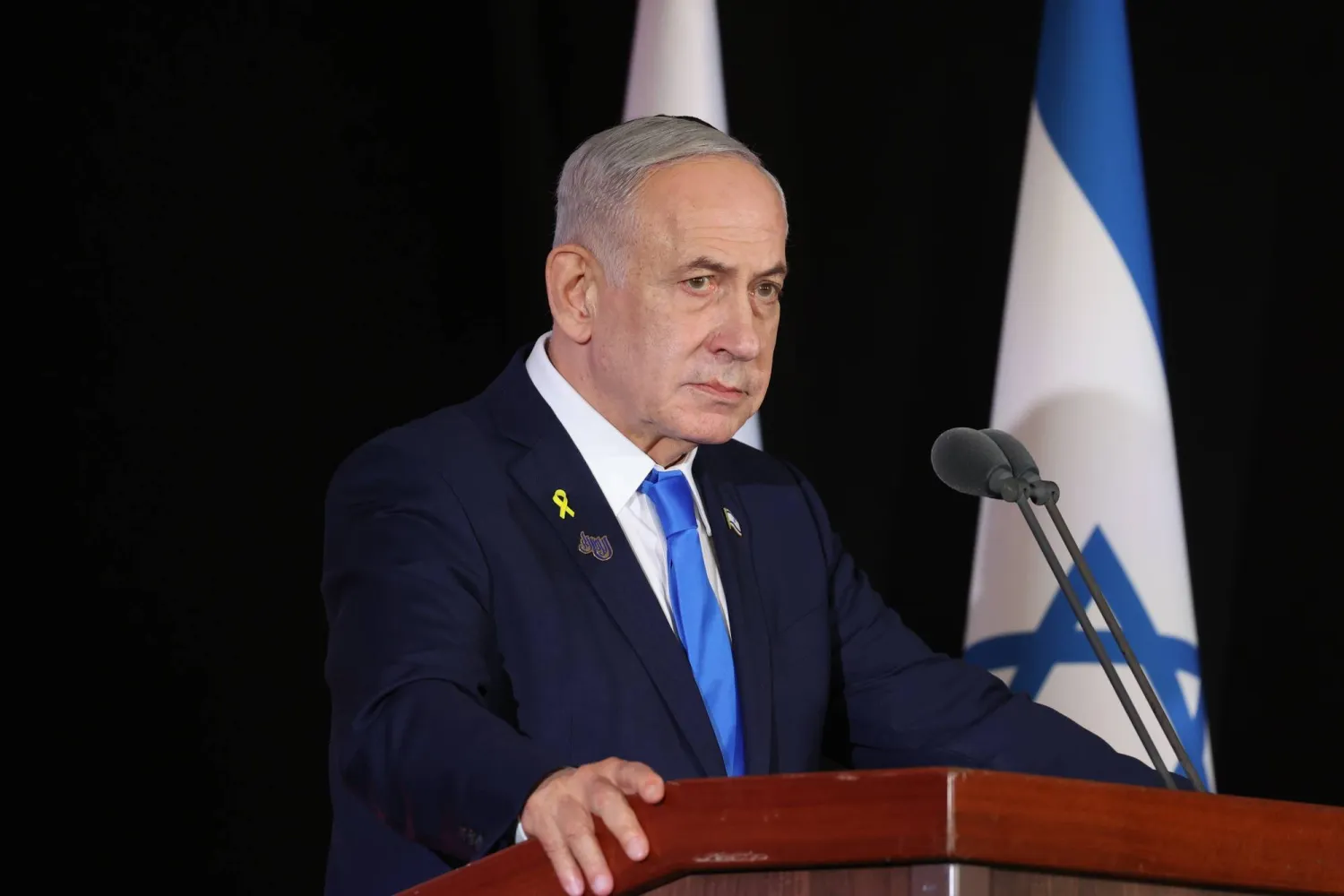
Israeli Prime Minister Benjamin Netanyahu delivers a speech during the ceremony of the Iron Swords War Memorial Day on Mount Herzl in Jerusalem, Israel, 16 October 2025 to commemorate the victims of the October 7 attacks. (EPA)
TT

ICC Rejects Israel Appeal Bid Over Arrest Warrants

Israeli Prime Minister Benjamin Netanyahu delivers a speech during the ceremony of the Iron Swords War Memorial Day on Mount Herzl in Jerusalem, Israel, 16 October 2025 to commemorate the victims of the October 7 attacks. (EPA)

The International Criminal Court Friday rejected Israel's bid to appeal against arrest warrants for its Prime Minister Benjamin Netanyahu and former defense minister Yoav Gallant over the Gaza war.

In a ruling that made headlines around the world, the ICC in November found "reasonable grounds" to believe Netanyahu and Gallant bore "criminal responsibility" for alleged war crimes and crimes against humanity in Gaza.

The ICC also issued arrest warrants for three top leaders from the Palestinian movement Hamas but dropped these after their deaths.

The warrants against Netanyahu and Gallant sparked outrage in Israel and also in the United States, which has since slapped sanctions on top ICC officials.

Netanyahu described it as an "anti-Semitic decision" and the then US president Joe Biden slammed it as "outrageous".

Israel had asked the court in May to dismiss the warrants while it weighed a separate challenge over whether the ICC had jurisdiction in the case.

The court rejected this on July 16, saying there was "no legal basis" for quashing the warrants while the jurisdiction challenge was pending.

A week later, Israel asked for leave to appeal that ruling, but judges ruled on Friday that "the issue, as framed by Israel, is not an appealable issue."

"The Chamber therefore rejects the request," said the ICC in a complex, 13-page ruling.

ICC judges are still weighing a wider Israeli challenge over jurisdiction.

When the court originally issued the arrest warrants in November, it simultaneously rejected an Israeli appeal against its jurisdiction.

However, in April, the ICC's Appeals Chamber ruled the Pre-Trial Chamber was wrong to dismiss the challenge and ordered it to look again in detail at Israel's arguments.

It is not clear when it will hand down a ruling on that issue.


Trump Warns of More Strikes on Iran’s Kharg Island, Pressures Allies on Strait of Hormuz

A tanker sails in the Gulf, near the Strait of Hormuz, as seen from northern Ras al-Khaimah, near the border with Oman’s Musandam governance, amid the US-Israeli conflict with Iran, in United Arab Emirates, March 11, 2026. (Reuters)
TT

Trump Warns of More Strikes on Iran’s Kharg Island, Pressures Allies on Strait of Hormuz

A tanker sails in the Gulf, near the Strait of Hormuz, as seen from northern Ras al-Khaimah, near the border with Oman’s Musandam governance, amid the US-Israeli conflict with Iran, in United Arab Emirates, March 11, 2026. (Reuters)

US President Donald Trump threatened further strikes on Iran's Kharg Island oil export hub and urged allies to deploy warships to secure the Strait of Hormuz, an artery for global energy supplies, as Tehran vowed to intensify its response.

With the US-Israeli war on Iran in its third week, Trump said US strikes had "totally demolished" much of the island and warned of more, telling NBC News on Saturday, "We may hit it a few more times just for fun."

The remarks marked a sharp escalation from Trump, who had previously said the US was targeting only military sites on Kharg, and undercut diplomatic efforts.

WAR, ENERGY CRISIS LOOK SET TO PERSIST

The war showed no sign of ending. Trump said Tehran appeared ready to ‌make a deal ‌to end the conflict but that "the terms aren't good enough yet."

Tehran's ability to halt shipping ‌through ⁠the Strait of Hormuz, ⁠through which a fifth of the world's oil passes, poses a difficult problem for the US and its allies. Energy prices are soaring as the war causes the biggest-ever disruption in oil supply, and the energy crisis looked set to continue.

"The Countries of the World that receive Oil through the Hormuz Strait must take care of that passage, and we will help — A LOT!" Trump wrote in a social media post on Saturday. "The US will also coordinate with those Countries so that everything goes quickly, smoothly, and well."

Iranian Foreign Minister Abbas Araqchi said Iran would respond to any attack on its energy facilities.

Iran's Revolutionary Guards said on Sunday they had carried out missile ⁠and drone strikes on targets in Israel and three US bases in the region, calling ‌the attacks the first round of retaliation for workers killed in Iran's industrial ‌areas. The Israeli military said it was intercepting incoming launches.

Saudi Arabia intercepted and destroyed 10 drones in Riyadh and the east, the defense ministry ‌said. Iran's Revolutionary Guards said they no had connection to the attack, semi-official Fars news agency reported.

A drone attack disrupted ‌a major United Arab Emirates energy hub on Saturday, and the US warned US citizens on Saturday to leave Iraq.

The war that Trump and Israeli Prime Minister Benjamin Netanyahu launched on February 28 has killed more than 2,000 people, mostly in Iran, according to reports from governments and state media.

At least 15 were killed when an airstrike hit a refrigerator and heater factory in the central Iranian city of Isfahan, the semi-official ‌Fars news agency said on Saturday.

NO IMMEDIATE TAKERS ON TRUMP'S HORMUZ REQUEST

Russia is supplying Iran with Shahed drones to use against the US and Israel, Ukrainian President Volodymyr ⁠Zelenskiy told CNN. Shahed drones have ⁠been linked to other attacks on countries in the region, although their manufacturers are not always clear.

Oil market disruptions looked unlikely to end soon. Some oil-loading operations were suspended in the UAE's Fujairah emirate, a global ship-refueling hub, after a drone attack, industry and trade sources said on Saturday.

Trump, in a post on his Truth Social platform, urged China, France, Japan, South Korea, Britain and others to send warships to the Strait of Hormuz. None of those countries gave any immediate indication they would do so.

Takayuki Kobayashi, Japan's ruling party policy chief, declined to rule out the possibility, but told public broadcaster NHK that "the (legal) threshold is very high."

Japan interprets its pacifist postwar constitution to mean it can deploy its military if the nation's survival is threatened, but the government would have to invoke a 2015 security law that has not been used.

France is seeking to assemble a coalition to secure the Strait of Hormuz once the security situation stabilizes, while Britain is discussing a range of options with allies to ensure the security of shipping, officials have said.

Iran's Supreme Leader Mojtaba Khamenei, who replaced his slain father, has said the Strait of Hormuz should remain closed.


North Korean Leader Kim Observes Test of Rocket Launch Systems with His Daughter

This picture taken on March 14, 2026 and released by North Korea's official Korean Central News Agency (KCNA) via KNS on March 15, 2026 shows North Korean leader Kim Jong Un and his daughter Kim Ju Ae observing a training exercise of North Korean Army's 600mm-caliber ultra-precision multiple rocket launchers, at an undisclosed location in North Korea. (KCNA via KNS / AFP)
TT

North Korean Leader Kim Observes Test of Rocket Launch Systems with His Daughter

This picture taken on March 14, 2026 and released by North Korea's official Korean Central News Agency (KCNA) via KNS on March 15, 2026 shows North Korean leader Kim Jong Un and his daughter Kim Ju Ae observing a training exercise of North Korean Army's 600mm-caliber ultra-precision multiple rocket launchers, at an undisclosed location in North Korea. (KCNA via KNS / AFP)

North Korean leader Kim Jong Un, accompanied by his teenage daughter, observed a live-fire test of multiple rocket launch systems, state media reported Sunday, a likely response to ongoing US-South Korean military training that North Korea views as an invasion rehearsal.

The official Korean Central News Agency reported that Kim watched the strike drill involving twelve 600mm-caliber, ultraprecision rocket launchers off North Korea's east coast on Saturday.

South Korea’s military said Saturday it detected about 10 ballistic missiles fired from North Korea’s capital region toward the eastern sea. South Korea’s national security council called the launches a provocation that violated UN Security Council resolutions that bans any ballistic activities by North Korea.

KCNA cited Kim as saying that the drill would expose enemies within the 420-kilometer (260-mile) striking range, to “uneasiness” and give them “a deep understanding of the destructive power of tactical nuclear weapon,” KCNA said. He apparently referred to South Korea and US troops stationed in South Korea.

“If this weapon is used, the opponent’s military infrastructure within its striking range can never survive,” Kim said, according to KCNA.

KCNA photos showed Kim and his daughter, reportedly named Kim Ju Ae and aged about 13, walking near huge olive-green launch trucks and looking at weapons being launched from them. The girl has been accompanying her father at numerous high-profile events like missile tests and military parades since late 2022, stoking outside speculation that she’s being groomed as his heir.

Experts say North Korea’s large-sized rocket launchers blur the boundaries between artillery systems and ballistic missiles because they can create their own thrust and are guided during delivery. North Korea has said some of these systems are capable of delivering nuclear warheads.

The springtime US-South Korean Freedom Shield training, a computer-simulated command post exercise, is to run through March 19. North Korea often reacts to the exercise with its own weapons tests and fiery rhetoric.


Türkiye’s Foreign Minister Hakan Fidan Talks Diplomatic Efforts as Regional War Rages

FILED - 28 November 2025, Berlin: Turkish Foreign Minister Hakan Fidan speaks at a press conference in Berlin. Photo: Soeren Stache/dpa
TT

Türkiye’s Foreign Minister Hakan Fidan Talks Diplomatic Efforts as Regional War Rages

FILED - 28 November 2025, Berlin: Turkish Foreign Minister Hakan Fidan speaks at a press conference in Berlin. Photo: Soeren Stache/dpa

Türkiye’s powerful foreign minister said Saturday that there is no serious initiative to resume negotiations between the United States and Iran but that he believes Iran is open to back-channel talks.

The comments by Foreign Minister Hakan Fidan to The Associated Press in an exclusive interview came as Ankara is striving to stay out of the widening war in the Middle East.

Ankara, which has good relations with both Washington and Tehran, had attempted to mediate a solution between them before the US and Israel attacked Iran two weeks ago, triggering the war.

“The conditions are not very much conducive” to diplomacy now, Fidan said. The Iranians “feel betrayed” because for a second time they were attacked while in active negotiations with the US over their nuclear program, he said, but added, “I think they are open to any sensible back-channel diplomacy.”

Fidan, 57, served as Türkiye’s intelligence chief for more than a decade before being appointed foreign minister in 2023.

Key role in formulating Türkiye’s Middle East policy

In that role, he played a key part in shaping Türkiye’s policy in the Middle East, particularly toward Syria, Iraq and Iran. He is considered to be one of President Recep Tayyip Erdogan ’s most trusted advisers and one of the potential candidates to succeed him.

Türkiye has maintained a neutral position in the war, criticizing both the US and Israeli strikes against Iran and Tehran’s retaliatory actions against Gulf states that host US bases. Fidan said he has been attempting to persuade the Iranians to halt those attacks.

Fidan said Türkiye’s top priority is to remain outside of the conflict, even after three missiles believed to come from Iran were intercepted over Türkiye by NATO defenses. Türkiye is a NATO member and an air base in southern Türkiye is used by NATO forces, including US troops.

Iranian officials have insisted that they did not fire at Türkiye, although the available data shows that the missiles came from Iran, the Turkish foreign minister said.

He ruled out a military response at this stage, saying that NATO’s defenses were effective and that Ankara’s “primary objective” is to stay out of the conflict.

“I know that we are being provoked and we will be provoked, but this is our objective,” he said. “We want to stay out of this war.”

Fidan, who has regular contact with Iranian officials, said he does not know the severity of the wounds suffered by Iran’s new Supreme Leader Mojtaba Khamenei in a strike earlier in the war, but that “what we know is that he is alive and functioning.”

Khamenei was appointed to replace his father, Ali Khamenei, who was killed Feb. 28 during the war’s opening salvo.

Fidan said “the process of electing a new leader and the medical conditions of the new leader, it created a gap” in Iran’s power structure and “I think that gap has been filled by the high command of the Revolutionary Guards,” referring to the paramilitary force reporting to the Supreme Leader.

A failed peace initiative

Before the conflict, Türkiye tried to avert a war by offering to host talks in Istanbul that would have brought US, Iran and other regional countries together. Iran later opted for talks mediated by Oman, without the participation of regional actors and focusing solely on its nuclear program — talks that ultimately failed.

Fidan said that Iran had refused to discuss its missile program and the proxy armed groups it backs in the region, including the Lebanese Hezbollah and a group of Iraqi militias — both of which have now waded into the regional war.

Türkiye had proposed that “the Americans and the Iranians can discuss fully the nuclear issue and we as regional countries can come together to discuss the other two with Iran” as part of an initiative to build trust within the region.

Tensions with Israel

Türkiye and Israel have tense relations, with Erdogan becoming one of the most vocal critics of Israel’s actions in Gaza. Türkiye has cut trade ties with Israel and frequently accuses Israel of committing genocide. Israel in turn accuses Türkiye of supporting Hamas, the Palestinian militant group that launched the deadly Oct. 7, 2023 attack in southern Israel.

Since Israel launched its strikes on Iran, some have gone as far as to suggest that Türkiye could be the next target. Fidan dismissed that possibility, while acknowledging that the war in Iran gave Türkiye an increased incentive to step up its own production of weapons and air defenses.

“As long as Netanyahu is there, (Israel) will always identify somebody as an enemy,” he said. “Because they need it to advance their own agenda. If not Türkiye, they would name some other country in the region.”

He criticized Israel’s role elsewhere in the region, including in Syria, where both countries have strategic interests.

Türkiye has been a strong backer of the current government in Damascus led by interim President Ahmad al-Sharaa.

Israel regards al-Sharaa’s government with suspicion and, since it took power in December 2024, Israeli forces have seized control of a swathe of land in southern Syria and launched airstrikes on Syrian military facilities, wiping out much of the country’s arsenal. Israel has said its presence in Syria is meant to secure its border from another Oct. 7-style attack.

“They are after not security, they are after more land,” Fidan said. “So as long as they don’t give up this idea, there will always be a war in the Middle East.”

An ongoing role in Gaza

Türkiye has also sought to play an active role in postwar Gaza. It has joined US President Donald Trump’s Board of Peace — boycotted by many other countries that see it as an attempt to supplant the United Nations and criticize the lack of a role for Palestinians — and has offered to supply troops for an international stabilization force in the battered enclave.

Fidan said it was important for Türkiye to join the Board of Peace, as an “opportunity” to stop the war, although “we are not under the illusion that the Board of Peace will address all the existing issues.”

Fidan said Türkiye has not received a request to contribute troops to the stabilization force, which he attributed to the Israeli opposition, but added, “I think the Americans are quietly trying to settle the issue with the Israelis to allow Türkiye to participate.”

Fidan said however, that Türkiye’s priority was the establishment of an administration committee for Gaza, which is to be made up of 15 politically independent Palestinian administrators.

“We expect them to go into Gaza and start their work,” he said. “This has not started yet, so we need to start from somewhere.”