


US Strikes Two More Alleged Drug-carrying Boats, this Time in the Pacific Ocean

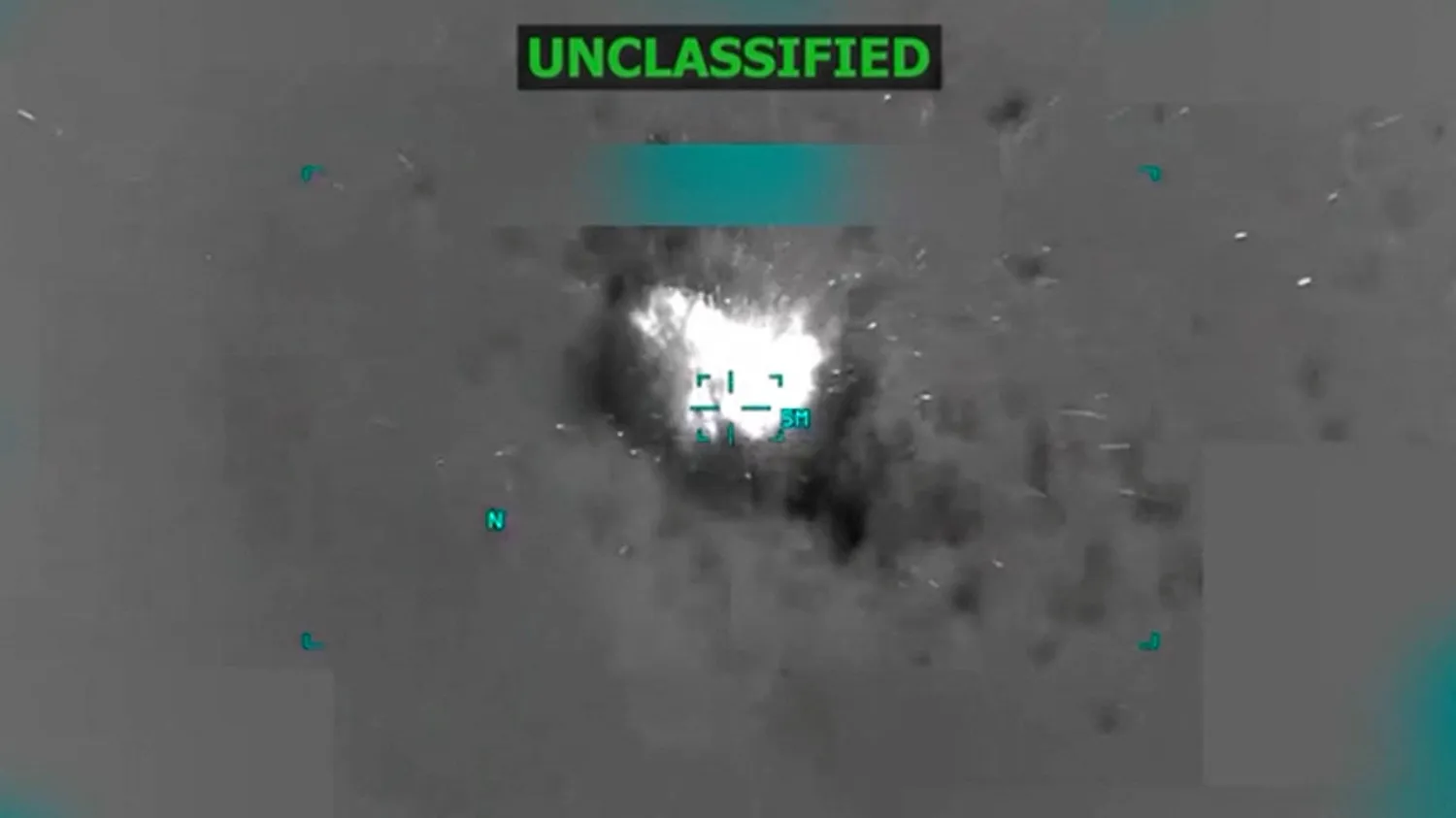
A boat burns off the coast of Venezuela in this screen grab taken from a video released October 14, 2025, depicting what US President Donald Trump said on a post on Truth Social was a US strike on a suspected drug-trafficking boat. Donald Trump via Truth Social/via REUTERS
TT

US Strikes Two More Alleged Drug-carrying Boats, this Time in the Pacific Ocean

A boat burns off the coast of Venezuela in this screen grab taken from a video released October 14, 2025, depicting what US President Donald Trump said on a post on Truth Social was a US strike on a suspected drug-trafficking boat. Donald Trump via Truth Social/via REUTERS

The US military on Wednesday launched its ninth strike against an alleged drug-carrying vessel, killing three people in the waters of the eastern Pacific Ocean, Defense Secretary Pete Hegseth said Wednesday, further expanding the Trump administration’s campaign against drug trafficking in South America.

Wednesday's strike followed a strike Tuesday night, also in the eastern Pacific, that killed two people, according to Hegseth.

The attacks Tuesday and Wednesday were departures from the seven previous US strikes that had targeted vessels in the Caribbean. They bring the death toll to at least 37 from attacks that began last month, The Associated Press said.

The strikes represent an expansion of the military's targeting area as well as a shift to the waters off South America where much of the cocaine from the world’s largest producers is smuggled. Hegseth’s social media posts also drew a direct comparison between the war on terrorism that the US declared after the Sept. 11, 2001, attacks and the Trump administration's crackdown.

“Just as Al Qaeda waged war on our homeland, these cartels are waging war on our border and our people,” Hegseth said, adding “there will be no refuge or forgiveness — only justice.”

Later Wednesday, he referred to the alleged drug-runners as “the ‘Al Qaeda’ of our hemisphere.”

Republican President Donald Trump has justified the strikes by asserting that the United States is engaged in an “armed conflict” with drug cartels and proclaiming the criminal organizations unlawful combatants, relying on the same legal authority used by President George W. Bush's administration for the war on terrorism.

Trump says strikes on land could be next

Asked about the latest boat attack, Trump insisted that “we have legal authority. We’re allowed to do that.” He said similar strikes could eventually come on land.

“We will hit them very hard when they come in by land,” Trump told reporters in the Oval Office. “We’re totally prepared to do that. And we’ll probably go back to Congress and explain exactly what we’re doing when we come to the land.”

Lawmakers from both political parties have expressed concerns about Trump ordering the military actions without receiving authorization from Congress or providing many details.

Appearing alongside Trump, Secretary of State Marco Rubio defended such strikes, saying, “If people want to stop seeing drug boats blow up, stop sending drugs to the United States.”

Trump said the strikes he is ordering are meant to save Americans and “the only way you can’t feel bad about it ... is that you realize that every time you see that happen, you’re saving 25,000 lives.”

Targeting a boat in a thoroughfare for cocaine smuggling

In the first brief video Hegseth posted Wednesday, a small boat, half-filled with brown packages, is seen moving along the water. Several seconds into the video, the boat explodes and is seen floating motionless on the water in flames.

The second video shows another boat moving quickly before being struck by an explosion. Video apparently recorded after the explosion shows packages floating in the water.

The US military has built up an unusually large force in the Caribbean Sea and the waters off the coast of Venezuela since this summer, raising speculation that Trump could try to topple Venezuelan President Nicolás Maduro. Maduro faces charges of narcoterrorism in the US.

In his posts on the strikes, Trump has repeatedly argued that illegal narcotics and the drug fentanyl carried by the vessels have been poisoning Americans.

While the bulk of American overdose deaths are from fentanyl, the drug is transported by land from Mexico. Venezuela is a major drug transit zone, but the eastern Pacific Ocean, not the Caribbean, is the primary area for smuggling cocaine.

Colombia and Peru, countries with coastlines on the eastern Pacific, are the world’s top cocaine producers. Wedged between them is Ecuador, whose world-class ports and myriad maritime shipping containers filled with bananas have become the perfect vehicle for drug traffickers to move their product.

The administration has sidestepped prosecuting any occupants of alleged drug-running vessels after returning two survivors of an earlier strike to their home countries of Ecuador and Colombia.

Ecuadorian officials later said they released the man who was returned because they had no evidence he committed a crime in their country.

Questions from Congress as strikes continue

Some Republican lawmakers have asked the White House for more clarification on its legal justification and specifics on how the strikes are conducted, while Democrats insist they are violations of US and international law.

Sen. Richard Blumenthal, a Democratic member of the Senate Armed Services Committee, said he was alarmed and angry about a lack of information on the strikes.

“Expanding the geography simply expands the lawlessness and the recklessness in the use of the American military without seeming legal or practical justification,” Blumenthal said.

He said the way to target trafficking would be stopping the boats and interrogating those aboard to find the source of the drugs, “not just destroy the smugglers who are likely to be at the bottom of the smuggling chain.”

The Republican-controlled Senate recently voted down a Democratic-sponsored war powers resolution, mostly along party lines, that would have required the president to seek authorization from Congress before further military strikes.

Republican Sen. John Kennedy of Louisiana said he’s met with Rubio.

“He has researched the legal ramifications carefully and he believes we’re on solid ground in attacking these narcoterrorists," Kennedy said. "I trust his judgment.”



Leaders of Japan and South Korea Discuss Economy and Regional Challenges at Summit

13 January 2026, Japan, Nara: Japan's Prime Minister Sanae Takaichi shakes hands with South Korea's President Lee Jae Myung at the start of their summit meeting in Nara. (dpa)
TT

Leaders of Japan and South Korea Discuss Economy and Regional Challenges at Summit

13 January 2026, Japan, Nara: Japan's Prime Minister Sanae Takaichi shakes hands with South Korea's President Lee Jae Myung at the start of their summit meeting in Nara. (dpa)

South Korean President Lee Jae Myung and Japanese Prime Minister Sanae Takaichi agreed to step up cooperation between the neighbors, whose relations are occasionally strained, as they both face growing uncertainty and regional challenges.

"I believe cooperation between Korea and Japan is now more important than ever and anything else, as we have to continue moving forward to a new, better future amid this complex, unstable international order," Lee said at the outset of the summit Tuesday.

Takaichi said she renewed her determination to further improve Japan's relations with South Korea “as I believe the two countries should cooperate and contribute for the stability in the region.”

“This year I will elevate Japan-South Korea relations even higher," said Takaichi, who aims to secure stable ties with Seoul while Tokyo struggles with a worsening dispute with China.

The meeting could deliver a political win as Takaichi seeks to shore up her power. A few months after taking office, she enjoys strong approval ratings but her party has a majority in only one of two houses of Parliament. There is growing speculation she may be planning a snap election in hopes of gaining more seats.

Takaichi is hosting Lee in her hometown, Nara, an ancient capital known for its treasured deer and centuries-old Buddhist temples, following a request by Lee during the October APEC meeting in Gyeongju, South Korea.

Nara, the center of cultural exchanges between the Korean Peninsula and Japan in ancient times, “carries a special meaning at a time Korea-Japan exchanges are more important than ever," Lee said.

Takaichi was in Nara on Monday to prepare and posted on X: “I hope to further push forward Japan’s relations with South Korea in the forward-looking way as we meet in the ancient capital of Nara with more than 1,300 years of history and longstanding cultural exchanges between Japan and the Korean Peninsula.”

The Japanese prime minister faces intensifying trade and political tension with China over a remark about Taiwan that angered Beijing days after she took office. Takaichi said that potential Chinese military action against Taiwan, the island democracy Beijing claims as its own, could justify Japanese intervention.

Tuesday's meeting was intended to focus on trade and the challenges of China and North Korea, as well as efforts to deepen trust between the two countries.

Japan and South Korea, both key US allies, must also figure out how to deal with President Donald Trump’s unpredictable diplomacy, and both countries are under US pressure to increase defense spending.

Lee was in Beijing last week for talks with Chinese leader Xi Jinping as China steps up economic and political pressure against Japan and seeks to cozy up to Seoul. During the visit, the South Korean leader told reporters that relations with Japan are as important as those with China but that South Korea's ability to broker reconciliation between its neighbors is limited.

Lee, in an interview Monday with Japan’s NHK television, noted his interest in gaining Japanese backing for South Korea's participation the 12-member Comprehensive and Progressive Agreement for Trans-Pacific Partnership. He said that would involve South Korea lifting a ban on imports from Fukushima and nearby Japanese prefectures affected by the 2011 Fukushima Daiichi nuclear disaster and may take time because of health concerns among South Koreans.

Lee also said his country wants to cooperate with Japan on security under a trilateral framework that includes the US, but “what’s really important is the issue of deep mutual trust.”

Relations between Seoul and Tokyo have begun improving in recent years in the face of shared challenges such as growing China-US competition and North Korea’s advancing nuclear program.

There were early concerns about Takaichi's ability to work with Lee, fed by her reputation as a security hawk and an assumption by some that the left-wing South Korean leader would tilt toward North Korea and China. But so far, both leaders have sought to set aside their differences.

While the two leaders are expected to avoid discussing their historical disputes, media reports say they may discuss possible humanitarian cooperation in the ongoing effort to recover remains from a former undersea mining site in western Japan where 180 workers, mostly Korean forced laborers, were killed in a 1942 accident.


People Inside Iran Describe Heavy Security and Scattered Damage in First Calls to Outside World

Members of the Iranian police attend a pro-government rally in Tehran, Iran, January 12, 2026. Stringer/WANA (West Asia News Agency) via Reuters
TT

People Inside Iran Describe Heavy Security and Scattered Damage in First Calls to Outside World

Members of the Iranian police attend a pro-government rally in Tehran, Iran, January 12, 2026. Stringer/WANA (West Asia News Agency) via Reuters

Iranians could call abroad on mobile phones Tuesday for the first time since communications were halted during a crackdown on nationwide protests in which activists said at least 646 people have been killed.

Several people in Tehran were able to call The Associated Press and speak to a journalist there. The AP bureau in Dubai, United Arab Emirates, was unable to call those numbers back. The witnesses said SMS text messaging still was down and that internet users in Iran could connect to government-approved websites locally but nothing abroad.

The witnesses gave a brief glimpse into life on the streets of the Iranian capital over the four and a half days of being cut off from the world. They described seeing a heavy security presence in central Tehran.

Anti-riot police officers, wearing helmets and body armor, carried batons, shields, shotguns and tear gas launchers. They stood watch at major intersections. Nearby, the witnesses saw members of the Revolutionary Guard's all-volunteer Basij force, who similarly carried firearms and batons. Security officials in plainclothes were visible in public spaces as well.

Several banks and government offices were burned during the unrest, they said. ATMs had been smashed and banks struggled to complete transactions without the internet, the witnesses added.

However, shops were open, though there was little foot traffic in the capital. Tehran's Grand Bazaar, where the demonstrations began Dec. 28, was to open Tuesday. However, a witness described speaking to multiple shopkeepers who said the security forces ordered them to reopen no matter what. Iranian state media had not acknowledged that order.

The witnesses spoke on condition of anonymity for fear of reprisal.

Iran says it communicated with Washington

US President Donald Trump has said Iran wants to negotiate with Washington after his threat to strike country over its crackdown.

Iranian Foreign Minister Abbas Araghchi, speaking to Al Jazeera in an interview aired Monday night, said he continued to communicate with US envoy Steve Witkoff.

The communication “continued before and after the protests and are still ongoing," Araghchi said. However, “Washington’s proposed ideas and threats against our country are incompatible.”

White House press secretary Karoline Leavitt said Iran’s public rhetoric diverges from the private messaging the administration has received from Tehran in recent days.

“I think the president has an interest in exploring those messages,” Leavitt said. “However, with that said, the president has shown he’s unafraid to use military options if and when he deems necessary, and nobody knows that better than Iran.”

Meanwhile, pro-government demonstrators flooded the streets Monday in support of the theocracy, a show of force after days of protests directly challenging the rule of 86-year-old Supreme Leader Ali Khamenei. Iranian state television aired chants from the crowd, which appeared to number in the tens of thousands, who shouted “Death to America!” and “Death to Israel!”

Others cried out, “Death to the enemies of God!” Iran’s attorney general has warned that anyone taking part in protests will be considered an “enemy of God,” a death-penalty charge.

Trump imposes tariffs on Iran trading partners

Trump announced Monday that countries doing business with Iran will face 25% tariffs from the United States. Trump announced the tariffs in a social media posting, saying they would be “effective immediately.”

Trump said Sunday that his administration was in talks to set up a meeting with Tehran, but cautioned that he may have to act first as reports of the death toll in Iran mount and the government continues to arrest protesters.

“I think they’re tired of being beat up by the United States,” Trump said. “Iran wants to negotiate.”

Iran, through the country’s parliamentary speaker, warned Sunday that the US military and Israel would be “legitimate targets” if Washington uses force to protect demonstrators.

More than 10,700 people also have been detained over the two weeks of protests, said the US-based Human Rights Activists News Agency, which has been accurate in previous unrest in recent years and gave the latest death toll early Tuesday. It relies on supporters in Iran crosschecking information. It said 512 of the dead were protesters and 134 were security force members.

With the internet down in Iran, gauging the demonstrations from abroad has grown more difficult. The Associated Press has been unable to independently assess the toll. Iran’s government hasn’t offered overall casualty figures.


Trump Says Nations Doing Business with Iran Face 25% Tariff on US Trade

US President Donald Trump speaks with members of the media aboard Air Force One en route from Florida to Joint Base Andrews, Maryland, US, January 11, 2026. REUTERS/Nathan Howard
TT

Trump Says Nations Doing Business with Iran Face 25% Tariff on US Trade

US President Donald Trump speaks with members of the media aboard Air Force One en route from Florida to Joint Base Andrews, Maryland, US, January 11, 2026. REUTERS/Nathan Howard

President Donald Trump said on Monday any country that does business with Iran will face a tariff rate of 25% on any trade with the US, as Washington weighs a response to the situation in Iran which is seeing its biggest anti-government protests in years.

"Effective immediately, any Country doing business with the Islamic Republic of Iran will pay a Tariff of 25% on any and all business being done with the United States of America," Trump said in a post on Truth Social. Tariffs are paid by US importers of goods from those countries. Iran, a member of the OPEC oil producing group, has been heavily sanctioned by Washington for years. It exports much of its oil to China, with Türkiye, Iraq, and India among its other top trading partners.

"This Order is final ‌and ⁠conclusive," Trump said ‌without providing any further detail.

There was no official documentation from the White House of the policy on its website, nor information about the legal authority Trump would use to impose the tariffs, or whether they would be aimed at all of Iran's trading partners. The White House did not respond to a request for comment.

The Chinese embassy in Washington criticized Trump's approach, saying China will take "all necessary measures" to safeguard its interests and opposed "any illicit unilateral sanctions and long-arm jurisdiction."

"China's position against the indiscriminate imposition of tariffs is consistent and clear. Tariff wars and trade wars have no winners, and ⁠coercion and pressure cannot solve problems," a spokesperson of the Chinese embassy in Washington said on X.

Japan and South Korea, which agreed on trade ‌deals with the US last year, said on Tuesday they are ‍closely monitoring the development.

"We ... plan to take any necessary ‍measures once the specific actions of the US government become clear," South Korea's trade ministry said in a ‍statement.

Japan’s Deputy Chief Cabinet Secretary Masanao Ozaki told reporters that Tokyo will "carefully examine the specific content of any measures as they become clear, as well as their potential impact on Japan, and will respond appropriately."

Iran, which had a 12-day war with US ally Israel last year and whose nuclear facilities the US military bombed in June, is seeing its biggest anti-government demonstrations in years. Trump has said the US may meet Iranian officials and that he was in contact with Iran's opposition, while piling pressure on its leaders, including threatening military action.

Tehran said ⁠on Monday it was keeping communication channels with Washington open as Trump considered how to respond to the situation in Iran, which has posed one of the gravest tests of clerical rule in the country since the Iranian Revolution in 1979.

Demonstrations evolved from complaints about dire economic hardships to defiant calls for the fall of the deeply entrenched clerical establishment. US-based rights group HRANA said it had verified the deaths of 599 people - 510 protesters and 89 security personnel - since the protests began on December 28.

While air strikes were one of many alternatives open to Trump, "diplomacy is always the first option for the president," White House press secretary Karoline Leavitt said on Monday.

During the course of his second term in office, Trump has often threatened and imposed tariffs on other countries over their ties with US adversaries and over trade policies that he has described as unfair to Washington.

Trump's trade policy is under legal pressure as ‌the US Supreme Court is considering striking down a broad swathe of Trump's existing tariffs.

Iran exported products to 147 trading partners in 2022, according to World Bank's most recent data.