


Pakistan, Afghanistan Hold Third Day of Peace Talks as Border Tensions Test Ceasefire

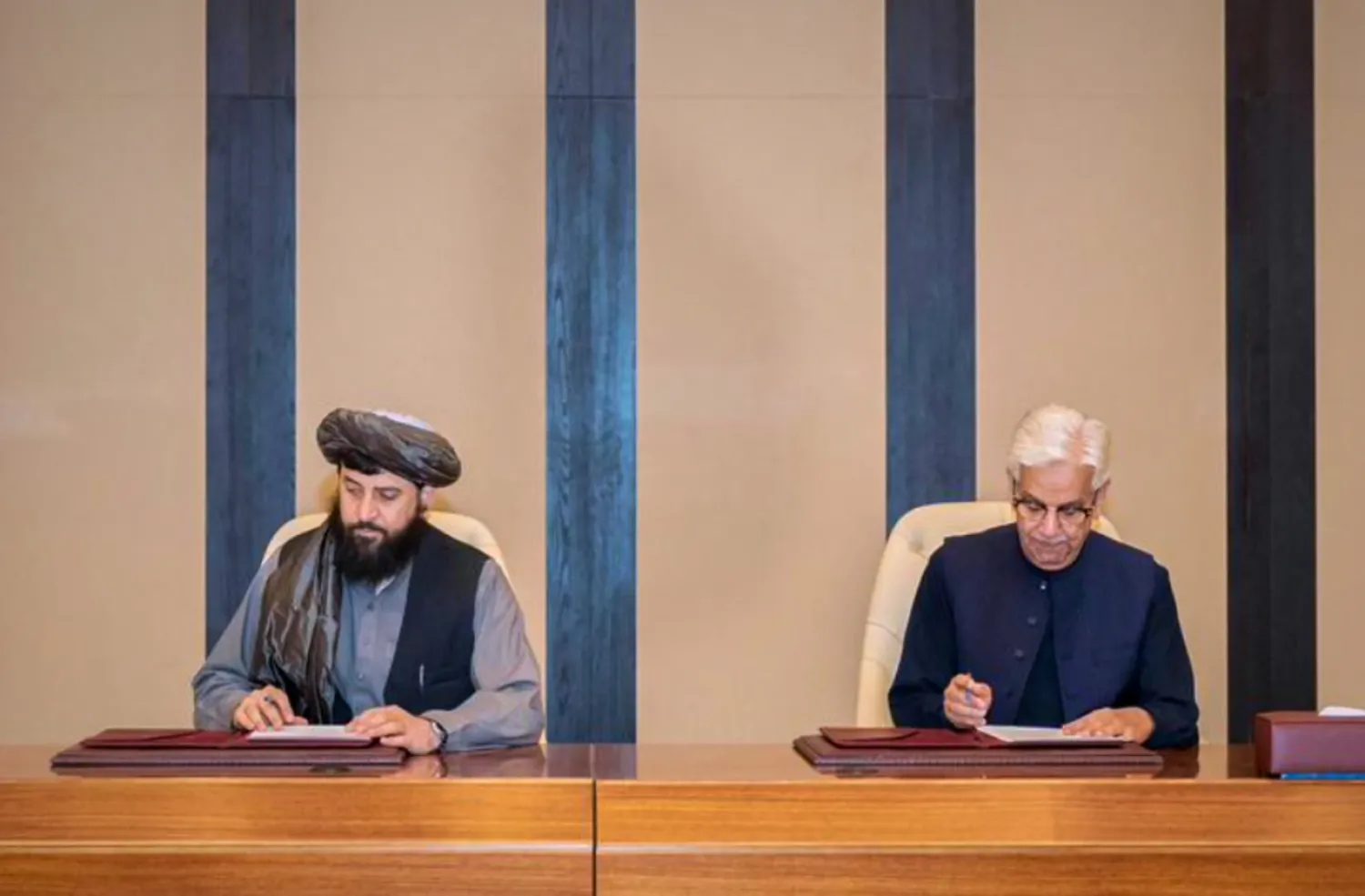
Pakistani Defense Minister Khawaja Asif, center right, and Afghan Defense Minister Mullah Muhammad Yaqoob sign a ceasefire agreement in Doha, Qatar, Sunday, October 19, 2025.(Qatar Ministry of Foreign Affairs via AP)
TT

Pakistan, Afghanistan Hold Third Day of Peace Talks as Border Tensions Test Ceasefire

Pakistani Defense Minister Khawaja Asif, center right, and Afghan Defense Minister Mullah Muhammad Yaqoob sign a ceasefire agreement in Doha, Qatar, Sunday, October 19, 2025.(Qatar Ministry of Foreign Affairs via AP)

Peace talks between Pakistan and neighboring Afghanistan entered the third day on Monday in Istanbul, officials from both sides said.

The talks come a day after US President Donald Trump pledged to resolve the crisis between the two neighbors “very quickly” and as tensions along the border remain high following recent exchanges of fire that have killed dozens of soldiers and civilians on the both sides, The AP news reported.

The clashes prompted Qatar to host the first round of negotiations that led to a cease-fire agreement on Oct. 19 between Islamabad and Kabul.

Afghan media on Monday quoted Zabihullah Mujahid, the chief spokesman for Afghanistan’s Taliban government, as saying the Istanbul discussions were still in progress, with no outcome announced yet. Pakistani officials also confirmed the talks are underway.

The officials who have direct knowledge of the negotiations being hosted by Turkish government spoke on condition of anonymity because they were not authorized to brief the media.

Pakistan’s army said Sunday it had killed 25 militants while “repelling two major infiltration attempts” along the border, even as delegations were talking in Istanbul. It also said five Pakistani soldiers had died during exchanges of fire.

It was not possible to verify the casualty figures as the area is remote and off-limits to the media.

Trump, speaking on the sidelines of the ASEAN summit in Malaysia on Sunday, said he had learned that Pakistan and Afghanistan had begun peace efforts, adding that he would “get that solved very quickly.”

Pakistan last year recommended Trump for the Nobel Peace Prize for helping defuse a crisis with neighboring India when the two nuclear-armed rivals were on the brink of a wider conflict. That standoff followed the killing of tourists in Indian-controlled Kashmir in April and ended after US-led diplomatic efforts produced a truce, which Trump has repeatedly taken credit for.

The latest Istanbul talks, hosted by the Turkish government and facilitated by Qatar, are aimed at ensuring that the ceasefire remains intact and that the two sides reach a broader agreement.

Pakistan has long accused Afghanistan’s Taliban rulers of allowing militants to use Afghan soil to launch attacks across the border — allegations Kabul strongly denies.

No Pakistani government spokesman was immediately available for comment on the latest round of talks, which were expected to conclude Friday. A joint statement was anticipated before midnight.

According to two Pakistani security officials, the delegation from Islamabad presented its final position to the Afghan Taliban representatives, emphasizing that “patronage of terrorists is unacceptable” to Pakistan.

The officials said Pakistan also expects Kabul to take “concrete and verifiable” action against the outlawed Pakistani Taliban, or Tehrik-e-Taliban Pakistan (TTP), which has stepped up cross-border attacks and violence since the Taliban seized power in 2021.

The officials said Türkiye, as host nation, is striving to keep the discussions “productive, fruitful and result oriented.” They said Pakistan had shared solid evidence with the Afghan side about the cross-border attacks by Pakistani Taliban from the Afghan soil.

The trade and border communities are also waiting for a positive outcome, as all crossings between the two countries have been shut for two weeks. Hundreds of trucks carrying goods are stranded, awaiting the reopening of key trade routes.

Pakistan’s border regions have experienced violence since 1979, when it became a frontline state in the U.S.-backed war against the Soviet Union in Afghanistan.



French, Japanese Ships Cross Strait of Hormuz in First Since War

A cargo ship in the Gulf, near the Strait of Hormuz, as seen from northern Ras al-Khaimah, near the border with Oman’s Musandam governance, amid the US-Israeli conflict with Iran, in United Arab Emirates, March 11, 2026. (Reuters)
TT

French, Japanese Ships Cross Strait of Hormuz in First Since War

A cargo ship in the Gulf, near the Strait of Hormuz, as seen from northern Ras al-Khaimah, near the border with Oman’s Musandam governance, amid the US-Israeli conflict with Iran, in United Arab Emirates, March 11, 2026. (Reuters)

One French- and another Japanese-owned vessel are among a handful of vessels to have crossed the war-torn Strait of Hormuz, maritime tracking data showed Friday.

The passage, a vital maritime route for oil and liquified natural gas, has been virtually blocked by Iran since the start of the war, said AFP.

But both ships made the crossing on Thursday, according to ship tracking company Marine Traffic's website.

The Maltese-flagged Kribi belonging to the French maritime transport group CMA CGM crossed the waterway to leave the Gulf on Thursday afternoon, Marine Traffic's data showed.

By early Friday, it was off Muscat, Oman, still broadcasting the message "owner France" on its transponder system in the field usually used to give the destination.

The vessel's navigation data showed it had crossed via an Iranian-approved route through its waters, dubbed the "Tehran Toll Booth" by leading shipping journal Lloyd's List.

- Southern route -

In addition, three tankers -- including one co-owned by a Japanese company -- crossed the Strait of Hormuz on Thursday by taking an alternative, southern route.

They hugged close to the shore of Oman's Musandam Peninsula -- a first in nearly three weeks according to Lloyd's List.

Before the war, which started more than a month ago, about a fifth of global oil and liquefied natural gas (LNG) passed through the Strait.

All three ships signaled they were an "OMANI SHIP" in the message broadcast by their transponder as they crossed the strait.

The Sohar LNG, which was empty when crossing, is co-owned by Japanese shipping company Mitsui O.S.K.

That makes it the first Japanese vessel to exit the Gulf since the start of the war, according to a company statement quoted by Japanese media.

The Hong-Kong flagged New Vision, which crossed the strait on March 1 right after the war started, is expected in the French port of Le Havre on Saturday evening.

Since the conflict started however, that has dwindled to a trickle as Iran selectively attacks ships and energy facilities throughout the Gulf in retaliation for US and Israeli attacks.

A few commercial ships crossing the Strait of Hormuz recently have passed through the Iranian-approved route in the north of the waterway.

- Down to a trickle -

Just 221 commodities vessels have crossed the Strait of Hormuz since March 1, some more than once, according to Kpler data up to Friday morning.

In peacetime, the same waterway handles around 120 daily transits, according to Lloyd's List.

Of the vessels that made the crossing, 60 percent either came from Iran or were heading there.

It was not clear from the data how many had been cleared to make the crossing by Tehran.

But it did show that, among the 118 crossings by ships carrying cargo, 37 had left the Gulf carrying crude oil.

Most of those oil tankers -- 30 of them -- came from Iran or sailed under the Iranian flag. And most ships carrying Iranian oil did not specify their destination on their transponder.

Of those who did, all but one reported they were heading to China.

In the early days of the war, transponder data showed dozens of ships broadcasting messages such as "Chinese crew" or "Chinese owner" in the field usually used for their destination.

This appeared to be an attempt by the ships to avoid being targeted by Iran.


Iran Executes Two Linked to Opposition Group

Executions in Iran have surged in recent years - AFP
TT

Iran Executes Two Linked to Opposition Group

Executions in Iran have surged in recent years - AFP

Iran on Saturday executed two men it said were convicted of links to an opposition group, the People's Mojahedin Organization of ‌Iran, and ‌of carrying out armed ‌attacks, ⁠domestic media reported.

The ⁠executions were the latest in recent days of individuals with PMOI links.

The PMOI confirmed ⁠Saturday's executions, saying ‌in ‌a statement that Iran was "trying ‌to hide its ‌weakness by executing political prisoners, especially PMOI members and supporters." Four PMOI ‌members were executed earlier this week, ⁠it ⁠said.

The group said the two men executed on Saturday were arrested in January 2024 and had their death sentences upheld in December 2025.


Earthquake Kills 8 Members of Same Family near Afghan Capital

Previous earthquake in Afghanistan (Archive-Reuters)
TT

Earthquake Kills 8 Members of Same Family near Afghan Capital

Previous earthquake in Afghanistan (Archive-Reuters)

An earthquake that struck Afghanistan overnight killed eight members of the same family in Kabul province, the health ministry said on Saturday.

The 5.8-magnitude quake struck at 8.42 pm (1612 GMT) on Friday at a depth of 186 kilometers (115 miles) at the epicenter in northeastern Badakhshan province, according to the US Geological Survey (USGS).

Shaking was felt in multiple parts of the country, including the capital Kabul, according to AFP journalists.

"In the Gosfand Dara area of Kabul Province, eight members of a family died as a result of the earthquake," Health Ministry spokesman Sharafat Zaman said in a message to media.

He added that a child aged around two years old was the only survivor from the household and the country's disaster management agency said the boy had been injured in the tremor.

Afghanistan is frequently jolted by earthquakes, particularly along the Hindu Kush mountain range near where the Eurasian and Indian tectonic plates meet.

In August, a shallow magnitude 6 earthquake wiped out mountainside villages and killed more than 2,200 people in eastern Afghanistan, making it the deadliest tremor in the country's recent history.