


Russia and Ukraine Say Their Forces Are Locked in Fierce Fighting in the Ruins of Pokrovsk

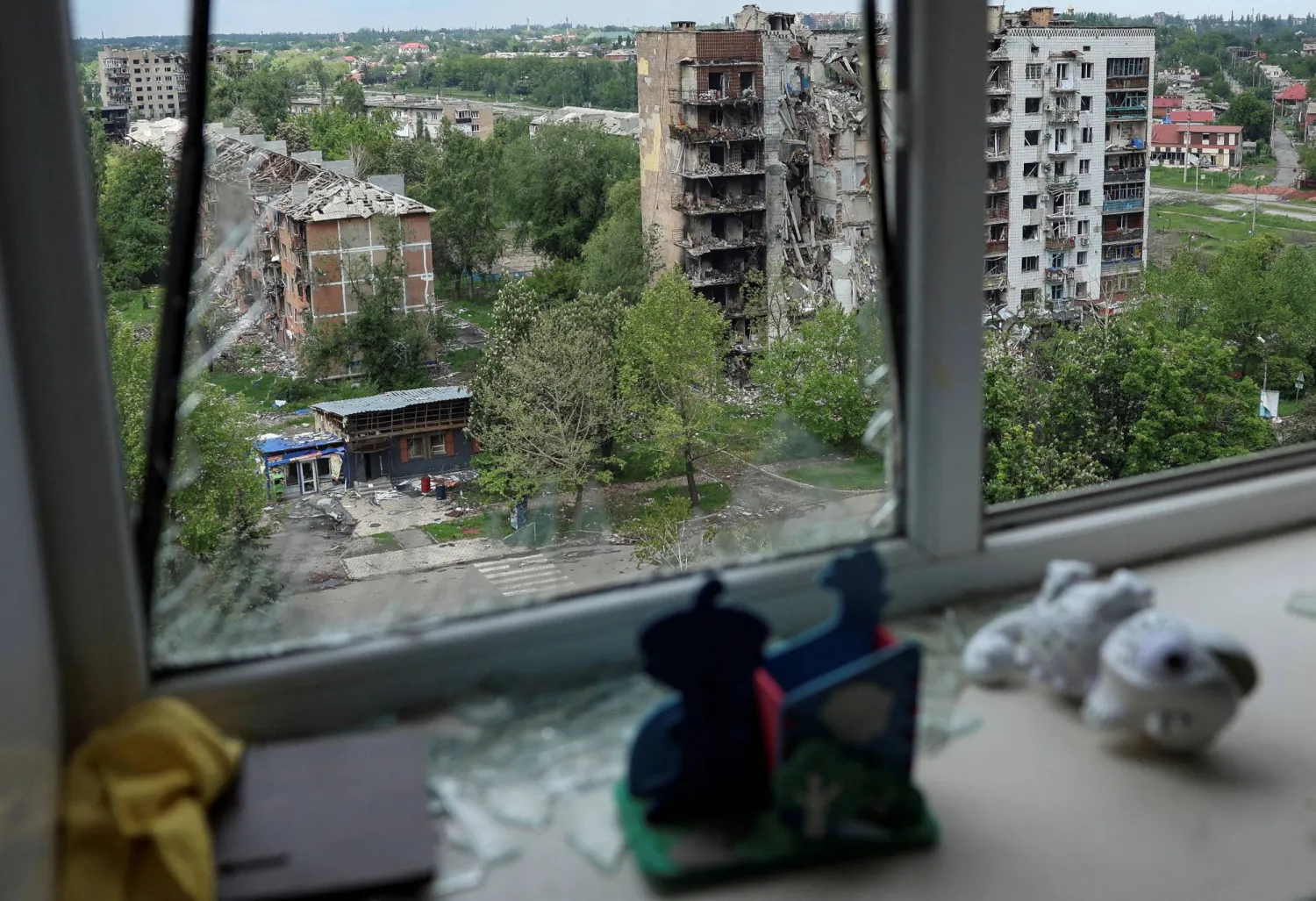
A view shows apartment buildings hit by Russian military strikes in the front line town of Pokrovsk, amid Russia's attack on Ukraine, in Donetsk region, Ukraine May 21, 2025. (Reuters)
TT

Russia and Ukraine Say Their Forces Are Locked in Fierce Fighting in the Ruins of Pokrovsk

A view shows apartment buildings hit by Russian military strikes in the front line town of Pokrovsk, amid Russia's attack on Ukraine, in Donetsk region, Ukraine May 21, 2025. (Reuters)

Russia said on Wednesday that its forces were advancing north inside Pokrovsk in a drive to take full control of the Ukrainian city, but the Ukrainian army said its units were battling hard to try to stop the Russians from gaining new ground. 

Ukraine has acknowledged that its troops face a difficult position in the strategic eastern city, once an important transport and logistics hub for the Ukrainian army, which Russia has been trying to capture for more than a year. 

Russia sees the city as the gateway to its capture of the remaining 10%, or 5,000 square km (1,930 square miles) of Ukraine's eastern industrial Donbas region, one of its key aims in the almost four-year-old war. 

The Russian defense ministry said two assault groups were destroying Ukrainian troops that were surrounded in several districts of the city and continuing an offensive pushing north through it. Russian forces were clearing Ukrainian troops from settlements on Pokrovsk's southeastern flank and had repelled Ukrainian attempts to break out of encirclement. 

The Ukrainian military denied that its troops were surrounded in Pokrovsk. It said they were trying to stop Russian soldiers from digging in while seeking to secure and protect logistics routes in the wider area. 

"Measures are being taken to block the enemy, which is attempting to infiltrate and accumulate in the city of Pokrovsk," the Ukrainian General Staff said in a statement. 

"Active countermeasures are being taken against attempts by enemy infantry groups to gain a foothold." 

Ukrainian President Volodymyr Zelenskiy said on Monday the area around Pokrovsk remained under severe pressure but that up to 300 Russian servicemen still in the city had made no gains in the past day and there were just 60 in another city, Kupiansk. 

The Russian Defense Ministry said on Wednesday that either Zelenskiy had no grasp of what was happening or he was deliberately trying to conceal the parlous situation for Kyiv's forces. 

Ukrainian units were trapped in "cauldrons" in both locations, it said, and their position was deteriorating rapidly while Russian forces advanced, "leaving no chance for Ukrainian servicemen to save themselves other than by voluntary surrender". 

Reuters was unable to verify either side's assertions because of restrictions on access to the battlefield from both sides. 

PLATFORM TO DRIVE NORTH 

Moscow says capturing Pokrovsk would give it a platform to drive north towards the two biggest remaining Ukrainian-controlled cities in Donetsk - Kramatorsk and Sloviansk. It would give Moscow its most important single territorial gain inside Ukraine since it took the ruined city of Avdiivka in early 2024. 

In a break from the frontal assaults which Russian forces have used against other cities, Russia has used pincer movements to almost encircle Ukrainian forces in both Pokrovsk and the city of Kupiansk while small highly-mobile units and drones disrupted logistics and sowed chaos behind Ukrainian lines. 

Russia's tactics in both locations have created what Russian military bloggers call a grey zone of ambiguity where neither side had full control, but which was extremely difficult for Ukraine to defend. 

Open-source battlefield maps show that Russian forces are a few kilometers away from fully encircling Pokrovsk, known by Russia as Krasnoarmeysk, and control a significant part of Kupiansk where they are advancing on the main road to the city. 

Pokrovsk, a road and rail hub in Ukraine's eastern Donetsk region, had a pre-war population of some 60,000 people. But most people have now fled, all children have been evacuated and few civilians remain amid its pulverized apartment buildings and cratered roads. 

As well as trying to take the whole of Donbas, Russia has been making gradual advances in the Kharkiv and Dnipopetrovsk regions further west. 

Russia's military says it now controls more than 19% of Ukraine, or some 116,000 square km (44,800 square miles). 

Ukrainian maps also show Russian control at around 19% of Ukraine, up around 1 percentage point from Moscow's position two years ago. 


Macron Urges 'Calm' ahead of Tense Rally for Slain Far-right Activist

French police secure the area after a bomb threat at the headquarters of France's hard-left party La France Insoumise (France Unbowed - LFI) and its evacuation in Paris, France, February 18, 2026. REUTERS/Sarah Meyssonnier
TT

Macron Urges 'Calm' ahead of Tense Rally for Slain Far-right Activist

French police secure the area after a bomb threat at the headquarters of France's hard-left party La France Insoumise (France Unbowed - LFI) and its evacuation in Paris, France, February 18, 2026. REUTERS/Sarah Meyssonnier

French President Emmanuel Macron appealed on Saturday for cooler heads to prevail ahead of a rally for a far-right activist whose killing, blamed on the hard left, has put the country on edge.

Macron also said his government would hold a meeting next week to discuss "violent action groups" in the wake of the fatal beating of Quentin Deranque, which has ignited tensions between the left and right ahead of the 2027 presidential vote.

The 23-year-old died from head injuries following clashes between radical left and far-right supporters on the sidelines of a demonstration against a politician from the left-wing France Unbowed (LFI) party in the southeastern city of Lyon last week.

A rally, widely publicized online by ultra-nationalist and far-right groups, is expected to be attended by 2,000 to 3,000 people, with the authorities fearing further clashes with left-wing protesters.

Speaking at a farming trade fair in Paris, Macron urged "everyone to remain" calm ahead of the rally for Deranque in Lyon, which is set to go ahead under high security later on Saturday despite Lyon's left-wing green mayor asking the state to ban it.

"In the Republic, no violence is legitimate," said Macron, who will be unable to contest next year's election after hitting the two-term limit. "There is no place for militias, no matter where they come from."

- 'Over 1,000 neo-Nazis' -

Ahead of the Lyon rally, some residents living near the march's planned route had barricaded the ground floor windows of their apartments, fearing unrest.

"At my age, I'm not going to play the tough guy. If I have to go out somewhere, I'll avoid the places where they're marching," said Lyon local Jean Echeverria, 87.

"They'll just keep fighting each other, it'll never end. Between the extreme of this and the extreme of that, it's non-stop," he added.

Two friends of Deranque's were behind the official call to march in his honor.

But according to the Deranque family's lawyer, Fabien Rajon, his parents will not take part in the rally, which they have urged to go ahead "without violence" and "without political statements".

Several ultra-right-wing groups, including Deranque's nationalist Allobroges Bourgoin faction, have nonetheless heavily publicized the march on social media.

The authorities fear that far-right and hard-left activists from elsewhere in Europe might travel to France for the event, stoking concerns of further unrest.

Jordan Bardella, the head of the anti-immigration National Rally (RN) party -- which senses its best chance ever of scoring the presidency in next year's vote -- has urged supporters not to go.

"We ask you, except in very specific and strictly supervised local situations not to attend these gatherings nor to associate the National Rally with them," he wrote in a message sent to party officials and seen by AFP.

LFI coordinator Manuel Bompard backed the Lyon mayor's call for a ban, warning on X that the march would be a "fascist demonstration" which "over 1,000 neo-Nazis from all over Europe" were expected to attend.

But Interior Minister Laurent Nunez declined to ban the rally, arguing that he had to "strike a balance between maintaining public order and freedom of expression" and pledging an "extremely large police deployment".

- 'Wound' -

Deranque's death has provoked a reaction from US President Donald Trump's administration, with state department official Sarah Rogers on Friday branding the killing "terrorism" and claiming that "violent radical leftism is on the rise".

Likewise, Italian Prime Minister Giorgia Meloni on Wednesday called Deranque's death "a wound for all Europe", prompting Macron to urge the far-right leader to stay out of French matters.

Six men suspected of involvement in the fatal assault have been charged over the killing, while a parliamentary assistant to a radical left-wing MP has also been charged with complicity.

A far-right collective called Nemesis, which claims to "defend Western women" from the violence allegedly wrought by immigrants, said Deranque had been at the protest in Lyon to protect its members when he was assaulted by "anti-fascist" activists.

Having urged both the far right and hard left to clean up their acts, Macron said his administration would hold a meeting next week "take stock of violent action groups which are active and have links with political parties of any description".


US Military Strikes Another Alleged Drug Boat in Eastern Pacific, Killing 3

A shot of a boat targeted by a US raid in the Caribbean (archive - Reuters)
TT

US Military Strikes Another Alleged Drug Boat in Eastern Pacific, Killing 3

A shot of a boat targeted by a US raid in the Caribbean (archive - Reuters)

The US military said Friday that it has carried out another deadly strike on a vessel accused of trafficking drugs in the Eastern Pacific Ocean.

US Southern Command said on social media that the boat “was transiting along known narco-trafficking routes in the Eastern Pacific and was engaged in narco-trafficking operations.” It said the strike killed three people. A video linked to the post shows a boat floating in the water before bursting into flames.

Friday’s attack raises the death toll from the Trump administration’s strikes on alleged drug boats to at least 148 people in at least 43 attacks carried out since early September in the Caribbean Sea and eastern Pacific Ocean.

President Donald Trump has said the US is in “armed conflict” with cartels in Latin America and has justified the attacks as a necessary escalation to stem the flow of drugs. But his administration has offered little evidence to support its claims of killing “narcoterrorists.”

Critics have questioned the overall legality of the strikes as well as their effectiveness, in part because the fentanyl behind many fatal overdoses is typically trafficked to the US over land from Mexico.


Afghanistan Quake Causes No ‘Serious’ Damage, Injuries, Says Official

Afghan men prepare meals during the holy fasting month of Ramadan in Kabul, Afghanistan, 19 February 2026. (EPA)
TT

Afghanistan Quake Causes No ‘Serious’ Damage, Injuries, Says Official

Afghan men prepare meals during the holy fasting month of Ramadan in Kabul, Afghanistan, 19 February 2026. (EPA)

A 5.8-magnitude earthquake that rocked eastern Afghanistan including the capital Kabul has resulted in only minor damage and one reported injury, a disaster official told AFP on Saturday.

The quake hit on Friday just as people in the Muslim-majority country were sitting down to break their Ramadan fast.

The epicenter was near several remote villages around 130 kilometers (80 miles) northeast of Kabul, the United States Geological Survey said.

"There aren't any serious casualties or damages after yesterday's earthquake," said Mohammad Yousuf Hamad, spokesman for the National Disaster Management Authority.

He added that one person had sustained "a minor injury in Takhar", in Afghanistan's north, "and three houses had minor damage in Laghman" province.

Zilgay Talabi, a resident of Khenj district near the epicenter, said the tremor was "very strong, it went on for almost 30 seconds".

Earthquakes are common in Afghanistan, particularly along the Hindu Kush mountain range, near where the Eurasian and Indian tectonic plates meet.

In August last year, a shallow 6.0-magnitude quake in the country's east wiped out mountainside villages and killed more than 2,200 people.

Weeks later, a 6.3-magnitude quake in northern Afghanistan killed 27 people.

Large tremors in western Herat, near the Iranian border, in 2023, and in Nangarhar province in 2022, killed hundreds and destroyed thousands of homes.

Many homes in the predominantly rural country, which has been devastated by decades of war, are shoddily built.

Poor communication networks and infrastructure in mountainous Afghanistan have hampered disaster responses in the past, preventing authorities from reaching far-flung villages for hours or even days before they could assess the extent of the damage.
