


German Military Creates Rapid Response Teams to Counter Drone Threats

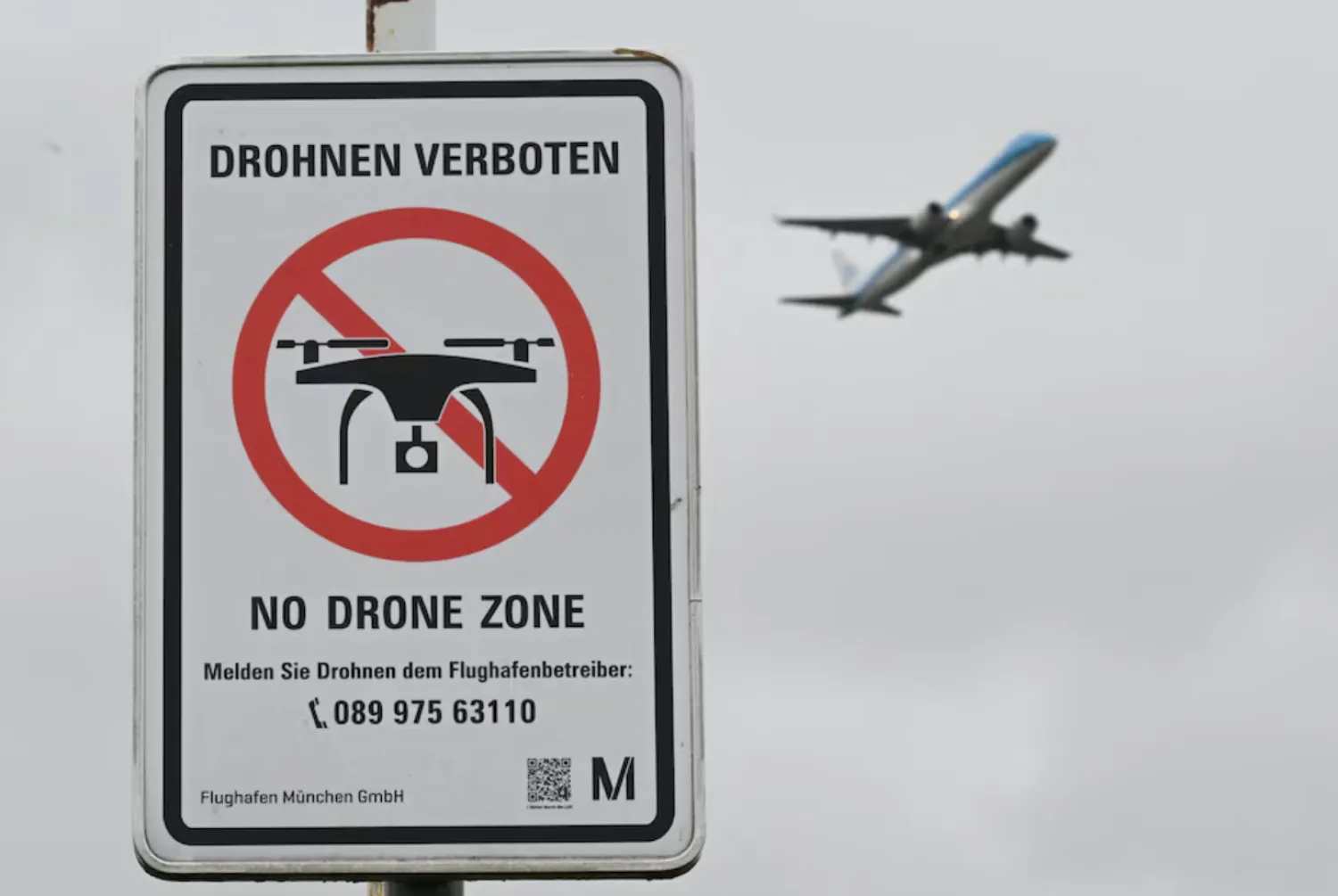
A sign with a drone ban is displayed outside the airport in Munich, Germany October 6, 2025. REUTERS/Angelika Warmuth/File
TT

German Military Creates Rapid Response Teams to Counter Drone Threats

A sign with a drone ban is displayed outside the airport in Munich, Germany October 6, 2025. REUTERS/Angelika Warmuth/File

The German military is setting up rapid response teams to counter acute drone threats, a top German military official said, most recently dispatching these experts to assist in Belgium.

"These anti-drone units are being established right now," Lieutenant General Alexander Sollfrank, who heads Germany's joint operations command and oversees the country's defense planning, told Reuters in an interview.

The German defense ministry said late on Thursday it was sending counter-drone experts to Belgium after a request from the country, which has been struggling with an increase in drone sightings near military installations and civilian airports.

DRONE SIGHTINGS CAUSE HEADACHES ACROSS EUROPE

"An advance party of air force personnel have arrived in Belgium to explore the situation and coordinate a temporary mission involving drone detection and counter-drone capabilities with the Belgian forces," the ministry said in a statement.

"The main party will follow shortly."

Sightings of drones over airports and military bases have become a constant problem in Belgium in recent days and have caused major disruptions across Europe in recent months.

They forced the temporary closures of airports in several countries including Sweden on Thursday.

Some officials have blamed the incidents on "hybrid warfare" by Russia. Moscow has denied any connection with the incidents.

Sollfrank declined to go into detail when talking about the new counter-drone units, citing operational security, but said a team sent to Copenhagen last month during an EU summit had been equipped with a mix of sensors and effectors.

"They have various systems to spot and counter drones. We have the option, for example, to assume control over a drone and land it at a specific location," said the general.

The counter-drone experts also have drones at their disposal that can eject nets to catch drones and thus take them down, as well as interceptors that ram hostile drones, he added.

BELGIUM AIRPORTS LATEST TO SPOT DRONES

Belgium's Liege airport resumed flights after a temporary halt due to a drone sighting on Friday, in the second such incident this week.

Drones spotted flying over airports in the capital, Brussels, and in Liege, in the country's east, forced the diversion of many incoming planes and the grounding of some due to depart on Tuesday.

The Belgian government called an emergency meeting of key government ministers and security chiefs on Thursday to address what the defense minister called a coordinated attack.


US Does ‘Not Need’ Help from Allies on Iran, Trump Says

An F/A-18F Super Hornet launches from the flight deck of the US Navy Nimitz-class aircraft carrier USS Abraham Lincoln during the Operation Epic Fury attack on Iran from an undisclosed location March 6, 2026. (US Navy/Handout via Reuters)
TT

US Does ‘Not Need’ Help from Allies on Iran, Trump Says

An F/A-18F Super Hornet launches from the flight deck of the US Navy Nimitz-class aircraft carrier USS Abraham Lincoln during the Operation Epic Fury attack on Iran from an undisclosed location March 6, 2026. (US Navy/Handout via Reuters)

President Donald Trump said Tuesday that US forces "no longer need" military help in the Iran war, after his calls for assistance from allies to reopen the Strait of Hormuz to oil traffic were largely rebuffed.

The American president has spent recent days griping about how world powers have so far declined to send warships to escort tankers through the narrow waterway in and out of the Gulf and key to the transit of crude.

With the war in its third week, Trump has repeatedly stressed that US and Israeli air strikes have decimated Iran's leadership, military facilities, and weapons manufacturing capacity.

"The United States has been informed by most of our NATO 'Allies' that they don't want to get involved with our Military Operation against the Terrorist Regime of Iran, in the Middle East," Trump posted on his Truth Social platform.

"Because of the fact that we have had such Military Success, we no longer 'need,' or desire, the NATO Countries' assistance -- WE NEVER DID! Likewise, Japan, Australia, or South Korea," Trump said, adding: "WE DO NOT NEED THE HELP OF ANYONE!"

Speaking of allies who have rejected his call for assistance, the 79-year-old Republican said he is "not surprised by their action, however, because I always considered NATO, where we spend Hundreds of Billions of Dollars per year protecting these same Countries, to be a one way street."

The US-Israeli war on Iran has expanded dramatically across the Middle East, with Iran targeting the energy facilities of its crude-producing neighbors.

Tehran has also attacked and threatened tankers transiting the Strait of Hormuz, all but closing the vital waterway through which one fifth of global crude oil passes.

French President Emmanuel Macron insisted Tuesday that his country would not participate in operations to open the Strait of Hormuz given the current context of air strikes and other military dangers, but once the situation becomes "calmer" it could participate in an "escort system" alongside other nations.

Britain has also waved off Washington's request for assistance. But Trump on Monday suggested Paris and London would lend a hand to the United States in the operation, and said several other countries -- without naming them -- had responded favorably to his call.


45 Million More Face Hunger Threat from Extended Middle East War, Says UN

 A displaced stands by tents, which have plastic sheeting to protect against rain, following an escalation between Hezbollah and Israel, amid the US-Israeli conflict with Iran, in Beirut, Lebanon, March 17, 2026. (Reuters)
A displaced stands by tents, which have plastic sheeting to protect against rain, following an escalation between Hezbollah and Israel, amid the US-Israeli conflict with Iran, in Beirut, Lebanon, March 17, 2026. (Reuters)
TT

45 Million More Face Hunger Threat from Extended Middle East War, Says UN

 A displaced stands by tents, which have plastic sheeting to protect against rain, following an escalation between Hezbollah and Israel, amid the US-Israeli conflict with Iran, in Beirut, Lebanon, March 17, 2026. (Reuters)
A displaced stands by tents, which have plastic sheeting to protect against rain, following an escalation between Hezbollah and Israel, amid the US-Israeli conflict with Iran, in Beirut, Lebanon, March 17, 2026. (Reuters)

An extra 45 million people could face acute hunger if the Middle East war rages on beyond June, swelling the number worldwide to a "terrible" high, the United Nations warned Tuesday.

The war, now in its third week, and its shockwaves on food and fuel costs could price families out of staple foods far beyond the region, the UN's World Food Program said.

"The escalating humanitarian fallout from the conflict in the Middle East is growing more concerning by the day," warned WFP deputy executive director Carl Skau.

"Our analysis projects that if the Middle East conflict continues through June," and oil prices remain above $100 a barrel, "an additional 45 million people could be pushed into acute hunger by price rises," he told a Geneva press conference.

"This would take global hunger levels to an all-time record, and it's a terrible, terrible prospect," he said, with nearly 320 million people -- already a huge number -- currently acutely food insecure.

"Really it is again taking this to a whole other level," said Skau.

"The consequences are falling on the world's most vulnerable people who are already living in dire conditions. They do not have the margins to cope with a new jump in living costs."

Skau called for countries to make more humanitarian resources available.

- 'Stretched to the limit' -

The United States and Israel launched their war on Iran on February 28, with Tehran in turn striking targets in Israel and Gulf nations. Lebanon was drawn into the conflict when Iran-backed Hezbollah attacked Israel.

WFP is providing hot meals and bread to tens of thousands of people in Lebanon and is seeking $77 million for its operations in the country over the next three months.

Skau said the agency was already facing a "perfect storm" before the war erupted.

"Hunger has never been as severe as now," he declared.

The nearly 320 million people in acute food insecurity marks a three-fold increase in five years, driven by extreme weather events, conflict and pockets of famine.

Meanwhile, WFP faced a 40-percent cut in its resources last year, as international funding dried up.

"We are basically stretched to the limit", said Skau, and the Middle East is making WFP's operations "much, much more expensive".

He said WFP's operating costs had surged -- notably through soaring fuel prices and longer supply chain routes -- with shipping costs up 18 percent and trucks running on pricier fuel.

The disruption to fertilizer exports through the Strait of Hormuz comes just as sub-Saharan Africa heads into a planting season and poses a "major risk" to countries like Somalia and Kenya, he said.

"In Somalia we have clear indications that we're heading into a famine: we have two consecutive droughts," he said, but WFP is struggling to assist around 700,000 people in the country and "we just don't have the funding".

The agency has cut life-saving food rations for people in famine conditions in Sudan and is now only able to support one in four acutely malnourished children in Afghanistan, "which is now the world's worst malnutrition crisis", said Skau.

"People are dying in Afghanistan due to the lack of assistance."


Senior US Counterterrorism Official Resigns to Protest Iran War

Joe Kent, Director of the US National Counterterrorism Center, speaks during a congressional debate at KATU studios Oct. 7, 2024, in Portland, Ore. (AP)
TT

Senior US Counterterrorism Official Resigns to Protest Iran War

Joe Kent, Director of the US National Counterterrorism Center, speaks during a congressional debate at KATU studios Oct. 7, 2024, in Portland, Ore. (AP)

A senior US counterterrorism official resigned on Tuesday to protest the US-Israeli war against Iran and said the country posed no imminent threat to the United States.

"I cannot in good conscience support the ongoing war in Iran," Joseph Kent, the director of the National Counterterrorism Center (NCTC), said in his resignation letter to President Donald Trump.

Kent -- a former member of the Green Beret special forces who served multiple combat tours -- said "Iran posed no imminent threat to our nation, and it is clear that we started this war due to pressure from Israel and its powerful American lobby."

Kent, 45, who was appointed to head the NCTC by Trump, is the first senior US official to resign from his administration to protest the war against Iran.

Trump, speaking to reporters in the Oval Office, accused Kent of being "very weak on security" and said it's a "good thing that he's out."

White House Press Secretary Karoline Leavitt pushed back against what she called "false claims" in Kent's resignation letter, calling "insulting and laughable" the suggestion that the decision to go to war was made "based on the influence of others."

"As President Trump has clearly and explicitly stated, he had strong and compelling evidence that Iran was going to attack the United States first," Leavitt said.

"President Trump ultimately made the determination that a joint attack with Israel would greatly reduce the risk to American lives that would come from a first strike by the terrorist Iranian regime and address this imminent threat to America's national security interests," she said.

Kent's wife, Shannon, also served in the US military and was killed in a suicide bombing in Syria in 2019.

"As a Gold Star husband who lost my beloved wife Shannon in a war manufactured by Israel, I cannot support sending the next generation off to fight and die in a war that serves no benefit to the American people nor justifies the cost of American lives," Kent wrote.

- 'Misinformation campaign' -

As head of the NCTC, Kent worked under Tulsi Gabbard, the director of national intelligence, analyzing and coordinating the US response to terrorist threats and serving as the principal counterterrorism adviser to the president.

"Until June of 2025, you understood that the wars in the Middle East were a trap that robbed America of the precious lives of our patriots and depleted the wealth and prosperity of our nation," Kent said in his letter to Trump, which he posted on X.

Kent accused "high-ranking Israeli officials and influential members of the American media" with engaging in a misinformation campaign that "sowed pro-war sentiments to encourage a war with Iran."

"This echo chamber was used to deceive you into believing that Iran posed an imminent threat to the United States, and that should you strike now," he said.

"This was a lie and is the same tactic the Israelis used to draw us into the disastrous Iraq war," Kent said.

"I cannot support sending the next generation off to fight and die in a war that serves no benefit to the American people nor justifies the cost of American lives," he added.

Senator Mark Warner, the ranking Democrat on the Senate Select Committee on Intelligence, said Kent's "record is deeply troubling."

"But on this point, he is right: there was no credible evidence of an imminent threat from Iran that would justify rushing the United States into another war of choice in the Middle East," Warner said.

Kent ran twice unsuccessfully -- in 2022 and 2024 -- as a Trump-endorsed Republican for a seat in the US House of Representatives from Washington state.
