


Iran Nuclear Stalemate Drives Escalation with Israel, No End in Sight

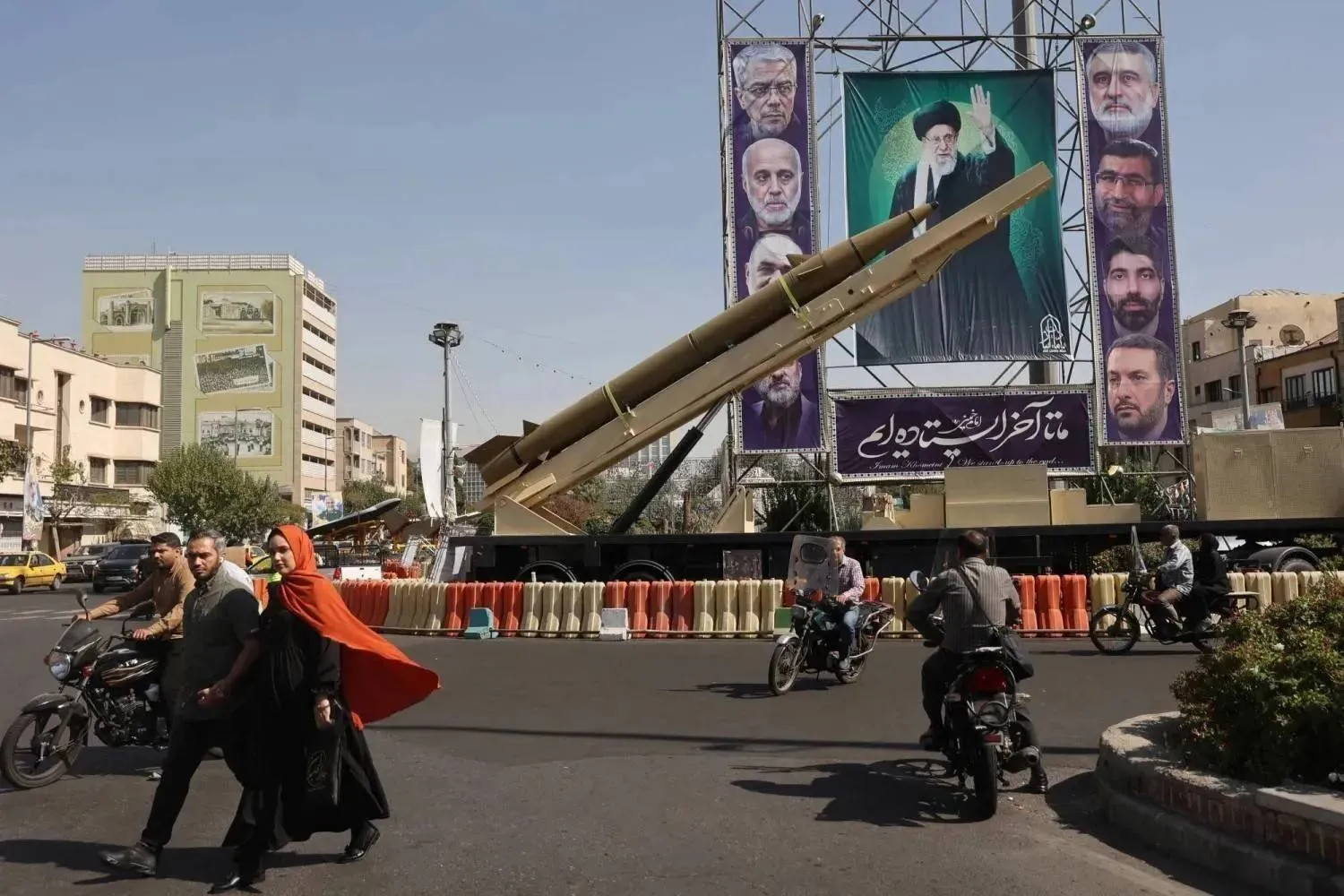
Iranian ballistic missile displayed next to a banner showing Supreme Leader Ali Khamenei and Revolutionary Guard leaders killed in Israeli strikes on a Tehran street (Reuters file photo)
TT

Iran Nuclear Stalemate Drives Escalation with Israel, No End in Sight

Iranian ballistic missile displayed next to a banner showing Supreme Leader Ali Khamenei and Revolutionary Guard leaders killed in Israeli strikes on a Tehran street (Reuters file photo)

With no direct negotiations or meaningful international monitoring of Iran’s nuclear program, and growing uncertainty over the size of its stockpile of enriched material, fears are rising across the region that a fresh confrontation between Iran and Israel has become a matter of time.

Although the likelihood of war appears high, most analysts say the moment has not yet arrived, as both sides continue rebuilding their military capabilities at a rapid pace amid unprecedented diplomatic paralysis.

Farzin Nadimi, a senior fellow at the Washington Institute for Near East Policy, says the chance of a new war between Iran and Israel is very high, but adds that indicators do not point to it being imminent.”

He told Asharq Al-Awsat that both sides will likely try to delay the inevitable through limited diplomatic efforts to contain escalation, while frantically rebuilding their arsenals.

Escalation and denial of mediation with Washington

Iran continues to issue threats while insisting on its conditions for any future talks, projecting a sense of confidence that has been reflected in statements by several Iranian officials.

They have stressed their readiness to respond “with greater force” to any Israeli attack, while denying that Tehran has sent messages or shown willingness to negotiate with Washington. Some of these warnings, analysts say, have even been channeled through outlets operating from within the US capital itself.

Ali Larijani, secretary of Iran’s Supreme National Security Council, denied that Tehran had sought to lift sanctions through any mediation or correspondence with the US administration, insisting that Iran “will not surrender to American hegemonic tendencies even if that means facing a new confrontation.”

Larijani said “the American narrative about Iran’s weakness is ridiculous,” adding that the country “has chosen the path of resistance despite economic hardships,” and “will not burden itself with empty talk from any government.”

Nadimi says Iran’s hardened rhetoric in recent weeks reflects “growing confidence within the regime,” whose leaders believe their performance during the last twelve-day war with Israel was “successful” and earned them domestic momentum.

Iran, he says, “believes it can perform even better in any future confrontation after reactivating its missile and drone production lines around the clock.”

Nuclear stalemate and absence of international oversight

Analysts say the region has entered a phase of “dangerous stagnation” following the collapse of the 2015 nuclear deal and the return of strict US sanctions, as Iran continues to bar International Atomic Energy Agency inspectors from accessing suspected enrichment sites, including the new facility under the Pickaxe mountain.

According to IAEA Director General Rafael Grossi, Iran still holds about 400 kilograms of uranium enriched to 60 percent, a quantity nearing weapons-grade levels that has heightened Israeli concern that Tehran is approaching a “red line.”

Some warn that continued uncertainty over Iran’s nuclear capabilities “may push Israel to act again to complete what it sees as an unfinished mission during the last war.”

Iran, however, appears increasingly willing to deter such action, arguing that any new attack would offer an opportunity to restore balance and shed the image of weakness left by the previous conflict.

Since the end of the brief military confrontation between Iran and Israel last summer, regional power dynamics have shifted markedly.

Iran now appears more isolated than at any time since the 2003 US invasion of Iraq, while several Arab states have strengthened their influence in Washington through close economic and strategic ties with President Trump’s administration, which continues to support Israel politically and militarily.

Even so, these states are working to keep communication channels open with Tehran to avoid a full-scale regional war. They do not want another conflict, but recognize that Iran, despite its relative weakness, remains capable of sowing turmoil through its regional proxies.

This vulnerability, Nadimi says, “may make Iran more dangerous because it could resort to reckless options in an attempt to restore its regional stature.”

No alternative to force

On the Israeli side, the government does not hide its intention to resume military operations against Iran “the moment it moves closer to producing a nuclear weapon.”

Tel Aviv believes containing Iran’s nuclear program “will not be achieved through negotiations, but through preemptive strikes,” even as Arab states increase pressure on Washington to rein in any uncalculated Israeli escalation.

Chances of returning to the negotiating table now appear almost nonexistent, particularly after Iran’s Supreme Leader Ali Khamenei declared that “America’s arrogant nature accepts nothing but surrender,” signaling rejection of any talks under US terms.

Most assessments converge on the view that any future confrontation between Iran and Israel, if it occurs, will be broader and bloodier than previous rounds.

Tehran is preparing to use its missile and drone arsenal on an unprecedented scale, while Israel continues to deliver precision strikes on sites believed to house secret enrichment facilities.



Trump Hints at Land Strike as Venezuela Pressure Mounts

A US Air Force C-130J Super Hercules aircraft approaches for landing at Rafael Hernandez Airport, amid tensions between US President Donald Trump's administration and the government of Venezuelan President Nicolas Maduro, in Aguadilla, Puerto Rico, December 28, 2025. (Reuters)
TT

Trump Hints at Land Strike as Venezuela Pressure Mounts

A US Air Force C-130J Super Hercules aircraft approaches for landing at Rafael Hernandez Airport, amid tensions between US President Donald Trump's administration and the government of Venezuelan President Nicolas Maduro, in Aguadilla, Puerto Rico, December 28, 2025. (Reuters)

A throwaway remark last week by President Donald Trump has raised questions about whether US forces may have carried their first land strike against drug cartels in Venezuela.

Trump said the US knocked out a "big facility" for producing trafficking boats, as he was discussing his pressure campaign against Venezuelan President Nicolas Maduro in an interview broadcast Friday.

"They have a big plant or a big facility where they send, you know, where the ships come from," Trump said in an interview with billionaire supporter John Catsimatidis on the WABC radio station in New York.

"Two nights ago we knocked that out. So we hit them very hard."

Trump did not say where the facility was located or give any other details. US forces have carried out numerous strikes in both the Caribbean Sea and eastern Pacific Ocean since September, killing more than 100 people.

The Pentagon referred questions about Trump's remarks to the White House. The White House did not respond to requests for comment from AFP.

There has been no official comment from the Venezuelan government.

Trump has been saying for weeks that the United States will "soon" start carrying out land strikes targeting drug cartels in Latin America, but there have been no confirmed attacks to date.

The Trump administration has been ramping up pressure on Maduro, accusing the Venezuelan leader of running a drug cartel himself and imposing an oil tanker blockade.

Maduro has accused Washington of attempting regime change.


UN Chief Says ‘Get Serious’ in Grim New Year Message

 UN Secretary-General Antonio Guterres. (AFP)
UN Secretary-General Antonio Guterres. (AFP)
TT

UN Chief Says ‘Get Serious’ in Grim New Year Message

 UN Secretary-General Antonio Guterres. (AFP)
UN Secretary-General Antonio Guterres. (AFP)

The United Nations urged global leaders Monday to focus on people and the planet in a New Year's message depicting the world in chaos.

"As we enter the new year, the world stands at a crossroads. Chaos and uncertainty surround us. Division. Violence. Climate breakdown. And systemic violations of international law," UN Secretary-General Antonio Guterres said in a video message.

In 2026, as war rages in Ukraine and elsewhere, world leaders must work to ease human suffering and fight climate change, he added.

"I call on leaders everywhere: Get serious. Choose people and planet over pain," said Guterres, criticizing the global imbalance between military spending and financing for the poorest countries.

Military spending is up nearly 10 percent this year to $2.7 trillion, which is 13 times total world spending on development aid and equivalent to the entire gross domestic product of Africa, he said.

Wars are raging at levels unseen since World War II, he added.

"In this New Year, let's resolve to get our priorities straight. A safer world begins by investing more in fighting poverty and less in fighting wars. Peace must prevail," said Guterres, who will be serving his last year as secretary general.


Türkiye and Armenia Agree to Simplify Visa Procedures to Normalize Ties

Türkiye’s President Recep Tayyip Erdogan, right, and Armenia's Prime Minister Nikol Pashinyan shake hands before a meeting at Prague Castle in Prague, Czech Republic, Thursday, Oct. 6, 2022. (Turkish Presidency via AP, File)
TT

Türkiye and Armenia Agree to Simplify Visa Procedures to Normalize Ties

Türkiye’s President Recep Tayyip Erdogan, right, and Armenia's Prime Minister Nikol Pashinyan shake hands before a meeting at Prague Castle in Prague, Czech Republic, Thursday, Oct. 6, 2022. (Turkish Presidency via AP, File)

Türkiye and Armenia have agreed to simplify visa procedures as part of efforts to normalize ties, Türkiye’s Foreign Ministry announced Monday, making it easier for their citizens to travel between the two countries.

Relations between Türkiye and Armenia have long been strained by historic grievances and Türkiye’s alliance with Azerbaijan. The two neighboring countries have no formal diplomatic ties and their joint border has remained closed since the 1990s.

The two countries, however, agreed to work toward normalization in 2021, appointing special envoys to explore steps toward reconciliation and reopening the frontier. Those talks have progressed in parallel with efforts to ease tensions between Armenia and Azerbaijan.

Türkiye supported Azerbaijan during its 2020 conflict with Armenia for control of the Karabakh region, known internationally as Nagorno-Karabakh, a territorial dispute that had lasted nearly four decades.

The Turkish Foreign Ministry said in a statement posted on social platform X that Ankara and Yerevan agreed that holders of diplomatic, special and service passports from both countries would be able to obtain electronic visas free of charge as of Jan. 1.

“On this occasion, Türkiye and Armenia reaffirm once again their commitment to continue the normalization process between the two countries with the goal of achieving full normalization without any preconditions,” the ministry said.

Türkiye and Armenia also have a more than century-old dispute over the deaths of an estimated 1.5 million Armenians in massacres, deportations and forced marches that began in 1915 in Ottoman Türkiye. Historians widely view the event as genocide.

Türkiye denies the deaths constituted genocide, saying the toll has been inflated and those killed were victims of civil war and unrest. It has lobbied to prevent countries from officially recognizing the massacres as genocide.