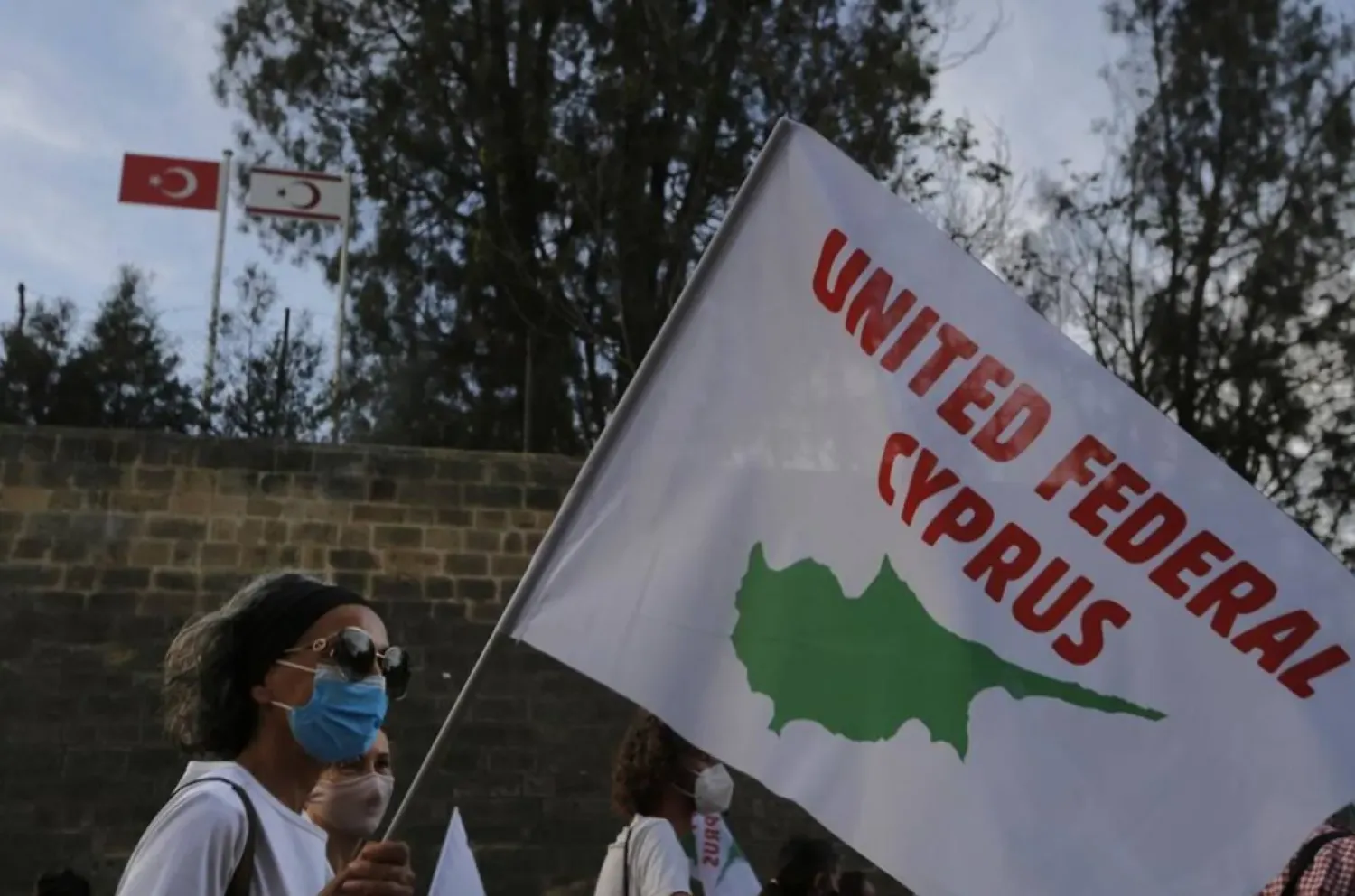
Türkiye Says Two-State Solution is Most Realistic Option for Cyprus Issue

A Greek Cypriot protestor waves a banner, during a peace protest in divided capital Nicosia, Cyprus, Saturday, April 24, 2021. (AP Photo/Petros Karadjias)
TT

Türkiye Says Two-State Solution is Most Realistic Option for Cyprus Issue

A Greek Cypriot protestor waves a banner, during a peace protest in divided capital Nicosia, Cyprus, Saturday, April 24, 2021. (AP Photo/Petros Karadjias)

President Tayyip Erdogan said on Thursday that Türkiye believes the most realistic way to resolve the Cyprus issue is having two states on the ethnically-split island, and added there was no point in holding negotiations that would yield no results.

Erdogan was speaking alongside Tufan Erhurman, the newly elected Turkish Cypriot president who has pledged to explore a federal solution - long supported by the United Nations - to end the island's nearly 50-year-old division, Reuters.

Türkiye, the only country which recognises the breakaway Turkish Republic of Northern Cyprus, and former Turkish Cypriot president Ersin Tatar have backed a two-state policy, which was ruled out by Greek Cypriots.


German Investigators Launch Probe Into Boeing 787 Incident in Frankfurt

04 June 2026, Hesse, Frankfurt: A Lufthansa Dreamliner aircraft rests on its nose in front of a terminal at Frankfurt Airport after the nose landing gear collapsed. Photo: Mike Seeboth/dpa
TT

German Investigators Launch Probe Into Boeing 787 Incident in Frankfurt

04 June 2026, Hesse, Frankfurt: A Lufthansa Dreamliner aircraft rests on its nose in front of a terminal at Frankfurt Airport after the nose landing gear collapsed. Photo: Mike Seeboth/dpa

The German Federal Bureau of Aircraft Accident Investigation (BFU) has begun an investigation into the Boeing 787 jetliner whose nose gear collapsed on Thursday at a gate at Frankfurt airport, according to a BFU spokesperson.

An interim report is expected in about eight weeks, and the final report ⁠in about a ⁠year, said the spokesperson.

Lufthansa, which operated the aircraft, said several crew members and ground staff were lightly injured and hospitalized; two ⁠Lufthansa employees who were briefly hospitalized on Thursday were able to leave the same day.

The affected Boeing 787-9 will be repaired after the investigation, Reuters quoted Lufthansa as saying.

Passengers had not yet boarded the aircraft.

The incident occurred at 12:45 p.m. (1045 GMT) ⁠on Thursday, ⁠and the jet was scheduled to depart for Los Angeles as flight LH450.

The Boeing 787-9 is a relatively new addition for the Lufthansa Group, which is planning to gradually phase out less efficient jets and simplify its fleet.


US Domestic Treatment Centers Ready for Ebola Even as Kenya Plans Persist

 A health worker stands at a temporary health clinic at the Mpondwe border crossing linking Uganda and the Democratic Republic of the Congo, Thursday, June 4, 2026. (AP)
A health worker stands at a temporary health clinic at the Mpondwe border crossing linking Uganda and the Democratic Republic of the Congo, Thursday, June 4, 2026. (AP)
TT

US Domestic Treatment Centers Ready for Ebola Even as Kenya Plans Persist

 A health worker stands at a temporary health clinic at the Mpondwe border crossing linking Uganda and the Democratic Republic of the Congo, Thursday, June 4, 2026. (AP)
A health worker stands at a temporary health clinic at the Mpondwe border crossing linking Uganda and the Democratic Republic of the Congo, Thursday, June 4, 2026. (AP)

Most of the 13 US treatment centers in a government-funded hospital network for severe infectious diseases are ready to handle patients, including those with Ebola if needed, representatives from the hospitals said this week.

The current Ebola outbreak in the Democratic Republic of Congo has resulted in 344 confirmed cases of the disease and 60 deaths, according to the World Health Organization. So far, one American confirmed to have Ebola has been treated in Germany.

The US State Department has said that US citizens exposed to the virus but with no symptoms would be quarantined in Kenya at a facility it's building and vowed to keep the US free of travelers with Ebola.

The US Department of Health and Human Services told Reuters on Wednesday the US network is ready if needed for outbreak response.

Public health experts have increased calls for the government ‌to bring any ‌sick Americans home for treatment, with protests at the Kenya site leading ‌to ⁠at least two ⁠deaths. A Kenyan court has also ordered a block to the construction.

The US has spent hundreds of millions of dollars on preparing its health system to be able to handle Ebola patients since the 2014 Ebola outbreak in West Africa, including funding the network of 13 treatment centers.

AT LEAST 9 OF 13 CENTERS READY TO GO

Reuters reached out to the 13 hospitals and universities around the country that are part of the program called the National Emerging Special Pathogens Training and Education Center, nine of which confirmed they are able to receive patients who have been exposed ⁠to Ebola.

The network includes well-known sites such as the University of Nebraska and ‌Emory University in Atlanta, which recently housed Americans exposed to hantavirus on ‌a cruise, as well as others like Bellevue Hospital in New York and Cedars-Sinai Medical Center in Los Angeles.

Emory and ‌three other hospitals did not respond to requests for comment.

"The United States’ investment in preparedness... remains a critical ‌component of national health security," Emily Hilliard, a spokesperson for HHS, said.

Hospitals "stand ready to safely evaluate, isolate, and treat patients with high-consequence infectious diseases while supporting ongoing response efforts," she said.

INVESTMENT AFTER 2014 OUTBREAK

In the 2014 West Africa outbreak, the US brought several Ebola patients back to be treated domestically. The following year, HHS received around $260 million in funding for Ebola preparedness and ‌response activities in support of the regional treatment network.

Recently, HHS has provided $21 million a year in funding to the group, which has continued in 2026.

The facilities ⁠are required to be ⁠able to take care of at least two patients with exposure to a contagious viral hemorrhagic fever like Ebola. The facilities are required to train their personnel quarterly, and have lab testing capabilities and personal protective equipment on hand.

The US CDC has dozens of employees in the DRC and has said it plans to send members of the Public Health Service Corps to staff the Kenya site. Americans also volunteer there for international relief organizations.

Healthcare officials in the US, including former Centers for Disease Control and Prevention officials, argued in an open letter earlier this week that building the new facility in Kenya would raise serious health risks compared with medical repatriation to fully staffed and prepared US facilities.

One former CDC official who is familiar with the response effort said the Kenya quarantine plan could hinder recruiting Americans to help with the outbreak.

"People are concerned they will be abandoned by their government, and many see it as a slap in the face to have taken an oath to serve the American public and get repaid that way," the former official said.


WFP: Middle East Conflict Pushing Millions Into Hunger

Farmers harvest wheat in a field on a hillside in the Argo district of Afghanistan's Badakhshan province on June 4, 2026. (Photo by Omer ABRAR / AFP)
TT

WFP: Middle East Conflict Pushing Millions Into Hunger

Farmers harvest wheat in a field on a hillside in the Argo district of Afghanistan's Badakhshan province on June 4, 2026. (Photo by Omer ABRAR / AFP)

The Middle East conflict is pushing millions of people closer to hunger, as rising fuel and transport costs drive up food prices while funding shortfalls force aid agencies to scale back assistance, the UN World Food Program said on Friday.

Joint US-Israeli strikes on Iran in February triggered a regional conflict stretching across the Gulf and into Lebanon, disrupting key shipping routes, including the Strait of Hormuz, forcing vessels to reroute and sharply constraining global energy flows and supply chains.

In March, the WFP forecast as many as 45 million people could fall into ⁠acute food insecurity ⁠if oil prices remained around $100 per barrel through June.

That scenario is now unfolding, the agency said, according to Reuters, with benchmark crude prices staying above that level since early March.

Households in Afghanistan, Somalia and Sri Lanka are among the most seriously affected and face mounting pressure due to higher fuel costs, ⁠food price spikes, income losses and disrupted trade.

In Somalia, 6.5 million people - roughly a third of the population - are expected to face severe hunger in 2026, while Afghanistan could see 17.4 million people affected, the WFP said.

The situation is projected to worsen, with an additional 2.5 million Somalis and 2.3 million Afghans at risk of falling into food insecurity if disruptions persist.

Both countries are reliant on imported energy and food.

The Middle East crisis comes amid a deep funding shortfall for ⁠aid agencies.

⁠The WFP said it expected to serve 1.5 million fewer people globally in 2026, and an extra 9 million fewer if the situation persists for six months.

In Afghanistan, surging fuel prices have driven up aid transport costs as much as fivefold, and delivery times have shot up from 10 days up to as many as 75 days as trucks had to use alternative corridors, the WFP said.

In Somalia, soaring jet fuel prices are leading to higher operational costs for the United Nations Humanitarian Air Service - the only means to safely access hard-to-reach areas, the WFP said.