


Britain Announces Largest Asylum Policy Overhaul in Modern Times

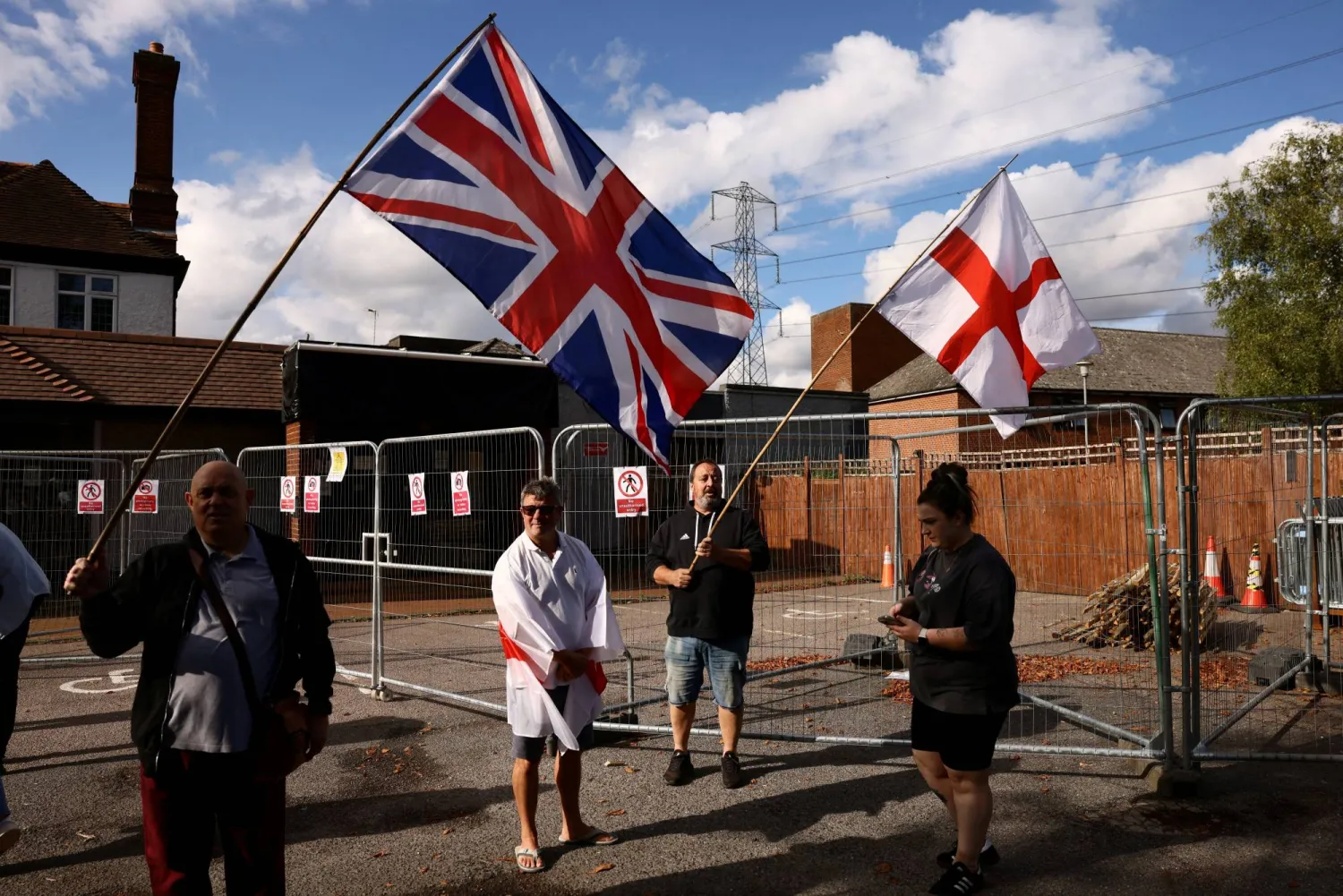
FILE PHOTO: Protesters hold the Union Jack and St George's flags outside the Bell Hotel in Essex after the British government challenged a court ruling requiring asylum seekers to be temporarily evicted from the hotel in Epping, Britain, August 29, 2025. REUTERS/Jack Taylor/File Photo
TT

Britain Announces Largest Asylum Policy Overhaul in Modern Times

FILE PHOTO: Protesters hold the Union Jack and St George's flags outside the Bell Hotel in Essex after the British government challenged a court ruling requiring asylum seekers to be temporarily evicted from the hotel in Epping, Britain, August 29, 2025. REUTERS/Jack Taylor/File Photo

Britain said on Saturday it would launch the largest overhaul of policy on asylum seekers in modern times, drawing inspiration from Denmark's approach, one of the toughest in Europe and widely criticized by rights groups.

The Labour government has been hardening its immigration policies, particularly on illegal small-boat crossings from France, as it seeks to stem the surging popularity of the populist Reform UK party, which has driven the immigration agenda and forced Labour to adopt a tougher line.

As part of the changes, the statutory duty to provide support to certain asylum seekers, including housing and weekly allowances, will be revoked, the Home Office (interior ministry) said in a statement.

The department, led by Shabana Mahmood, said the measures would apply to asylum seekers who can work but choose not to, and to those who break the law. It said that taxpayer-funded support would be prioritized for those contributing to the economy and local communities.

Mahmood is expected to provide further details on Monday about the measures, which the Home Office says are designed to make Britain less attractive to illegal migrants and make it easier to remove them, Reuters reported.

"This country has a proud tradition of welcoming those fleeing danger, but our generosity is drawing illegal migrants across the Channel," Mahmood said. "The pace and scale of migration is placing immense pressure on communities."

More than 100 British charities wrote to Mahmood urging her to "end the scapegoating of migrants and performative policies that only cause harm", saying such steps are fueling racism and violence.

Polls suggest immigration has overtaken the economy as voters' top concern. Some 109,343 people claimed asylum in the UK in the year ending March 2025, a 17% rise on the previous year and 6% above the 2002 peak of 103,081.

The Home Office said its reforms would be inspired not only by Denmark but other European countries, where refugee status is temporary, support is conditional and integration is expected.

"The UK will now match and in some areas exceed these standards," the department said.

Earlier this year, a delegation of senior Home Office officials visited Copenhagen to study Denmark's approach to asylum, where migrants are only granted temporary residence permits, usually for two years, and must reapply when these expire.

If the Social Democratic Danish government deems their home country safe, asylum seekers can be repatriated. The path to citizenship has also been lengthened and made more difficult, with stricter rules for family reunification.

Among other measures, 2016 legislation allows Danish authorities to seize asylum seekers' valuables to offset support costs.

Britain currently grants asylum to those who can prove they are unsafe at home, with refugee status given to those deemed to be at risk of persecution. The status lasts for five years, after which they can apply for permanent settlement if they meet certain criteria.

Denmark has been known for its tough immigration policies for over a decade, which the Home Office says have reduced asylum claims to a 40-year low and resulted in the removal of 95% of rejected applicants.

Britain's Refugee Council said on X that refugees do not compare asylum systems while fleeing danger, and that they come to the UK because of family ties, some knowledge of English, or existing connections that help them start anew safely.

Anti-immigration sentiment has been growing in the UK, with protests taking place this summer outside hotels sheltering asylum seekers with state funding.



Switzerland Closes Tehran Embassy but Maintains 'Open Line' between US, Iran

07 March 2026, Iran, Tehran: Members of the Iranian Red Crescent Society (IRCS) rescue teams work at the site of a building damaged in an airstrike in Iran, following the strikes launched by the United States and Israel on February 28, which killed Supreme Leader Ali Khamenei and senior military officials, prompting Iran to retaliate with strikes on Israel and Gulf states. Photo: IRCS via ZUMA Press Wire/dpa
TT

Switzerland Closes Tehran Embassy but Maintains 'Open Line' between US, Iran

07 March 2026, Iran, Tehran: Members of the Iranian Red Crescent Society (IRCS) rescue teams work at the site of a building damaged in an airstrike in Iran, following the strikes launched by the United States and Israel on February 28, which killed Supreme Leader Ali Khamenei and senior military officials, prompting Iran to retaliate with strikes on Israel and Gulf states. Photo: IRCS via ZUMA Press Wire/dpa

Switzerland said Wednesday it was temporarily closing its embassy in Tehran due to the Middle East war but maintaining an "open line" of communication between the United States and Iran.

For decades, neutral Switzerland has played a key role in maintaining basic diplomatic contacts between Iran and the United States, AFP said.

The foreign ministry in Bern said that in view of the war in the Middle East and the increasing security risk, it had "decided to temporarily close the Swiss embassy in Tehran".

Ambassador Olivier Bangerter and the remaining five other Swiss staff members left Iran by land earlier on Wednesday and will return to Tehran once the situation allows.

"As part of its good offices, Switzerland will continue to maintain an open line of communication between the United States and Iran, in consultation with the two countries," said the ministry statement.

Both the United States and Iran were informed of the temporary closure of the embassy and the departure of its Swiss staff.

"Switzerland will continue to be available to channel communications that the parties consider useful," the statement added.

"The protecting power mandate, under which Switzerland represents US interests in Iran, can be exercised independently of geographical location."

- The protecting power -

Renowned for its neutrality, Switzerland has been representing US interests in Iran since Washington broke off relations with Tehran after the 1980 hostage crisis, a year after the Iranian revolution.

In its role as the so-called protecting power, Switzerland has for decades allowed the two feuding nations to maintain a minimum of diplomatic and consular relations.

The Swiss embassy in Tehran handles all consular affairs between the United States and Iran, including passport requests, altering civil status and consular protection for US citizens in Iran.

Under the protecting power mandate, "Switzerland can either offer to act as a go-between on its own initiative or can fulfil this function at the request of the parties concerned, provided that all those involved agree," the foreign ministry says on its website.

The United States and Iran held a third round of indirect talks through Omani negotiators, on Iran's nuclear program, in the Swiss city of Geneva on February 26.

Two days later, the United States and Israel launched the first wave of attacks in a war that has seen Iran strike targets in multiple countries around the Gulf.

Switzerland has called for de-escalation and a return to diplomacy.


Norway Police Arrest 3 Suspects in Bombing of US Embassy

Forensic investigators work at the scene in connection with the arrest of three brothers after the explosion at the US embassy on Sunday, in Oslo, Wednesday, March 11, 2026. (Stian Lysberg Solum/NTB via AP)
TT

Norway Police Arrest 3 Suspects in Bombing of US Embassy

Forensic investigators work at the scene in connection with the arrest of three brothers after the explosion at the US embassy on Sunday, in Oslo, Wednesday, March 11, 2026. (Stian Lysberg Solum/NTB via AP)

Norwegian police said on Wednesday they had apprehended three brothers suspected of carrying out Sunday's bombing at the US embassy in Oslo, in an attack investigators have branded an act of terrorism.

The powerful early-morning blast from an improvised explosive device (IED) damaged the entrance to the embassy's consular section but caused no injuries, Norwegian authorities have said.

The three suspects, all in their 20s, are Norwegian citizens with a family background from Iraq, Reuters quoted police as saying.

"They are suspected of a terror bombing," ⁠Police Attorney Christian Hatlo ⁠told reporters.

"We believe they detonated a powerful bomb at the US embassy with the intention of taking lives or causing significant damage," Hatlo said, adding that none of the suspects had so far been interrogated.

One of the men was believed to have planted the bomb while the two others were believed to have taken part in the plot, Hatlo said.

The brothers, who were not named, ⁠had not previously been subject to police investigations, he added.

A lawyer representing one of the three men said he had only briefly met with his client and that it was too early to say how the suspect would plead.

Lawyers representing the two others did not immediately respond to requests for comment when contacted by Reuters.

"Although it is early in the investigation, it is important that the police have achieved what they characterize as a breakthrough in the case," Norway's Minister of Justice and Public Security Astri Aas-Hansen said in a statement.

Images of one of the suspects released by police on Monday showed a ⁠hooded person, ⁠whose face was not visible, wearing dark clothes and carrying a bag or rucksack.

Investigators on Monday said one hypothesis was that the incident was "an act of terrorism" linked to the war in the Middle East, but that other possible motives were also being explored.

Police are now investigating whether the bombing was done on behalf of a foreign state, Hatlo said, reiterating that they were also looking into other possible motives.


Iran Tells World to Get Ready for Oil at $200 a Barrel as It Fires on Merchant Ships

Commercial vessels are pictured offshore in Dubai on March 11, 2026. (AFP)
TT

Iran Tells World to Get Ready for Oil at $200 a Barrel as It Fires on Merchant Ships

Commercial vessels are pictured offshore in Dubai on March 11, 2026. (AFP)

Iran said the world should be ready for oil at $200 a barrel as its forces hit merchant ships on Wednesday and the International Energy Agency recommended a massive release of strategic reserves to dampen one of the worst oil shocks since the 1970s.

The war unleashed with joint US and Israeli air strikes nearly two weeks ago has so far killed around 2,000 people, mostly Iranians and Lebanese, as it has spread into Lebanon and thrown global energy markets and transport into chaos.

Despite what the Pentagon has described as the most intense airstrikes since the start of the war, Iran also fired at Israel and targets across the Middle East on Wednesday, demonstrating it can still fight back.

On Wednesday, three vessels were reported to have been hit in Gulf waters as Iran's Revolutionary Guards said their forces had fired on ships in the Gulf that had disobeyed their orders.

US President Donald Trump suggested the campaign would not last much longer, telling Axios news website there was "practically nothing left" to target in Iran.

"Any time I want it to end, it will end," he said in a telephone interview.

Oil prices, which shot up earlier in the week to nearly $120 a barrel before settling back to around $90, rose more than 4% on Wednesday amid renewed fears about supply disruption, while Wall Street's main share indexes fell in morning trade.

Previously, stock markets had rebounded as investors bet on Trump ‌finding a quick exit.

But ‌other signs pointed to a continuation of fighting which has seen ports and cities in the Gulf states as ‌well as ⁠targets in Israel hit ⁠by drone and missile barrages from Iran, adding urgency to calls from Türkiye and Europe to end the fighting.

An Israeli military official said the military still had an extensive list of targets to hit in Iran, including ballistic missile and nuclear-related sites.

'LEGITIMATE TARGETS"

So far there has been no sign that ships can safely sail through the Strait of Hormuz, the now-blockaded channel along the Iranian coast that serves as a conduit for around a fifth of the world's oil.

Trump said on Wednesday that ships "should" transit through the Strait but sources said Iran had deployed about a dozen mines in the channel, further complicating the blockade.

The US military told Iranians to stay clear of ports with Iranian navy facilities, drawing a warning from Iran's military that if the ports were threatened, economic and trade centers in the region would be "legitimate targets".

With prices at the pumps already surging in some countries and Trump's Republican Party trailing badly in the polls ahead of midterm elections, oil ⁠prices have become an increasingly urgent element in the calculations behind the war.

The International Energy Agency, made up of major oil consuming ‌nations, recommended releasing 400 million barrels from global strategic reserves to stabilize prices, the biggest such intervention in history, which ‌was swiftly endorsed by Washington.

But the rate at which countries can release strategic reserves will vary and the amount released would account for just a fraction of the supply through the Hormuz Strait.

Iranian ‌officials made clear on Wednesday they intended to impose a prolonged economic shock as the war continues.

"Get ready for oil to be $200 a barrel, because the oil price ‌depends on regional security, which you have destabilized," Ebrahim Zolfaqari, spokesperson for Iran's military command, said in comments addressed to Washington.

After offices of a bank in Tehran were hit overnight, Zolfaqari said Iran would respond with attacks on banks that do business with the US or Israel. People across the Middle East should stay 1,000 meters from banks, he added.

At sea, a Thai-flagged bulk carrier was set ablaze, forcing the evacuation of crew, with three people reported missing and believed trapped in the engine room.

Two other ships, a Japanese-flagged container ship and a Marshall Islands-flagged bulk carrier, were also reported to have sustained ‌damage from projectiles, bringing the number of merchant ships that have been hit since the war began to 14.

IRANIAN OFFICIAL SAYS MOJTABA KHAMENEI LIGHTLY WOUNDED

In Iran, huge crowds took to the streets for funerals for top commanders killed in airstrikes. They ⁠carried caskets and brandished flags and portraits of ⁠slain Supreme Leader Ali Khamenei and his son and successor, Mojtaba.

An Iranian official told Reuters that Mojtaba Khamenei had been lightly wounded early in the war, when airstrikes killed his father, mother, wife and a son. He has not appeared in public or issued any direct message since the war began.

The Iranian military said on Tuesday it had launched missiles at targets including a US base in northern Iraq and at targets in central Israel. Explosions rang out in Bahrain, while in Dubai four people were wounded by two drones that crashed near the airport.

In Tehran, residents said they were growing accustomed to nightly airstrikes that have sent hundreds of thousands of people fleeing to the countryside and contaminated the city with black rain from oil smoke.

"There were bombings last night but I did not get scared like before. Life goes on," Farshid, 52, told Reuters by phone.

'NO TIME LIMIT', SAYS ISRAEL

Despite calls from Trump for Iranians to rise up, US and Israeli hopes that Iran's system of clerical rule would be overthrown by popular protest have not been borne out.

Iran's police chief, Ahmadreza Radan, said on Wednesday anyone taking to the streets would be treated "as an enemy, not a protester. All our security forces have their fingers on the trigger".

A senior Israeli official told Reuters Israeli leaders now privately accepted that Iran's ruling system could survive the war. Two other Israeli officials said there was no sign Washington was close to ending the campaign.

US and Israeli officials say their aim is to end Iran's ability to project force beyond its borders and destroy its nuclear program.

Israel's Defense Minister Israel Katz said on Wednesday the operation "will continue without any time limit, as long as required, until we achieve all objectives and win the campaign".