


Iran Warns of Attempts to Target Supreme Leader Khamenei

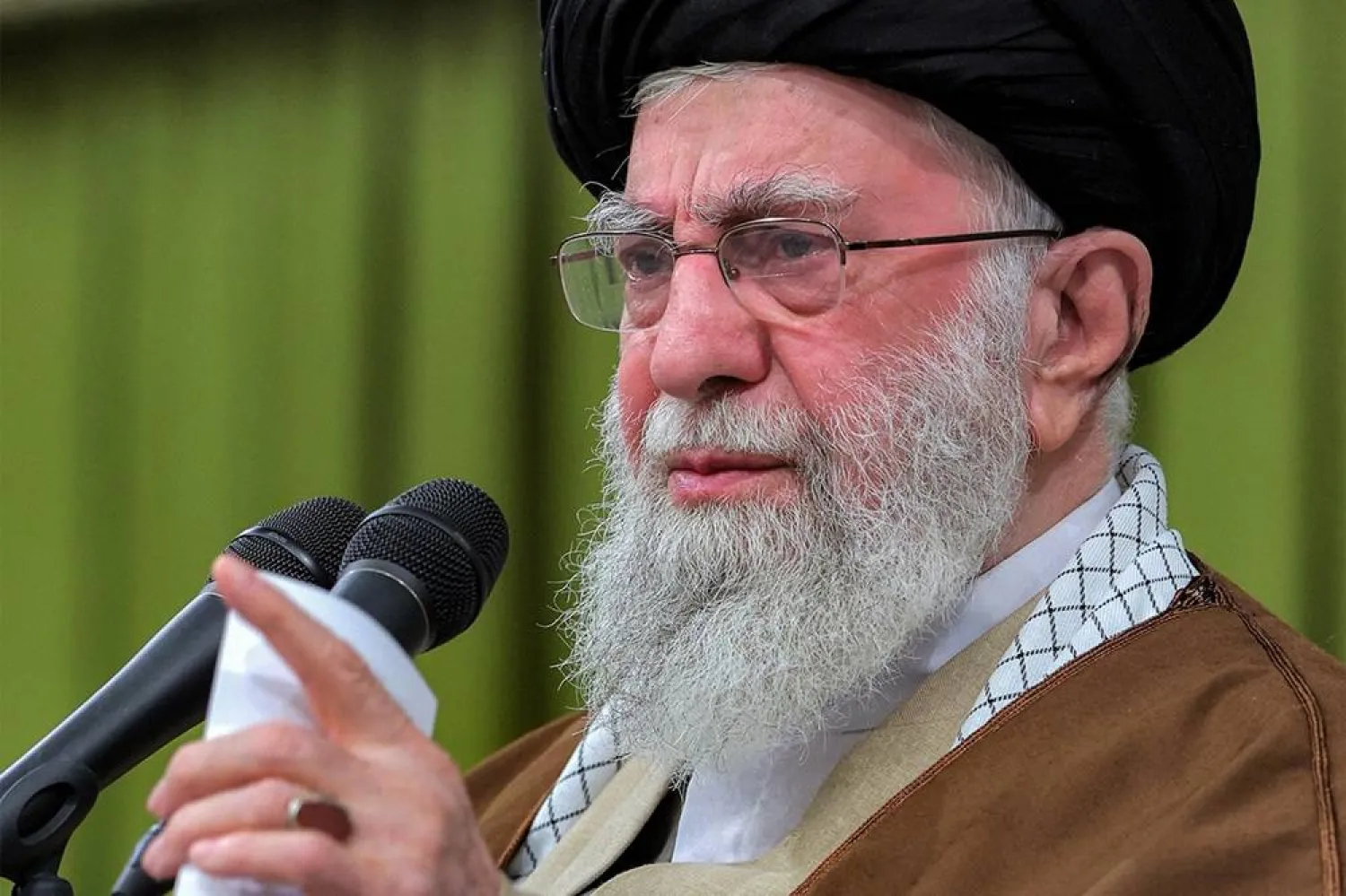
Iran's Supreme Leader Ali Khamenei shows him (L) addressing attendees while accompanied on stage by President Masoud Pezeshkian during a meeting with officials in Tehran on January 28, 2025. (KHAMENEI.IR / AFP)
TT

Iran Warns of Attempts to Target Supreme Leader Khamenei

Iran's Supreme Leader Ali Khamenei shows him (L) addressing attendees while accompanied on stage by President Masoud Pezeshkian during a meeting with officials in Tehran on January 28, 2025. (KHAMENEI.IR / AFP)

Iran's intelligence ministry has warned of attempts by foreign adversaries, including the United States and Israel, to target supreme leader Ali Khamenei and destabilize the country.

The country's ISNA news agency reported on Saturday that intelligence minister Esmail Khatib cautioned "the enemy seeks to target the supreme leader, sometimes with assassination attempts, sometimes with hostile attacks".

While it was not immediately clear if the minister was referring to a specific incident, and Iranian officials often allege foreign plots, statements on threats against Khamenei's life had been rare prior to a 12-day war between Israel and Iran in June.

"Those who act in this direction, knowingly or unknowingly, are the infiltrating agents of the enemy," Khatib added, referring directly to Israel and the United States.

During the conflict earlier this year, Israel targeted senior Iranian military officials, nuclear scientists and sites as well as residential areas, with the US later joining with strikes on key nuclear facilities.

Asked about reports during the war that US President Donald Trump vetoed an Israeli plan to kill the supreme leader out of concern it would escalate the Iran-Israel showdown, Israeli Prime Minister Benjamin Netanyahu was dismissive but said the move would "end the conflict".

At the time, Trump had also said that Iran's supreme leader was a "very easy target" and that "we are not going to take him out, at least not for now."

He later said in a post on Truth Social he had saved Iran's supreme leader from "A VERY UGLY AND IGNOMINIOUS DEATH".

The 86-year-old Khamenei has been Iran's supreme leader since 1989 and has the final say on all state affairs.

Earlier this month, Iran's President Masoud Pezeshkian said he was particularly concerned for Khamenei's life during the war and feared that the country's institutions "would start fighting among each other."

In July, Khamenei said Israel's attacks during the war were intended to weaken the country, sow "unrest and bring people into the streets to overthrow the system".

A ceasefire between Iran and Israel has been in place since June 24, but both Israel and the United States have threatened new strikes if Tehran revives its nuclear program.



Taiwan Says China Sanctions on European Arms Makers Will Not Hit Weapons Sourcing

A Taiwan flags flutters on the roof of the headquarters of Aerospace Industrial Development Corporation (AIDC) in Taichung on April 21, 2026. (AFP)
TT

Taiwan Says China Sanctions on European Arms Makers Will Not Hit Weapons Sourcing

A Taiwan flags flutters on the roof of the headquarters of Aerospace Industrial Development Corporation (AIDC) in Taichung on April 21, 2026. (AFP)

Taiwan's defense minister downplayed on Monday the impact of Chinese sanctions on seven European companies over arms sales to the island, saying it was not the first time China had taken such action and it would not affect Taipei's ability to source weapons.

China's Commerce Ministry banned exports on Friday of dual-use items to the seven companies over arms sales to Taiwan, placing them on its export control list, in a ‌rare case of Europe-targeted, ‌Taiwan-related sanctions.

Taiwan, which China views as its own ‌territory, ⁠gets most of its ⁠weapons from the United States. Europe has not sold any big-ticket items like fighter jets to Taipei for around three decades, fearful of raising the ire of Beijing.

Taking lawmaker questions in parliament, Taiwan Defense Minister Wellington Koo said it was not the first time China had implemented such measures.

"However, I think such an action, as I understand it, does not affect ⁠our ability to continue sourcing goods through relevant diversified ‌channels," he added, without elaborating.

While many ‌countries, especially in Europe, are nervous about any defense cooperation with Taiwan due to ‌fears of Chinese retaliation, Taipei has found an increasingly sympathetic ear in ‌parts of Central and Eastern Europe, especially since Russia invaded Ukraine in 2022.

Four of the seven companies on the new Chinese list are Czech.

China has repeatedly sanctioned major US arms makers over sales to Taiwan, most recently in December following ‌the US announcement of an $11 billion weapons sale package to the island.

JAPAN SCRAPS ARMS EXPORTS CONTROLS

Asked whether Taiwan ⁠could start buying ⁠weapons from Japan, after Tokyo last week scrapped restrictions on overseas arms sales, Koo said the recipients of weapons exports must be countries that have signed a defense equipment and technology transfer agreement with Japan, which Taiwan has not done.

When asked whether that could happen one day, Koo responded: "In the future, no possibility can be ruled out. I think I can only say that at present, no transfer agreement exists."

While countries such as the Philippines welcomed the change, China expressed deep concern.

Relations between Japan and China have been at a low ebb since Japanese Prime Minister Sanae Takaichi said in November that a Chinese attack on Taiwan threatening Japan's survival could trigger a military response.


Türkiye’s Erdogan Offers Support to Trump in Call After White House Dinner Shooting

Turkish President Recep Tayyip Erdogan makes a speech during an event in Istanbul, Türkiye, April 24, 2026. (Reuters)
TT

Türkiye’s Erdogan Offers Support to Trump in Call After White House Dinner Shooting

Turkish President Recep Tayyip Erdogan makes a speech during an event in Istanbul, Türkiye, April 24, 2026. (Reuters)

Turkish President Recep Tayyip Erdogan offered his support for US President Donald Trump in a phone call following a ‌shooting ‌at the ‌White ⁠House Correspondents' Association dinner, the ⁠Turkish presidency said late on Sunday.

"Erdogan said he saw the ⁠incident as ‌a ‌heinous act against democracy ‌and press ‌freedom," the presidency said in a statement on X.

Earlier, ‌Erdogan had condemned the incident ⁠in ⁠a separate statement on X, saying he was happy that Trump and first lady Melania Trump were unharmed.


Latest US Military Strike on Alleged Drug Boat Kills 3 in Eastern Pacific

A US strike targets a boat suspected of being used for drug smuggling in the Eastern Pacific (Reuters file)
TT

Latest US Military Strike on Alleged Drug Boat Kills 3 in Eastern Pacific

A US strike targets a boat suspected of being used for drug smuggling in the Eastern Pacific (Reuters file)

The latest US military strike on a boat accused of ferrying drugs in the eastern Pacific Ocean killed three people Sunday, according to a social media post by US Southern Command.

The Trump administration's campaign of blowing up alleged drug-trafficking vessels in Latin American waters has gone on since early September and killed at least 186 people in total. Other strikes have taken place in the Caribbean Sea.

The military has not provided evidence that any of the vessels were carrying drugs.

After Sunday's attack, Southern Command posted a video on X showing a boat moving swiftly in the water before an explosion left it in flames. It repeated previous statements by saying it had targeted the alleged drug traffickers along known smuggling routes.

The attacks began as the US built up its largest military presence in the region in generations and came months ahead of the raid in January that captured then-Venezuelan President Nicolás Maduro. He was brought to New York to face drug trafficking charges and has pleaded not guilty.

President Donald Trump has said the US is in “armed conflict” with cartels in Latin America and has justified the attacks as a necessary escalation to stem the flow of drugs into the United States.

Critics, meanwhile, have questioned the overall legality of the boat strikes.