

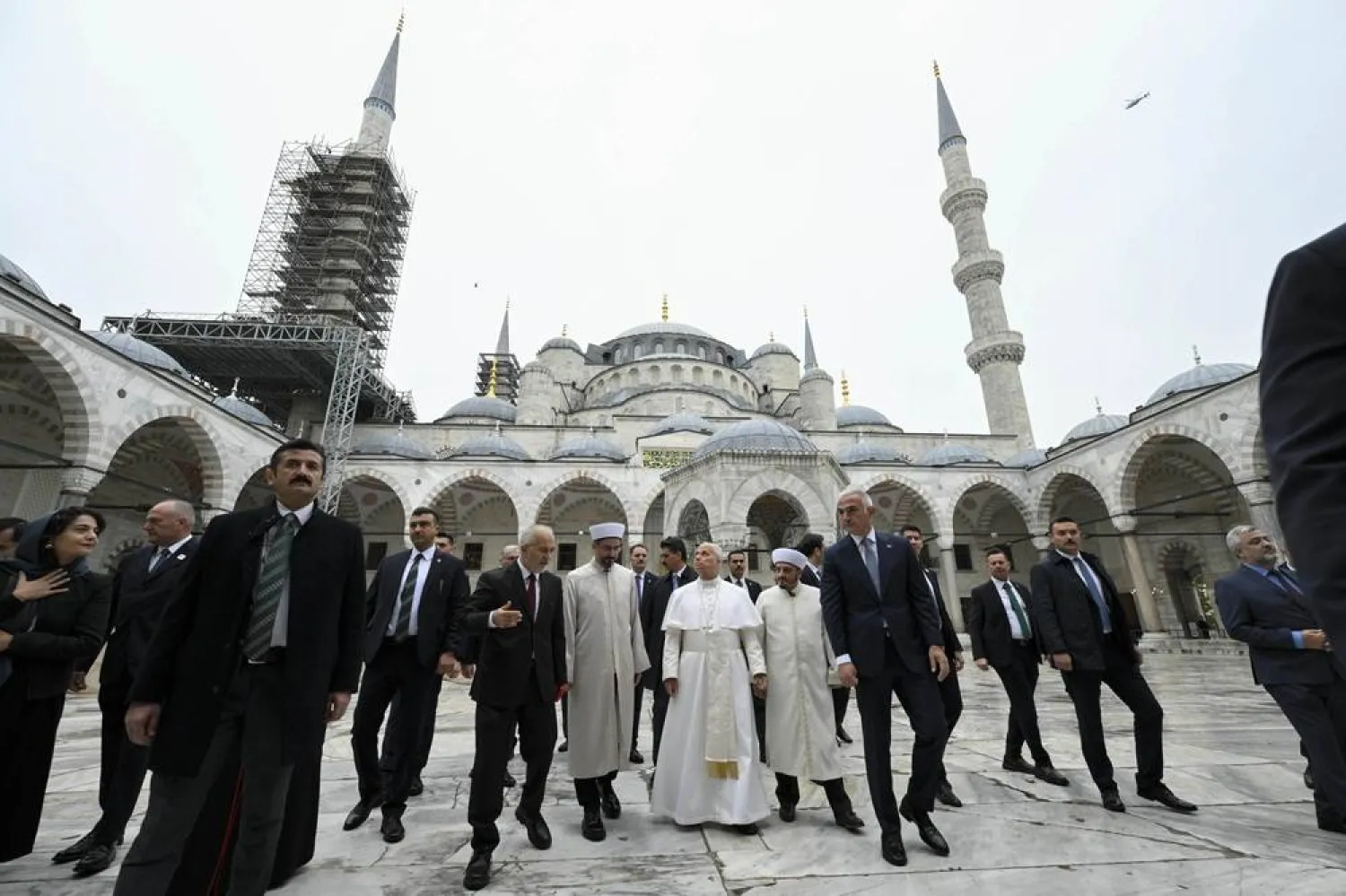

Pope Visits Istanbul’s Blue Mosque at Start of Day of Meetings with Türkiye's Religious Leaders

A handout picture provided by the Vatican Media shows Pope Leo XIV (C) during a visit to the Sultan Ahmed Mosque (The Blue Mosque) in Istanbul, Türkiye, 29 November 2025. (EPA/Vatican Media)
TT

Pope Visits Istanbul’s Blue Mosque at Start of Day of Meetings with Türkiye's Religious Leaders

A handout picture provided by the Vatican Media shows Pope Leo XIV (C) during a visit to the Sultan Ahmed Mosque (The Blue Mosque) in Istanbul, Türkiye, 29 November 2025. (EPA/Vatican Media)

Pope Leo XIV visited Istanbul’s Blue Mosque on Saturday but didn't stop to pray, as he opened an intense day of meetings and liturgies with Türkiye's religious leaders and a Mass for the country's tiny Catholic community.

The head of Türkiye's Diyanet religious affairs directorate showed Leo the soaring tiled domes of the 17th-century mosque and the Arabic inscriptions on its columns, as Leo nodded in understanding.

The Vatican had said Leo would observe a “brief minute of silent prayer” there, but it didn't appear that he had. The imam of the mosque, Asgin Tunca, said he had invited Leo to pray, since the mosque was “Allah's house,” but the pope declined.

Speaking to reporters after the visit, Tunca said he had told the pope: "It’s not my house, not your house, (it’s the) house of Allah,” he said. He said he told Leo: “'If you want, you can worship here,’ I said. But he said, ‘That’s OK.’”

“He wanted to see the mosque, wanted to feel (the) atmosphere of the mosque, I think. And was very pleased,” he said.

Later, Vatican spokesman Matteo Bruni said: “The pope experienced his visit to the mosque in silence, in a spirit of contemplation and listening, with deep respect for the place and the faith of those who gather there in prayer.”

Leo, history's first American pope, was following in the footsteps of his recent predecessors, who all made high-profile visits to the Sultan Ahmed Mosque, as it is officially known, in a gesture of respect to Türkiye's Muslim majority. Leo removed his shoes and walked through the carpeted mosque in his white socks.

But the visits have always raised questions about whether the pope would pray in the Muslim house of worship, or at the very least pause to gather thoughts in a meditative silence.

There were no doubts in 2014 when Pope Francis visited: He stood for two minutes of silent prayer facing east, his head bowed, eyes closed and hands clasped in front of him. The Grand Mufti of Istanbul, Rahmi Yaran, told the pope afterwards, “May God accept it.”

When Pope Benedict XVI visited Türkiye in 2006, tensions were high because Benedict had offended many in the Muslim world a few months earlier with a speech in Regensburg, Germany that was widely interpreted as linking Islam and violence.

The Vatican added a visit to the Blue Mosque at the last minute in a bid to reach out to Muslims, and Benedict was warmly welcomed. He observed a moment of silent prayer, head bowed, as the imam prayed next to him, facing east.

Benedict later thanked him “for this moment of prayer" for what was only the second time a pope had visited a mosque, after St. John Paul II visited one briefly in Syria in 2001.

Hagia Sophia left off itinerary

Past popes have also visited the nearby Hagia Sophia landmark, once one of the most important historic cathedrals in Christianity and a United Nations-designated world heritage site.

But Leo left that visit off his itinerary on his first trip as pope. In July 2020, Türkiye converted Hagia Sophia from a museum back into a mosque, a move that drew widespread international criticism, including from the Vatican.

After the mosque visit, Leo held a private meeting with Türkiye's Christian leaders at the Syriac Orthodox Church of Mor Ephrem. In the afternoon, he was expected to pray with the spiritual leader of the world’s Orthodox Christians, Patriarch Bartholomew, at the patriarchal church of Saint George.

He will end the day with a Catholic Mass in Istanbul's Volkswagen Arena for the country's Catholic community, who number 33,000 in a country of more than 85 million people, most of whom are Sunni Muslim.

Leo had prayed with these Christian leaders on Friday in Iznik, at the site of the A.D. 325 Council of Nicaea, the highlight of his trip. The occasion was to mark the 1,700th anniversary of the council, the unprecedented meeting of bishops that produced the creed, or statement of faith, that is still recited by millions of Christians today.

Standing over the ruins of the site, the men recited the creed. Leo urged them “to overcome the scandal of the divisions that unfortunately still exist and to nurture the desire for unity.”

Such unity, he said, was of particular importance at a time “marked by many tragic signs, in which people are subjected to countless threats to their very dignity.”

The Nicaea gathering took place at a time when the Eastern and Western churches were still united. They split in the Great Schism of 1054, a divide precipitated largely by disagreements over the primacy of the pope, and then in other splintering divisions. But even today, Catholic, Orthodox and most historic Protestant groups accept the Nicaean Creed, making it a point of agreement and the most widely accepted creed in Christendom.

As a result, celebrating its origins at the site of its creation with the spiritual leaders of the Catholic and Orthodox churches and other Christian representatives marked a historic moment in the centuries-old quest to reunite all Christians.



Türkiye Says Greece-Chevron Activity off Crete Unlawful 

A Chevron gas station sign is pictured at one of their retain gas stations in Cardiff, California October 9, 2013. REUTERS/Mike Blake/File Photo
TT

Türkiye Says Greece-Chevron Activity off Crete Unlawful 

A Chevron gas station sign is pictured at one of their retain gas stations in Cardiff, California October 9, 2013. REUTERS/Mike Blake/File Photo

Türkiye said on Thursday it opposed Greece's "unilateral activities" in energy fields south of Crete with a consortium led by US major Chevron as a violation of international law and good neighbourly relations.

Athens responded that its policies abide international law.

The Chevron-led consortium signed exclusive lease agreements on Monday to look for natural gas off southern Greece, expanding US presence in the eastern Mediterranean.

"We oppose this unlawful activity, which is being attempted in violation of the 2019 Memorandum of Understanding on Maritime Jurisdiction between Libya and our country," the Turkish Defense Ministry said at a press briefing.

It said the activity, while not directly impacting Türkiye's continental shelf, also violated Libya's maritime jurisdiction that was declared to the United Nations in May last year.

"We continue to provide the necessary support to the Libyan authorities to take action against these unilateral and unlawful activities by Greece," the ministry said.

A 2019 agreement signed by Türkiye and Libya set out maritime boundaries in the Mediterranean Sea. It was rejected by Greece as it ignored the presence of the Greek island of Crete between the coasts of Türkiye and Libya. The Chevron deal doubles the amount of Greek maritime acreage available for exploration and is the second in months involving a US energy major, as the European Union seeks to phase out supplies from Russia and the US seeks to replace them.

Asked about the Turkish objections later on Thursday, Greek government spokesman Pavlos Marinakis told a press briefing that Athens followed an "active policy" and "exercises its rights in accordance with international law and respects international law steadfastly - and I think no one questions that, period."

There was no immediate comment from Chevron.

Neighbors and NATO members Türkiye and Greece have been at odds over a range of issues for decades, primarily maritime boundaries and rights in the Aegean, an area widely believed to hold energy resources and with key implications for airspace and military activity.

A 2023 declaration on friendly relations prompted a thaw between the sides and leaders have voiced a desire to address remaining issues.


Andrew Mountbatten-Windsor Arrested on Suspicion of Misconduct in Public Office

FILE - Britain’s Andrew Mountbatten-Windsor, formerly known as Prince Andrew, looks round as he leaves after attending the Easter Matins Service at St. George's Chapel, Windsor Castle, England, April 20, 2025. (AP Photo/Kirsty Wigglesworth, File)
TT

Andrew Mountbatten-Windsor Arrested on Suspicion of Misconduct in Public Office

FILE - Britain’s Andrew Mountbatten-Windsor, formerly known as Prince Andrew, looks round as he leaves after attending the Easter Matins Service at St. George's Chapel, Windsor Castle, England, April 20, 2025. (AP Photo/Kirsty Wigglesworth, File)

UK police arrested Andrew Mountbatten-Windsor on Thursday on suspicion of misconduct in public office.

The Thames Valley Police, an agency that covers areas west of London, including Mountbatten-Windsor’s former home, said it was “assessing” reports that the former Prince Andrew sent trade reports to convicted sex offender Jeffrey Epstein in 2010. The assessment followed the release of millions of pages of documents connected to a US investigation of Epstein.

The police force did not name Mountbatten-Windsor, as is normal under UK law. But when asked if he had been arrested, the force pointed to a statement saying that they had arrested a man in his 60s. Mountbatten-Windsor is 66.

“Following a thorough assessment, we have now opened an investigation into this allegation of misconduct in public office,’’ the statement said. “It is important that we protect the integrity and objectivity of our investigation as we work with our partners to investigate this alleged offence."

“We understand the significant public interest in this case, and we will provide updates at the appropriate time,” the statement added.

Pictures circulated online appearing to show unmarked police cars at Wood Farm on the Sandringham Estate in Norfolk, with plainclothes officers appearing to gather outside the home of Mountbatten-Windsor.


Georgia Arrests Two Foreigners Trying to Purchase Uranium

FILE PHOTO: A block with the symbol, atomic number and mass number of Uranium (U) element, in this illustration taken January 21, 2026. REUTERS/Dado Ruvic/Illustration/File Photo
TT

Georgia Arrests Two Foreigners Trying to Purchase Uranium

FILE PHOTO: A block with the symbol, atomic number and mass number of Uranium (U) element, in this illustration taken January 21, 2026. REUTERS/Dado Ruvic/Illustration/File Photo

Georgia has ‌detained two people who attempted to purchase $3 million worth of uranium and a cache of a radioactive isotope found in nuclear weapons testing programs, the national security service said on Thursday.

Two foreign nationals from unspecified countries were arrested in the city of Kutaisi, the State Security Service said in a statement.

"They were planning to ‌illegally purchase ‌nuclear material uranium and radioactive ‌substance ⁠Cesium 137 for $3 ⁠million and illegally transport it to the territory of another country," Reuters quoted it as saying.

It said other foreigners had been arriving in Georgia in recent weeks with the aim of purchasing and transporting the nuclear and ⁠radioactive materials, without elaborating further.

The ‌statement did ‌not specify the quantity of materials the individuals were ‌attempting to procure. There were ‌no details on the substances' origin or potential destination.

Cesium 137 is a radioactive isotope present primarily in the aftermath of nuclear weapons testing ‌and nuclear power plant accidents such as the Chernobyl disaster in ⁠then-Soviet ⁠Ukraine in 1986.

The security of nuclear materials was one of the biggest concerns after the 1991 fall of the Soviet Union, of which Georgia was part. There have been several serious incidents involving the illicit trade in nuclear materials in Georgia over recent decades.

Most recently, three Chinese citizens were arrested in the capital Tbilisi for attempting to purchase two kilograms of "nuclear material" uranium.