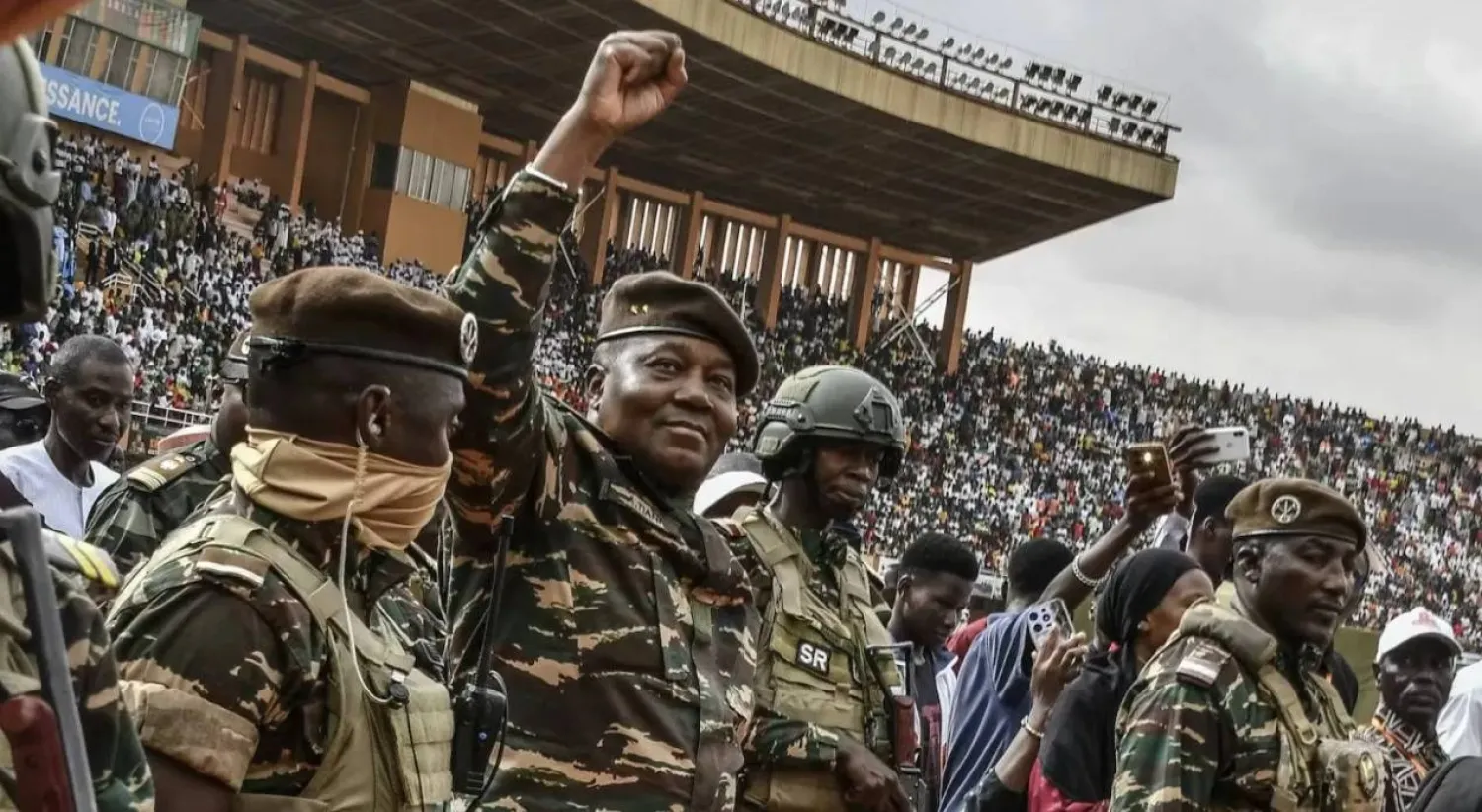
Niger Says Putting its Uranium on International Market

Niger's head of the junta General Abdourahamane Tiani. AFP
TT

Niger Says Putting its Uranium on International Market

Niger's head of the junta General Abdourahamane Tiani. AFP

Niger's military regime on Sunday announced it was putting uranium produced by Somair -- a subsidiary of French giant Orana before the regime nationalized it in June -- on the international market.

Uranium mining in Niger is at the center of a standoff between the junta that took power in 2023 and Orano, which is 90-percent owned by the French government and has operated mines in Niger for decades.

The news was announced on state television Tele Sahel in a report Sunday evening citing comments by head of the junta General Abdourahamane Tiani.

Tiani, the report said, had claimed "Niger's legitimate right to dispose of its natural riches to sell them to whoever wants to buy them, under the rules of the market, in complete independence".

Russian Energy Minister Sergei Tsivilev said in July that Moscow wanted to mine uranium in Niger.

Since the junta took power in a 2023 coup, Niger has turned to Russia, which commands the world's largest arsenal of atomic weapons, for help in fighting the west African country's militant insurgency.

At the same time, it has turned its back on former colonial power France, which it accused of supporting separatist groups.

In 2024, Niger removed Orano's operational control of its three main mines in the country: Somair, Cominak and Imouraren, which has one of the largest uranium deposits in the world.

Orano officially retains a 60 percent stake in the subsidiaries, and has undertaken various arbitration procedures to try to win back operational control.

Niger in 2022 accounted for about a quarter of the natural uranium supplied to European nuclear power plants, according to data from the atomic organization Euratom.


NATO ‘Will Always Defend’ Türkiye, Says Rutte

A handout photo made available by the Turkish Defense Ministry Press Office shows Turkish Defense Minister Yasar Guler (R) and North Atlantic Treaty Organization (NATO) Secretary General Mark Rutte (L) shaking hands during a meeting in Ankara, Türkiye, 21 April 2026. (EPA/Turkish Defense Ministry/Handout)
TT

NATO ‘Will Always Defend’ Türkiye, Says Rutte

A handout photo made available by the Turkish Defense Ministry Press Office shows Turkish Defense Minister Yasar Guler (R) and North Atlantic Treaty Organization (NATO) Secretary General Mark Rutte (L) shaking hands during a meeting in Ankara, Türkiye, 21 April 2026. (EPA/Turkish Defense Ministry/Handout)

NATO chief Mark Rutte said on Wednesday the alliance would do "what's necessary to defend" its members including Türkiye after intercepting four missiles fired from Iran and head into Turkish air space over the past weeks.

A member of the US-led defense alliance, Türkiye, which borders Iran, has been largely spared the sort of retaliation from Tehran suffered by countries in the Middle East before the ceasefire.

NATO forces had shot down ballistic missiles fired from Iran for four times, prompting the alliance to deploy a new Patriot missile battery at Incirlik air base in southern Türkiye.

"Iran is spreading terror and chaos, and you feel this prominently here in Türkiye," Rutte told journalists on a visit to Türkiye’s largest defense electronics company Aselsan.

"In recent weeks, NATO has successfully intercepted ballistic missiles heading to Türkiye from Iran on four separate occasions," he said.

"NATO is prepared for such threats and will always do what is necessary to defend Türkiye and all others. And we cannot do it alone," he added.

Rutte's visit comes ahead of a July summit by NATO leaders to be held in Ankara.

Praising the progress made by Türkiye in the defense field, Rutte said: "We can learn a lot from what Türkiye is doing here".

"This is needed because we live in a more dangerous world... and that means we need strong defenses to protect our security".

Rutte said: "Türkiye has gone through a defense industrial revolution. I could really say it's a revolution in recent years."

The NATO chief is due to meet with President Recep Tayyip Erdogan.


China Warns Middle East at ‘Critical Juncture’ After Trump Extends Ceasefire

 13 April 2026, China, Beijing: Guo Jiakun, spokesman for the Chinese Foreign Ministry, speaks to journalists. (dpa)
13 April 2026, China, Beijing: Guo Jiakun, spokesman for the Chinese Foreign Ministry, speaks to journalists. (dpa)
TT

China Warns Middle East at ‘Critical Juncture’ After Trump Extends Ceasefire

 13 April 2026, China, Beijing: Guo Jiakun, spokesman for the Chinese Foreign Ministry, speaks to journalists. (dpa)
13 April 2026, China, Beijing: Guo Jiakun, spokesman for the Chinese Foreign Ministry, speaks to journalists. (dpa)

China warned on Wednesday that the situation in the Middle East was at a "critical juncture" after US President Donald Trump extended a ceasefire to allow Iran more time to negotiate.

Trump indefinitely pushed back the end of the two-week truce on Tuesday with Tehran yet to respond but he said a US blockade of Iran's ports would continue.

"The current regional situation stands at a critical juncture transitioning between war and peace; the paramount priority remains to make every effort to prevent a resumption of hostilities," Chinese foreign ministry spokesman Guo Jiakun told a news briefing.

Guo did not comment directly on the ceasefire when asked about it, adding only that Beijing would continue to play a "constructive" role.


Extreme Heat Threatens Global Food Systems, UN Agencies Warn

Emmanuel, a worker at the Fasoranti farm, harvests cocoa pods in Akure, Ondo State, Nigeria, 20 April 2026. (EPA)
TT

Extreme Heat Threatens Global Food Systems, UN Agencies Warn

Emmanuel, a worker at the Fasoranti farm, harvests cocoa pods in Akure, Ondo State, Nigeria, 20 April 2026. (EPA)

Extreme heat is pushing global agrifood systems to the brink, threatening the livelihoods and health of more than a billion people, according to a new report by the UN's food and weather agencies.

The United Nations Food and Agriculture Organization (FAO) and the World Meteorological Organization (WMO) said heatwaves are becoming more frequent, intense and prolonged, damaging crops, livestock, fisheries and forests.

"Extreme heat is rewriting the script on what farmers, fishers and foresters can grow and when they can grow. In some cases it is even dictating if they can still work," said Kaveh Zahedi, ‌head of ‌FAO's climate change office.

"At its core, this report ‌is ⁠telling us that ⁠we face a very uncertain future," he told Reuters.

Recent climate datasets show global warming is accelerating, with 2025 ranking among the three hottest years on record, triggering more frequent and severe weather extremes.

Acting as a risk multiplier, extreme heat intensifies droughts, wildfires and pest outbreaks and sharply cuts crop yields once critical temperature thresholds are breached.

RISKS ESCALATE RAPIDLY AS TEMPERATURES PUSH HIGHER

The report said higher temperatures ⁠are shrinking the safety margin that plants, animals and ‌humans rely on to function, with yields for ‌most major crops falling once temperatures exceed about 30 degrees Celsius (86 degrees Fahrenheit).

Zahedi cited ‌Morocco, where six years of drought were followed by record heatwaves. "This led ‌to a fall in cereal yields by over 40%. It decimated the olive and citrus harvest. Basically, those harvests failed," he said.

Marine heatwaves are also becoming more frequent, depleting oxygen levels in water and threatening fish stocks. In 2024, 91% of the world's ‌oceans experienced at least one marine heatwave, the report said.

Risks rise sharply as warming accelerates. The intensity of extreme ⁠heat events is ⁠expected to roughly double at 2 degrees Celsius of warming and quadruple at 3 degrees, compared with 1.5 degrees, the report said.

Zahedi said every one-degree rise in average global temperatures cuts yields of the world's four major crops - maize, rice, soya, and wheat - by about 6%.

The FAO and WMO said piecemeal responses were inadequate and called for better risk governance and early-warning weather systems to help farmers and fishers take preventive action.

"If you can get the data into the farmers' hands, they can adjust when they plant, they can adjust what they plant, they can adjust when they harvest," Zahedi said.

But the report said adaptation alone is not enough, arguing the only lasting solution to the growing threat of extreme heat is ambitious, coordinated action to curb climate change.