
Iranian President Rejects ‘Humiliating Conditions’ Set by US For Resuming Nuclear Talks

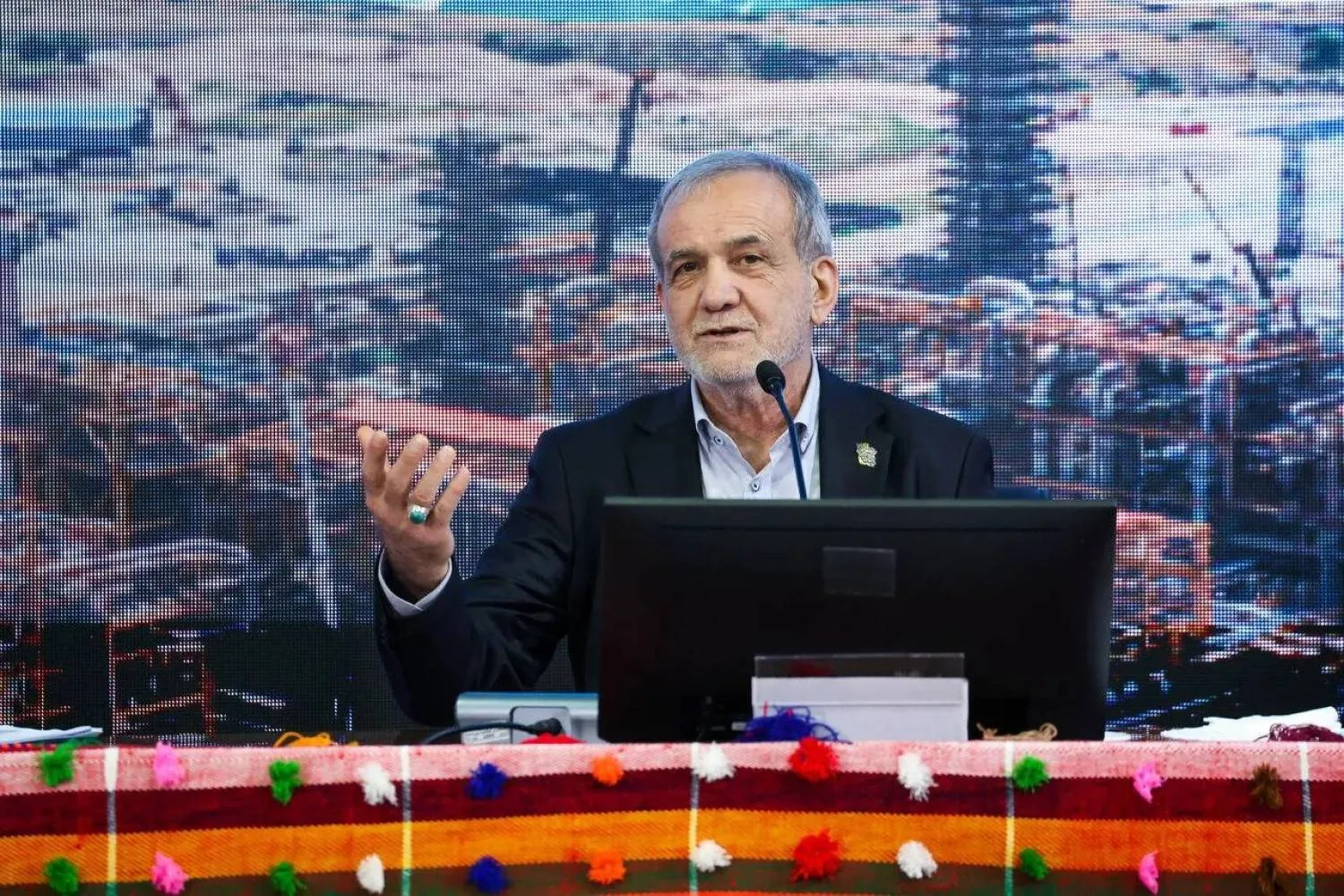
Iranian President Masoud Pezeshkian (IRNA) 
TT

Iranian President Rejects ‘Humiliating Conditions’ Set by US For Resuming Nuclear Talks

Iranian President Masoud Pezeshkian (IRNA) 

Iranian President Masoud Pezeshkian rejected “humiliating conditions” set by the US for resuming nuclear talks, warning against any attempts to exert coercion, bullying, or any process that undermines Iran’s military capacities in the face of Israel.

At a meeting with a group of political elites, prominent figures and secretaries of parties, held Wednesday evening in Tehran, the President said Iran seeks peace but will not accept humiliating impositions.

“Iran had previously negotiated with the United States and had been ready to reach an agreement, but Washington disrupted the deal by resorting to war,” he noted.

Pezeshkian added, “Now, the US is proposing humiliating conditions for the resumption of talks,” which he said Iran is not prepared to accept. “Iran will not submit to humiliation nor accept a weak and fragmented country.”

Iran had passed a law last July to suspend its cooperation with the IAEA, denying UN inspectors access into the country. The suspension came after US and Israeli airstrikes targeted Iran’s nuclear facilities on June 22.

The Iranian President affirmed that his country does not seek confrontation, noting that Tehran has repeatedly declared it is not pursuing the construction of a nuclear bomb and is ready for any form of verification.

Washington had set conditions for the resumption of talks with Iran. The US has insisted that Iran must completely halt its uranium enrichment program. Tehran rejected Washington’s demands, describing them as an “unacceptable infringements on its national sovereignty.”

Speaking on Thursday during a visit to South Khorasan province, Pezeshkian urged national unity to overcome the country’s difficulties and problems.

“If the Muslim communities were united, and rejected differences and conflicts, Israel would not have committed all these atrocities and crimes in the region,” he said.

IRGC Spokesperson

Commenting on the June war with Israel, a spokesperson for the Iranian Revolution Guards Corps (IRGC) said Iran had built up a complete intelligence database on Israeli targets prior to the 12‑day war, enabling Iranian missiles to strike with precise accuracy.

Brigadier General Mohammad Naeini said “based on intelligence collected from within the Israeli occupied territory, Iranian missile strikes destroyed 47 strategic centers, several science and technology parks, and two power plants.”

He said nearly 80% of Iran’s counterstrikes during the war relied on intelligence gathered in previous years, without which the operations would not have been possible.

Araghchi’s Visit to Russia

Amid a crisis in Iran’s relations with the International Atomic Energy Agency (IAEA) and ongoing disagreements with the West over the nuclear deal, Iranian Foreign Minister Abbas Araghchi kicked off a visit on Tuesday to Moscow, where he held talks with his counterpart, Sergei Lavrov.

Prior to Araghchi’s visit, the Russian diplomat had affirmed the need for the IAEA to fully comply with neutrality when dealing with Iran.

On Wednesday, the foreign ministers inked a cooperation document, which comes following the entry into force of a comprehensive strategic partnership treaty ratified by the Russian parliament and president over the summer, and formally adopted in Iran in early October.

On Thursday, Araghchi wrote on X: “Building on our Strategic Partnership Treaty, Iran and Russia's foreign ministries have agreed on a three-year roadmap to regularize and elevate our cooperation and coordination.”

He added that closer collaboration between Moscow and Tehran will enable stronger action against unlawful Western sanctions, promote regional stability, advance infrastructure projects, and block illegal measures in the UN Security Council.


Iran’s Former Top Diplomat Urges Deal with US to End War

 A newly constructed bridge struck by US airstrikes Thursday is seen in Karaj, west of Tehran, Iran, Friday, April 3, 2026. (AP)
A newly constructed bridge struck by US airstrikes Thursday is seen in Karaj, west of Tehran, Iran, Friday, April 3, 2026. (AP)
TT

Iran’s Former Top Diplomat Urges Deal with US to End War

 A newly constructed bridge struck by US airstrikes Thursday is seen in Karaj, west of Tehran, Iran, Friday, April 3, 2026. (AP)
A newly constructed bridge struck by US airstrikes Thursday is seen in Karaj, west of Tehran, Iran, Friday, April 3, 2026. (AP)

Iran should make a deal with the United States to end the war by offering to curb its nuclear program and reopen the Strait of Hormuz in exchange for sanctions relief, a former Iranian foreign minister said.

Mohammad Javad Zarif, who served as foreign minister from 2013-2021, claimed in an op-ed for American journal Foreign Affairs that Tehran had the "upper hand" in the conflict against the US and Israel, but argued Iran needed to stop the war to prevent the loss of more civilian lives and damage to infrastructure.

"Iran should use its upper hand not to keep fighting but to declare victory and make a deal that both ends this conflict and prevents the next one," Zarif said in the piece published late Thursday.

"It should offer to place limits on its nuclear program and to reopen the Strait of Hormuz in exchange for an end to all sanctions -- a deal Washington wouldn't take before but might accept now," he added.

Iran should also be prepared to accept a mutual "nonaggression pact" with the United States, as well as economic relations, he said. Tehran and Washington have had no diplomatic ties since shortly after the 1979 revolution.

Zarif, one of the architects of the now moribund 2015 deal over the Iranian nuclear program, is seen as a relative moderate within the regime’s elite, but has no official post in the current government.

However, this is one of the first times during this conflict that a high-profile figure in Iran has called for a deal and an end to the war, with top military and political officials urging daily for fighting to continue until the US is defeated.

US President Donald Trump has evoked ongoing talks with Tehran without giving details but also threatened to send the country "back to the stone ages" if it fails to agree terms.

"As an Iranian, outraged by Donald Trump's reckless aggression and crude insults, yet proud of our armed forces and resilient people, I am torn about publishing this peace-plan in Foreign Affairs," Zarif wrote in English on X Friday.

"Yet I'm convinced that war must end on terms consistent with Iran's national interests," he added.

Zarif in the Foreign Affairs piece warned that "although continuing to fight the United States and Israel might be psychologically satisfying, it will lead only to the further destruction of civilian lives and infrastructure".


China Says Peace Talks Advance Between Afghanistan, Pakistan

 Local residents look at a damaged area of a police station after an overnight deadly bombing in the Bannu district of northwestern Pakistan, Friday, April 3, 2026. (AP)
Local residents look at a damaged area of a police station after an overnight deadly bombing in the Bannu district of northwestern Pakistan, Friday, April 3, 2026. (AP)
TT

China Says Peace Talks Advance Between Afghanistan, Pakistan

 Local residents look at a damaged area of a police station after an overnight deadly bombing in the Bannu district of northwestern Pakistan, Friday, April 3, 2026. (AP)
Local residents look at a damaged area of a police station after an overnight deadly bombing in the Bannu district of northwestern Pakistan, Friday, April 3, 2026. (AP)

Negotiations ‌between Afghanistan and Pakistan are advancing steadily, China said on Friday following reports that the South Asian neighbors were meeting there to try to end their worst conflict since the Taliban returned to power in 2021.

China, which shares a western border with both nations, has been trying to mediate between the allies ‌turned foes, ‌holding telephone calls with their ‌foreign ⁠ministers and sending ⁠a special envoy on visits in March.

"Both Pakistan and Afghanistan attach importance to, and welcome, China's mediation, and are willing to sit down for talks again, which is a positive development," ⁠foreign ministry spokesperson Mao Ning told ‌a daily press ‌conference.

Mao did not say where the ‌talks were being held, though the neighbors ‌have previously said they were in the northwestern city of Urumqi.

China has been mediating and promoting talks, in close communication with both ‌sides to build suitable conditions and provide a platform, Mao ⁠said, ⁠adding that the three countries would issue further information in due course.

The fighting between Pakistan and Afghanistan that started in October has killed scores of people on both sides, with Afghans taking the brunt.

Islamabad accuses the Afghan Taliban of harboring militants who launch attacks in Pakistan, although Kabul denies this calling the militancy its neighbor's domestic problem.


USS Gerald R. Ford Carrier Departs Croatia

Harbor tugboats and other civilian vessels approach the US Navy aircraft carrier USS Gerald R. Ford at an anchor point off the Croatian coastal city of Split on March 28, 2026, for a scheduled port visit and maintenance stop following involvement Middle East war operations. (AFP)
TT

USS Gerald R. Ford Carrier Departs Croatia

Harbor tugboats and other civilian vessels approach the US Navy aircraft carrier USS Gerald R. Ford at an anchor point off the Croatian coastal city of Split on March 28, 2026, for a scheduled port visit and maintenance stop following involvement Middle East war operations. (AFP)

The USS Gerald R. Ford has departed Croatia after a five-day port visit, the US Navy said Thursday without specifying where the world's largest aircraft carrier is headed next.

The carrier "remains poised for full mission tasking in support of national objectives in any area of operation," according to the Navy, which said the ship "completed scheduled repairs and received supplies to sustain operations."

The carrier played a major role in the US-Israeli air campaign against Iran but sailed to Crete and then Croatia after a laundry fire broke out on March 12.

The blaze injured two sailors and caused major damage to some 100 beds, according to the US military. The Navy said Thursday that the "routine investigation into the ship's laundry and berthing fire is ongoing."

The Ford's exit from Iran operations left a gap in US forces in the region, taking the number of carriers deployed there from two to one.

But the USS George H.W. Bush aircraft carrier and its accompanying warships left port for what the military described as a "regularly scheduled deployment" on Tuesday, and it is reportedly bound for the Middle East.

The Ford has been at sea for more than nine months -- a deployment that has already seen it take part in US operations in the Caribbean, where Washington's forces have carried out strikes on alleged drug-smuggling boats, interdicted sanctioned tankers and seized Venezuelan leader Nicolas Maduro.