


Venezuela’s Interim Government Says It Remains United Behind Maduro After His US Capture

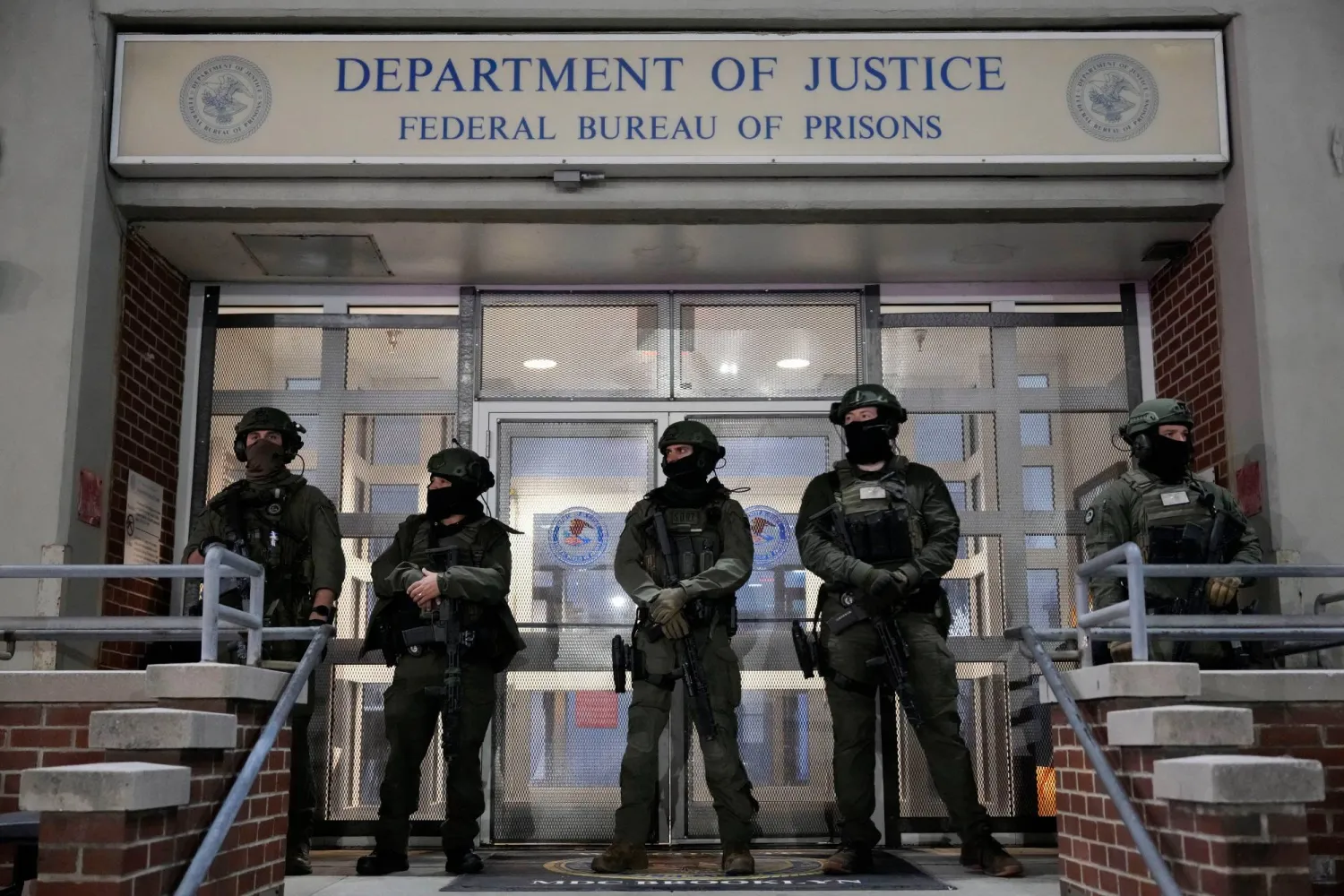
 Federal law enforcement personnel stand watch outside the Metropolitan Detention Center as they await the arrival of captured Venezuelan President Nicolas Maduro, Saturday, Jan. 3, 2026, in New York. (AP Photo/Yuki Iwamura)
Federal law enforcement personnel stand watch outside the Metropolitan Detention Center as they await the arrival of captured Venezuelan President Nicolas Maduro, Saturday, Jan. 3, 2026, in New York. (AP Photo/Yuki Iwamura)
TT

Venezuela’s Interim Government Says It Remains United Behind Maduro After His US Capture

 Federal law enforcement personnel stand watch outside the Metropolitan Detention Center as they await the arrival of captured Venezuelan President Nicolas Maduro, Saturday, Jan. 3, 2026, in New York. (AP Photo/Yuki Iwamura)
Federal law enforcement personnel stand watch outside the Metropolitan Detention Center as they await the arrival of captured Venezuelan President Nicolas Maduro, Saturday, Jan. 3, 2026, in New York. (AP Photo/Yuki Iwamura)

A top Venezuelan official declared on Sunday that the country's government would stay unified behind President Nicolas Maduro, whose capture by the US has sparked deep uncertainty about what is next for the oil-rich South American nation.  

Maduro is in a New York detention center awaiting a Monday court appearance on drug charges, after US President Donald Trump ordered his removal and said the US would take control of Venezuela.  

But in Caracas, top officials in Maduro's government, who have called the detentions of Maduro and his wife Cilia Flores a kidnapping, were still in charge.  

"Here, the unity of the revolutionary force is more than guaranteed, and here there is only one president, whose name is Nicolas Maduro Moros. Let no one fall for the enemy’s provocations," Interior Minister Diosdado Cabello said in an audio shared by the ruling PSUV socialist party on Sunday as he urged calm.  

Images of the 63-year-old Maduro blindfolded and handcuffed on Saturday stunned Venezuelans.  

The action is Washington's most controversial intervention in Latin America since the invasion of Panama 37 years ago. 

Vice President Delcy Rodriguez - who also serves as oil minister - has taken over as interim leader with ‌the blessing of Venezuela's ‌top court, though she has said Maduro remains president.  

Because of her connections with the private sector ‌and ⁠her deep knowledge of ‌oil, the country's top source of revenue, Rodriguez has long been considered the most pragmatic member of Maduro's inner circle, but she has publicly contradicted Trump on his claims she is willing to work with the US. 

The Venezuelan government has said for months that Trump's pressure campaign is an effort to take possession of the country's vast natural resources, especially its oil, and officials have made much of Trump's Saturday comments on the subject, when he said major US oil companies would move in.  

“We are outraged because in the end everything was revealed — it was revealed that they only want our oil,” added Cabello, who has close ties to the military.  

Venezuela's state-run oil company PDVSA is asking some of its joint ventures to cut back crude output by shutting down oilfields or groups of wells ⁠amid an export paralysis, three sources close to the decision told Reuters.  

Oil exports from the OPEC country remain at a standstill since the US last month announced a blockade on sanctioned tankers moving in ‌and out of Venezuelan waters and the seizure of two oil cargoes.  

Once one of the most ‍prosperous nations in Latin America, Venezuela's economy nosedived further under Maduro, ‍sending about one in five Venezuelans abroad in one of the world's biggest exoduses. 

MUTED STREETS  

Maduro opponents in Venezuela have been wary of celebrating his seizure ‍and extraction, and the presence of security forces seemed, if anything, lighter than usual on Sunday.  

Despite the nervous mood, some bakeries and coffee shops were open and joggers and cyclists were out like a normal Sunday morning. Some citizens were stocking up on essentials.  

“Yesterday I was very afraid to go out, but today I had to. This situation caught me without food and I need to figure things out. After all, Venezuelans are used to enduring fear," said a single mother in oil city Maracaibo, who said she bought rice, vegetables and tuna.  

"If this is necessary for my son to grow up in a free country, I’ll keep enduring the fear."  

The owner of a small supermarket in the same city said the business did not ⁠open on Saturday after US Special Forces swooped in on helicopters to seize Maduro after strikes on military installations in Caracas and elsewhere. 

"Today we’ll work until noon since we’re close to many neighborhoods - people have nowhere to buy food and we need to help them," the shop owner said.  

To the disappointment of Venezuela's opposition, Trump has given short shrift to the idea of 58-year-old opposition leader and Nobel Peace Prize winner Maria Corina Machado taking over, saying she lacked support.  

Machado was banned from standing in the 2024 election but has said her ally Edmundo Gonzalez, 76, who the opposition and some international observers say overwhelmingly won that vote, has a democratic mandate to take the presidency.  

It is unclear just how Trump plans to oversee Venezuela and his focus on foreign affairs runs the risk of alienating some supporters who oppose foreign interventions.  

While many Western nations oppose Maduro, there were many calls for the US to respect international law and resolve the crisis diplomatically.  

There were also questions over the legality of seizing a foreign head of state. Democrats said they were misled at recent Congress briefings and have demanded a plan for what is to follow.  

The UN Security Council planned to meet on Monday to discuss the US attack, which Secretary-General Antonio Guterres described as ‌a dangerous precedent.  

Russia and China, both major backers of Venezuela, have criticized the US Maduro was indicted in 2020 on US charges including narco-terrorism conspiracy. He has always denied any criminal involvement. 



Iranian Official Says Kharg Oil Exports 'Normal', after US Strikes

A satellite image of Iran's Kharg Island (AFP)
TT

Iranian Official Says Kharg Oil Exports 'Normal', after US Strikes

A satellite image of Iran's Kharg Island (AFP)

Oil export operations from Iran's Kharg island in the Gulf were proceeding as normal Saturday after US strikes on the crude export hub which caused no casualties, a regional official said.

Activities of oil companies "at this export terminal are continuing as normal", said Ehsan Jahaniyan, deputy governor of Iran's southern Bushehr province, quoted by the IRNA news agency.

The Fars news agency, citing sources on the island, earlier reported there had been no damage to oil facilities after President Donald Trump said US strikes had destroyed only military targets, AFP reported.

Trump had threatened to target oil infrastructure on the island, a crucial hub for Iran, if Tehran continues to block the strategic Strait of Hormuz.

Iran has, in turn, threatened to target US-linked oil infrastructure.

Deputy governor Jahaniyan said that after the attacks "daily life and routine activities of the residents are also fully maintained."

The attack "did not cause any casualties among military personnel, company employees, or residents of Kharg island, he added.

According to Fars, the US operation "tried to damage the army's defenses, the Joshan naval base, the airport control tower and the helicopter hangar of the Iran Continental Shelf Oil Company."

Kharg Island, a scrubby stretch of land in the northern Gulf around 30 kilometres (19 miles) off the Iranian mainland, handles roughly 90 percent of Iran's crude exports.


Four Killed in Russian Air Attack on Ukraine

Four Killed in Russian Air Attack on Ukraine
TT

Four Killed in Russian Air Attack on Ukraine

Four Killed in Russian Air Attack on Ukraine

Russia hammered Ukraine with missiles and drones overnight, killing four people and causing damage across five regions of the country, Ukrainian officials said on Saturday.

The main target was energy infrastructure outside the capital Kyiv, President Volodymyr Zelenskiy said, adding that residential buildings, schools and businesses were also damaged, Reuters reported.

He said the Sumy, Kharkiv, Dnipro and Mykolaiv regions were also targeted in an attack that included around 430 drones and 68 missiles, most of which were downed by air defences.

Saturday's strikes come as the spiraling Iran conflict has distracted international attention from a US-backed peace push in the four-year war, which Kyiv says Moscow has no interest in ending.

"Russia will try to exploit the war in the Middle East to cause even greater destruction here in Europe, in Ukraine," Zelenskiy wrote on X.

He repeated his call for Kyiv's partners to boost production of critical air-defence weapons, stocks of which have been diminishing as the US and its allies in the Gulf have fended off Iranian strikes.

Russia's winter attacks on Ukraine have left swathes of major cities without power or heating, part of a campaign to weaken resolve as Moscow's troops press a battlefield offensive and demand Kyiv cede more territory in the east.

Ukraine's forces have targeted Russian strategic infrastructure such as oil refineries, depots and terminals in long-range strikes.

Ukraine's Energy Ministry said on Saturday that consumers in six regions were without electricity after the overnight strikes and Russian shelling of frontline areas.

"There's no way Russia will stop," said local resident Natalia Fetko, 57, whose building was damaged in the strike. "Nothing is enough for them."

All four deaths occurred in the Kyiv region, where 15 people were also wounded and damage recorded in four districts, according to regional military administrator Mykola Kalashnyk.

Saturday's attack also prompted NATO member Poland to scramble jets to protect its airspace, but no violations were observed, Warsaw's military said.


Son of Ousted Shah Says Ready for Iran Transition 'Under My Leadership'

Smoke rises following an explosion during a protest marking the annual al-Quds Day (Jerusalem Day) on the last Friday of the holy month of Ramadan, amid the US-Israeli conflict with Iran, in Tehran, Iran, March 13, 2026.- Reuters
TT

Son of Ousted Shah Says Ready for Iran Transition 'Under My Leadership'

Smoke rises following an explosion during a protest marking the annual al-Quds Day (Jerusalem Day) on the last Friday of the holy month of Ramadan, amid the US-Israeli conflict with Iran, in Tehran, Iran, March 13, 2026.- Reuters

The exiled son of Iran's last shah who was ousted by the 1979 revolution said on Saturday he was ready to lead a transition "as soon as the Islamic Republic falls".

In a message on his social media channels, US-based Reza Pahlavi said he had already been working to select individuals both inside and outside Iran to serve on what he called a "Transitional System".

Pahlavi leads one of several opposition movements based outside Iran but his prominence grew after January protests against the clerical system, with some demonstrators calling for a return of the monarchy, according to AFP.

Longstanding supreme leader Ali Khamenei was killed on February 28 in US-Israeli airstrikes but after a fortnight of war the clerical system remains in place even if his successor, his son Mojtaba, has yet to make a public appearance.

Pahlavi said that Saeed Ghasseminejad, senior Iran and financial economics advisor at the US-based think tank Foundation for Defense of Democracies (FDD), which is staunchly critical of the Islamic republic, had been leading the process to select members of a transitional body.

"Capable individuals both inside and outside the country have been identified and evaluated to lead various sections of the Transitional System," he said

"The Transitional System, under my leadership, will be ready to assume governance of the country as soon as the Islamic Republic falls, and in the shortest possible time, establish order, security, freedom, and the conditions for Iran's prosperity and flourishing," he added.

In a boost to Pahlavi, vast pro-monarchy rallies took place in February in Munich and several cities in North America in the biggest yet such show of support.

But he has notably also failed to win recognition from US President Donald Trump, who has never officially met with Pahlavi and repeatedly expressed scepticism over his ability to lead Iran.

"They talk about the son of the shah, they talk about other people, but (he) hasn't been there in many years," Trump said this week.

Pahlavi was undergoing air force training in the US when his father Mohammad Reza Pahlavi was ousted and never returned to the country.

Trump has repeatedly referred to Venezuela, where in January US forces captured president Nicolas Maduro, with Washington now working with his former deputy Delcy Rodriguez.

But it remains unclear how such a scenario could play out in Iran.

"I like the idea of internal because it works well, I think we have proven that so far in Venezuela," Trump said.