

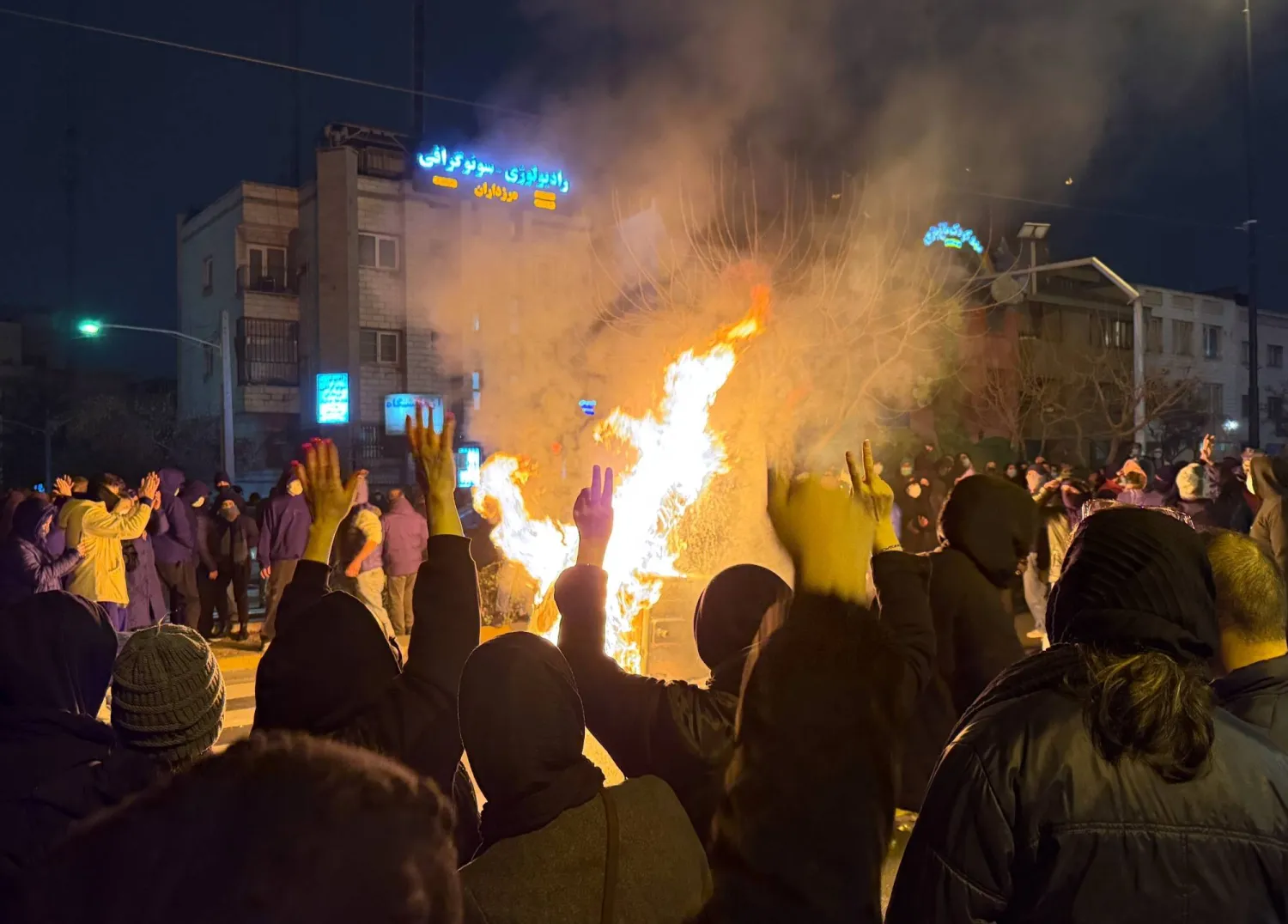

Trump Warns of ‘Very Strong Action’ if Iran Hangs Protesters

 In this photo obtained by The Associated Press, Iranians attend an anti-government protest in Tehran, Iran, Friday, Jan. 9, 2026. (UGC via AP)
In this photo obtained by The Associated Press, Iranians attend an anti-government protest in Tehran, Iran, Friday, Jan. 9, 2026. (UGC via AP)
TT

Trump Warns of ‘Very Strong Action’ if Iran Hangs Protesters

 In this photo obtained by The Associated Press, Iranians attend an anti-government protest in Tehran, Iran, Friday, Jan. 9, 2026. (UGC via AP)
In this photo obtained by The Associated Press, Iranians attend an anti-government protest in Tehran, Iran, Friday, Jan. 9, 2026. (UGC via AP)

US President Donald Trump warned of unspecified "very strong action" if Iranian authorities go ahead with threatened hangings of some protesters, with Tehran calling American warnings a "pretext for military intervention".

International outrage has built over the crackdown that a rights group said has likely killed thousands during protests posing one of the biggest challenges yet to Iran's clerical leadership.

Iran's UN mission posted a statement on X, vowing that Washington's "playbook" would "fail again".

"US fantasies and policy toward Iran are rooted in regime change, with sanctions, threats, engineered unrest, and chaos serving as the modus operandi to manufacture a pretext for military intervention," the post said.

Iranian authorities have insisted they had regained control of the country after successive nights of mass protests nationwide since.

Rights groups accuse the government of fatally shooting protesters and masking the scale of the crackdown with an internet blackout that has now surpassed the five-day mark.

New videos on social media, with locations verified by AFP, showed bodies lined up in the Kahrizak morgue just south of the Iranian capital, with the corpses wrapped in black bags and distraught relatives searching for loved ones.

Trump -- who earlier told the protesters in Iran that "help is on its way" -- said Tuesday in a CBS News interview that the United States would act if Iran began hanging protesters.

Tehran prosecutors have said Iranian authorities would press capital charges of "moharebeh", or "waging war against God", against some suspects arrested over recent demonstrations.

"We will take very strong action if they do such a thing," said the American leader, who has repeatedly threatened Iran with military intervention.

"When they start killing thousands of people -- and now you're telling me about hanging. We'll see how that's going to work out for them," Trump said.

The US State Department on its Farsi language X account said 26-year-old protestor Erfan Soltani had been sentenced to be executed on Wednesday.

"Erfan is the first protester to be sentenced to death, but he won't be the last," the State Department said, adding more than 10,600 Iranians had been arrested.

Rights group Amnesty International called on Iran to immediately halt all executions, including Soltani's.

Trump urged on his Truth Social platform for Iranians to "KEEP PROTESTING", adding: "I have cancelled all meetings with Iranian Officials until the senseless killing of protesters STOPS. HELP IS ON ITS WAY."

It was not immediately clear what meetings he was referring to or what the nature of the help would be.

- 'Rising casualties' -

European nations also signaled their anger over the crackdown, with France, Germany and the United Kingdom among the countries that summoned their Iranian ambassadors, as did the European Union.

"The rising number of casualties in Iran is horrifying," said EU chief Ursula von der Leyen, vowing further sanctions against those responsible.

Norway-based NGO Iran Human Rights said it had confirmed 734 people killed during the protests, including nine minors, but warned the death toll was likely far higher.

"The real number of those killed is likely in the thousands," IHR's director Mahmood Amiry-Moghaddam said.

Iranian state media has said dozens of members of the security forces have been killed, with their funerals turning into large pro-government rallies.

Authorities in Tehran have announced a mass funeral ceremony in the capital on Wednesday for the "martyrs" of recent days.

Amir, an Iraqi computer scientist, returned to Baghdad on Monday and described dramatic scenes in Tehran.

"On Thursday night, my friends and I saw protesters in Tehran's Sarsabz neighborhood amid a heavy military presence. The police were firing rubber bullets," he told AFP in Iraq.

Reza Pahlavi, the US-based son of Iran's ousted shah, called on the military to stop suppressing protests.

"You are the national military of Iran, not the military of the Islamic Republic," he said in a statement.

- 'Serious challenge -

The government on Monday sought to regain control of the streets with mass nationwide rallies that supreme leader Ali Khamenei hailed as proof that the protest movement was defeated, calling them a "warning" to the United States.

In power since 1989 and now aged 86, Khamenei has faced significant challenges, most recently the 12-day war in June against Israel, which forced him to go into hiding.

Analysts have cautioned that it is premature to predict the immediate demise of the theocratic system, pointing to the repressive levers the leadership controls, including the Revolutionary Guard Corps, which is charged with safeguarding the revolution.

Nicole Grajewski, professor at the Sciences Po Center for International Studies, told AFP the protests represented a "serious challenge" to the country, but it was unclear if they would unseat the leadership, pointing to "the sheer depth and resilience of Iran's repressive apparatus".



Spain Removes Ambassador to Israel

Spanish Prime Minister Pedro Sanchez delivers a speech during the opening ceremony of the first International Forum Against Hatred in Madrid, Spain, 11 March 2026.  EPA/Chema Moya
Spanish Prime Minister Pedro Sanchez delivers a speech during the opening ceremony of the first International Forum Against Hatred in Madrid, Spain, 11 March 2026. EPA/Chema Moya
TT

Spain Removes Ambassador to Israel

Spanish Prime Minister Pedro Sanchez delivers a speech during the opening ceremony of the first International Forum Against Hatred in Madrid, Spain, 11 March 2026.  EPA/Chema Moya
Spanish Prime Minister Pedro Sanchez delivers a speech during the opening ceremony of the first International Forum Against Hatred in Madrid, Spain, 11 March 2026. EPA/Chema Moya

Spain’s government decided to remove its ambassador to Israel, according ⁠to the official state ⁠gazette published on Wednesday.

Spain's ⁠embassy in Tel Aviv will be led by a charge d'affaires, a source at ⁠the ⁠Foreign Ministry said.

Relations between Spain and the United States are "operating normally" despite US President Donald Trump's threats to cut trade with Madrid over its opposition to the US-Israeli war on Iran, the Spanish foreign minister said on Tuesday.

The leftist government of Prime Minister Pedro Sanchez drew Trump's ire last week after rejecting the war as reckless and illegal while banning US aircraft from using jointly operated bases in southern Spain in the offensive against Tehran.

Foreign Minister Jose Manuel Albares told reporters both Spain's embassy in Washington and the US ⁠embassy in Madrid were ⁠operating with "absolute normalcy”

"Our embassy in Washington is operating normally and has all the contacts it should have as usual," he said, adding that the same applied to the US embassy in Madrid.

Trump threatened on March 3 to impose a full trade embargo on Madrid, also citing the latter's ⁠refusal to meet NATO's new defense spending target of 5% of national output.


Kremlin Says It Is in Constant Touch with Iranian Leaders

05 March 2026, Russia, Moscow: Kremlin Spokesman Dmitry Peskov attends a meeting between Russian President Vladimir Putin and President of the Central African Republic Faustin-Archange Touadera at the Kremlin. (Kremlin/dpa)
TT

Kremlin Says It Is in Constant Touch with Iranian Leaders

05 March 2026, Russia, Moscow: Kremlin Spokesman Dmitry Peskov attends a meeting between Russian President Vladimir Putin and President of the Central African Republic Faustin-Archange Touadera at the Kremlin. (Kremlin/dpa)

Russia is constantly in touch with the Iranian leadership and willing to contribute to efforts to stabilize the region, the Kremlin said ‌on Wednesday.

"Here ‌I can ‌only ⁠say that we are ⁠in constant contact with the Iranian side and with the Iranian leadership," Kremlin spokesman ⁠Dmitry Peskov told reporters.

"As ‌President (Vladimir) ‌Putin has said, ‌Russia is always ready ‌to do what it can to restore peace and stability ‌in the region."

Putin and Foreign Minister Sergei Lavrov ⁠have ⁠spoken with their Iranian counterparts in recent days, while Putin also held a phone call with US President Donald Trump on Monday.


UK Bans Pro-Palestinian March Over Alleged Iran Support

A boy stands at the site of an Israeli strike on a tent sheltering displaced people, in Nuseirat, central Gaza Strip March 9, 2026. REUTERS/Mahmoud Issa
TT

UK Bans Pro-Palestinian March Over Alleged Iran Support

A boy stands at the site of an Israeli strike on a tent sheltering displaced people, in Nuseirat, central Gaza Strip March 9, 2026. REUTERS/Mahmoud Issa

The UK government has banned an annual pro-Palestinian march planned for Sunday which London police claim is organized by a group "supportive of the Iranian regime".

Interior minister Shabana Mahmood said late Tuesday she had approved the rare police request to prevent "serious public disorder" if the Al-Quds Day march and counter-protests had gone ahead.

It is the first time a protest march has been banned since 2012 but a static demonstration will be permitted, according to London's Metropolitan police.

Mahmood said she was "satisfied" a ban was "necessary" due to "the scale of the protest and multiple counter-protests, in the context of the ongoing conflict in the Middle East".

The minister added that she expected to see "the full force of the law applied to anyone spreading hatred and division".

The Islamic Human Rights Commission (IHRC), an NGO which organizes the annual Al-Quds Day march, said it "strongly condemns" the decision, which it called "politically charged".

"We are seeking legal advice and this decision will not go unchallenged," it added, accusing the Met of having "brazenly abandoned their sworn principle of policing without fear or favor".

It said the London force "unashamedly regurgitate Zionist talking points about the IHRC "without a shred of evidence".

The group describes the day and march as an "international demonstration ... in support of Palestinians and all the oppressed around the world".

Al-Quds day, which takes its name from the Arabic for Jerusalem, originated in Iran in 1979 in support of the Palestinian people, and is now marked annually in various countries, notably in the Muslim world. It aims to protest Israel's occupation of east Jerusalem.

But the Met's Assistant Commissioner Ade Adelekan said it was "uniquely contentious having originated in Iran and in London is organized by the Islamic Human Rights Commission".

He claimed that the organization was "supportive of the Iranian regime".

"The threshold to ban a protest is high and we do not take this decision lightly," AFP quoted Adelekan as saying.

He noted the Met has "a proven track record" of permitting free speech and protest rights at dozens of major pro-Palestinian and other demonstrations in recent years.

"But in our assessment this march raises unique risks and challenges," he said.

"We must consider the likely high numbers of protestors and counter protestors coming together and the extreme tensions between different factions.

"We have taken into consideration the likely impact on protests of the volatile situation in the Middle East, with the Iranian regime attacking British allies and military bases overseas."

The ban on the march and any associated counter-protest marches is valid for a month from Wednesday.