


Europe’s Leaders Stand Firm in Davos as CEOs Warn on Emotions

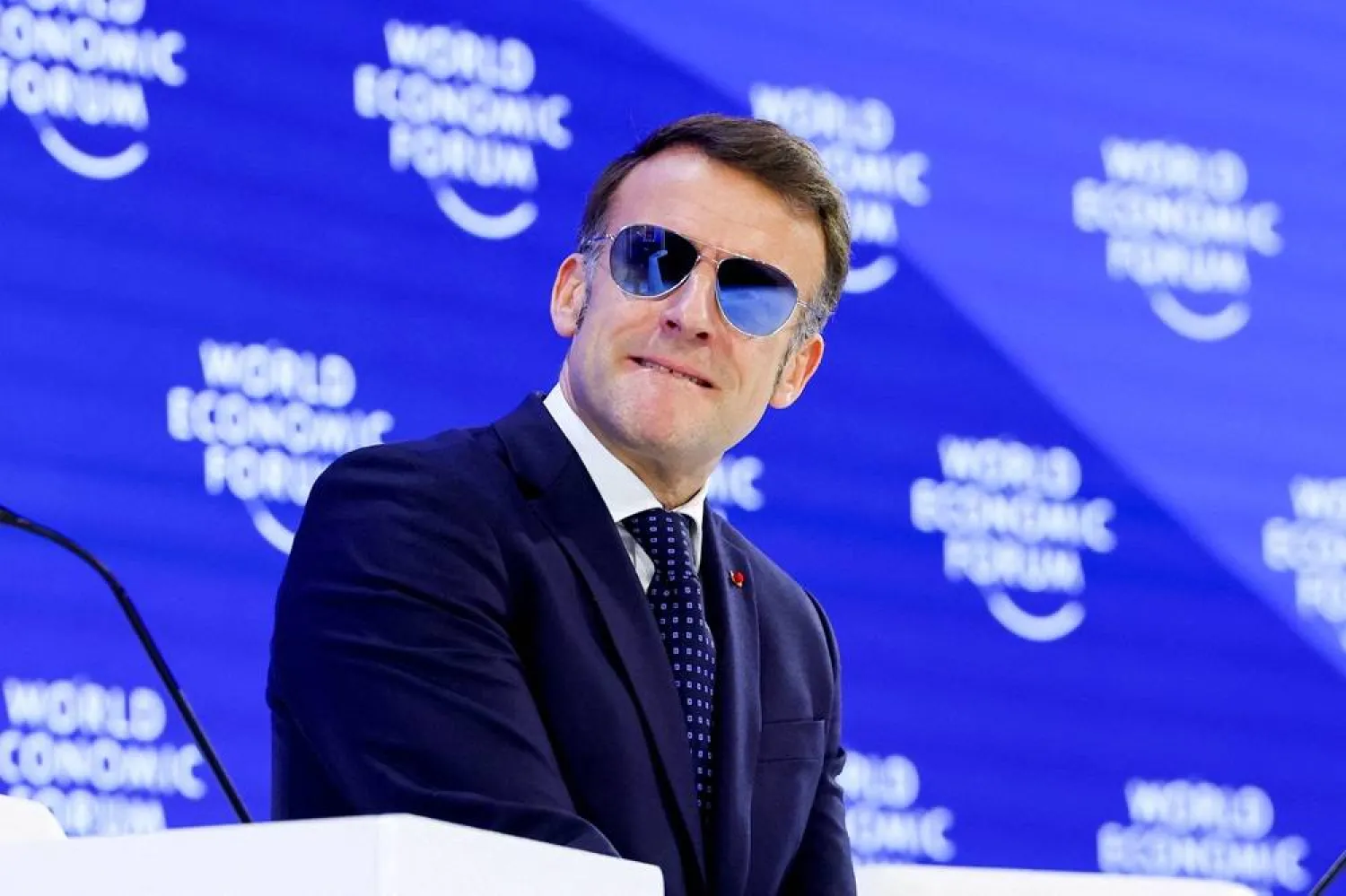
 France's President Emmanuel Macron attends the 56th annual World Economic Forum (WEF) meeting in Davos, Switzerland, January 20, 2026. (Reuters)
France's President Emmanuel Macron attends the 56th annual World Economic Forum (WEF) meeting in Davos, Switzerland, January 20, 2026. (Reuters)
TT

Europe’s Leaders Stand Firm in Davos as CEOs Warn on Emotions

 France's President Emmanuel Macron attends the 56th annual World Economic Forum (WEF) meeting in Davos, Switzerland, January 20, 2026. (Reuters)
France's President Emmanuel Macron attends the 56th annual World Economic Forum (WEF) meeting in Davos, Switzerland, January 20, 2026. (Reuters)

European leaders, rattled by Donald Trump's latest global gambit, are looking to present a united front in Davos, as CEOs warned against an emotional response to the US president's ambition to take over Greenland.

French President Emmanuel Macron said the European Union should not bend to "the law of the strongest", adding that it was "crazy" that the bloc was having to contemplate using its "anti-coercion instrument" against the United States.

"We do believe that we need more growth, we need more stability in this world, but we do prefer respect to bullies," Macron told the World Economic Forum's annual meeting, the day before Trump's arrival in Switzerland.

Without referring directly to Trump, European Commission President Ursula von der Leyen highlighted a need to respond to seismic shifts in the world and said the speed and scale of change had driven a consensus in Europe on independence.

"It is time to seize this opportunity and build a new independent Europe," she said in a speech.

Belgium's Prime Minister Bart De Wever said the ‌27-member bloc was "at a ‌crossroads" where it must decide on how to get out of a "very bad position" ‌after ⁠trying to appease ‌Trump to get his support for the Ukraine war.

"So, we should unite and we should say to Donald Trump ... 'You're crossing red lines here.' We either stand together or we will stand divided," De Wever said on a panel discussion.

EUROPEANS AT ODDS OVER HOW TO RESPOND TO TRUMP

Trump announced tariffs on Saturday on imports from European allies that oppose the US acquiring Greenland, an autonomous part of Denmark.

European governments, which are facing growing challenges from populist, nationalist parties, have been at odds over how to respond to the tariff threat while maintaining US support for Ukraine.

Macron said Europe should not accept a world where might was right and called for bold moves to defend ⁠European industries.

"Let's not be shy. Let's not be divided. Let's not accept a global order, which will be divided by those who claim to have the bigger voice," ‌Macron said.

Macron also appeared to see an opportunity for Europe in Trump's chaotic ‍policies.

"We have a place where the rule of law ‍and predictability is still the rule of the game, and my guess is that it is under-priced by the market," he ‍said in his speech.

However, some senior bankers and executives in Davos, who spoke on condition of anonymity, said they saw the response from European leaders to Trump's moves as emotional rather than pragmatic. Two suggested the continent needed to look beyond the way the US president delivers his message and have a negotiation.

"But they won't even want to have that conversation, because they're so offended by the style. And so, what you have in Europe is a very, very, delicate balance of a continent that cannot move together," one senior banker told Reuters.

European countries say Trump's threat of new tariffs would violate a trade deal reached with ⁠the US last year, and EU leaders are set to discuss possible retaliation at an emergency summit in Brussels on Thursday.

US Treasury Secretary Scott Bessent, however, voiced confidence that the United States and European countries would find a solution and avoid what some have warned could become a prolonged trade war.

"Why are we jumping there? Why are you taking it to the worst case? ... Calm down the hysteria. Take a deep breath," he said.

UKRAINE PUSHES FOR SECURITY GUARANTEES, RECONSTRUCTION PLAN

Meanwhile, Ukrainian President Volodymyr Zelenskiy said on Tuesday that he was ready to join other global leaders in Davos, but only if the US was ready to sign documents on security guarantees for Ukraine and a post-war prosperity plan.

"Ukraine is ready for meetings ... if those meetings are actually effective," he wrote on X.

His comments came as CEOs, including finance industry executives, are expected to meet on Wednesday to discuss post-war reconstruction, a source familiar with the matter said.

But any decisions were unlikely, the source told Reuters, adding: "You need peace in order to reconstruct the place."

Zelenskiy urged the US to pile more ‌pressure on Russia after its latest massive air attack on Ukraine cut heating to half of the capital and affected substations the United Nations' atomic watchdog said are vital for nuclear safety.



Iran's Top Negotiator Threatens 'Faster, More Intense' Response to US Attacks

People walk past a large anti-US banner with reference to the dropping of the atomic bomb on the Japanese city of Hiroshima, in Tehran on September 2, 2026. (Photo by Atta KENARE / AFP) /
TT

Iran's Top Negotiator Threatens 'Faster, More Intense' Response to US Attacks

People walk past a large anti-US banner with reference to the dropping of the atomic bomb on the Japanese city of Hiroshima, in Tehran on September 2, 2026. (Photo by Atta KENARE / AFP) /

Iran's top negotiator Mohammad Bagher Ghalibaf threatened on Sunday to launch swifter and more forceful responses to US attacks, after Tehran targeted American warships in retaliation for US attacks on tankers.

"The Americans must have understood that the era of proportionate responses has come to an end," said Ghalibaf in a speech carried by state media, adding that "any aggression against Iran's interests and security will receive a faster, more intense and more painful response.”

Iran said Sunday that it struck an unmanned US military boat in the Strait of Hormuz.

US Central Command, which oversees the US military operations in the Middle East, did not confirm the claim or respond to request for comment. It comes one day after the US said it struck Iranian oil tankers in retaliation for Iran launching ballistic missiles at Navy warships.


A Fuel Tanker Explosion in West Iran Kills 11 and Injures 7

A fuel tanker exploded in western Iran, killing 11 people and injuring seven others, according to the state media.(AP)
TT

A Fuel Tanker Explosion in West Iran Kills 11 and Injures 7

A fuel tanker exploded in western Iran, killing 11 people and injuring seven others, according to the state media.(AP)

A fuel tanker exploded in western Iran, killing 11 people and injuring seven others, state media said.

IRNA reported late Saturday that the tanker hit other cars before bursting into flames near a traffic police station close to the Kurdish city of Sanandaj, some 400 kilometers (248 miles) west of the capital, Tehran. The report cited a faulty brake system, The Associated Press said.

The injured were transferred to hospitals.

In 2018, a similar road accident between a fuel tanker and an intercity passenger bus near Sanandaj killed 15 people and injured four.

Road and traffic accidents annually leave more than 17,000 dead in Iran. Experts blame the high fatality rate on unsafe vehicles, disregard for traffic rules, and inadequate emergency services.


Nepali Rescuers Buoyed by Miracle Finds but Tough Conditions Persist

Nepal Army personnel work to build an iron bridge across Tadi Khola river following the deadly flash floods and mudslide, in Devighat, Nuwakot district, Nepal, September 4, 2026. REUTERS/Adnan Abidi
TT

Nepali Rescuers Buoyed by Miracle Finds but Tough Conditions Persist

Nepal Army personnel work to build an iron bridge across Tadi Khola river following the deadly flash floods and mudslide, in Devighat, Nuwakot district, Nepal, September 4, 2026. REUTERS/Adnan Abidi

Nepali rescuers faced challenging conditions on Sunday as search operations after catastrophic floods entered their 12th day, buoyed by the extraordinary rescues of four survivors.

The glacial and mountain collapse on the China-Nepal border has killed at least 1,372 people and left more than 5,500 missing across the two countries, AFP said.

Rescuers found two more people alive on Saturday, joining two saved the day before in what have been described as miraculous tales of survival.

Three of those have been found in hydropower tunnels where the government initially said it believed more than 100 workers could be alive.

"Search and rescue is going on at the tunnels despite geography, adverse weather and lack of connectivity," Energy Minister Biraj Bhakta Shrestha told AFP.

Rescue workers were experiencing "multiple challenges", he said.

The wall of icy water and debris tore through mountain districts on August 26, destroying roads, bridges and other infrastructure.

On Saturday, rescuers pulled a Chinese man alive from deep inside a hydropower tunnel, and a 64-year-old Nepali woman, Chandrika Shrestha, from her mud-covered home.

Prime Minister Balendra Shah said the latter rescue had "given hope to the entire nation".

A day earlier, two Nepali hydropower workers were rescued at the Trishuli 3A tunnel, where searches continue alongside multiple other sites, with at least 12 hydropower projects affected.

Biraj Bhakta Shrestha said work was continuing to restore electricity in several areas.

"Places that have unreachable, we've tried to restore power with solar," he told AFP.

Foreign Minister Shisir Khanal has called the disaster a "Himalayan tsunami" and has warned reconstruction costs could run into the billions of dollars.

The United Nations has said the magnitude of the destruction makes delivering aid an immense challenge, and has launched a $50 million appeal to help more than 84,000 people.

With mortuaries overflowing, Nepal has buried hundreds of bodies in mass graves, after taking DNA samples for future identification, according to the police.

Only around 100 bodies have been identified and handed over to families.

Nepal will hold a national day of mourning on Monday, the 13th day since the disaster, in line with a traditional period of mourning in Hindu rituals.

While the exact cause of the glacial collapse is unclear, climate change is accelerating glacial melting worldwide, increasing the risk of such disasters.

In Nepal, rescuers have retrieved 1,341 bodies, while around 4,996 people remain missing, according to the disaster agency.

Chinese state media report that 31 people have been killed and 531 are missing in Tibet.

The combined toll is 1,372 dead and more than 5,500 missing, including around 800 foreigners, among them tourists and pilgrims.