
Iran Army Chief Warns US and Israel, Says Forces on High Alert

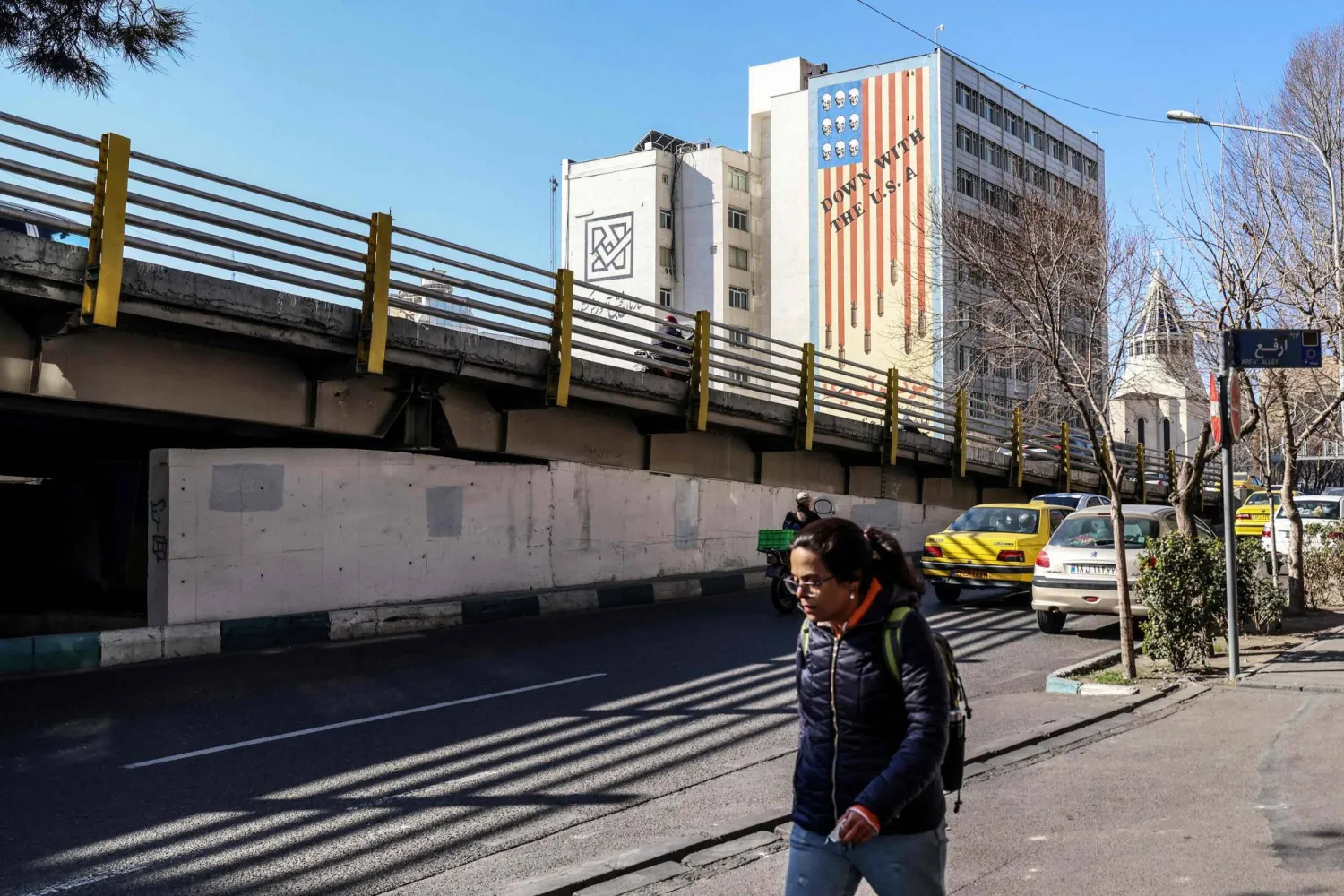
An Iranian walks past a huge anti-US mural painted on the side of a building in the Iranian capital Tehran on January 31, 2026. (Photo by Atta KENARE / AFP)
TT

Iran Army Chief Warns US and Israel, Says Forces on High Alert

An Iranian walks past a huge anti-US mural painted on the side of a building in the Iranian capital Tehran on January 31, 2026. (Photo by Atta KENARE / AFP)

Iranian army chief Amir Hatami on Saturday warned the United States and Israel against an attack, saying his country's forces were on high alert.

He also insisted Iran’s nuclear expertise could not be eliminated, after US President Donald Trump said he expected Tehran to seek a deal to avoid US strikes.

"If the enemy makes a mistake, without a doubt it will endanger its own security, the security of the region, and the security of the Zionist regime," Hatami said, according to the official IRNA news agency.

According to AFP, he noted that Iran's armed forces were "at full defensive and military readiness".

Washington sent a naval strike group to the Middle East led by the USS Abraham Lincoln aircraft carrier, with Trump threatening to intervene militarily after a deadly crackdown by Iranian authorities on two weeks of anti-government protests.

The deployment has raised fears of a possible direct confrontation with Iran, which has warned it would respond with missile strikes on US bases, ships and allies -- notably Israel -- in the event of an attack.

On Friday, Trump said he predicted that Iran would seek to negotiate a deal over its nuclear and missile programs rather than face American military action.

Iranian Foreign Minister Abbas Araghchi had said earlier that Tehran was ready for nuclear talks, but its missiles and defense "will never be negotiated".

The US carried out strikes on key Iranian nuclear sites in June when it briefly joined Israel's 12-day war against its regional foe.

Israeli attacks also hit military sites across the country and killed senior officers and top nuclear scientists.

But Hatami on Saturday insisted that Iran's nuclear technology "cannot be eliminated, even if scientists and sons of this nation are martyred".

On Friday, US Central Command (CENTCOM) said Iran's Revolutionary Guard Corps (IRGC) would conduct "a two-day live-fire naval exercise" in the Strait of Hormuz, a key transit hub for global energy supplies.

In a statement, CENTCOM warned the IRGC against "any unsafe and unprofessional behavior near US forces".

Nationwide protests against the rising cost of living erupted in Iran on December 28, before turning into a broader anti-government movement that peaked on January 8 and 9.

Iranian authorities have said the protests began peacefully before turning into "riots" involving killings and vandalism, blaming the United States and Israel for fomenting the unrest in a "terrorist operation".

The official death toll from the authorities stands at 3,117.

However, the US-based Human Rights Activists News Agency (HRANA) said it has confirmed 6,563 deaths, including 6,170 protesters and 124 children.

The protests have since subsided.


10 Security Officials, 37 Militants Killed in SW Pakistan Attacks

Security personnel inspect the blast site after an attack by Baloch separatists in Quetta on January 31, 2026. (Photo by Adnan AHMED / AFP)
TT

10 Security Officials, 37 Militants Killed in SW Pakistan Attacks

Security personnel inspect the blast site after an attack by Baloch separatists in Quetta on January 31, 2026. (Photo by Adnan AHMED / AFP)

At least 10 security officials and 37 militants were killed as ethnic Baloch separatists launched "coordinated" attacks across Pakistan's Balochistan province on Saturday, an official said, the latest violence in insurgency-hit southwest region.

"The terrorists ... launched coordinated attacks this morning at more than 12 locations,” a senior security official told AFP on condition of anonymity as he was not authorized to speak to the media.

"Thirty-seven terrorists have been eliminated... Ten security personnel were martyred while a few others were injured," the official added.

Pakistan has been battling a separatist insurgency in Balochistan for decades, where militants target state forces, foreign nationals and non-locals in the mineral-rich southwestern province bordering Afghanistan and Iran.


Mine Collapses in Eastern Congo, Leaving at Least 200 Dead

FILE - Miners work at the D4 Gakombe coltan mining quarry in Rubaya, Congo, May 9, 2025. (AP Photo/Moses Sawasawa, File)
TT

Mine Collapses in Eastern Congo, Leaving at Least 200 Dead

FILE - Miners work at the D4 Gakombe coltan mining quarry in Rubaya, Congo, May 9, 2025. (AP Photo/Moses Sawasawa, File)

A landslide earlier this week collapsed several mines at a major coltan mining site in eastern Congo, leaving at least 200 people dead, rebel authorities said Saturday.

The collapse took place Wednesday at the Rubaya mines, which are controlled by the M23 rebels, Lumumba Kambere Muyisa, the spokesperson of the rebel-appointed governor of North-Kivu province told The Associated Press. He said the landslide was caused by heavy rains.

“For now, there are more than 200 dead, some of whom are still in the mud and have not yet been recovered,” Muyisa said. He added that several others were injured and taken to three health facilities in the town of Rubaya, while ambulances were expected to transfer the wounded Saturday to Goma, the nearest city around 50 kilometers (30 miles) away.

The rebel-appointed governor of North Kivu has temporarily halted artisanal mining on the site and ordered the relocation of residents who had built shelters near the mine, Muyisa said.

A former miner at the site told The Associated Press there have been repeated landslides because the tunnels are dug by hand, poorly constructed, and left without maintenance.

“People dig everywhere, without control or safety measures. In a single pit, there can be as many as 500 miners, and because the tunnels run parallel, one collapse can affect many pits at once,” Clovis Mafare said.

Rubaya lies in the heart of eastern Congo, a mineral-rich part of the Central African nation which for decades has been ripped apart by violence from government forces and different armed groups, including the Rwanda-backed M23, whose recent resurgence has escalated the conflict, worsening an already acute humanitarian crisis.

Congo is a major supplier of coltan, a black metallic ore that contains the rare metal tantalum, a key component in the production of smartphones, computers and aircraft engines.

The country produced about 40 percent of the world’s coltan in 2023, according to the US Geological Survey, with Australia, Canada and Brazil being other big suppliers. Over 15% of the world’s supply of tantalum from Rubaya’s mines.

In May 2024, M23 seized the town and took control of its mines. According to a UN report, since seizing Rubaya, the rebels have imposed taxes on the trade and transport of coltan, generating at least $800,000 a month.

Eastern Congo has been in and out of crisis for decades. Various conflicts have created one of the world’s largest humanitarian crises with more than 7 million people displaced, including 100,000 who fled homes this year.

Despite the signing of a deal between the Congolese and Rwandan governments brokered by the US and ongoing negotiations between rebels and Congo, fighting continues on several fronts in eastern Congo, continuing to claim numerous civilian and military casualties.

The deal between Congo and Rwanda also opens up access to critical minerals for the US government and American companies.


Iran President Says Trump, Netanyahu, Europe Stirred Tensions in Recent Protests

HANDOUT - 31 December 2025, Iran, Tehran: Iranian President Masoud Pezeshkian chairs a cabinet meeting in Tehran. Photo: -/Iranian Presidency/dpa
TT

Iran President Says Trump, Netanyahu, Europe Stirred Tensions in Recent Protests

HANDOUT - 31 December 2025, Iran, Tehran: Iranian President Masoud Pezeshkian chairs a cabinet meeting in Tehran. Photo: -/Iranian Presidency/dpa

Iranian President Masoud Pezeshkian said on Saturday that US ⁠President Donald Trump, Israeli Prime Minister Benjamin ⁠Netanyahu and Europe had stirred tensions in the recent protests that gripped ⁠the country and "provoked" people.

Pezeshkian also urged his government to heed public grievances after the demonstrations.

"We must work with the people and for the people and serve the people as much as possible," Pezeshkian said in a speech broadcast on state TV.

"If we act justly, the people will see it and will accept it, and under such conditions, no power can cripple a government, a society, or a nation that acts justly, fairly, and on the basis of rights."

Trump predicted on Friday that Iran would seek to negotiate a deal rather than face American military action, despite Tehran warning that its arsenal of missiles would never be up for discussion.

"I can say this, they do want to make a deal," Trump told reporters in the Oval Office.

Asked if he had given Iran a deadline to enter talks on its nuclear and missile programs, Trump said "yeah, I have," but refused to say what it was.

"We have a large armada, flotilla, call it whatever you want, heading toward Iran right now," Trump said, referring to a US naval carrier group in waters off Iran.

"Hopefully we'll make a deal. If we do make a deal, that's good. If we don't make a deal, we'll see what happens."

Trump cited what he said was Iran's decision to halt the executions of protesters -- after a crackdown in which rights groups say more than 6,000 people were killed -- as evidence to show Tehran was ready to negotiate.