

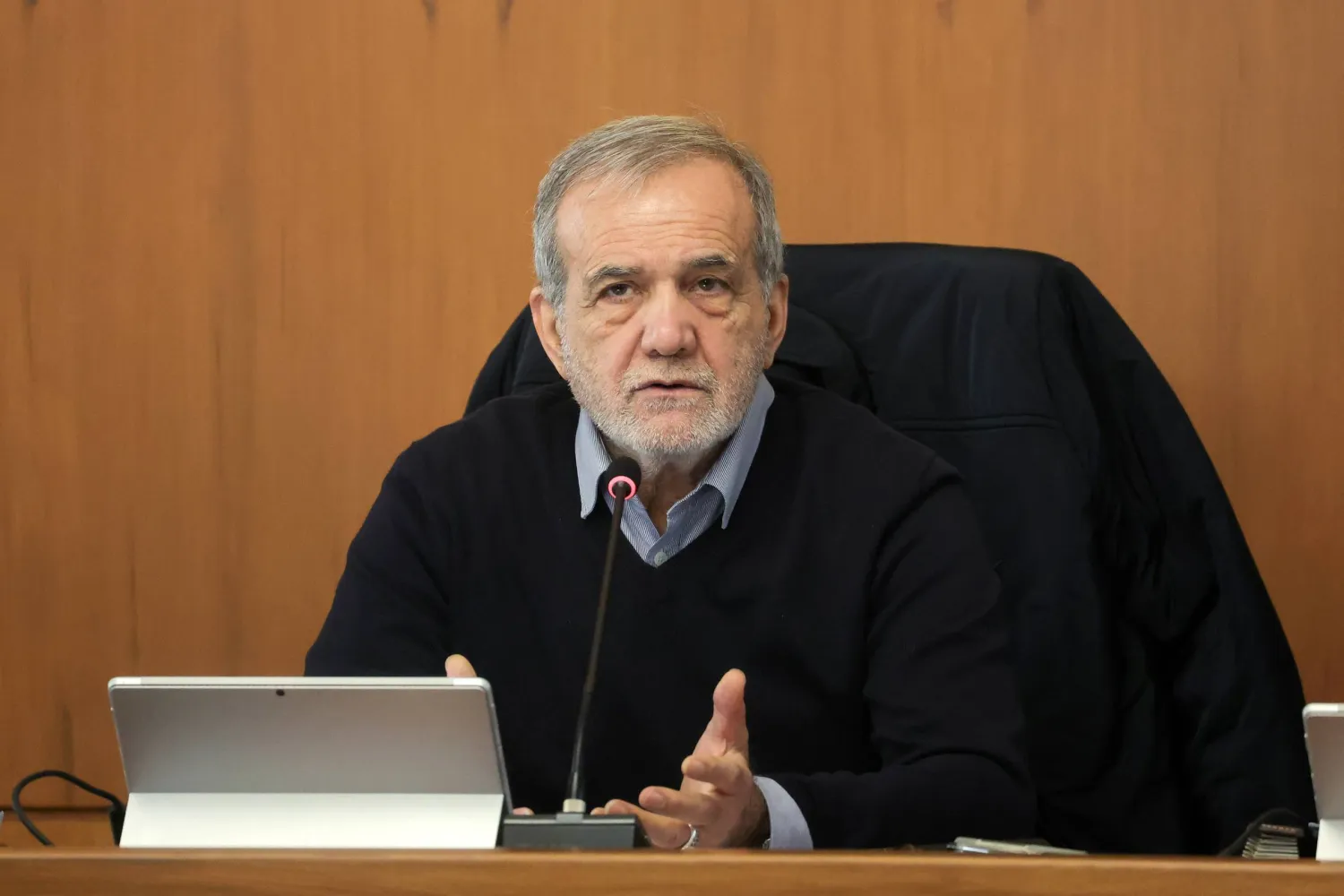

Iran's President Seeks 'Fair and Equitable Negotiations' with the United States

31 December 2025, Iran, Tehran: Iranian President Masoud Pezeshkian chairs a cabinet meeting in Tehran. Photo: Iranian Presidency/dpa
TT

Iran's President Seeks 'Fair and Equitable Negotiations' with the United States

31 December 2025, Iran, Tehran: Iranian President Masoud Pezeshkian chairs a cabinet meeting in Tehran. Photo: Iranian Presidency/dpa

Iran's president said Tuesday he instructed the country’s foreign minister to “pursue fair and equitable negotiations” with the United States, the first clear sign from Tehran it wants to try to negotiate as tensions remain high with Washington after the country's bloody crackdown on nationwide protests last month. 

The announcement marked a major turn for reformist President Masoud Pezeshkian, who had broadly warned Iranians for weeks that the turmoil in his country had gone beyond his control. It also signals that the president received support from Iran's Supreme Leader Ali Khamenei for talks that the 86-year-old cleric previously had dismissed. 

Türkiye had been working behind the scenes to make the talks happen there later this week as US Mideast envoy Steve Witkoff is traveling in the region. A Turkish official later said the location of talks was uncertain but that Türkiye was ready to support the process. The official did not provide further details. 

But whether Iran and the US can reach an agreement remains to be seen, particularly as President Donald Trump now has included Iran's nuclear program in a list of demands from Tehran in any talks. Trump ordered the bombing of three Iranian nuclear sites during the 12-day war Israel launched against Iran in June. 

Iran's president signals talks are possible  

Writing on X, Pezeshkian said in English and Farsi that the decision came after “requests from friendly governments in the region to respond to the proposal by the President of the United States for negotiations.” 

“I have instructed my Minister of Foreign Affairs, provided that a suitable environment exists — one free from threats and unreasonable expectations — to pursue fair and equitable negotiations, guided by the principles of dignity, prudence, and expediency,” he said. 

The US has yet to acknowledge the talks will take place. A semiofficial news agency in Iran on Monday reported — then later deleted without explanation — that Pezeshkian had issued such an order to Foreign Minister Abbas Araghchi, who held multiple rounds of talks with Witkoff before the 12-day war. 

Khamenei adviser speaks on nuclear issue  

Late Monday, the pan-Arab satellite channel Al Mayadeen, which is politically allied with the Iranian-backed Lebanese group Hezbollah, aired an interview with Ali Shamkhani, a top Khamenei adviser on security. 

Shamkhani, who now sits on the country’s Supreme National Security Council and who in the 1980s led Iran's navy, wore a naval uniform as he spoke. 

He suggested that if the talks happened, they would be indirect at the beginning, then move to direct talks if a deal appeared to be attainable. Direct talks with the US long have been a highly charged political issue within Iran's theocracy, with reformists like Pezeshkian pushing for them and hard-liners dismissing them. 

The talks would solely focus on nuclear issues, he added. 

Asked about whether Russia could take Iran's enriched uranium like it did in Tehran's 2015 nuclear deal with world powers, Shamkhani dismissed the idea, saying there was “no reason” to do so. Kremlin spokesperson Dmitry Peskov on Monday said Russia had “long offered these services as a possible option that would alleviate certain irritants for a number of countries.” 

“Iran does not seek nuclear weapons, will not seek a nuclear weapon and will never stockpile nuclear weapons, but the other side must pay a price in return for this," he said. 

Iran had been enriching uranium up to 60% purity, a short, technical step away from weapons-grade levels. The International Atomic Energy Agency had said Iran was the only country in the world to enrich to that level that wasn't armed with the bomb. 

Iran has been refusing requests by the IAEA to inspect the sites bombed in the June war. 

“The quantity of enriched uranium remains unknown, because part of the stockpile is under rubble, and there is no initiative yet to extract it, as it is extremely dangerous,” Shamkhani said. 

Witkoff traveling to Israel  

Witkoff is expected to meet Prime Minister Benjamin Netanyahu and other Israeli security officials on Tuesday, according to a White House official who was not authorized to comment publicly about the talks and spoke on condition of anonymity. 

While in Israel, Witkoff will meet with the head of the Mossad intelligence service and the Israeli military's chief of staff, according to another official who was not authorized to speak to the media and spoke on condition of anonymity. 

Israel is expected to ask that any agreement with Iran include removing enriched uranium from the country, stopping the enrichment of uranium, limiting the creation of ballistic missiles and ending support for Tehran's proxies. 

However, Shamkhani in his interview rejected giving up uranium enrichment — a major obstacle in earlier talks with the US In November, Araghchi said Iran was doing no enrichment in the country because of the US bombing of the nuclear sites. 

“We have talks going on with Iran, we’ll see how it all works out,” Trump told reporters in the Oval Office on Monday. Asked what his threshold was for military action against Iran, he declined to elaborate. 

“I’d like to see a deal negotiated,” Trump said. “Right now, we’re talking to them, we’re talking to Iran, and if we could work something out, that’d be great. And if we can’t, probably bad things would happen.” 

Mike Pompeo, a hard-liner on Iran who served as CIA director and secretary of state in Trump's first term, said it was “unimaginable that there can be a deal.” 

“I think they may come away with some set of understandings,” Pompeo said at Dubai's World Governments Summit. “But to think that there’s a long-term solution that actually provides stability and peace to this region while Khamenei is still in power is something I pray for but find unimaginable.” 


US Tanker Approached by Iranian Gunboats in Strait of Hormuz

An Iranian Revolutionary Guard vessel watches an American warship in the Strait of Hormuz, May 19, 2023. (AP)
TT

US Tanker Approached by Iranian Gunboats in Strait of Hormuz

An Iranian Revolutionary Guard vessel watches an American warship in the Strait of Hormuz, May 19, 2023. (AP)

British maritime security firm Vanguard Tech said Tuesday that a US-flagged tanker was approached and challenged by Iranian gunboats in the Strait of Hormuz, before continuing on its way.

The Stena Imperative was approached by three pairs of small armed boats belonging to the Iranian Revolutionary Guards while transiting the strait approximately 16 nautical miles (30 kilometers) north of Oman, the company said.

The gunboats hailed it by radio, ordering the captain "to stop the engines and prepare to be boarded", but the ship increased speed and maintained course, the firm added, stressing it did not enter Iranian territorial waters.

"The vessel is now being escorted by a US warship," Vanguard Tech said.

Earlier, the British maritime security agency UKMTO reported the incident without specifying the nationality of the ship or the boats that approached it.

The Iranian news agency Fars said a vessel, whose nationality it did not specify, had entered the country's territorial waters in the Strait of Hormuz illegally, at which point Iranian units "requested" that it present the necessary permissions.

"The vessel had no legal authorization to be in these waters," Fars said. "It was therefore warned and immediately left Iranian waters."

The strait, a key passage for the global transport of oil and liquefied natural gas, has been the scene of several incidents in the past.

A senior Iranian official from the naval forces of the Revolutionary Guards threatened last week to block the passage in the event of a US attack.


NATO Says ‘Planning Underway’ for New Arctic Mission

The Danish Navy ocean patrol vessel F357 Thetis is pictured during a visit of Denmark's Defense Minister at the army contribution in Nuuk, Greenland, on January 31, 2026. (AFP)
TT

NATO Says ‘Planning Underway’ for New Arctic Mission

The Danish Navy ocean patrol vessel F357 Thetis is pictured during a visit of Denmark's Defense Minister at the army contribution in Nuuk, Greenland, on January 31, 2026. (AFP)

NATO said Tuesday that military planning has started for a new mission to bolster security in the Arctic, after US President Donald Trump made protecting the region central to his demands for Greenland.

"Planning is underway for a NATO enhanced vigilance activity, named Arctic Sentry," said Martin O'Donnell, a spokesman for NATO's Supreme Headquarters Allied Powers Europe.

"The activity will even further strengthen NATO's posture in the Arctic and High North," he added, without providing further details.

Trump's threats against Greenland last month plunged the transatlantic alliance into its deepest crisis in years.

The unpredictable US leader backed off his desire to take control of Denmark's autonomous Arctic territory after saying he had struck a "framework" deal with NATO chief Mark Rutte to ensure greater American influence.

NATO said it would take steps to boost its presence in the Arctic after Trump used the alleged threat of Russia and China to justify his designs on Greenland.

Meanwhile Denmark and Greenland have kicked off talks with the United States over the territory and are expected to renegotiate a 1951 treaty governing American troop deployments on the island.

Danish Prime Minister Mette Frederiksen has said that NATO countries back having a "permanent presence" in the Arctic, including around Greenland, as part of efforts to step up security.


WHO Appeals for $1 Bn for World’s Worst Health Crises in 2026

 Displaced Palestinian children gather at a tent camp in Gaza City, February 3, 2026. (Reuters)
Displaced Palestinian children gather at a tent camp in Gaza City, February 3, 2026. (Reuters)
TT

WHO Appeals for $1 Bn for World’s Worst Health Crises in 2026

 Displaced Palestinian children gather at a tent camp in Gaza City, February 3, 2026. (Reuters)
Displaced Palestinian children gather at a tent camp in Gaza City, February 3, 2026. (Reuters)

The World Health Organization on Tuesday appealed for $1 billion to tackle health crises this year across the world's 36 most severe emergencies, including in Gaza, Sudan, Haiti and the Democratic Republic of Congo.

The UN health agency estimated 239 million people would need urgent humanitarian assistance this year and the money would keep essential health services going.

WHO health emergencies chief Chikwe Ihekweazu told reporters in Geneva: "A quarter of a billion people are living through humanitarian crises that strip away the most basic protections: safety, shelter and access to health care.

"In these settings, health needs are surging, whether due to injuries, disease outbreaks, malnutrition or untreated chronic diseases," he warned.

"Yet access to care is shrinking."

The agency's emergency request was significantly lower than in recent years, given the global funding crunch for aid operations.

Washington, traditionally the UN health agency's biggest donor, has slashed foreign aid spending under President Donald Trump, who on his first day back in office in January 2025 handed the WHO his country's one-year withdrawal notice.

Last year, WHO had appealed for $1.5 billion but Ihekweazu said that only $900 million was ultimately made available.

Unfortunately, he said, the agency had been "recognizing ... that the appetite for resource mobilization is much smaller than it was in previous years".

"That's one of the reasons that we've calibrated our ask a little bit more towards what is available realistically, understanding the situation around the world, the constraints that many countries have," he said.

The WHO said in 2026 it was "hyper-prioritizing the highest-impact services and scaling back lower-impact activities to maximize lives saved".

Last year, global funding cuts forced 6,700 health facilities across 22 humanitarian settings to either close or reduce services, "cutting 53 million people off from health care", Ihekweazu said.

"Families living on the edge face impossible decisions, such as whether to buy food or medicine," he added, stressing that "people should never have to make these choices".

"This is why today we are appealing to the better sense of countries, and of people, and asking them to invest in a healthier, safer world."
