
Iran Steps up Arrests While Remaining Positive on US Talks

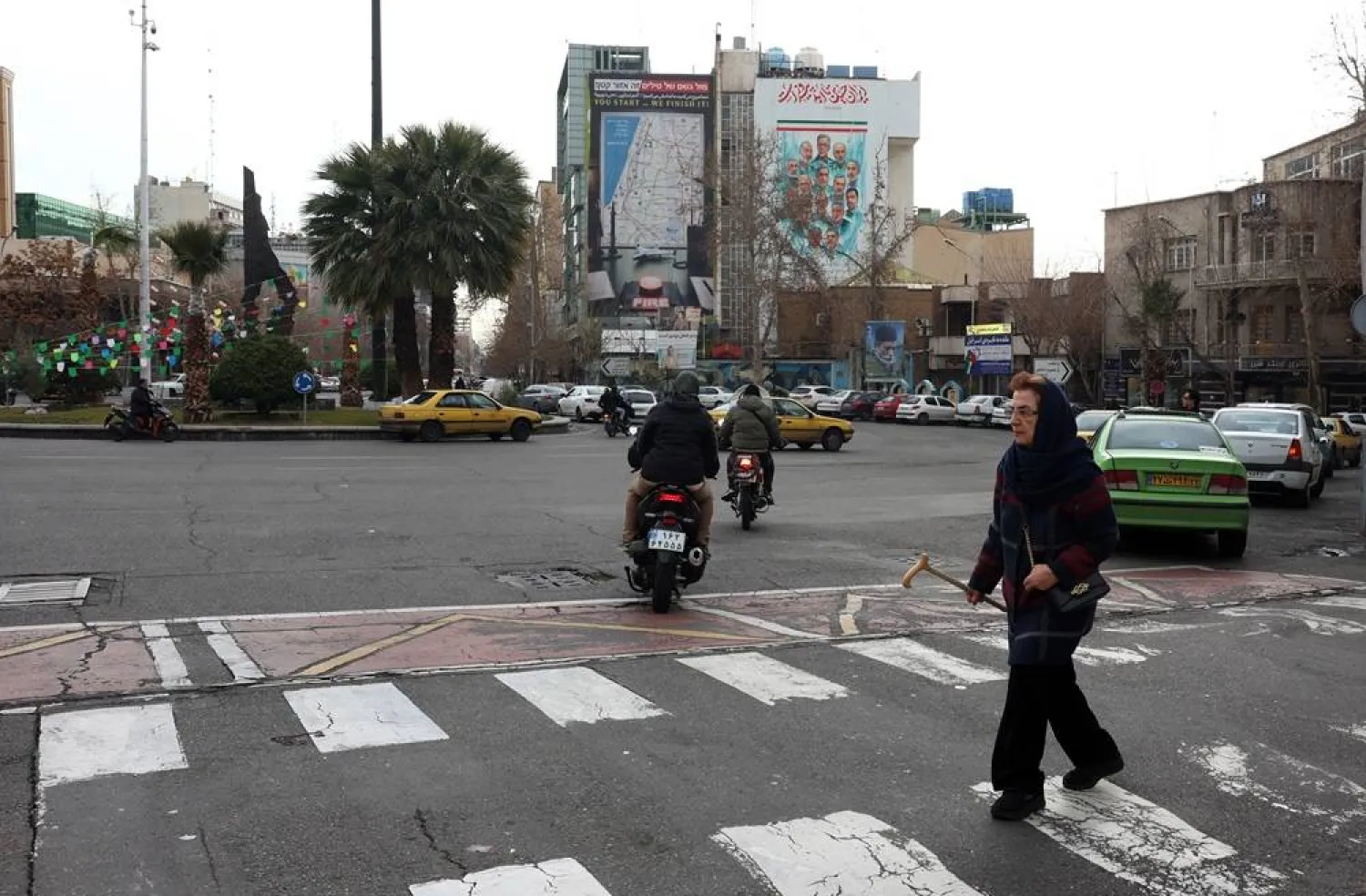
Iranians cross a road near an anti-US and anti-Israeli billboard reading "You start... we finish it" in Palestine Square in Tehran, Iran, 09 February 2026, amid heightened regional tensions. (EPA)
TT

Iran Steps up Arrests While Remaining Positive on US Talks

Iranians cross a road near an anti-US and anti-Israeli billboard reading "You start... we finish it" in Palestine Square in Tehran, Iran, 09 February 2026, amid heightened regional tensions. (EPA)

Iran stepped up its crackdown on Monday after recent protests, with more arrests, while holding the door open to Washington for further nuclear negotiations. 

The arrests -- including that of Javad Emam, the spokesperson for the main reformist coalition -- came after Iranian and US officials held talks in Oman that both sides painted as positive. 

On Saturday, Iran heaped more jail time on Nobel Peace Prize winner Narges Mohammadi, and on Monday arrested Hossein Karoubi, the son of prominent dissident Mehdi Karoubi. 

Weeks after repressing a wave of protests, one of the greatest challenges to government authority since it came to power in the 1979 revolution, Tehran has taken a two-track approach. 

It is rounding up and jailing perceived critics, while at the same time pursuing a potential diplomatic opening with US President Donald Trump's administration. 

A spokesperson for the Reformist Front coalition, told local media on Monday that Iran's Revolutionary Guards had arrested the group's spokesman Emam. 

Emam was one of at least five Reformist Front figures to be detained, alongside those of several activists and filmmakers for co-signing a protest statement. 

Iran's government has branded the protests "riots" fuelled by its arch-foes Israel and the United States. 

- 'Frustrate the enemy' - 

On Monday, supreme leader Ali Khamenei called on the nation to show "resolve" against foreign pressure. 

"National power is less about missiles and aircraft and more about the will and resolve of the people," Khamenei said, adding: "Show it again and frustrate the enemy." 

Alongside this defiance, Iran has signaled it could come to some kind of deal to dial back its nuclear program to avoid further conflict with Washington. 

The official IRNA news agency reported that Iranian atomic agency chief Mohammad Eslami had said that Tehran could dilute its highly-enriched uranium in return for sanctions relief. 

"In response to a question about the possibility of diluting 60 percent enriched uranium," IRNA reported, Eslami "said this depends on whether all sanctions would be lifted in return." 

The report did not specify whether such an agreement would include only nuclear sanctions imposed on Iran by the United States, or all international economic measures targeting the country. 

Diluting or "downblending" uranium means mixing it with other substances to reduce the enrichment level, so the final product does not exceed a given enrichment threshold -- and thus extending the amount of time it would take Iran to create sufficient nuclear material for a bomb. 

Tehran furiously insists it has never planned to build a nuclear weapon, and that enrichment for civilian research and energy is its sovereign right, but the US, Israel and most Western capitals do not believe this. 

At the talks in Oman last week, the US and Iran agreed to discuss Tehran's nuclear program, though Washington and Israel also want to put the Iran's ballistic missiles and its support for militant groups in the region on the agenda. 

- 'Propaganda' - 

The United States has not, however, given any sign that the crackdown on Iran's domestic critics is of any concern to it in the talks. 

On Saturday, Iranian Nobel Peace Prize winner Narges Mohammadi was sentenced to six years in prison on charges of harming national security. 

She was also given a one-and-a-half-year prison sentence for "propaganda" against Iran's system, her foundation said in a statement. 

Already incarcerated for much of the past decade as a result of her campaigning against capital punishment and the mandatory dress code for women, she now faces up to 17 more years behind bars and 154 lashes. 

The arrest of Reformist Front spokesman Emam followed those on Sunday of three other figures, including Azar Mansouri, who has led the coalition since 2023. Another reformist lawmaker was arrested on Monday. 

The reformist camp largely backed incumbent president Masoud Pezeshkian in the 2024 presidential election. 

Separately, Hussein Karoubi was also picked up. Karoubi's father Mehdi Karoubi was a figure in the 2009 Green movement protests and has been under house arrest more or less ever since. 

- Thousands killed - 

The authorities in Iran have acknowledged that 3,117 people were killed in the protests, published a list of 2,986 names, most of whom they say were members of the security forces and innocent bystanders. 

International organizations have put the toll far higher. 

The US-based Human Rights Activists News Agency (HRANA) says it has verified 6,961 deaths, mostly protesters, and has another 11,630 cases under investigation. 

It has also counted more than 51,000 arrests. 


Russian Missile Kills Three on Bus in East Ukraine

This photograph shows residential buildings heavily damaged by a Russian air strike at the beginning of the full-scale invasion, where more than 50 people were killed, in the center of the city of Izium, Kharkiv region on March 10, 2026, amid the Russian invasion of Ukraine. (AFP)
TT

Russian Missile Kills Three on Bus in East Ukraine

This photograph shows residential buildings heavily damaged by a Russian air strike at the beginning of the full-scale invasion, where more than 50 people were killed, in the center of the city of Izium, Kharkiv region on March 10, 2026, amid the Russian invasion of Ukraine. (AFP)

A Russian strike in eastern Ukraine on Friday killed three people on a bus near the embattled town of Kupiansk, which Moscow's army is battling to recapture, investigators said.

The wider Kharkiv region, which borders Russia, was partly occupied when Russian forces invaded in February 2022, but was largely liberated by Ukraine months later.

"Three people were killed as a result of the strike: the bus driver and two passengers," local investigators announced.

The bus was near the village of Nova Oleksandrivka when it was hit by an Iskandr missile, they added. Investigators posted images of a red bus with its windows blown out.

There was no immediate comment from the Kremlin, which claims its forces do not target civilians.

Peace talks spearheaded by the United States aiming to halt more than four years of fighting have been derailed by the US-Israeli war with Iran.

Russia's invasion sparked the bloodiest war in Europe since World War II, forcing the displacement of millions and leaving hundreds of thousands of soldiers and civilians dead on both sides.


Türkiye Says Third Ballistic Missile from Iran Shot Down

 This handout photograph taken and released on March 9, 2026, by Turkish news agency DHA (Demiroren News Agency) shows part of a second Iranian ballistic missile destroyed by NATO in Turkish airspace. (Photo by Handout / DHA (Demiroren News Agency) / AFP)
This handout photograph taken and released on March 9, 2026, by Turkish news agency DHA (Demiroren News Agency) shows part of a second Iranian ballistic missile destroyed by NATO in Turkish airspace. (Photo by Handout / DHA (Demiroren News Agency) / AFP)
TT

Türkiye Says Third Ballistic Missile from Iran Shot Down

 This handout photograph taken and released on March 9, 2026, by Turkish news agency DHA (Demiroren News Agency) shows part of a second Iranian ballistic missile destroyed by NATO in Turkish airspace. (Photo by Handout / DHA (Demiroren News Agency) / AFP)
This handout photograph taken and released on March 9, 2026, by Turkish news agency DHA (Demiroren News Agency) shows part of a second Iranian ballistic missile destroyed by NATO in Turkish airspace. (Photo by Handout / DHA (Demiroren News Agency) / AFP)

Türkiye’s defense ministry on Friday said a ballistic missile from Iran had been shot down in Turkish airspace by NATO forces in the third such incident of the Middle East war. 

"A ballistic munition launched from Iran and entering Turkish airspace was neutralized by NATO air and missile defense assets deployed in the eastern Mediterranean," a ministry statement said. 

Hours earlier, sirens wailed at Türkiye’s southern Incirlik airbase, a key NATO facility where US troops are stationed, state news agency Anadolu reported. 

Local media also reported sirens in Batman, 600 kilometers (370 miles) further east. 

NATO air defenses shot down a first ballistic missile fired from Iran on March 4, with a second intercepted on Monday. 

Residents of the southern city of Adana, next to Incirlik, were woken by sirens at 3:25 am (0025 GMT) and several posted footage of a fast-moving object that appeared to be on fire, the Ekonomim business news website reported. 

Separately, sirens sounded in Batman around 4:00 am, with reporters saying the alarm appeared to be coming from a military drone base next to the city's airport. 

Monday's incident prompted Washington to close its consulate in Adana and urge all US citizens to leave southeastern Türkiye. 

Iranian President Masoud Pezeshkian denied the missile had been fired from Iran in a phone call to Türkiye’s Recep Tayyip Erdogan. 

Since the US-Israeli war on Iran started on February 28, Tehran has retaliated with strikes across the Middle East. 

Incirlik is an important NATO facility used by US troops for decades, but which also hosts military personnel from Spain and Poland, its website says. 

US troops are also stationed at Kurecik, a base in the central Malatya province, where they man an early-warning radar system NATO describes as a "key element" of its missile shield that can detect Iranian missile launches. 

Although Ankara has categorically denied radar data has ever been used to help Israel, its presence has rattled Tehran. 

On Tuesday, Türkiye said a Patriot missile defense system was being deployed in Malatya just days after NATO moved to strengthen its "alliance-wide ballistic missile defense posture". 


Russia Says It Doesn't See Iran Crisis Reducing US Interest in Ukraine Peace Talks

FILE PHOTO: Kremlin spokesman Dmitry Peskov attends a meeting of Russian President Vladimir Putin with Palestinian President Mahmoud Abbas at the Kremlin in Moscow, Russia, January 22, 2026. REUTERS/Ramil Sitdikov/Pool/File Photo
TT

Russia Says It Doesn't See Iran Crisis Reducing US Interest in Ukraine Peace Talks

FILE PHOTO: Kremlin spokesman Dmitry Peskov attends a meeting of Russian President Vladimir Putin with Palestinian President Mahmoud Abbas at the Kremlin in Moscow, Russia, January 22, 2026. REUTERS/Ramil Sitdikov/Pool/File Photo

Russia is not concerned at this point that the Iran crisis will reduce US interest in mediating ‌peace talks ‌on Ukraine, ‌Kremlin ⁠spokesman Dmitry Peskov said ⁠on Friday.

"No, there are no such concerns at ⁠this time; our ‌contacts with ‌our American ‌counterparts provide ‌no grounds for such doubts," Peskov told reporters in ‌response to a question.

Russia is ⁠expecting ⁠a new round of negotiations, but has nothing to announce yet on the timing, he said.