

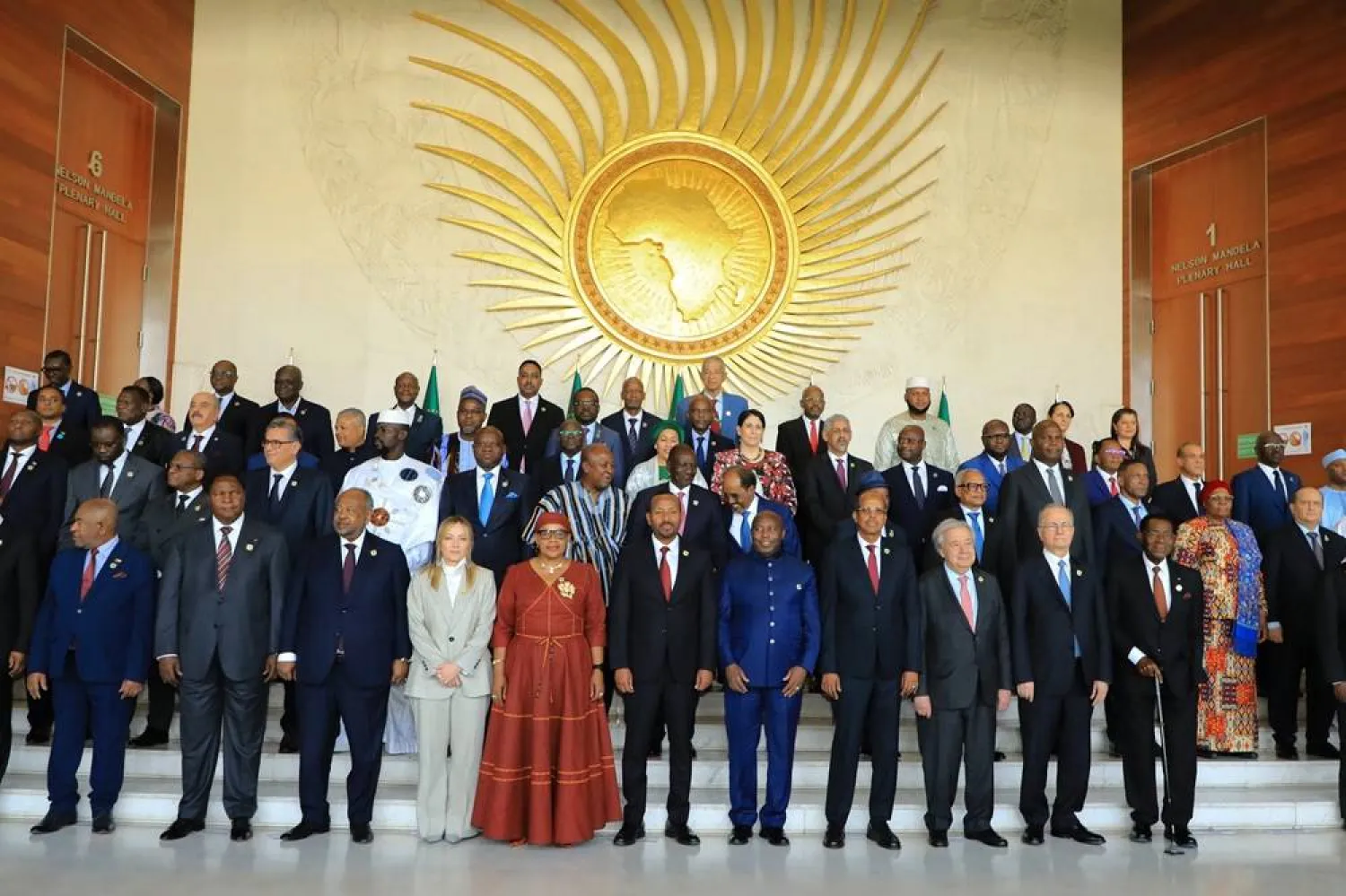

African Union Summit Calls for Unified Action to Confront Continent’s Challenges

Participants pose for a family photo during the African Union’s 39th Ordinary Session of Assembly of Heads of State and Government in Addis Ababa, Ethiopia, 14 February 2026. (EPA)
TT

African Union Summit Calls for Unified Action to Confront Continent’s Challenges

Participants pose for a family photo during the African Union’s 39th Ordinary Session of Assembly of Heads of State and Government in Addis Ababa, Ethiopia, 14 February 2026. (EPA)

African leaders meeting in Addis Ababa at the 39th Ordinary Session of the African Union (AU) Assembly of Heads of State and Government called for unified action and African-led solutions to address the continent’s mounting challenges, particularly in the areas of peace and security and Africa’s representation on the UN Security Council.

Chairperson of the AU Commission Mahmoud Ali Youssouf stressed the importance of adhering to the principle of “African solutions to African problems,” noting that it has become a strategic necessity amid an increasingly turbulent global geopolitical environment.

He said water security and sanitation systems feature prominently on the agenda of this year’s summit, reflecting their central role in stability and sustainable development.

UN Secretary-General Antonio Guterres urged an end to Africa’s continued absence from permanent representation on the UN Security Council, describing the situation as unacceptable.

Africa must be present in all decisions related to the continent, he urged, reaffirming UN support for AU priorities, including silencing the guns, advancing the Sustainable Development Goals, and reforming the global financial architecture and the Security Council.

Ethiopian Prime Minister Abiy Ahmed said Africa is at a critical juncture, calling on member states to deepen their commitment to African-led solutions and collective responsibility in confronting shared challenges.

The summit also witnessed important institutional developments, including the election of the AU Bureau for 2026 and the handover of the rotating AU chairmanship from Angolan President Joao Lourenco to Burundian President Evariste Ndayishimiye.

Egypt, for its part, renewed calls for adopting a “comprehensive approach” to strengthening security across the continent.

Presenting the annual report of the AU Peace and Security Council, Egyptian Foreign Minister Badr Abdelatty said such an approach is essential to addressing interconnected challenges, foremost among them terrorism and foreign interference that undermine state sovereignty.

He underscored the need to boost early warning systems and activate preventive diplomacy and mediation mechanisms to address tensions at their early stages.

He underlined Egypt’s firm commitment to supporting Africa’s peace and security, highlighting its role in conflict prevention, preserving sovereignty and territorial integrity, and advancing stability and development.

He also drew attention to the African Union Support and Stabilization Mission in Somalia, noting that it continues to make progress despite funding gaps and renewed calls for sustainable and predictable financing.

African affairs analyst Ramy Zohdy said Egypt’s call for a comprehensive approach reflects a qualitative shift in understanding the nature of security threats facing the continent.

He told Asharq Al-Awsat that security in Africa can no longer be viewed solely through a military lens, but as an interconnected system encompassing political, economic, social, water, food, and information security.

Zohdy added that conflicts in the Sahel, the Horn of Africa, Central Africa, and the Great Lakes region are interlinked rather than isolated, stressing that restoring African ownership of solutions is key to reducing reliance on external interference.

A comprehensive approach could curb terrorism if it simultaneously strengthens national security institutions, disrupts illicit financing networks, and promotes development in fragile regions, he stressed.

The absence of an effective African collective security system has opened the door to external intervention, while stronger and more effective AU institutions would help narrow that space and reinforce the sovereignty of African states, he remarked.



Türkiye Says US Patriot System Deployed to Boost Air Defense amid Iran War

A Turkish soldier stands guard as army and security personnel search a field after a piece of ammunition fell following the interception of a missile launched from Iran by a NATO air defense system, in Diyarbakir, Türkiye, March 9, 2026. REUTERS/Sertac Kayar
TT

Türkiye Says US Patriot System Deployed to Boost Air Defense amid Iran War

A Turkish soldier stands guard as army and security personnel search a field after a piece of ammunition fell following the interception of a missile launched from Iran by a NATO air defense system, in Diyarbakir, Türkiye, March 9, 2026. REUTERS/Sertac Kayar

Türkiye said on Tuesday that a US Patriot air defense system was deployed to its southeast, near a NATO radar base, as part of steps by the alliance to boost air defenses in the face of missile threats from the Iran war.

It is being deployed to Malatya province, the location of the Kurecik NATO radar base, which provides vital data for the alliance ‌and helped ‌identify two Iranian ballistic missiles heading toward ‌ Türkiye ⁠over the last ⁠week, said Reuters.

Iran has said it is not at war with regional countries and denies explicitly targeting its neighbor Türkiye. Ankara has warned Tehran against firing any more missiles towards it and the two countries' presidents discussed the issue on Monday.

"In addition to ⁠the measures we take on a ‌national level, air and missile ‌defense measures by NATO have been increased. In that ‌framework, one Patriot System is being deployed to ‌Malatya to contribute to defending our air space," the defense ministry said.

It added that Türkiye would continue to evaluate regional developments and cooperate with NATO allies.

The deployment comes ‌amid reports that Washington is looking into redeploying its military assets, including Patriot ⁠systems, currently stationed ⁠in South Korea.

It was not immediately clear where the Patriot system or its batteries were being redeployed from.

Türkiye, an emerging leader in the global defense industry that has the alliance's second-largest army, lacks its own fully fledged air defenses despite development efforts, and has relied on NATO air defenses stationed in the eastern Mediterranean Sea in both missile incidents in the last week.

There is currently one Patriot system, from Spain, deployed in Türkiye as part of NATO defens es.


Israel’s Netanyahu Warns ‘We Are Not Done Yet’ in Iran

A person holds a sign supporting Israeli Prime Minister Benjamin Netanyahu and US President Donald Trump during a gathering of Iranian community members showing support for Israel and the United States, outside the Consulate General of Israel in Los Angeles, on March 5, 2026. (AFP)
TT

Israel’s Netanyahu Warns ‘We Are Not Done Yet’ in Iran

A person holds a sign supporting Israeli Prime Minister Benjamin Netanyahu and US President Donald Trump during a gathering of Iranian community members showing support for Israel and the United States, outside the Consulate General of Israel in Los Angeles, on March 5, 2026. (AFP)

Prime Minister Benjamin Netanyahu warned that Israel's military offensive against Iran was "not done yet", saying the operation was degrading Iran's clerical leadership.

"Our aspiration is to bring the Iranian people to cast off the yoke of tyranny; ultimately, it depends on them. But there is no doubt that with the actions taken so far, we are breaking their bones -- and we are not done yet," Netanyahu said during a visit to the National Health Command Center on Monday night, according to a statement published Tuesday.

Israel ‌is ahead of schedule in achieving its war goals in Iran, its ambassador to France said on Tuesday, adding that the operation aims to weaken Iran’s authorities to curb attacks beyond its borders and allow its people to shape their own future. 

"When we were asked at the start of this war about its duration, we said ‌it would ‌last a few weeks. ‌That ⁠hasn’t changed," Joshua Zarka told ⁠BFM TV. "We are ahead of schedule to achieve our war objectives." 

Zarka, formerly Israel’s lead diplomat on Iran, said the goals extend beyond ending Iran’s nuclear program. They include weakening the government to the point ⁠that its population can "take its fate ‌into its own ‌hands," and ensuring Tehran can no longer mount ‌attacks beyond its borders. 

Asked about the ‌appointment of Mojtaba Khamenei as the new Supreme Leader, Zarka said that if he follows his father Ali Khamenei's positions, he "would also be on ‌a list of those who should be eliminated." 

Israel has simultaneously launched ⁠major ⁠operations against Iran-backed Hezbollah after it struck Israeli territory. The Lebanese government has said it wants direct talks with Israel to halt the fighting, but Zarka argued that Beirut is not disarming Hezbollah. 

"At this stage, I’m not aware of any decision to enter negotiations to end this war," he said. "What would end it is the disarmament of Hezbollah — and that is a choice for the Lebanese government." 


Attacks against Israel Intensify as New Supreme Leader Takes over in Iran

 08 March 2026, Israel, Tel Aviv: Israelis inspect the damage of a site hit by an Iranian ballistic missile in central Israel. (dpa)
08 March 2026, Israel, Tel Aviv: Israelis inspect the damage of a site hit by an Iranian ballistic missile in central Israel. (dpa)
TT

Attacks against Israel Intensify as New Supreme Leader Takes over in Iran

 08 March 2026, Israel, Tel Aviv: Israelis inspect the damage of a site hit by an Iranian ballistic missile in central Israel. (dpa)
08 March 2026, Israel, Tel Aviv: Israelis inspect the damage of a site hit by an Iranian ballistic missile in central Israel. (dpa)

Iran and Hezbollah intensified their attacks against Israel after Tehran appointed Mojtaba Khamenei to replace his slain father as Iran's supreme leader.

On Monday, reports said Iran launched seven missile barrages at Israel while Lebanon’s Hezbollah conducted seven waves of rocket, mortar, and drone attacks targeting Israeli forces at the border and inside Israel.

In Tel Aviv, analysts said the escalation came as a message from the new supreme leader that he was avenging his father's murder.

The attacks sent five million residents running to bomb shelters throughout Sunday evening and Monday afternoon, reported Israeli media.

Emergency responders and news outlets have repeatedly documented injuries sustained while civilians ran for cover, including the death of a 102-year-old man who fell on his way to a protected space in Ramat Gan and later died of his wounds.

Two workers at a construction site were killed and tens of accidents were reported due to the fall of rocket debris in two separate locations following several rocket barrages launched by Iran.

The Israeli army, which has maintained strict secrecy regarding the outcome of Iran and Hezbollah bombings against its sensitive military positions, affirms that along its US partners, is engaged in an intensive operation aimed at degrading Iranian missile capabilities and targeting Hezbollah infrastructure in Lebanon.

The army even boasted that its forces have launched more strikes than the US against Iran, despite being occupied in a second front against Hezbollah at the Lebanese borders.

More Israeli strikes

The Tel Aviv-based Institute for National Security Studies (INSS) said that early in the war, US forces carried out over three times as many strikes in Iran, but since the shift to the "next phase," Israel has dramatically increased its attacks, potentially reflecting strategy, munitions limits and political calculations.

During the first five days of the war, US forces struck about 2,000 targets in Iran, compared with roughly 600 Israeli strikes.

Over the weekend, however, after both Israel and the United States announced a transition to the “next phase” of Operation Roaring Lion, the trend shifted. Since then, the Israeli army has carried out nearly three times as many strikes as the US military, hitting about 2,800 targets compared with roughly 1,000 US strikes.

Overall, according to INSS figures, the United States has attacked about 3,000 targets in Iran since the start of the operation. Israel has struck around 3,400 targets in Iran, in addition to about 600 more in Lebanon.

According to the Yedioth Ahronoth daily, the data suggest that after the transition to the new phase of the campaign, Israel sharply accelerated its strikes in Iran, while the US has largely maintained the operational tempo it set earlier in the war.

Behind the numbers may lie a broader story reflecting different approaches by Israel and the US to managing the conflict.

It said that one possible reason Washington has not significantly increased its strike rate may involve munitions supplies and interceptor inventories.

Also, the US has moved additional military assets toward the Middle East, some of which are still en route.

These include the aircraft carrier USS George Bush and its strike group, which includes three destroyers. In recent days, four US B-1 bombers have also arrived in Britain.

From Israel’s perspective, the shift in strike tempo as the campaign enters its next phase may reflect progress in the fighting. It may also indicate concern that Trump could halt the operation due to public opinion in the United States.

Israeli officials reportedly understood early in the war that it would be important to maximize operational gains quickly.

At the same time, Trump has said several times that the war could last a month or even longer, and there are signs the campaign is far from over.

Trump also said the final decision on when the war ends will ultimately rest with him, although Israeli Prime Minister Benjamin Netanyahu will have influence over the timing.

Meanwhile, reports said Trump and his administration have so far offered mixed messages and contradictory explanations on the joint US-Israeli military campaign against Iran.

According to polls, most Americans still ignore why they are at war that has immediately impacted the US economy and energy prices.

According to the right-wing Israel Hayom newspaper, Israelis estimate that despite the wave of large-scale Iranian attacks against Israel, Tehran has not altered its tactics, continuing to bet on the US to intervene and stop the war.