


African Union Summit Calls for Unified Action to Confront Continent’s Challenges

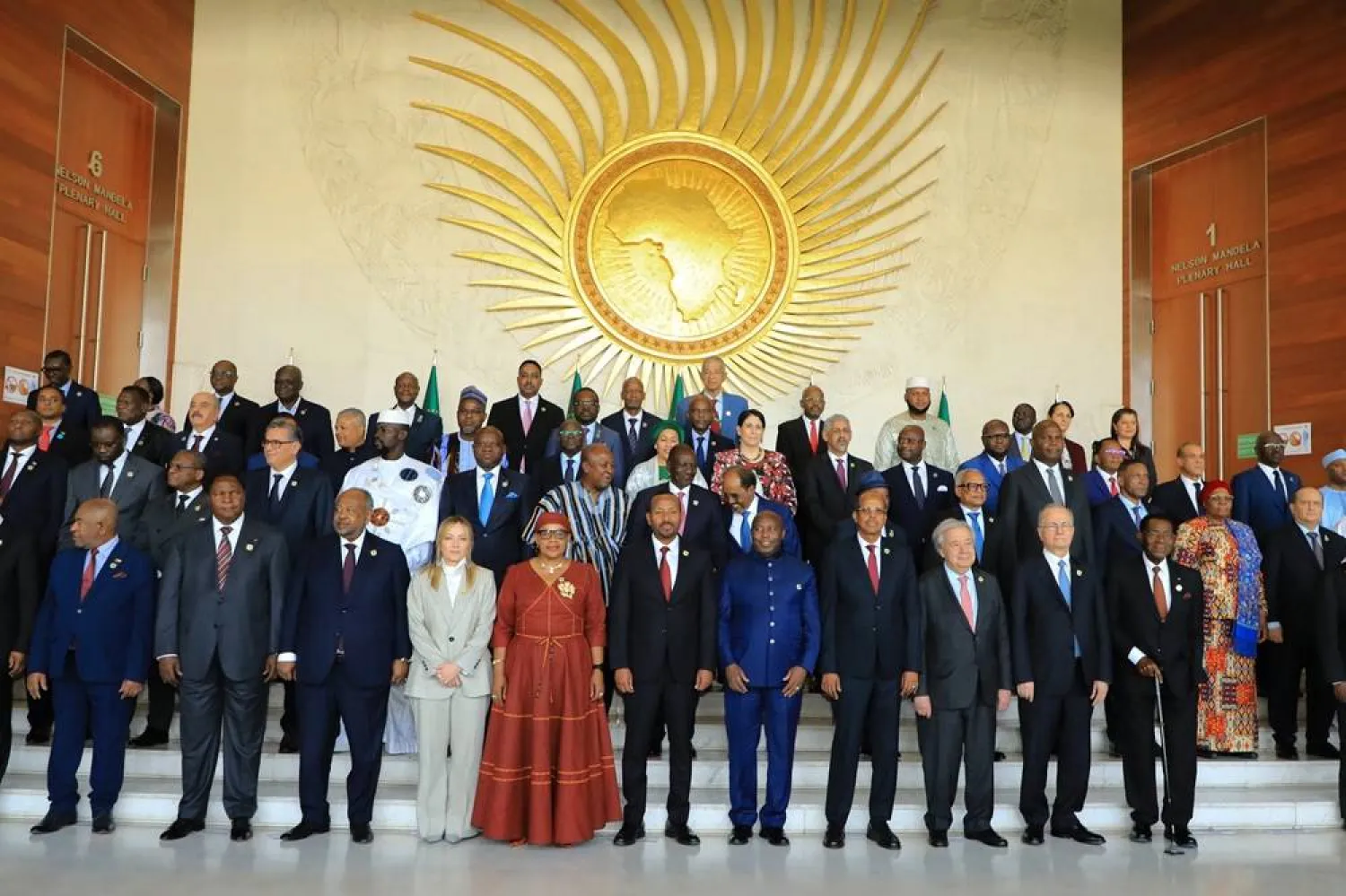
Participants pose for a family photo during the African Union’s 39th Ordinary Session of Assembly of Heads of State and Government in Addis Ababa, Ethiopia, 14 February 2026. (EPA)
TT

African Union Summit Calls for Unified Action to Confront Continent’s Challenges

Participants pose for a family photo during the African Union’s 39th Ordinary Session of Assembly of Heads of State and Government in Addis Ababa, Ethiopia, 14 February 2026. (EPA)

African leaders meeting in Addis Ababa at the 39th Ordinary Session of the African Union (AU) Assembly of Heads of State and Government called for unified action and African-led solutions to address the continent’s mounting challenges, particularly in the areas of peace and security and Africa’s representation on the UN Security Council.

Chairperson of the AU Commission Mahmoud Ali Youssouf stressed the importance of adhering to the principle of “African solutions to African problems,” noting that it has become a strategic necessity amid an increasingly turbulent global geopolitical environment.

He said water security and sanitation systems feature prominently on the agenda of this year’s summit, reflecting their central role in stability and sustainable development.

UN Secretary-General Antonio Guterres urged an end to Africa’s continued absence from permanent representation on the UN Security Council, describing the situation as unacceptable.

Africa must be present in all decisions related to the continent, he urged, reaffirming UN support for AU priorities, including silencing the guns, advancing the Sustainable Development Goals, and reforming the global financial architecture and the Security Council.

Ethiopian Prime Minister Abiy Ahmed said Africa is at a critical juncture, calling on member states to deepen their commitment to African-led solutions and collective responsibility in confronting shared challenges.

The summit also witnessed important institutional developments, including the election of the AU Bureau for 2026 and the handover of the rotating AU chairmanship from Angolan President Joao Lourenco to Burundian President Evariste Ndayishimiye.

Egypt, for its part, renewed calls for adopting a “comprehensive approach” to strengthening security across the continent.

Presenting the annual report of the AU Peace and Security Council, Egyptian Foreign Minister Badr Abdelatty said such an approach is essential to addressing interconnected challenges, foremost among them terrorism and foreign interference that undermine state sovereignty.

He underscored the need to boost early warning systems and activate preventive diplomacy and mediation mechanisms to address tensions at their early stages.

He underlined Egypt’s firm commitment to supporting Africa’s peace and security, highlighting its role in conflict prevention, preserving sovereignty and territorial integrity, and advancing stability and development.

He also drew attention to the African Union Support and Stabilization Mission in Somalia, noting that it continues to make progress despite funding gaps and renewed calls for sustainable and predictable financing.

African affairs analyst Ramy Zohdy said Egypt’s call for a comprehensive approach reflects a qualitative shift in understanding the nature of security threats facing the continent.

He told Asharq Al-Awsat that security in Africa can no longer be viewed solely through a military lens, but as an interconnected system encompassing political, economic, social, water, food, and information security.

Zohdy added that conflicts in the Sahel, the Horn of Africa, Central Africa, and the Great Lakes region are interlinked rather than isolated, stressing that restoring African ownership of solutions is key to reducing reliance on external interference.

A comprehensive approach could curb terrorism if it simultaneously strengthens national security institutions, disrupts illicit financing networks, and promotes development in fragile regions, he stressed.

The absence of an effective African collective security system has opened the door to external intervention, while stronger and more effective AU institutions would help narrow that space and reinforce the sovereignty of African states, he remarked.



Iran, US Race to Find Crew Member of Crashed American Fighter Jet

A US Air Force F-16 Fighting Falcon aircraft refuels from a KC-135 Stratotanker aircraft during a mission supporting Operation Epic Fury during the Iran war at an undisclosed location, April 2, 2026.  US Air Force/Handout via REUTERS
A US Air Force F-16 Fighting Falcon aircraft refuels from a KC-135 Stratotanker aircraft during a mission supporting Operation Epic Fury during the Iran war at an undisclosed location, April 2, 2026. US Air Force/Handout via REUTERS
TT

Iran, US Race to Find Crew Member of Crashed American Fighter Jet

A US Air Force F-16 Fighting Falcon aircraft refuels from a KC-135 Stratotanker aircraft during a mission supporting Operation Epic Fury during the Iran war at an undisclosed location, April 2, 2026.  US Air Force/Handout via REUTERS
A US Air Force F-16 Fighting Falcon aircraft refuels from a KC-135 Stratotanker aircraft during a mission supporting Operation Epic Fury during the Iran war at an undisclosed location, April 2, 2026. US Air Force/Handout via REUTERS

Iranian and American forces raced each other Saturday to recover a crew member from the first US fighter jet to go down inside Iran since the start of the war.

Tehran said it had shot down the F-15 warplane and US media reported United States special forces had rescued one of its two crew members, with the other was still missing.

Iran's military also said it downed a US A-10 ground attack aircraft in the Gulf, with US media saying the pilot of that plane was rescued, reported AFP.

The war erupted more than a month ago with US-Israeli strikes on Iran that killed supreme leader Ali Khamenei, triggering retaliation that spread the conflict throughout the Middle East, convulsing the global economy and impacting millions of people worldwide.

US Central Command did not immediately respond to a request for comment on the loss of the F-15, but White House Press Secretary Karoline Leavitt said: "The president has been briefed."

President Donald Trump told NBC the F-15 loss would not affect negotiations with Iran, saying: "No, not at all. No, it's war."

On Saturday, there were fresh strikes on Israel, Lebanon and Iran, as well as on Gulf states.

An AFP journalist saw a thick haze of grey smoke covering Tehran's skyline after hearing several blasts over the capital. It was not immediately clear what had been targeted.

- 'Valuable reward' -

A spokesperson for the Iranian military's central operational command earlier said "an American hostile fighter jet in central Iranian airspace was struck and destroyed by the IRGC Aerospace Force's advanced air defense system".

"The jet was completely obliterated, and further searches are ongoing."

An Iranian television reporter on a local official channel said anyone who captured a crew member alive would "receive a valuable reward".

Retired US brigadier general Houston Cantwell, who has 400 hours of combat flight experience, said a pilot's training would likely kick in before he or she parachutes to the ground.

"My priority would be, first of all, concealment, because I don't want to be captured," he told AFP.

Mohammad Ghalibaf, the speaker of Iran's parliament, mocked the Trump administration.

He wrote on X: "After defeating Iran 37 times in a row, this brilliant no-strategy war they started has now been downgraded from 'regime change' to 'Hey! Can anyone find our pilots? Please?'

"Wow. What incredible progress. Absolute geniuses."


Explosion Hits Pro-Israel Center in the Netherlands

Rotterdam Police officers. (Getty Images/AFP)
TT

Explosion Hits Pro-Israel Center in the Netherlands

Rotterdam Police officers. (Getty Images/AFP)

A blast hit a pro-Israeli center in the Netherlands, police said Saturday, adding it caused minimal damage and no injuries.

A police spokeswoman told AFP no one was inside the site run by Christians for Israel, a non-profit, in the central city of Nijkerk when the explosion went off outside its gate late on Friday.

An investigation was ongoing.

The incident comes after a string of similar night-time attacks on Jewish sites in the Netherlands and neighboring Belgium in recent weeks that has heightened concerns in the wake of the war in the Middle East.


Iran Says Strike Hit Close to Its Bushehr Nuclear Facility, Killing a Guard and Damaging a Building

Iran's Bushehr nuclear reactor (Reuters)
TT

Iran Says Strike Hit Close to Its Bushehr Nuclear Facility, Killing a Guard and Damaging a Building

Iran's Bushehr nuclear reactor (Reuters)

Iran’s atomic agency says an airstrike has hit near its Bushehr nuclear facility, killing a security guard and damaging a support building. It is the fourth time the facility has been targeted during the war.

The agency announced Saturday’s attack on social media.

The US AP’s military pressed ahead Saturday in a frantic search for a missing pilot after Iran shot down an American warplane, as Iran called on people to turn the pilot in, promising a reward.

The plane, identified by Iran as a US F-15E Strike Eagle, was one of two attacked on Friday, with one service member rescued and at least one missing. It was the first time the United States lost aircraft in Iranian territory during the war, now in its sixth week, and could mark a new turning point in the campaign.

The conflict, launched by the US and Israel on Feb. 28, has rippled across the region. It has so far killed thousands, upended global markets, cut off key shipping routes, spiked fuel prices and shows no signs of slowing as Iran responds to US and Israeli airstrikes with attacks across the region.