Don’t Get Sense EU Countries Ready to Give Ukraine Date for Membership, EU’s Kallas Says

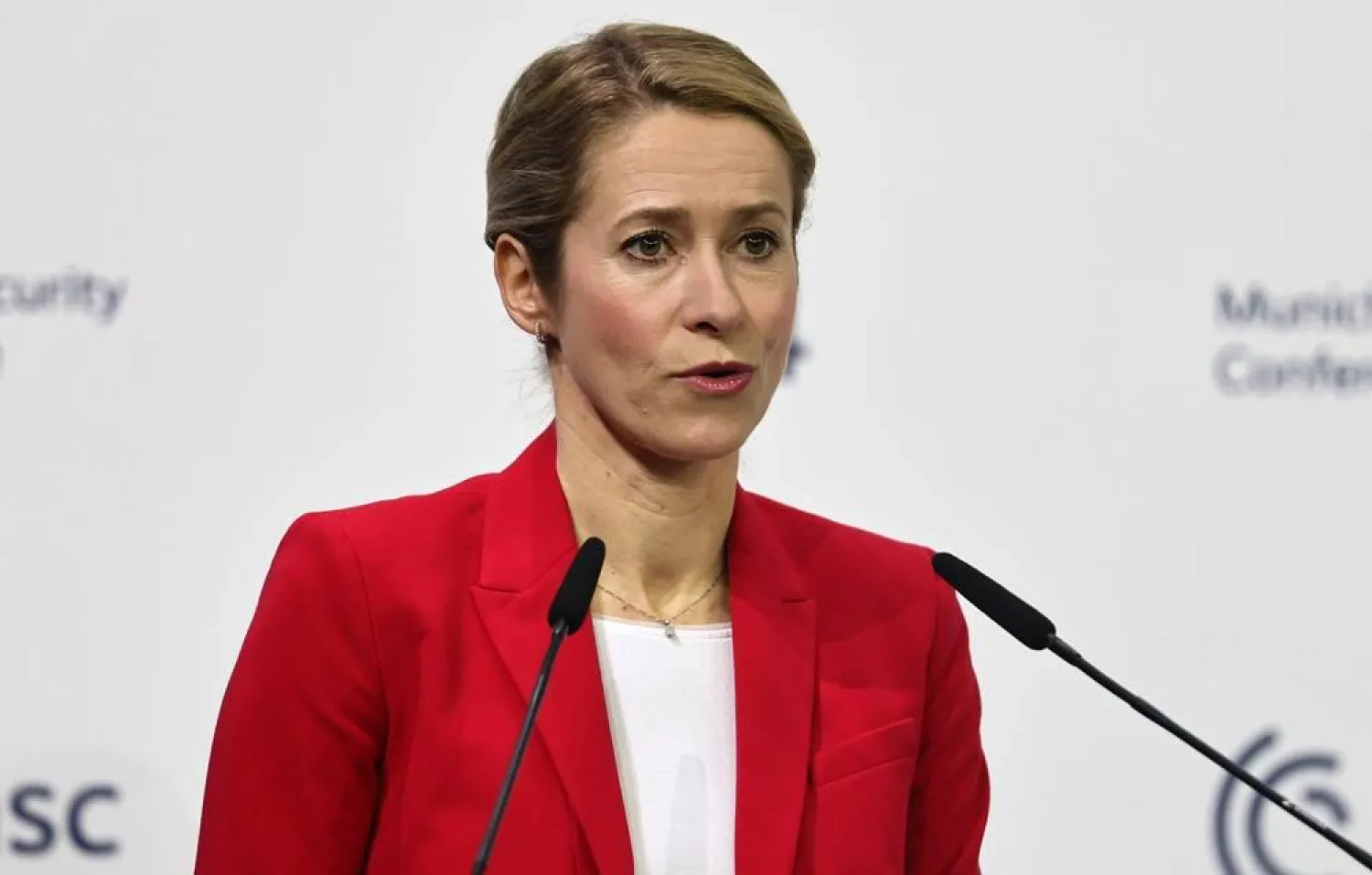
European High Representative for Foreign and Security Policy Kaja Kallas speaks during the 62nd Munich Security Conference (MSC), in Munich, Germany, 15 February 2026. (EPA)
TT

Don’t Get Sense EU Countries Ready to Give Ukraine Date for Membership, EU’s Kallas Says

European High Representative for Foreign and Security Policy Kaja Kallas speaks during the 62nd Munich Security Conference (MSC), in Munich, Germany, 15 February 2026. (EPA)

European Union foreign policy chief Kaja Kallas said on Sunday she felt that EU governments were not ready to give Ukraine a date for membership despite a demand to do so from President Volodymyr Zelenskiy.

Zelenskiy repeated on Saturday that he needed a date as part of security guarantees for a final peace package with Russia.

"My feeling is that the member states are not ready to ‌give a concrete ‌date," Kallas told a panel at the Munich ‌Security Conference. "There's ⁠a lot of ⁠work to be done."

UKRAINE PUSHING FOR 2027 MEMBERSHIP

Ukrainian EU membership in 2027 was penciled into a 20-point peace plan discussed between the United States, Ukraine and the European Union, diplomats have said, as a measure to ensure Ukraine's economic prosperity after the war ends.

But many EU governments believe that date, or any other fixed date, is completely unrealistic because EU ⁠accession is a merit-based process, moving forward only when ‌there is progress in adjusting a country's ‌laws to EU standards.

Latvian President Edgars Rinkevics echoed the Kallas comments but held out ‌little hope of an imminent peace deal.

"Yes, we understand that ‌we need Ukraine in the European Union and, yes, when talking with many heads of state I get the feeling there is no readiness to accept a date," he said.

Rinkevics said that the EU had always been creative when there ‌was a real need and could probably find a formula that suited the bloc, but it would ⁠also need ⁠to assuage Western Balkan states and Moldova, which have long been vying for membership.

"Like it or not it is very much tied to the peace deal. Will there be a peace deal or not? I don't see that Russia is going to move, and if Russia is not moving, then we are not going to have a deal," he said.

Ukraine applied to join the EU days after Russia launched its full-scale invasion in February 2022, seeking to anchor itself politically and economically to the West.

It has been pushing to make progress on its bid, despite the challenges of the war and opposition from EU member Hungary, which is blocking the start of detailed membership talks.


Helicopter Crash on Indonesia's Borneo Island Kills 8

Debris at the site of a helicopter crash in Sekadau regency, West Kalimantan province, Indonesia, April 16, 2026. Picture taken through a window. Indonesia's National Search and Rescue Agency (BASARNAS)/Handout via REUTERS
TT

Helicopter Crash on Indonesia's Borneo Island Kills 8

Debris at the site of a helicopter crash in Sekadau regency, West Kalimantan province, Indonesia, April 16, 2026. Picture taken through a window. Indonesia's National Search and Rescue Agency (BASARNAS)/Handout via REUTERS

A helicopter flying between palm oil plantations on Borneo Island crashed, killing the eight people on board, Indonesian officials said Friday.

The Airbus H130 owned by PT Matthew Air Nusantara lost contact Thursday, five minutes after it took off from Melawi district in West Kalimantan province.

It was on its way to another palm oil plantation in Kubu Raya district.

Searchers later located the wreckage and recovered the bodies of the two crew members and six passengers in the dense forests in Sekadau district, according to the National Search and Rescue Agency and the Transportation Ministry.

One of those killed was Malaysian, The Associated Press reported.

Indonesia, a sprawling archipelago of about 270 million people, has been plagued by transportation accidents, including plane and helicopter crashes and ferry sinkings.


US Military Expands Iran Blockade to Include Contraband Shipments

FILE PHOTO: Two F/A-18 Super Hornets launch from the flight deck of the US Navy Nimitz-class aircraft carrier USS Abraham Lincoln in support of the Operation Epic Fury attack on Iran from an undisclosed location March 3, 2026. US Navy/Handout via REUTERS
TT

US Military Expands Iran Blockade to Include Contraband Shipments

FILE PHOTO: Two F/A-18 Super Hornets launch from the flight deck of the US Navy Nimitz-class aircraft carrier USS Abraham Lincoln in support of the Operation Epic Fury attack on Iran from an undisclosed location March 3, 2026. US Navy/Handout via REUTERS

The US Navy said on Thursday the military had expanded a maritime blockade on Iran to include “contraband” shipments, adding that any vessel suspected of heading to Iranian territory would be subject to verification and inspection.

“These vessels, regardless of their location, are subject to boarding, inspection and seizure of cargo,” the Navy said in a statement updated after the blockade was imposed on Monday, according to Reuters.

Contraband includes weapons, weapons systems, ammunition, nuclear materials, crude oil and refined petroleum products, as well as iron, steel and aluminum.

As diplomatic activity intensifies, signals remain mixed over the course of US-Iran talks. A date for a second round of negotiations has yet to be set, with disagreements persisting over the nuclear file and sensitive issues related to highly enriched uranium and the duration of restrictions on Iran’s nuclear program.


IEA Chief Says Europe Has 'Maybe 6 Weeks or So' of Jet Fuel Left

 Aircraft pass behind kerosene storage facilities at Liege Airport in Liege, Belgium, 16 April 2026.  EPA/Olivier Hoslet
Aircraft pass behind kerosene storage facilities at Liege Airport in Liege, Belgium, 16 April 2026. EPA/Olivier Hoslet
TT

IEA Chief Says Europe Has 'Maybe 6 Weeks or So' of Jet Fuel Left

 Aircraft pass behind kerosene storage facilities at Liege Airport in Liege, Belgium, 16 April 2026.  EPA/Olivier Hoslet
Aircraft pass behind kerosene storage facilities at Liege Airport in Liege, Belgium, 16 April 2026. EPA/Olivier Hoslet

Europe has “maybe six weeks or so (of) jet fuel left,” the head of the International Energy Agency said Thursday in a wide-ranging Associated Press interview, warning of possible flight cancellations “soon” if oil supplies remain blocked by the Iran war.
IEA Executive Director Fatih Birol painted a sobering picture of the global repercussions of what he called “the largest energy crisis we have ever faced,” stemming from the pinch-off of oil, gas and other vital supplies through the Strait of Hormuz.
“In the past there was a group called ‘Dire Straits.’ It’s a dire strait now, and it is going to have major implications for the global economy. And the longer it goes, the worse it will be for the economic growth and inflation around the world,” he said.
The impact will be “higher petrol (gasoline) prices, higher gas prices, high electricity prices,” Birol told the AP, speaking in his Paris office looking out over the Eiffel Tower.
No country is immune Economic pain will be felt unevenly and "the countries who will suffer the most will not be those whose voice are heard a lot. It will be mainly the developing countries. Poorer countries in Asia, in Africa and in Latin America,” said the Turkish economist and energy expert who has led the IEA since 2015.
But without a settlement of the Iran war that permanently reopens the Strait of Hormuz, “Everybody is going to suffer,” he added.
“Some countries may be richer than the others. Some countries may have more energy than the others, but no country, no country is immune to this crisis," he said.
Without a reopening of the waterway, some oil products may dry up, he warned.
In Europe, “I can tell you soon we will hear the news that some of the flights from city A to city B might be canceled as a result of lack of jet fuel," he said.
Hormuz tolls a risk for the future Birol spoke out against the so-called “toll booth” system that Iran has applied to some ships, letting them travel through the strait for a fee. He said allowing that to become more permanent would run the risk of setting a precedent that could then be applied to other waterways, including the vital Malacca Strait in Asia.
“If we change it once, it may be difficult to get it back,” he said. “It will be difficult to have a toll system here, applied here, but not there.”
“I would like to see that the oil flows unconditionally from the point A to point B,” he said.
Even with a peace deal, strikes on energy facilities means it could be many months before pre-war production levels are restored, he said.
“Over 80 key assets in the region have been damaged. And out of these 80, more than one third are severely or very severely damaged,” he said.
“It will be extremely optimistic to believe that it will very quick," Birol said. “It will take gradually, gradually, up to two years to come back where we were before the war.”