


Kremlin Rejects European Assessment Navalny Died of Poisoning

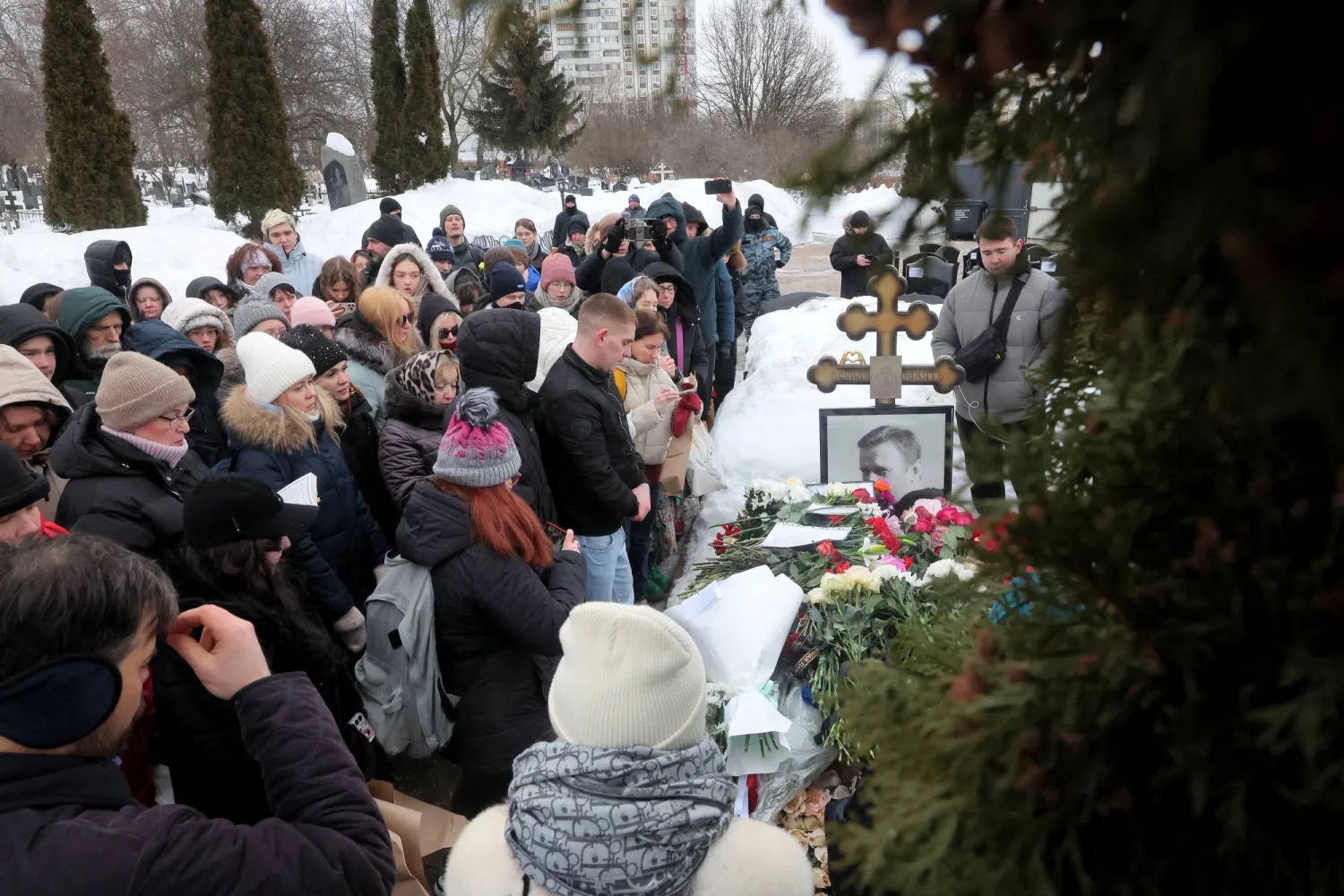
People queue to visit the grave of Alexei Navalny, the late Russian opposition leader, on the second anniversary of his death, at the Borisovskoye Cemetery in Moscow, Russia, 16 February 2026. EPA/MAXIM SHIPENKOV
TT

Kremlin Rejects European Assessment Navalny Died of Poisoning

People queue to visit the grave of Alexei Navalny, the late Russian opposition leader, on the second anniversary of his death, at the Borisovskoye Cemetery in Moscow, Russia, 16 February 2026. EPA/MAXIM SHIPENKOV

The Kremlin said Monday that it "strongly rejected" an assessment by five European countries that Russian opposition leader Alexei Navalny died from poisoning two years ago, as his supporters marked the anniversary of his death in prison.

Navalny, a charismatic anti-corruption campaigner who rallied hundreds of thousands to the streets in protest at the Russian leadership, was Russian President Vladimir Putin's fiercest domestic opponent for years.

He died in an Arctic prison colony in February 2024 while serving a 19-year sentence for "extremism", a charge that he and his supporters say was punishment for his opposition work, said AFP.

Britain, Sweden, France, Germany and the Netherlands issued a joint statement on Saturday saying they believed he had been poisoned with epibatidine -- a toxin found in poison dart frogs -- and that the Russian state had the "means, motive and opportunity" to administer it.

"We naturally do not accept such accusations. We disagree with them. We consider them biased and baseless," Kremlin spokesman Dmitry Peskov told reporters, including AFP, during a daily briefing call.

"In fact, we strongly reject them," he added.

Dozens of people visited his grave in Moscow early Monday, among them foreign diplomats, according to an AFP reporter at the scene.

Some of those who attended wore masks or scarves over their faces.

Russian authorities designated Navalny and his organization "extremist" before his death, and anyone who mentions him or his exiled anti-corruption foundation are liable for prosecution.

Navalny, a Yale-educated lawyer, was the most widely known Russian opposition figure and galvanized thousands of young people to protest against Putin.

He had already survived a suspected poisoning with the Novichok nerve agent in 2020.

- Ecuadoran dart frog -

Navalny's mother Lyudmila told reporters she felt vindicated by the European statement and called for those responsible to be held accountable.

"This confirms what we knew from the very beginning. We knew that our son did not simply die in prison, he was murdered," she said outside the cemetery where he was buried in Moscow.

"I think it will take some time, but we will find out who did it. Of course, we want this to happen in our country, and we want justice to prevail," she added.

Navalny's widow, Yulia Navalnya, said on Saturday it was now "science proven" that her husband had been murdered.

She had previously said in September that laboratory analysis of smuggled biological samples found that her husband was poisoned.

Epibatidine, found in the Ecuadoran dart frog, causes muscle paralysis and eventual asphyxiation.

Experts have said the toxin can also be produced synthetically, instead of extracting it directly from the frog itself.

The European statement did not say how it was administered or by whom.

Britain's foreign office said the poison is not found naturally in Russia and that "only the Russian state had the means, motive and opportunity to deploy this lethal toxin."

Russia's prison service said he died after going for a walk and falling ill.

Since Navalny's death, Russia's opposition has remained largely exiled and fragmented.

Navalny's widow Yulia vowed to take the mantle of Russia's opposition in the wake of his death but has struggled to galvanize widespread support.

Inside Russia, Moscow has intensified a crackdown on anybody who had links with the late opposition leader.

In addition to targeting his allies and backers, photographers who covered his court hearings and lawyers who represented him at trial have been sentenced to lengthy prison terms.

Merz Floats Sanctions Relief for Iran Peace Deal, Other EU Leaders Cautious

 Germany's Chancellor Friedrich Merz speaks during a press conference after taking part in an informal meeting of the European Council in Nicosia on April 24, 2026. (AFP)
Germany's Chancellor Friedrich Merz speaks during a press conference after taking part in an informal meeting of the European Council in Nicosia on April 24, 2026. (AFP)
TT

Merz Floats Sanctions Relief for Iran Peace Deal, Other EU Leaders Cautious

 Germany's Chancellor Friedrich Merz speaks during a press conference after taking part in an informal meeting of the European Council in Nicosia on April 24, 2026. (AFP)
Germany's Chancellor Friedrich Merz speaks during a press conference after taking part in an informal meeting of the European Council in Nicosia on April 24, 2026. (AFP)

German Chancellor Friedrich Merz suggested on Friday that the European Union could ease sanctions on Tehran as part of a comprehensive deal that would end the Iran war, but other EU leaders struck a more cautious note.

The 27-nation EU has imposed sanctions on Iran for years, including travel bans and asset freezes for senior officials and entities, in response to human rights violations, nuclear activities and military support for Russia.

US officials have suggested a ‌comprehensive deal covering Iran's ‌nuclear and missile programs and the ‌re-opening ⁠of the Strait of ⁠Hormuz could bring a lasting end to the US-Israeli war with Tehran, beyond the current ceasefire.

After an EU summit in Cyprus, Merz said the bloc could gradually ease sanctions on Iran in the event that a comprehensive agreement was reached.

European leaders have been largely sidelined in the current Middle ⁠East conflict but some European officials see ‌the bloc's sanctions as a possible ‌way for the EU to be involved in a diplomatic solution.

"The ‌easing of sanctions can be part of a process," ‌Merz told reporters after the Nicosia summit.

"No one has objected to that," he said of the summit deliberations. "It is, so to speak, part of the contribution we can make to advance this ‌process and, hopefully, lead to a permanent ceasefire."

But European Council President Antonio Costa, the chair ⁠of the summit, ⁠told a press conference after the end of the meeting: "It is too early to talk about relieving any kind of sanctions."

European Commission President Ursula von der Leyen said sanctions relief could only come after clear evidence of fundamental changes of course from Iran.

"We believe that sanctions relief should be conditional on verification of de-escalation, particularly on progress on the international effort to contain its nuclear threat, and on a change to the repression of its own people," she told the same press conference.


German Court Jails Hezbollah Supporter Over Videos Showing Weapons

Coffins sit on a trailer beneath portraits of Hezbollah fighters killed before a 10-day ceasefire was agreed between the Iran-backed militant group and Israel during a mass funeral procession in the southern village of Kfar Sir on April 21, 2026. (AFP)
TT

German Court Jails Hezbollah Supporter Over Videos Showing Weapons

Coffins sit on a trailer beneath portraits of Hezbollah fighters killed before a 10-day ceasefire was agreed between the Iran-backed militant group and Israel during a mass funeral procession in the southern village of Kfar Sir on April 21, 2026. (AFP)

A German court on Friday sentenced a supporter of Lebanon's Hezbollah party to more than three years in jail Friday over for "illegal access to weapons" and social media posts supporting the group.

Earlier in the same trial the 30-year-old was acquitted on charges of actually fighting for Hezbollah and being a member of the group.

The court in Berlin gave him a sentence of three years and nine months over social media posts he made with videos taken during a trip to Lebanon in 2023.

In the videos he was seen handling rifles and anti-tank missiles and taking part in shooting practice.

The court found he also spread propaganda videos and displayed Hezbollah symbols, such as flags and scarves.

However, the court said that the videos in question showed that the accused had had no training in dealing with the weapons and that he had acted in a "partly amateurish" fashion.

His earlier claims to have fought with the group were made up in order to impress his friends, the court found.

Hezbollah's military wing is classed as a terrorist organization by the United States, the European Union and Britain.

Germany considers Hezbollah a "Shiite terrorist organization" and in 2020 banned Hezbollah from carrying out activities on its soil.


Key Go-Between Switzerland to Reopen Embassy in Iran

 Milad telecommunication tower is seen at left in a general view of a part of Tehran, Iran, Thursday, April 23, 2026. (AP)
Milad telecommunication tower is seen at left in a general view of a part of Tehran, Iran, Thursday, April 23, 2026. (AP)
TT

Key Go-Between Switzerland to Reopen Embassy in Iran

 Milad telecommunication tower is seen at left in a general view of a part of Tehran, Iran, Thursday, April 23, 2026. (AP)
Milad telecommunication tower is seen at left in a general view of a part of Tehran, Iran, Thursday, April 23, 2026. (AP)

Switzerland said Friday it had begun sending staff back to Tehran and would gradually reopen its embassy, enabling it to continue as a facilitator for diplomatic contacts between Washington and Tehran.

For decades, neutral Switzerland has played a central role in maintaining basic diplomatic contacts between Iran and the United States.

But the country temporarily closed its embassy on March 11 days after the Middle East war erupted with the first US-Israeli attacks on Iran.

The Swiss foreign ministry said four staff had returned and insisted the channel of communication between the US and Iran had been kept open even while the mission was shut.

"The decision to gradually reopen the embassy was taken after a risk analysis and in consultation with Iran and the United States, whose interests Switzerland represents under its protecting power mandate," the foreign ministry said in a statement.

Switzerland "is prepared to provide its good offices if the parties so wish and supports all diplomatic initiatives that contribute to de-escalation and a lasting peace".

Switzerland has represented US interests in Iran since Washington broke off relations with Middle Eastern country after the 1980 hostage crisis, which came a year after the Iranian revolution.

The Swiss embassy in Tehran handles all consular affairs between the United States and Iran, including passport requests, altering civil status and consular protection for US citizens in Iran.

Under the protecting power mandate, "Switzerland can either offer to act as a go-between on its own initiative or can fulfil this function at the request of the parties concerned, provided that all those involved agree", the foreign ministry says on its website.

A ceasefire has been in place since April 8 but prospective peace talks between senior US and Iranian envoys Pakistan are hanging in the balance.

Iran has all but closed the Strait of Hormuz in retaliation for the war, while the US has imposed a blockade of its own on Iranian ports.
