


Satellite Imagery Shows Apparent Attack on Iranian Nuclear Site, Report Says

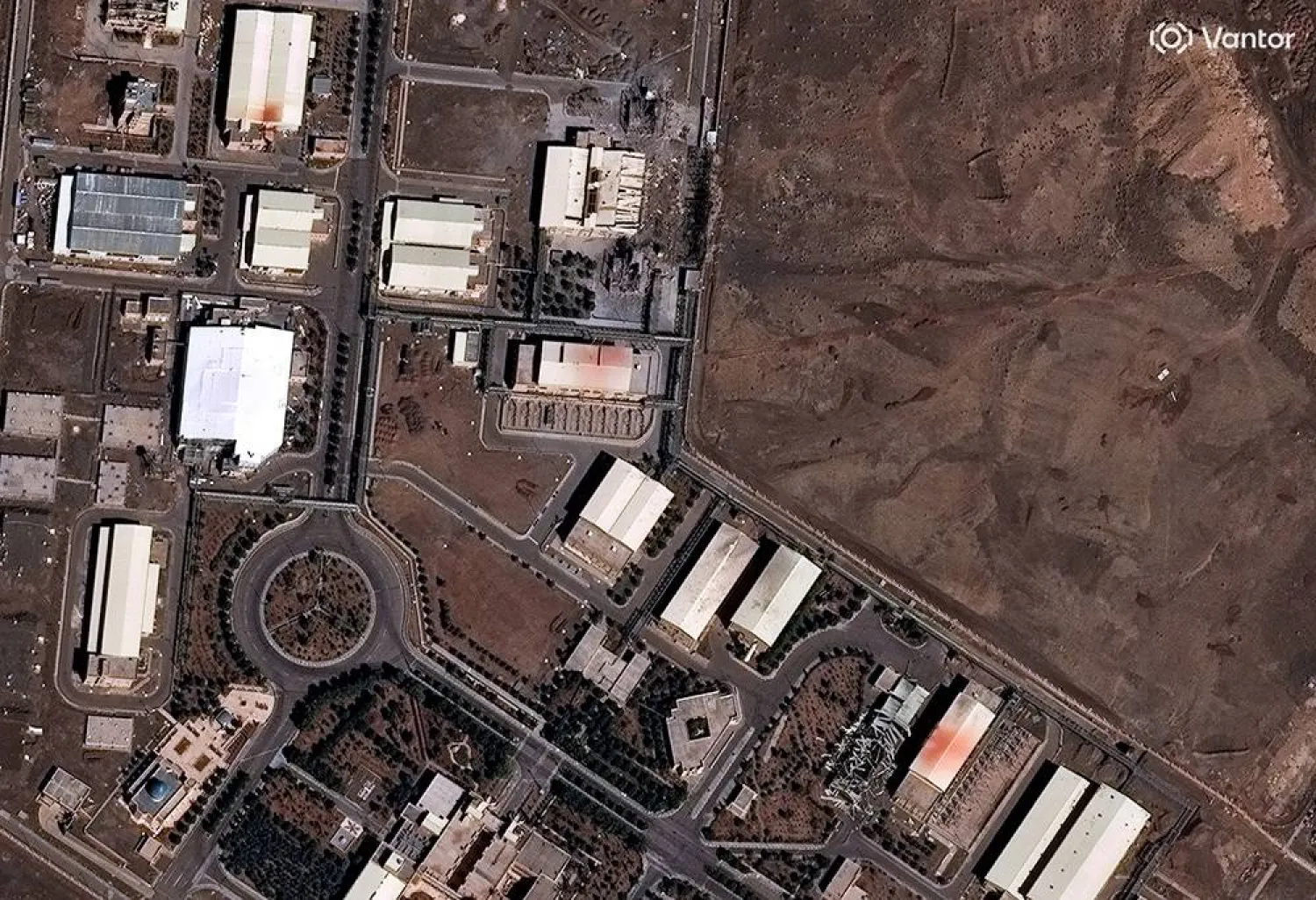
A satellite image shows a closer view of the Natanz Nuclear Facility with new building damage, amid the US-Israeli conflict with Iran, near Natanz, Iran, March 2, 2026. (Vantor/Handout via Reuters)
TT

Satellite Imagery Shows Apparent Attack on Iranian Nuclear Site, Report Says

A satellite image shows a closer view of the Natanz Nuclear Facility with new building damage, amid the US-Israeli conflict with Iran, near Natanz, Iran, March 2, 2026. (Vantor/Handout via Reuters)

Commercial satellite imagery has captured what appears to be the first known strikes on an Iranian nuclear site since the start of the US-Israeli air operation, an independent policy institute said on Monday.

The Institute for Science and International Security said imagery produced by Colorado-based Vantor showed two strikes on access points to the underground uranium enrichment plant at Natanz, which was hit by the US last June.

David Albright, a former UN nuclear inspector and founder of the institute, said the strikes appeared to have occurred sometime between Sunday afternoon and Monday morning local time, based on the satellite imagery his group reviewed.

He was unable to identify whether the US or Israel hit the Natanz complex, one of the main facilities of Iran's nuclear program.

He credited Ben Tzion Macales, an Israeli geo-analyst, as being ‌the first to ‌find satellite imagery of the Natanz strikes.

The US and Israel launched their air ‌war ⁠against Iran early Saturday, ⁠triggering Iranian retaliatory strikes around the region.

Albright's findings appeared to corroborate an earlier statement by Reza Najafi, Iran's envoy to the International Atomic Energy Agency, that Natanz was hit on Sunday. Najafi was disputing a comment by IAEA chief Raphael Grossi, who said there was no sign that any nuclear site had been hit.

Albright said it was likely that Grossi had relied on imagery produced before the pictures obtained by his institute.

The IAEA did not immediately respond to a request for comment. The White House and US Central Command also did not immediately respond.

Iran's nuclear program is among the reasons Israel and the US have given for ⁠the attacks, alleging Iran was getting too close to being able to eventually make ‌a nuclear bomb. Iran has repeatedly denied seeking a nuclear arsenal.

Albright's report ‌said Vantor's imagery showed that three buildings at Natanz had been destroyed. Two were personnel entrances to two underground halls housing thousands of centrifuges, ‌machines that enrich uranium for use in power plants or weapons depending on the duration.

Even though the halls ‌were rendered inoperable by the US attack in June, the strikes could indicate that the halls still contained "recoverable centrifuges" or other related equipment, the report said.

The third building destroyed covered the only vehicle access ramp to the underground halls, it said.

Grossi said in a statement to a meeting of the IAEA's 35-nation board of governors that the agency had no indication that "any of the nuclear installations ... have been ‌damaged or hit."

Moments after Grossi's remarks, Najafi told reporters outside that Natanz had been attacked.

"Again they attacked Iran's peaceful, safeguarded nuclear facilities yesterday," Najafi said. Asked by Reuters which facilities ⁠were hit, he replied: "Natanz" and ⁠left.

IAEA HAS LIMITED CONTACT WITH IRAN

While the IAEA's crisis-response center has been unable to reach Iran's nuclear regulatory authorities, there has been some contact with Iranian officials, Grossi told a press conference.

"We are, of course, in conversation with Iran, but at the moment, it's very limited. Until last Thursday, it was very intense," he said, adding that while the IAEA has no staff in Iran at the moment, it is watching satellite images closely.

Tehran has not let the IAEA return to its bombed facilities since they were attacked in June.

CALLS FOR DIALOGUE TO RESUME

Natanz housed facilities including two uranium-enrichment plants attacked in June - an above-ground one the IAEA says was destroyed and the underground facility containing the two centrifuge halls that were at least badly damaged at the time.

Asked about Najafi's remarks, Grossi stood firm at his later press conference, saying, "I will not get into a polemic on that. We stand by what I said before."

Grossi was in Geneva for the last two rounds of Oman-mediated talks between Iran and the United States, discussing nuclear specifics with both sides.

"An understanding eluded the parties this time. I am sure we are, quite understandably, feeling a strong sense of frustration," Grossi told the board.

Report: US, Kurds Discuss Potential Iran Military Operation

An Iranian Kurdish Peshmerga member of the Kurdistan Democratic Party of Iran (KDPI) inspects damage sustained at the Azadi Camp of the Kurdistan Democratic Party of Iran (KDPI) following an Iranian cross-border attack in the town of Koye (Koysinjaq), in the east of Erbil district in the autonomous Kurdish region of northern Iraq on March 3, 2026. (AFP)
TT

Report: US, Kurds Discuss Potential Iran Military Operation

An Iranian Kurdish Peshmerga member of the Kurdistan Democratic Party of Iran (KDPI) inspects damage sustained at the Azadi Camp of the Kurdistan Democratic Party of Iran (KDPI) following an Iranian cross-border attack in the town of Koye (Koysinjaq), in the east of Erbil district in the autonomous Kurdish region of northern Iraq on March 3, 2026. (AFP)

Iranian Kurdish militias have consulted with the United States in recent days about whether, and how, to attack Iran's security forces in the western part of the country, according to three sources with knowledge of the matter.

The Iranian Kurdish coalition of groups based on the Iran-Iraq border in the semi-autonomous region of Iraqi Kurdistan has been training to mount such an attack in hopes of weakening the country's military, as the United States and Israel pound Iranian targets with bombs and missiles.

The goal would be to create room for Iranians opposed to the regime to rise up now that Supreme Leader Ali Khamenei and other top officials have been killed since the US-Israeli attack began on Saturday, two of the sources said.

A final decision has not yet been made on the operation and its possible timing, added the sources, ‌who spoke on ‌condition of anonymity to talk freely about sensitive military planning.

The groups have requested ‌US ⁠military support and ⁠Iraqi leaders in Erbil and Baghdad have also been in touch with the Trump administration in recent days, they said.

The forces are in talks with the United States about CIA help to provide weapons, two of the sources said.

CNN was the first to report on the CIA's involvement with the groups and the potential ground operation. Axios said this week that President Trump held a telephone call with two of Iraqi Kurdistan’s top leaders.

Reuters could not independently confirm the extent of the CIA’s involvement in the planning of the operation, if it had facilitated the weapons or if any ⁠US forces planned to go into Iran with the Kurdish groups.

The CIA declined ‌to comment. The White House and the Pentagon did not immediately respond ‌to a request for comment.

The Kurdish Regional Government did not immediately respond to a request for comment.

KURDISH OPERATION WOULD ‌REQUIRE US SUPPORT

Any operation from Iraq would probably require significant US military and intelligence support.

The Pentagon says the ‌two US bases in Erbil have supported the international coalition fighting ISIS militants.

Kurdish groups in Iraqi Kurdistan have a long history of working with the US but their shifting allegiances and ideologies have at times strained ties with Washington.

The United States worked with some of the Kurdish groups in Iraq both during the Iraq War and the battle against ISIS.

But ‌it is unclear how successful the Iranian Kurdish groups would be in their fight inside Iran. The groups’ fighters have varying degrees of experience on the ⁠battlefield.

A source cited by CNN ⁠said the plan would be for Kurdish armed forces to take on Iranian security forces to make it easier for an uprising of unarmed Iranians in the country’s cities.

It is not clear exactly how such an operation in Iran by the Kurds will be received by other countries in the region.

An armed uprising by the Iranian Kurds could have serious consequences for Iran's stability.

It could add fuel to an armed separatist movement among the country's ethnic Baluch minority that keeps close ties with separatists in Pakistan's neighboring restive province of Baluchistan.

It is unlikely that Islamabad would tolerate any move toward Baluch independence.

Türkiye, a strong supporter of Syrian President Ahmed al-Sharaa, has seen the integration deal between Damascus and Kurdish forces as critical to restoring state authority across Syria.

It had threatened its own military operation against the Syrian Kurdish Democratic Forces (SDF) in the north, if the group did not agree to come under central government control.

Ankara has been working to advance its long-running efforts towards securing peace with the outlawed Kurdistan Workers Party (PKK) and is unlikely to be sympathetic towards the arming of Kurdish groups close to its borders.


Khamenei to be Buried in Mashhad

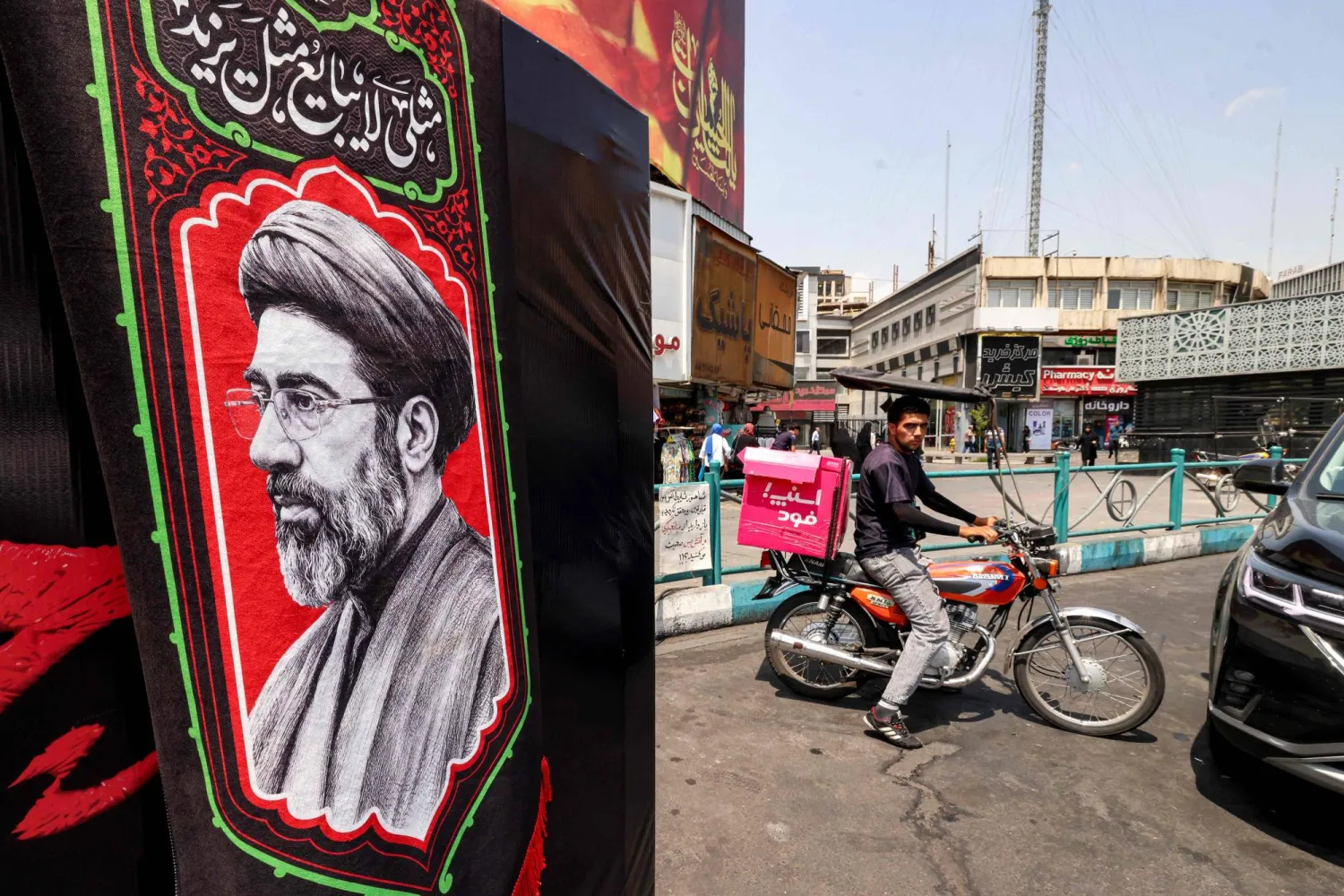
A man rides a motorbike past a billboard of Iran's supreme leader Ali Khamenei in Tehran, March 2. AFP
TT

Khamenei to be Buried in Mashhad

A man rides a motorbike past a billboard of Iran's supreme leader Ali Khamenei in Tehran, March 2. AFP

Iran’s late supreme leader Ali Khamenei, killed Saturday in US-Israeli strikes, will be buried in the holy city of Mashhad, several Iranian news agencies reported on Tuesday.

Khamenei, who died at 86 after leading the regime for 36 years, was originally from Mashhad, Iran’s second-largest city, where his father is buried at the Imam Reza shrine, according to AFP.

No date for the burial was disclosed.

After Khamenei's death, power was transferred temporarily to a group of three-man interim council.

The council includes President Masoud Pezeshkian, Judiciary Chief Gholam-Hossein Mohseni-Ejei and senior conservative cleric Alireza Arafi, a member of the Guardian Council and head of Iran’s seminaries.

Khamenei took the helm in Iran in 1989, following the death of Khomeini.
According to Iran’s constitution, the new supreme leader will be elected by the Assembly of Experts, composed of 88 clerics. All candidates must first be vetted by the Guardian Council for religious and political qualifications.

Fars, citing an official familiar with the process, reported that “for security reasons,” the assembly's final meeting could be postponed until after Khamenei's burial.

A joint US-Israel strike, launched Saturday on Tehran, killed Khamenei and targeted key military and leadership infrastructure.

Iranian media said the building housing the 88-member body in the holy city of Qom, south of Tehran, was hit Tuesday by US-Israeli strikes.


Pentagon Identifies First US Soldiers Killed in Iran War

A combination image of undated photos shows US Army Reserve Captain Cody A. Khork, 35, of Winter Haven, Florida, US Army Reserve Sgt. 1st Class Noah Tietjens, 42, of Bellevue, Nebraska, US Army Reserve Sgt. 1st Class Nicole Amor, 39, of White Bear Lake, Minnesota, and US Army Reserve Sgt. Declan Coady, 20, of West Des Moines, Iowa, who were killed March 1, 2026, at the Port of Shuaiba, Kuwait during a drone attack. Reuters
TT

Pentagon Identifies First US Soldiers Killed in Iran War

A combination image of undated photos shows US Army Reserve Captain Cody A. Khork, 35, of Winter Haven, Florida, US Army Reserve Sgt. 1st Class Noah Tietjens, 42, of Bellevue, Nebraska, US Army Reserve Sgt. 1st Class Nicole Amor, 39, of White Bear Lake, Minnesota, and US Army Reserve Sgt. Declan Coady, 20, of West Des Moines, Iowa, who were killed March 1, 2026, at the Port of Shuaiba, Kuwait during a drone attack. Reuters

The US military on Tuesday identified four of the first American soldiers killed in the war against Iran as the Trump administration warned the intensifying conflict would lead to more American casualties.

Among six US military deaths so far, the four soldiers were members of an Iowa unit of the US Army Reserve. They died on Sunday when a drone slammed into a US military facility in Port Shuaiba, Kuwait, the US military said on Tuesday. The Pentagon said four ranged in age from 20 to 42 and served in the 103rd Sustainment Command from Des Moines, Iowa, part of the Army's ⁠global logistics and ⁠supply operation.

The military identified the four US Army Reserve soldiers as:
* Captain Cody A. Khork, 35, of Winter Haven, Florida
* Sergeant 1st Class Noah L. Tietjens, 42, of Bellevue, Nebraska
* Sergeant 1st Class Nicole M. Amor, 39, of White Bear Lake, Minnesota
* Sergeant Declan J. Coady, 20, of West Des Moines, Iowa
Major General Todd Erskine, who leads the 79th Theater Sustainment Command, in a statement extended "my deepest sympathy and my respect" ⁠to relatives and unit members of the four.

Most of the soldiers had a history of overseas service. Khork had deployed to Saudi Arabia in 2018, Guantanamo Bay, Cuba in 2021 and Poland in 2024. Amor deployed to Kuwait and Iraq in 2019. Tietjens had two other deployments to Kuwait in 2009 and 2019.

Coady, who was posthumously promoted from specialist, had only enlisted in the Army Reserve in 2023.

President Donald Trump and other senior officials have warned the Iran conflict will result in more US military deaths as Tehran retaliates against US and Israeli strikes.

The US military's Central Command said on Tuesday that Iran has launched over 500 ballistic missiles and over 2,000 drones in its ⁠retaliatory attacks throughout ⁠the Middle East so far.

The risks to US forces in the Middle East came up during a closed-door briefing to lawmakers on Tuesday by Defense Secretary Pete Hegseth, General Dan Caine, chairman of the Joint Chiefs of Staff, CIA Director John Ratcliffe and Secretary of State Marco Rubio.

"They told us in that room that there are going to be more Americans that are gonna die - that they are not ... going to be able to stop these drones," Senator Chris Murphy, a Democrat, said.

The facility in Kuwait where the four deaths occurred was protected by concrete blast walls but did not have a fortified roof, two officials told Reuters.

It was unclear if there were air defenses in place but no alarm apparently sounded as the drone approached, one of the officials added, speaking on condition of anonymity.