


Sources to Asharq Al-Awsat: Tehran Seeks Details on Trump's Call with Kurdish Leaders

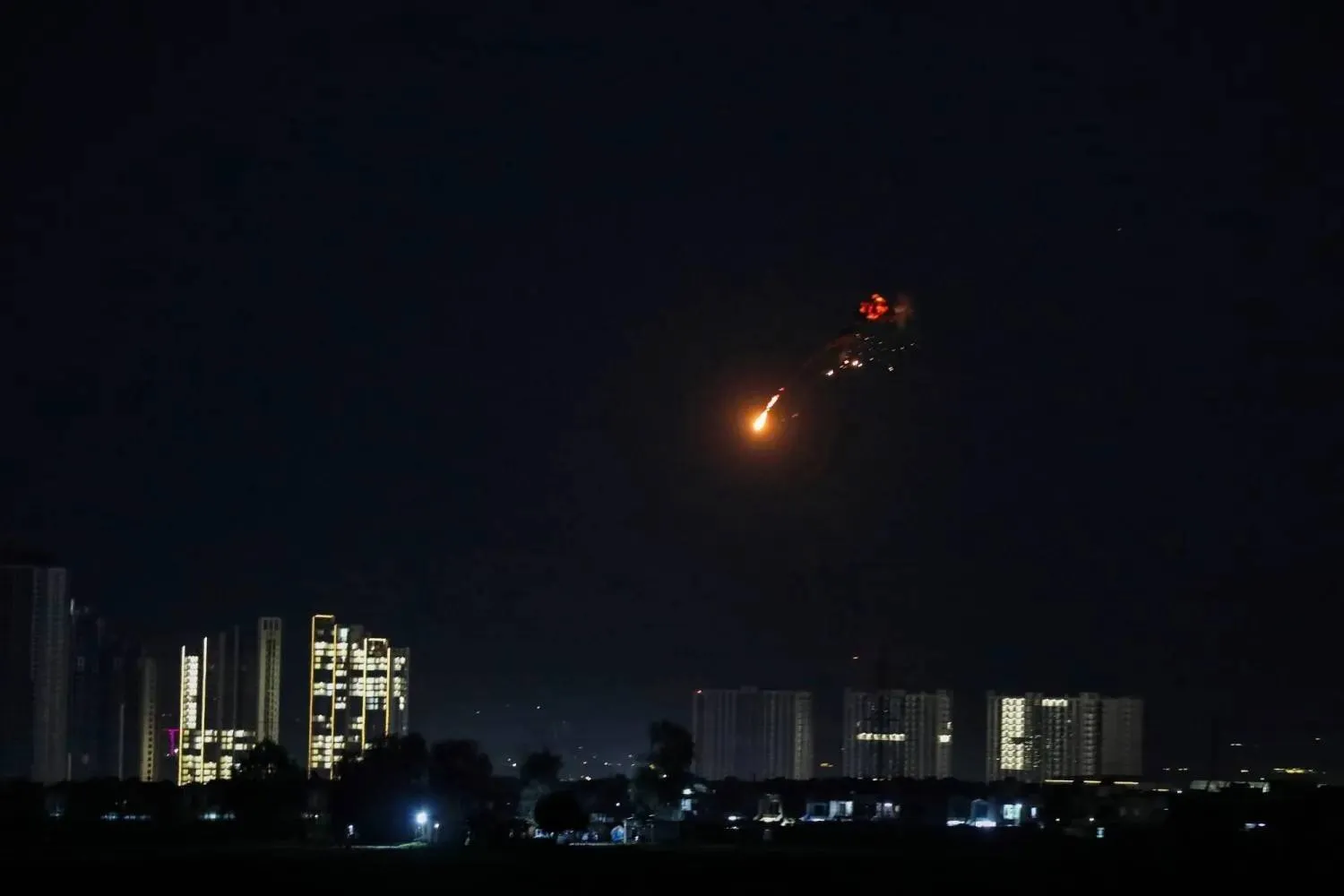
Air defense systems intercept a drone near the US consulate and Erbil International Airport in Erbil early Wednesday (EPA)
TT

Sources to Asharq Al-Awsat: Tehran Seeks Details on Trump's Call with Kurdish Leaders

Air defense systems intercept a drone near the US consulate and Erbil International Airport in Erbil early Wednesday (EPA)

Iranian Foreign Minister Abbas Araghchi and Ali Bagheri Kani, deputy secretary of Iran’s Supreme National Security Council, have asked Iraqi officials for detailed information about a phone call between US President Donald Trump and Iraqi Kurdish leaders Masoud Barzani and Bafel Talabani, according to informed sources who spoke to Asharq Al-Awsat.

The two Iranian officials expressed concern that the United States could exploit the Kurdistan Region to open a breach along Iran’s borders.

Sources said Tehran stressed that Iraq’s federal authorities in Baghdad must provide sufficient guarantees and take the necessary measures to prevent any Iraqi Kurdish party from offering facilitation to Iranian opposition groups.

Bagheri Kani was quoted as saying: “We ask for your help in finding out what took place between Trump and officials in Erbil and Sulaymaniyah.”

In a phone call with Iraqi National Security Adviser Qasim al-Araji, Bagheri said the strikes “were limited to US military bases,” adding that Iran had asked Iraq to take steps to prevent opposition groups from infiltrating the border between the two countries under the security agreement signed by Baghdad and Tehran.

A statement from Iraq’s National Security Adviser quoted Araji as saying the Iraqi government was fully committed to the security agreement with Iran and would not allow any groups to infiltrate Iranian territory or launch terrorist activities from Iraqi soil.

He added that the Kurdistan Region’s Interior Ministry had deployed security reinforcements from the Peshmerga forces to the border strip to strengthen control of the frontier sector from the Erbil side. Araji said Iraq was continuing diplomatic efforts with various parties to contain the crisis, halt escalation and return to dialogue.

The contacts came as security sources reported that a drone targeted a weapons depot in an attack on the headquarters of an Iranian Kurdish opposition group in the town of Diklah in Iraq’s Kurdistan Region on Wednesday, wounding two militants.

Iran’s Revolutionary Guard Corps said on Wednesday it had targeted Iranian Kurdish armed factions opposed to Tehran in Iraqi Kurdistan. In a statement, the Guard said “bases and headquarters belonging to Komala factions were successfully struck with three missiles” fired at 11:00 local time (0730 GMT).

Kurdish security sources said the drone strike targeted the headquarters of the Kurdistan Freedom Party of Iran northeast of Erbil province. They said two people were killed and another wounded in a morning attack by an explosive-laden drone on the headquarters of the Kurdistan Free Life Party (PJAK).

A spokesperson for the Kurdistan Freedom Party of Iran, Khalil Kani Sanani, told Agence France-Presse that Iranian authorities fired three missiles at a camp housing the party’s families, killing one camp guard and wounding three others. The camp lies east of Erbil, the capital of the autonomous Kurdistan Region in northern Iraq.

On Tuesday, a camp hosting Iranian Kurdish fighters and their families in the Kurdistan Region was hit by a drone strike that wounded one person, according to Mohammad Nazif Qader, a member of the Democratic Party of Iranian Kurdistan (PDKI).

In mid-February, Kurdish opposition groups based in Iraq announced the formation of a political coalition aimed at toppling the Iranian regime and securing the right to self-determination.

Separately, Iranian lawmaker Ebrahim Rezaei, spokesman for parliament’s national security and foreign policy committee, said no leniency should be shown toward anti-government groups inside the country or along the borders. He said they should be treated “as if they were soldiers of the United States and Israel,” according to the ISNA news agency.

Meanwhile, Reuters cited three sources as saying Iranian Kurdish armed groups had held consultations with the United States in recent days on the possibility of attacking Iranian security forces in western Iran and how such an operation could be carried out.

The sources said the alliance of Iranian Kurdish groups, based along the Iran–Iraq border in Iraq’s semi-autonomous Kurdistan Region, had trained for such an attack in hopes of weakening the Iranian army as the United States and Israel strike targets inside Iran.

Two sources said the plans aim to pave the way for anti-government Iranians to rise after the death of Iran’s Supreme Leader Ali Khamenei and several senior officials since the start of US–Israeli attacks last Saturday.

The sources, who requested anonymity due to the sensitivity of the military planning, said no final decision had been taken on whether to carry out the operation or when it might occur. They added that the Kurdish groups had requested military support from the United States and that leaders in Erbil and Baghdad had been in contact with the Trump administration in recent days.

Two sources also said the groups were discussing with the United States the possibility of receiving assistance from the Central Intelligence Agency to obtain weapons.

CNN first reported contacts between the CIA and the groups and the possibility of a ground operation, while Axios reported that Trump spoke this week by phone with two prominent leaders in Iraq’s Kurdistan Region.

It has not been possible to independently verify the extent of the CIA’s involvement in planning the operation, whether it has helped provide weapons, or whether there are plans to send US forces into Iran alongside Kurdish groups.

The CIA declined to comment, while the White House and the Pentagon did not respond to requests for comment. The Kurdistan Regional Government has also not responded to a request for comment.

Observers say any military operation launched from Iraqi territory would require significant US military and intelligence support. The Pentagon says two US bases in Erbil support the international coalition fighting ISIS.

Kurdish groups in Iraqi Kurdistan have long cooperated with the United States, although shifting loyalties and political orientations have at times strained relations with Washington. The United States worked with some of these groups during the Iraq war and in the fight against ISIS.

Even so, it remains unclear how effective Iranian Kurdish groups could be in any confrontation inside Iran, as their fighters have varying levels of combat experience.

The CIA is working to arm Kurdish forces with the aim of sparking a popular uprising in Iran, multiple people familiar with the plan told CNN.



Trump Renews Netanyahu Pardon Call, Saying Only Iran Should be Troubling Him

FILE - President Donald Trump shakes hands with Israel's Prime Minister Benjamin Netanyahu during a news conference at Mar-a-Lago, Dec. 29, 2025, in Palm Beach, Fla. (AP Photo/Alex Brandon, File)
TT

Trump Renews Netanyahu Pardon Call, Saying Only Iran Should be Troubling Him

FILE - President Donald Trump shakes hands with Israel's Prime Minister Benjamin Netanyahu during a news conference at Mar-a-Lago, Dec. 29, 2025, in Palm Beach, Fla. (AP Photo/Alex Brandon, File)

US President Donald Trump on Thursday called again on Israel's president to grant Prime Minister Benjamin Netanyahu a pardon for corruption charges, saying the premier should have nothing on his mind but the war with Iran.

Trump, referring to Netanyahu by his nickname, said in an interview with Israel's N12 television news: "President Herzog must give Bibi a pardon today. I don't want there to be anything troubling Bibi other than the war with Iran ... Herzog is a disgrace ... he promised ⁠me five times to ⁠give Bibi a pardon."

President Isaac Herzog's office said in response that while Israel is at war, he is not dealing with the matter of Netanyahu's pardon request, Reuters reported.

Herzog added that he deeply respects Trump's contribution to Israel's security and his position on ⁠Iran but that Israel is a sovereign state that abides by the rule of law.

"The president will examine the request according to the law, the good of the state, his conscience and free of any internal or external pressure," the statement from Herzog's office said.

03 March 2026, Israel, Palmachim Airbase: Israeli PrimeMinister Benjamin Netanyahu (C) visits the Palmachim Airbase accompanied by Minister of Defense israel Katz (R) and IDF Chief of Staff Lt. Gen. Eyal Zamir (L). Photo: Maayan Toaf/Israel Gpo/ZUMA Press Wire/dpa

Netanyahu is Israel's first sitting prime minister to be charged with a crime and denies bribery, fraud and breach of trust charges dating back to his 2019 ⁠indictment.

Trump ⁠has called on Israeli President Isaac Herzog to grant Netanyahu a pardon several times before.

Netanyahu submitted his pardon request in November.

Herzog has in the past disputed Trump's claim that he had promised to grant Netanyahu a pardon.

The United States and Israel on Saturday launched a joint bombing campaign against Iran.

Under Israeli law, the president has the authority to pardon convicts. But there is no precedent for issuing a pardon mid-trial. The legal process of a pardon can be slow.


US Says Attacks on Alleged Drug Boats Have Spooked Traffickers

Defense Secretary Pete Hegseth speaks at the inaugural Americas Counter Cartel Conference at US Southern Command in Doral, Fla., Thursday, March 5, 2026. (AP Photo/Rebecca Blackwell)
TT

US Says Attacks on Alleged Drug Boats Have Spooked Traffickers

Defense Secretary Pete Hegseth speaks at the inaugural Americas Counter Cartel Conference at US Southern Command in Doral, Fla., Thursday, March 5, 2026. (AP Photo/Rebecca Blackwell)

The US campaign to hunt down and destroy boats allegedly bringing drugs from South America has been so successful it is now hard to find targets, Pentagon chief Pete Hegseth said Thursday.

The United States began targeting these alleged smuggling speedboats in the Caribbean and eastern Pacific in early September and has since destroyed dozens of them, with at least 150 people killed.

The attacks have drawn criticism that they amount to extrajudicial killings.

Hegseth hailed them as he spoke at a conference on fighting drug cartels that was attended by officials from 18 Latin American countries.

"Last month, we went a few weeks without targeting a single boat. Why? Well, because we couldn't find a whole lot of boats to sink," Hegseth said.

"And that's the whole point, is to establish deterrence from narco-terrorists who have been able to traffic almost unfettered," AFP quoted Hegseth as saying.

President Donald Trump's administration insists it is effectively at war with what it calls "narco-terrorists" operating in Latin America.

But it has provided no definitive evidence that the vessels it targets are involved in drug trafficking, prompting heated debate about the legality of the operations.

International law experts and rights groups say the strikes likely amount to extrajudicial killings as they have apparently targeted civilians who do not pose an immediate threat to the United States.

Washington has deployed a large naval force in the Caribbean, where its forces have in recent months struck alleged drug-smuggling boats, seized oil tankers and carried out a stunning raid in which Venezuelan leftist leader Nicolas Maduro was captured and flown to New York for trial on drug trafficking charges.


Trump Says he Needs to be Involved in Selecting Iran's Next Leader

President Donald Trump speaks during a roundtable on  in Washington, DC on Wednesday, March 4, 2026. EPA/BONNIE CASH / POOL
President Donald Trump speaks during a roundtable on in Washington, DC on Wednesday, March 4, 2026. EPA/BONNIE CASH / POOL
TT

Trump Says he Needs to be Involved in Selecting Iran's Next Leader

President Donald Trump speaks during a roundtable on  in Washington, DC on Wednesday, March 4, 2026. EPA/BONNIE CASH / POOL
President Donald Trump speaks during a roundtable on in Washington, DC on Wednesday, March 4, 2026. EPA/BONNIE CASH / POOL

US President Donald Trump told Axios on Thursday that he needs to be personally ⁠involved in selecting Iran's ⁠next leader.

"Khamenei's son is unacceptable to me. ⁠We want someone that will bring harmony and peace to Iran," Axios quoted Trump as saying in an interview.

"I have to ⁠be ⁠involved in the appointment, like with Delcy in Venezuela," Trump said.

Rumors have long swirled around the possibility of Mojtaba Khamenei succeeding his father as supreme leader as he’s close with the Revolutionary Guards.

A member of parliament and firebrand cleric, Hamid Rasaee, wrote Thursday that the killed supreme leader’s son was “an outstanding seminarian” as well as a trusted adviser to his father and an “overseer of many of the country’s affairs.”

A reformist-aligned cleric, Rahmatollah Bigdeli, condemned what he called Rasaee’s “ignorance and bias.”

“The constitution does not specify a time limit for the validity of the interim leadership council, and questioning the validity of this council is tantamount to questioning the legitimacy of the decision-making bodies of the regime,” he replied on X.

A former minister also aligned with Iran’s reformists, Abbas Akhoundi, warned against “a diversionary and toxic debate” over the succession.

“The stench of the power struggle in wartime is nauseating,” Akhoundi wrote on X on Wednesday.