


Netanyahu, Trump Strike a Defiant Tone as Iran Says Can Fight for Months

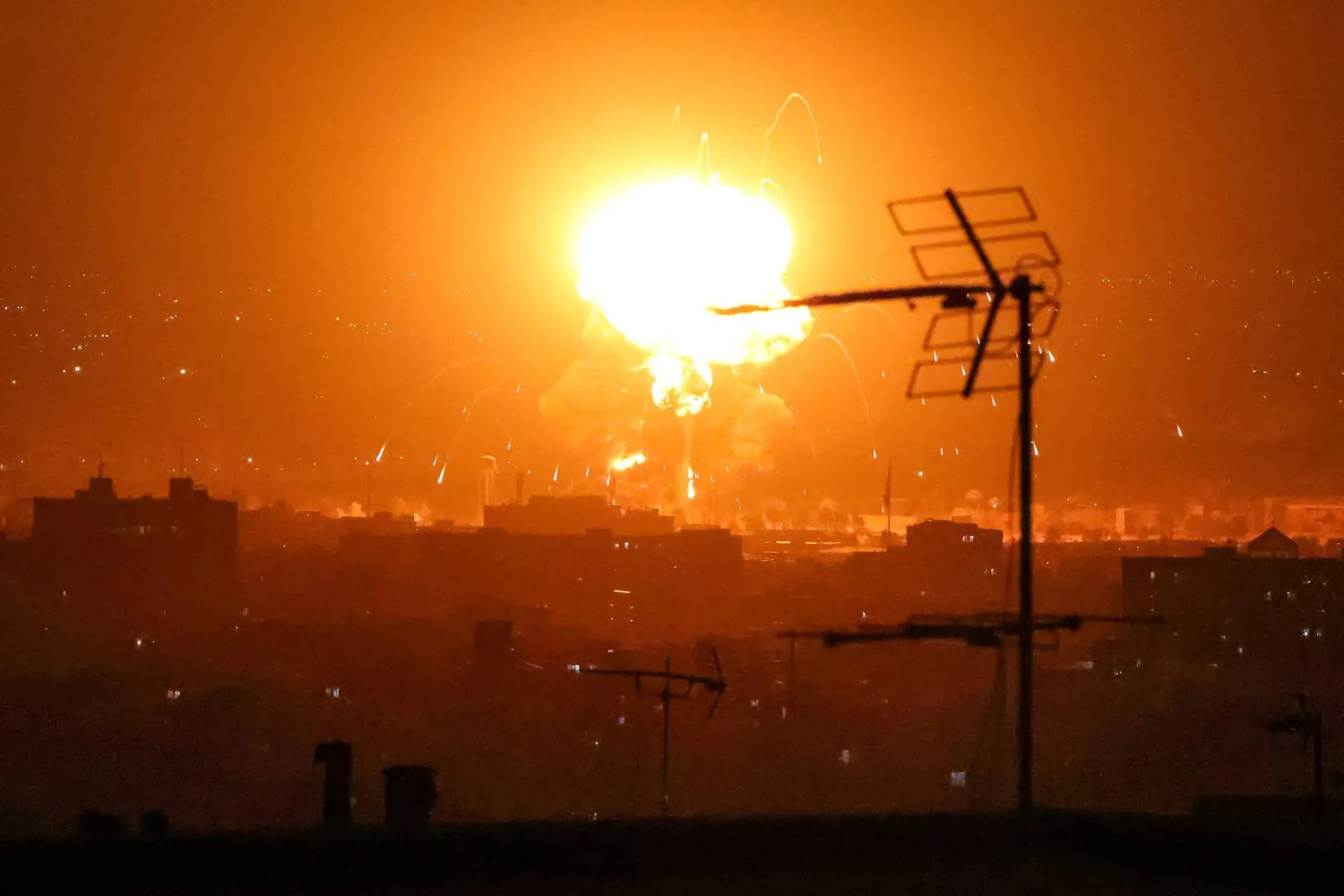
Explosions erupt following strikes in Tehran on March 7, 2026. (Photo by ATTA KENARE / AFP)
TT

Netanyahu, Trump Strike a Defiant Tone as Iran Says Can Fight for Months

Explosions erupt following strikes in Tehran on March 7, 2026. (Photo by ATTA KENARE / AFP)

Iran's Revolutionary Guards said Sunday that the country's forces could fight an intense war for six months against the United States and Israel, which said it struck Tehran's commanders at a seaside hotel in the heart of Beirut.

Tehran accused the US and Israel of striking an oil depot in the Iranian capital on Saturday, the first reported assault on the country's oil infrastructure as stock markets have slumped and crude prices surged.

The Israeli military said it struck "a number of fuel storage facilities in Tehran" that were used "to operate military infrastructure".

Israel's military also launched a new wave of strikes "across Tehran" on Sunday, after carrying out a precision strike targeting "key commanders" in the Quds Force, the foreign operations arm of Iran's Revolutionary Guards, at a hotel in an area of central Beirut popular with tourists.

Lebanon's health ministry said the strike killed at least four people at the hotel, where an AFP photographer saw shattered windows and charred walls.
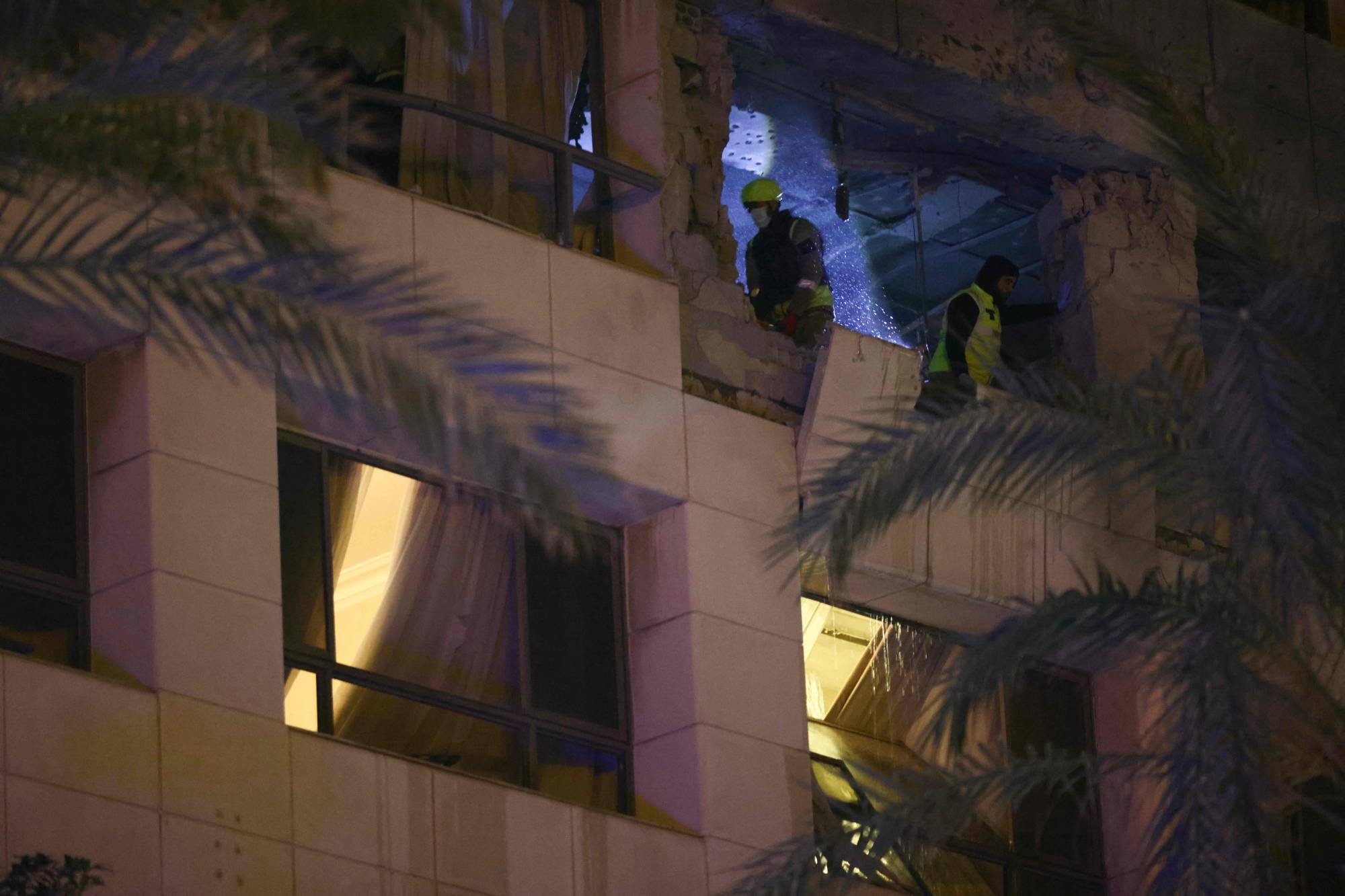
First aid responders inspect a Ramada hotel room targeted by an Israeli strike, in Beirut's seaside Rawche area, on March 8, 2026. (Photo by Ibrahim AMRO / AFP)

Israeli Prime Minister Benjamin Netanyahu has vowed to press on with the war against Iran "with all our force", with a plan to eradicate the country's leadership after joint US-Israeli raids killed supreme leader Ali Khamenei last week, sparking the regional conflict.

Despite the threat, the Revolutionary Guards said Sunday that Iranian forces could wage an "intense war" for six months at the current speed of fighting.

Guards spokesman Ali Mohammad Naini said Iran had so far used "first and second generation" missiles, but will use "advanced and less-used long-range missiles" in the coming days.

Iran's security chief Ali Larijani accused the Trump administration of seeking to replicate a scenario similar to Venezuela where it ousted leader Nicolas Maduro.

"Their perception was that it would be like Venezuela -- they would strike, take control and it would be over -- but now they are trapped," he said in a pre-recorded interview broadcast on state TV on Saturday.

Netanyahu said Israel had achieved almost total control of the skies over the Iranian capital.

US President Donald Trump Trump struck a similarly defiant tone, repeating the claim that Iran had been close to developing a nuclear weapon.

He also suggested US troops could eventually be needed to secure Iran's enriched uranium stockpiles.

Separately, he blamed Iran for what the country's authorities said was a deadly strike on an elementary school in Minab last Saturday that killed at least 150 people. Iran has blamed Washington for the strike.



Pezeshkian’s Apology to Neighbors Triggers Backlash in Iran

Iranian President Masoud Pezeshkian attends a leadership council meeting with judiciary chief Gholamhossein Mohseni-Ejei and Guardian Council member Ali Reza Arafi last week. (Iranian Presidency)
TT

Pezeshkian’s Apology to Neighbors Triggers Backlash in Iran

Iranian President Masoud Pezeshkian attends a leadership council meeting with judiciary chief Gholamhossein Mohseni-Ejei and Guardian Council member Ali Reza Arafi last week. (Iranian Presidency)

An apology by Iranian President Masoud Pezeshkian to neighboring countries for attacks that struck parts of their territories - and his pledge to halt such strikes unless their soil is used to attack Iran - has triggered sharp political debate within Tehran’s ruling establishment.

Lawmakers swiftly condemned the remarks, while military and judicial officials reiterated that US and Israeli interests across the region would remain legitimate targets. The dispute is unfolding at a delicate moment for Iran, following the killing of Supreme Leader Ali Khamenei.

Pezeshkian framed the apology as a political signal intended to reassure neighbors and prevent a wider regional confrontation. Critics, however, called it “an unjustified concession in the middle of an open war.”

Military and judicial leaders stressed that any US or Israeli base or interest used against Iran would remain a legitimate target — even if located on the territory of other regional states.

The episode has turned the president’s apology from a diplomatic gesture to contain tensions into the center of an internal power struggle, highlighting divisions within Iran’s leadership over the limits and management of the war.

Following Khamenei’s killing, a temporary leadership council assumed his duties. The body consists of Pezeshkian, judiciary chief Gholamhossein Mohseni-Ejei and Guardian Council member Alireza Arafi.

In a televised address, Pezeshkian said the council had decided not to target neighboring states or fire missiles at them unless Iran was attacked from their territory.

“I apologize in my name and on behalf of Iran to neighboring countries that Iran attacked,” he said, adding that Tehran does not intend to assault any state.

He said the Iranian Revolutionary Guard Corps had acted in recent days “based on a field decision” after senior commanders and the supreme leader were killed at the start of the war.

The comments quickly drew pushback. Mohseni-Ejei said evidence gathered by Iran’s armed forces showed that “the geography of some countries in the region has openly or secretly been placed in the service of the enemy,” allowing their territory to be used for attacks against Iran.

“Severe attacks on these targets will continue,” he said, adding that the strategy was already under way and backed by the government and other pillars of the system.

Iran’s military signaled little appetite for de-escalation. The command of Khatam al-Anbiya Headquarters, the joint operations center under the armed forces’ general staff, said that although it had “not carried out any aggression” against neighboring states so far, all US and Israeli bases and interests across land, sea and air in the region remained primary targets.

In a statement, the command said the armed forces “respect the interests and sovereignty of neighboring countries and have not carried out any aggression against them so far.” But it warned that if hostile actions continued, all military bases and interests belonging to the United States and the “Zionist entity” would face powerful strikes from Iranian armed forces.

A spokesman for the headquarters said any location from which attacks against Iran are launched would be considered a legitimate target, warning that any attempt to enter the region “will end at the bottom of the Gulf” and that Tehran “will not retreat” in confronting the United States and Israel.

In parliament, Mohammad Manan Raisi, a lawmaker representing Qom, said the president’s “strange apology to neighboring countries is regrettable.”

Addressing Pezeshkian, he wrote: “When will it be time for you to apologize to the Iranian people for these humiliating positions?”

Raisi added that the Assembly of Experts must urgently announce a new supreme leader, saying the president’s “humiliating statements” showed the need to select one as soon as possible.

“Is it not true that neighboring countries placed their land, property and hotels at the service of our enemies?” he said. “Should our military not have attacked these bases and enemy properties that you now apologize for striking in such a humiliating manner?”

Conservative lawmaker Jalal Rashidi Kouchi wrote on X: “With all due respect, Mr. President, an apology is offered when a mistake has been made... but we made no mistake.”

He said the president’s message lacked firmness, appearing weak in wording, delivery and even body language.

Iran’s foreign ministry also warned regional states against allowing their territory or resources to be used for attacks on Iran.

In a statement, it said international law prohibits using a country’s territory, directly or indirectly, to harm another state, citing UN General Assembly Resolution 3314 defining aggression.

Countries whose territory is used to launch military attacks against a third state bear international legal responsibility, including compensation for direct and indirect damages, the ministry said.

It added that Iran had been compelled, under its “inherent and natural right” of self-defense, to carry out necessary and proportionate defensive operations against the bases and facilities of aggressors in the region.

Those operations target facilities and capabilities that serve as sources or launch points for hostile acts against the Iranian people, the ministry said, adding that US bases in the region had not strengthened security but had instead supported “American aggressors and the Zionist entity.”

The ministry stressed that Iran seeks to maintain and develop friendly relations with regional states based on mutual respect, good neighborliness and respect for sovereignty and territorial integrity. Iranian defensive operations against US bases in the region, it added, should not be interpreted as hostility toward neighboring countries.

Parliament speaker Mohammad Bagher Ghalibaf also weighed in, writing on X that the Islamic Republic’s defense policies are “constant” and rooted in “principles.”

“As long as there are US bases in the region, its countries will not see stability,” he wrote, adding that “all officials and the people are united around this principle.”

The presidency later sought to clarify the president’s remarks. Mehdi Tabatabaei, head of public relations at the presidential office, said the message was straightforward: if regional states do not cooperate with US attacks on Iran, Tehran will not target them.

“The Islamic Republic will not bow to pressure,” he wrote on X. “Our armed forces will respond firmly, according to rules of engagement, to any attack launched from US bases.”


Tugboat Sinks in Strait of Hormuz, 3 Indonesian Crew Missing

FILE PHOTO: Tankers are seen off the coast of Fujairah, in Fujairah, United Arab Emirates, March 3, 2026. REUTERS/Amr Alfiky/File Photo
TT

Tugboat Sinks in Strait of Hormuz, 3 Indonesian Crew Missing

FILE PHOTO: Tankers are seen off the coast of Fujairah, in Fujairah, United Arab Emirates, March 3, 2026. REUTERS/Amr Alfiky/File Photo

Three Indonesian crew members are missing after a tugboat sank in the Strait of Hormuz on Friday, Jakarta's foreign ministry said in a statement.

There have been numerous attacks on ships navigating the Strait of Hormuz since the US-Israeli war on Iran started on February 28.

The tugboat had seven crew members from Indonesia, India and the Philippines, the ministry said, adding that four survived and three others, all Indonesians, are missing.

Before it sank, the boat experienced an explosion that caused it to catch fire, the statement said, adding that an investigation is ongoing by local authorities.

"One Indonesian survivor is currently receiving burn treatment at a hospital in the city of Khasab, Oman. The other three Indonesians are still being searched for by the local authorities," the Indonesian ministry said.

Another Indonesian national was at the location of the incident, but now on a different vessel and is currently safe, the statement added.


Trump Tells Britain he Does Not Need its Help to Win Iran War

FILE PHOTO: US President Donald Trump and British Prime Minister Keir Starmer announce an agreement between the two countries as they hold a press conference at Chequers at the conclusion of a state visit on September 18, 2025 in Aylesbury, Britain. Leon Neal/Pool via REUTERS/File Photo
TT

Trump Tells Britain he Does Not Need its Help to Win Iran War

FILE PHOTO: US President Donald Trump and British Prime Minister Keir Starmer announce an agreement between the two countries as they hold a press conference at Chequers at the conclusion of a state visit on September 18, 2025 in Aylesbury, Britain. Leon Neal/Pool via REUTERS/File Photo

President Donald Trump said on Saturday Britain was giving "serious thought" to sending two aircraft carriers to the Middle East, but added that the US does not need them to win the war with Iran, in the latest clash between the military allies.

Trump has repeatedly criticized British Prime Minister Keir Starmer suggesting this week that he helped "ruin" the countries' historically close relationship after London blocked initial US use of British bases to attack Iran.

In a post ⁠on Truth Social, ⁠Trump said he "will remember" the lack of British support during the conflict with Iran.

"The United Kingdom, our once Great Ally, maybe the Greatest of them all, is finally giving serious thought to sending two aircraft carriers to the Middle East," Reuters quoted Trump as saying.

"That’s OK, Prime Minister Starmer, we don’t need them any longer — But we will remember. We don’t need ⁠people that join Wars after we’ve already won!"

The social media post comes after Britain's defense ministry said on Saturday it was preparing the Prince of Wales aircraft carrier for possible deployment.

But no final decision has been taken about whether to send it to the Middle East, a British official said.

Starmer has defended his decision not to allow US forces to use British bases to support initial strikes on Iran, saying he needed to be satisfied that any military action was legal and well planned.

He later granted US forces permission to use British ⁠bases for what ⁠he called defensive strikes against Iranian missiles in storage depots or launchers.

Asked about Trump's comments, British foreign minister Yvette Cooper told Sky News on Sunday: "The thing I've learned doing this job is that you have to focus on substance and not on social media posts."

"We're not going to do things in terms of the rhetoric or hyperbole. We're going to do things on really practical, calm, steady decision making. Because I think that actually the British character more widely is to do things in a serious and steady way."

Starmer earlier this year criticized Trump's desire to buy Greenland and said his comments that European troops avoided frontline combat in the war in Afghanistan were "frankly appalling."