

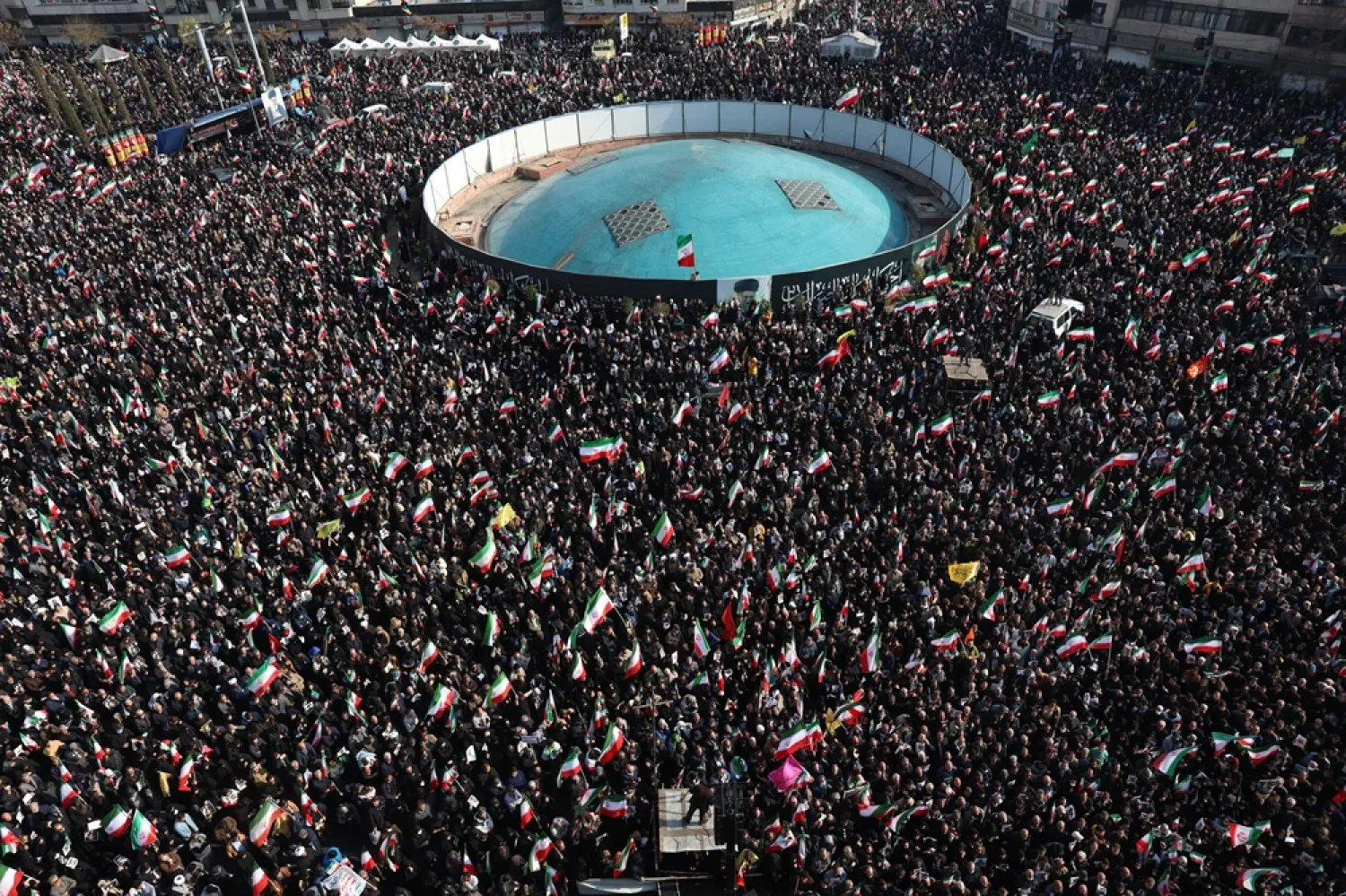

Iran Hardliners Rally Behind New Leader, Unsettling Global Markets

People gather in a rally to support Mojtaba Khamenei, the successor to his late father Ali Khamenei as supreme leader, in Tehran, Iran, Monday, March 9, 2026. (AP)
TT

Iran Hardliners Rally Behind New Leader, Unsettling Global Markets

People gather in a rally to support Mojtaba Khamenei, the successor to his late father Ali Khamenei as supreme leader, in Tehran, Iran, Monday, March 9, 2026. (AP)

Iran's hardliners staged a show of force on Monday, taking to the streets to proclaim their loyalty to new Supreme Leader Mojtaba Khamenei, whose rise appeared to dash hopes of a swift end to war in the Middle East causing havoc on global markets.  

The prospect that one of the most severe disruptions ever to hit global energy supplies could last longer than previously expected sent oil prices surging in record leaps and stock markets into a nosedive. 

Khamenei, 56, a cleric with a power base among the security forces and their vast business empire, has been declared unacceptable by US President Donald Trump, who has demanded Iran's unconditional surrender. 

Iranian state media showed large crowds in several cities rallying behind the new leader, waving Iranian flags and holding portraits of his father Ali Khamenei, killed by strikes on the war's first day. 

In Isfahan, state TV reported the sound of nearby explosions from apparent airstrikes as loyalists gathered in the historic Imam Square, chanting "God is the Greatest" below a stage with portraits of Ali and Mojtaba Khamenei.  

In Tehran, a eulogist could be heard singing: "Either death or Khamenei, our blood leads to paradise." 

POLITICAL SYSTEM RALLIES BEHIND NEW LEADER  

Politicians and institutions issued pledges of loyalty to the new supreme leader, whose wife, son and mother also ‌died at the start of ‌the US-Israeli air onslaught according to Iranian state media. 

"We will obey the commander-in-chief until the last drop of our blood," a ‌defense council ⁠statement said.  

Iranians ⁠reached by telephone were divided, with supporters of the authorities hailing the choice as a declaration of defiance and opponents fearful it would dash their hopes for change. 

"I am so happy that he is our new leader. It was a slap in the face to our enemies that thought the system will collapse with the killing of his father. Our late leader's path will continue," said university student Zahra Mirbagheri, 21, from Tehran. 

Many Iranians had initially celebrated the elder Khamenei's death, weeks after his security forces killed thousands of anti-government protesters in the worst domestic unrest since the era of Iran's 1979 revolution. But there has since been little sign of anti-government activity, with activists fearful of taking to the streets while Iran is under attack. 

"The (elite Revolutionary) Guards and the system are still powerful. They have tens of thousands of forces ready to fight to keep this regime in place. We, the people, have nothing," said Babak, 34, a businessman in the ⁠central city of Arak who asked to keep his family name confidential. 

Israel says its war aim is to overthrow Iran's ‌system of clerical rule. US officials mainly say Washington's aim is to destroy Iran's missile capabilities and nuclear program, but Trump ‌has said the war can end only with a compliant Iranian government.  

Israel had said it would kill whoever succeeded the elder Khamenei unless Iran ended its hostile policies. Fox News quoted Trump as ‌saying that he was "not happy" with the choice. 

OIL SURGES PAST $100 A BARREL, THEN DIPS BACK 

The war has effectively shut the Strait of Hormuz, a chokepoint for a ‌fifth of global oil and liquefied natural gas, leaving tankers unable to sail for more than a week and forcing producers to halt pumping as storage fills.  

Brent crude futures were up nearly 7.00% at $99.25 per barrel at 1610 GMT, having earlier shot as high as $119.50 in what would have been the biggest one-day rise on record. 

Since the war started, Brent has surged by as much as 65%. The prospect of a prolonged energy crisis - ‌reviving memories of the Middle East oil shock of the 1970s - sent global share markets into a tailspin.  

Bond yields surged as investors bet that central banks would have to cancel rate cuts or impose hikes to fight inflation. 

The price of gasoline ⁠has particular political resonance in the United States, ⁠where Trump's Republicans hope to keep control of Congress in midterm elections in November. 

The president is expected to review as early as Monday a set of options to tame domestic oil prices, including a possible release of crude oil from strategic reserves or restricting US exports, according to two people familiar with the matter. 

"Short-term oil prices, which will drop rapidly when the destruction of the Iran nuclear threat is over, is a very small price to pay for U.S.A., and World, Safety and Peace," Trump posted on Truth Social on Sunday night. "ONLY FOOLS WOULD THINK DIFFERENTLY!" 

OIL REFINERY HIT 

Tehran was choked in black smoke after an oil refinery was hit, an escalation in strikes on Iran's domestic energy supplies.  

World Health Organization chief Tedros Ghebreyesus warned of the dangers from such attacks. 

"Damage to petroleum facilities in Iran risks contaminating food, water and air – hazards that can have severe health impacts especially on children, older people, and people with pre-existing medical conditions," he wrote on X.  

Türkiye said on Monday NATO alliance air defenses had shot down a ballistic missile that was fired from Iran and entered Turkish airspace, the second such incident of the war. Iran did not immediately comment on the report. 

Türkiye, Iran's neighbor with NATO's second-largest army, had warned Tehran on Saturday against attacking again, but it has not suggested it wants to formally call on bloc members for further protection. 

Israel's military said it had launched new attacks in central Iran and struck the Lebanese capital Beirut, where Israel has extended its campaign after the Iran-backed militia Hezbollah fired across the border. 

US-Israeli attacks have killed at least 1,332 Iranian civilians and wounded thousands, according to Iran's UN ambassador.  

The toll from Israeli strikes on Lebanon rose to 486 people killed and 1,313 wounded since the start of fighting last week, the Lebanese health ministry said Monday. 

"The toll of the Israeli aggression from dawn on Monday, March 2, until Monday afternoon, March 9, has risen to 486 martyrs and 1,313 wounded," the ministry said in a statement. 

In Israel, ambulance workers said one man died from shrapnel wounds at a construction site near Tel Aviv's international airport, raising to 11 the death toll from Iranian strikes. 


Netanyahu on Syria Visit Says ‘Very Close’ to Toppling Iran Regime

09 September 2026, Israel, Northern Command: Israeli Prime Minister Benjamin Netanyahu observes operational activity from an Israeli military observation post on Mount Hermon near the Israeli Syrian border. (dpa)
TT

Netanyahu on Syria Visit Says ‘Very Close’ to Toppling Iran Regime

09 September 2026, Israel, Northern Command: Israeli Prime Minister Benjamin Netanyahu observes operational activity from an Israeli military observation post on Mount Hermon near the Israeli Syrian border. (dpa)

Israeli Prime Minister Benjamin Netanyahu said during a visit to Israeli troops in southern Syria on Wednesday that Iran's regime was on the verge of collapse, as fighting in the six-month Middle East war intensifies.

"There is still work to be done -- the main task is to bring down the terror regime in Iran. We are very close to that. We know that the entire axis will ultimately collapse," he said on the Syrian side of Mount Hermon on the Israel-Syria border during a visit with Defense Minister Israel Katz.

In southern Syria, Israeli forces have been stationed in a "security zone" since the fall of longtime ruler Bashar al-Assad in December 2024.

They occupy what was previously a buffer zone patrolled by the United Nations that had separated Israeli and Syrian forces in the Israeli-occupied Golan since 1974.

"We will not allow any terrorist army to establish itself on our border," Netanyahu reiterated on Wednesday.

Katz visited Israeli troops stationed in southern Syria two weeks ago, prompting condemnation from Damascus, which denounced a "flagrant violation of the country's sovereignty and territorial integrity".

Israel has carried out hundreds of strikes in Syria since the fall of Assad and made repeated incursions into Syrian territory.

Officials have also repeatedly vowed to keep troops in the security zone, where Israel is seeking a broader demilitarized area.

Netanyahu's threats against Iran come as Tehran and Washington are locked in a stalemate over the strategic Strait of Hormuz, with both sides trading attacks in the past week, six months into the war that the US and Israel launched against Iran at the end of February.


EU Gives Spain 115 Mn Euros Aid Over Ceuta Crisis

Improvised shelters at a makeshift camp in Trampolin Beach, following recent mass crossings of migrants from Morocco to Ceuta, in Ceuta, Spain, September 7, 2026. (Reuters)
TT

EU Gives Spain 115 Mn Euros Aid Over Ceuta Crisis

Improvised shelters at a makeshift camp in Trampolin Beach, following recent mass crossings of migrants from Morocco to Ceuta, in Ceuta, Spain, September 7, 2026. (Reuters)

The EU on Wednesday said it was granting Spain 115 million euros ($130 million) in emergency aid to help bolster border security and assist returns after the massive migrant rush into the north African exclave.

More than 70,000 migrants crossed into Spanish territory from Morocco on July 30 and 31 in an unprecedented rush that left scores dead, most by drowning as they tried to swim around a breakwater.

"The situation in Ceuta has put pressure on our external borders," said European Commission vice president Henna Virkkunen.

"Our message remains clear: we are committed to combat illegal migration and ensure the swift return of those who remain illegally in Ceuta."

Spain requested assistance from Brussels in late August.

The EU said that the funds would go towards "measures to enhance border surveillance, border protection and security-related infrastructure", such as thermal cameras and floating buoy systems and underwater drones.

"It will also serve to set up facilities for the screening of migrants, as well as to support returns of those who remain illegally in Ceuta," Brussels said.

Most of the migrants who entered Ceuta have returned to Morocco, but thousands have remained in often dire living conditions, increasing tensions in the small city and causing a political storm for the government.

The Ceuta crisis sparked rifts between EU nations, with Spain's left-wing government clashing with Italy's hard-right authorities after Rome ramped up border controls.

Spain's top criminal court on Monday opened an investigation into the deadly rush.


Suspected Measles Cases Kill Nearly 1,000 as Bangladesh Struggles to Contain Outbreak

A child receives treatment for measles, at Bangladesh Shishu Hospital & Institute in Dhaka on September 3, 2026. (Photo by Salahuddin Ahmed / AFP)
TT

Suspected Measles Cases Kill Nearly 1,000 as Bangladesh Struggles to Contain Outbreak

A child receives treatment for measles, at Bangladesh Shishu Hospital & Institute in Dhaka on September 3, 2026. (Photo by Salahuddin Ahmed / AFP)

Eight-month-old Rojatun Jannat Ramisa is struggling to breathe in a hospital in Bangladesh’s capital as her parents sit helplessly beside her. She's one of thousands of children sickened by a measles outbreak that's sweeping across the country and has killed hundreds of children following setbacks to the country's vaccine program.

Ramisa’s mother Ranu Akhter traveled hundreds of kilometers (miles) after doctors in eastern Bangladesh referred her to a specialized child hospital in Dhaka to seek treatment for the life-threatening condition, The Associated Press said.

“Fourteen days ago, when we were at the district hospital, there were other children being treated alongside my daughter. I saw that those children also had red rashes on their bodies, sores in their mouths and fevers,” Akhter told The Associated Press at Dhaka Shishu Hospital.

“It made me realize how widespread the measles outbreak is,” she said.

Every day, the death toll is rising.

Bangladesh races to vaccinate children Bangladesh has been racing to halt the outbreak's spread since March, when more than 100 children died in less than a month. By Tuesday, the death toll from suspected measles cases reached 999 since the start of the year, according to the government’s Directorate General of Health Services.

Since March, the country has recorded more than 166,000 suspected measles cases, including 19,835 laboratory-confirmed infections, according to the Ministry of Health.

The government launched an emergency vaccination drive in March together with the World Health Organization, the UN children’s agency and the Gavi vaccine alliance. It began with a focus on children from 6 months to 5 years old and later expanded nationwide in phases.

Measles is a highly contagious airborne disease that causes fever, respiratory symptoms and a characteristic rash. It can sometimes have severe or fatal complications, especially in young children, according to the WHO.

Two doses of a vaccine provide strong protection against measles, but the WHO says 95% of the population has to be vaccinated in order to stop the disease from spreading — which protects children like Ramisa who are too young to be vaccinated as well as immunocompromised people.

The pandemic and political upheaval set back vaccinations

A few years ago, Bangladesh had measles largely under control, with a vaccination program that was credited for decades for protecting children and mothers from the deadly diseases of tuberculosis, diphtheria, whooping cough, tetanus, poliomyelitis and measles. Between 2021 and 2025, the country recorded just 100 to 300 cases per year, down from 2,410 cases in 2020.

But in the last few years, disruptions to the vaccine program have left a growing number of children unvaccinated.

First the pandemic interrupted routine vaccinations, and then in 2024 the government largely missed a vaccination campaign previously carried out every four years.

Atiqul Islam, a neonatal and child specialist at Bangladesh Shishu Hospital and Institute, said during the pandemic period in 2021 and 2022, many did not take their children to get vaccinated.

“So, if you look at children who are now four or five years old, many of them missed their vaccinations. That created a gap. During the previous interim government, vaccines were also unavailable at many vaccination centers,” he said.

Rival politicians trade blame for vaccine shortfall Bangladesh's current government, headed by Prime Minister Tarique Rahman, said the failures in planning under ousted Prime Minister Sheikh Hasina and interim leader Muhammad Yunus left the country with shortages of vaccines and far behind on coverage.

The 2024 measles vaccination campaign was disrupted during the political upheaval that led to Hasina’s ouster. She left the country in the face of a mass uprising in August 2024, and was followed by Yunus, who led an interim administration that transferred power to an elected government after an election in February.

From exile in India, Hasina blamed the Yunus-led government for the disaster.

Doctor says things are getting better, but not fast enough At Bangladesh Shishu Hospital, Islam said the situation has improved, but not enough.

The doctor said his colleagues are struggling to treat infected children who often arrive at the hospital with serious complications like pneumonia, diarrhea and encephalitis, or brain swelling.

“For the past six months, we have been treating measles patients continuously, and we are exhausted,” he said.
