


New Crackdown Feared in Iran After Police Chief Brands Protesters ‘Enemies’

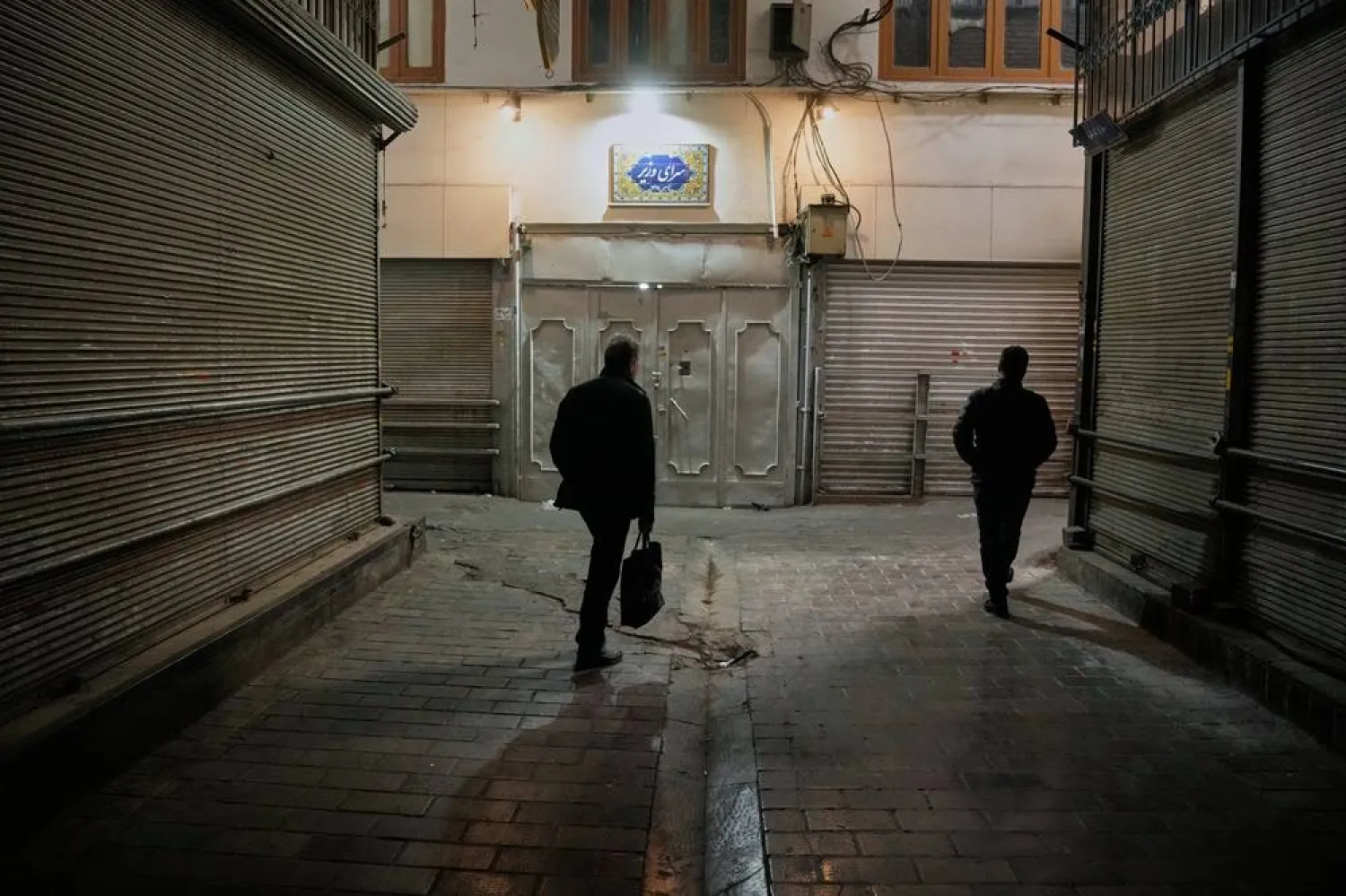
 People walk past closed shops at the nearly empty Tajrish traditional bazaar in northern Tehran, Iran, Tuesday, March 10, 2026. (AP)
People walk past closed shops at the nearly empty Tajrish traditional bazaar in northern Tehran, Iran, Tuesday, March 10, 2026. (AP)
TT

New Crackdown Feared in Iran After Police Chief Brands Protesters ‘Enemies’

 People walk past closed shops at the nearly empty Tajrish traditional bazaar in northern Tehran, Iran, Tuesday, March 10, 2026. (AP)
People walk past closed shops at the nearly empty Tajrish traditional bazaar in northern Tehran, Iran, Tuesday, March 10, 2026. (AP)

Campaigners fear Iranian authorities are intent on launching a new crackdown on opponents even under wartime conditions, after the police chief threatened to shoot protesters and treat them as enemies. 

The war between Iran and the United States and Israel erupted just weeks after unprecedented protests against the clerical establishment peaked in January. 

But rights groups say those demonstrations were put down in a crackdown that left thousands of people dead and tens of thousands arrested. 

The conflict, which began with an air strike that killed supreme leader Ali Khamenei and other top security officials, is the latest existential threat to the Islamic republic in its 47-year history after years of economic crises and protests. 

Rights activists say that even after the killing of its leader, Iran's system still has powerful levers of repression including the Revolutionary Guards as well as the regular police who both played a key role in putting down the protests in January. 

"If anyone comes forward in line with the wishes of the enemy, we will no longer see them as merely a protester, we will see them as an enemy," national police chief Ahmad-Reza Radan said in comments aired by state broadcaster IRIB late on Tuesday. 

"And we will do to them what we do to an enemy. We will deal with them in the same way we deal with enemies," he added. 

"All our forces are also ready, with their hands on the trigger, prepared to defend their revolution." 

A prominent figure in Iran, Radan had initially been reported to have been killed in an Israeli strike during Israel's 12-day war against Iran in June 2025 but later emerged unscathed. 

He is also one of several key officials to have so far survived the current conflict. 

Norway-based NGO Iran Human Rights (IHR) said Wednesday security forces had continued to arrest civil society activists in the western regions of Iran despite the ongoing wartime conditions. 

It said sociologist and civil rights activist Ghorban Abbasi in Naghadeh in west Azerbaijan province had been detained and taken to an unspecified location. 

- 'Real existential threat' - 

"This is the bitter reality of the Islamic republic: Even in the midst of a crisis, it seizes the opportunity for repression," Nobel peace prize laureate Shirin Ebadi wrote in a post on Telegram. 

"When the police chief says 'hands on the trigger' it means he is ready to kill citizens instead of protecting people's lives," she added. 

Iran "says in a thousand languages that its first enemy is its own people, followed by Israel and America." 

The US-based Human Rights Activists News Agency (HRANA) recorded more than 7,000 killings in the January crackdown, the vast majority protesters, though the toll may be far higher. More than 50,000 have been arrested, it said. 

There have been few reports so far of protests against the authorities amid the bombardments, although videos verified by AFP did emerge of people chanting "death to Mojtaba" in Tehran after Khamenei's son Mojtaba was named supreme leader in his place. 

Reza Pahlavi, the son of the shah deposed by the 1979 revolution, and who cheered on the January protests from his US exile, on Wednesday called on people to stay home and await a further call for action. 

In a clip shared virally on Wednesday, a presenter on state TV was seen warning "we will make mothers mourn those inside or outside the country who have the foolish idea that amid chaos something must be done". 

- 'Harsher repression than ever' - 

"Radan's statement is part of a broader pattern of threats from Islamic republic officials about an even more brutal crackdown on protests," said Mahmood Amiry-Moghaddam, director of Norway-based IHR. 

"The authorities know that their real existential threat is not American or Israeli bombs and missiles, but the Iranian people who demand fundamental change," he told AFP. 

The Iranian judiciary under its chief Gholamhossein Mohseni Ejei, another powerful figure who also survived the initial phase of this conflict, has already vowed harsh punishment for those arrested over the January protests, including the use of capital punishment. 

Iran executed more than 1,500 people in 2025, according to IHR, and is the world's most prolific executioner after China. 

"If it survives this war, we fear that the republic will respond with even harsher repression -- mass arrests, violent crackdowns on protests and the execution of prisoners, including political detainees and protesters -- than ever before," said Amiry-Moghaddam. 


Iran Executed 18 Protesters in 2026, Says UN

 UN High Commissioner for Human Rights Volker Turk speaks to the media, at the Office of the United Nations High Commissioner for Human Rights (OHCHR) Palais Wilson, in Geneva, Switzerland, Wednesday, June 10, 2026. (Keystone via AP)
UN High Commissioner for Human Rights Volker Turk speaks to the media, at the Office of the United Nations High Commissioner for Human Rights (OHCHR) Palais Wilson, in Geneva, Switzerland, Wednesday, June 10, 2026. (Keystone via AP)
TT

Iran Executed 18 Protesters in 2026, Says UN

 UN High Commissioner for Human Rights Volker Turk speaks to the media, at the Office of the United Nations High Commissioner for Human Rights (OHCHR) Palais Wilson, in Geneva, Switzerland, Wednesday, June 10, 2026. (Keystone via AP)
UN High Commissioner for Human Rights Volker Turk speaks to the media, at the Office of the United Nations High Commissioner for Human Rights (OHCHR) Palais Wilson, in Geneva, Switzerland, Wednesday, June 10, 2026. (Keystone via AP)

Iran has executed at least 40 people, including 18 protesters, on "national security grounds" since the start of 2026, the United Nations said Monday.

UN rights chief Volker Turk said he felt "deeply for the people in Iran, caught between war and cruel repression".

Since the start of the year, the Iranian authorities "have executed at least 40 people on national security grounds... including 18 protesters", he told the UN Human Rights Council.

Iran executes more people annually than any other nation besides China, according to rights groups.

Turk lamented that Tehran had ramped up repression since a deadly crackdown on protests in January, on top of the Middle East war, sparked in February by US and Israeli attacks on Iran.

He welcomed the announcement on Sunday that the United States and Iran had agreed a peace deal, stressing that "it is clear all sides need to exercise maximum restraint and work to implement the agreement reached, quickly and in good faith".

The conflict, he said, "has had a devastating impact on human rights across the region and around the world".

Repression in Iran was dire even before the war.

In late December, a protest movement sparked by economic pains quickly expanded into mass anti-government rallies, which were met by a crackdown that rights groups say killed thousands.

Iranian authorities portrayed the protests as riots backed by the United States and Israel and said the violence killed around 3,000 people.

Rights groups abroad put the toll higher and accused the security forces of firing at demonstrators.

"Since killing thousands of people during the egregious crushing of protests in January, the authorities have intensified their brutal crackdown, arresting thousands and imposing even more severe restrictions on civic space," Turk said.


Congo Reports Record One-Day Increase in Ebola Cases, a Month After Outbreak’s Declaration

Dz'na Lipe Jean‑Marie, secretary of the displacement camp, speaks during an Ebola awareness session as humanitarian agencies intensify efforts to contain a new Ebola outbreak involving the Bundibugyo strain, at Kpangba displacement camp where Ebola cases were observed, Djugu territory in Ituri province, Democratic Republic of Congo, June 13, 2026. (Reuters)
TT

Congo Reports Record One-Day Increase in Ebola Cases, a Month After Outbreak’s Declaration

Dz'na Lipe Jean‑Marie, secretary of the displacement camp, speaks during an Ebola awareness session as humanitarian agencies intensify efforts to contain a new Ebola outbreak involving the Bundibugyo strain, at Kpangba displacement camp where Ebola cases were observed, Djugu territory in Ituri province, Democratic Republic of Congo, June 13, 2026. (Reuters)

Congolese authorities have reported one of the highest increase in Ebola cases in one day, as weak contact tracing, insecurity and funding gaps continue to hinder the response a month after the outbreak was declared.

The Congolese Ministry of Health said Sunday 72 new cases were reported in a 24-hour period, bringing the total number of confirmed cases to 782. This includes 181 confirmed deaths, after 32 new deaths were confirmed.

However, the number of cases in Congo is believed to be higher because the outbreak was confirmed on May 15, weeks after it is suspected to have begun, and the contact tracing coverage rate is at 56%, a sharp decrease from last week.

The latest Ebola outbreak is caused by the rare Bundibugyo virus, which has no approved vaccine or treatment, unlike the Zaire virus, which was responsible for most of Congo’s past 16 outbreaks of the disease.

Fifty-six people have recovered, and the current fatality rate of the outbreak is 23%, the ministry said.

The World Health Organization said Sunday it is intensifying testing and contact tracing and treatment.

Africa's top health body said the same day it is deploying technical expertise and supporting laboratory systems, active case finding and community engagement efforts to accelerate the response to the disease outbreak.

“We remain committed to supporting affected countries until transmission is stopped. We call on partners and donors to urgently mobilize resources to strengthen the response and save lives,” said the head of the Africa Centers for Disease Control and Prevention, or Africa CDC, Jean Kaseya.

The outbreak is concentrated in Congo’s eastern province of Ituri, which accounts for more than 90% of the cases. Cases have also been recorded in the North Kivu and South Kivu provinces, and have spread across the border to Uganda.

Nearly a million people have been displaced by conflict in Ituri, according to the UN humanitarian office, making contact tracing difficult as people flee attacks or move frequently in the vast province with dense forests, poor roads and remote villages that can take days to reach.

Tracing is also difficult among the thousands of artisanal miners who regularly move between remote sites in the mineral-rich region.


Iran's Fars News Agency Says Hormuz Maritime Fees Added to US Deal Last Minute

Vessels at the Strait of Hormuz, as seen from Musandam, Oman, June 14, 2026. REUTERS/Stringer
TT

Iran's Fars News Agency Says Hormuz Maritime Fees Added to US Deal Last Minute

Vessels at the Strait of Hormuz, as seen from Musandam, Oman, June 14, 2026. REUTERS/Stringer

Iran's Fars news agency said on Monday, quoting what it said was an informed source, that Tehran added a clause on imposing maritime service fees to the framework deal with the United States shortly before its announcement.

"In the final moments of the negotiations, the text of the memorandum of understanding was amended to clearly and explicitly emphasize the issue of the Iranian-Omani sovereignty over the Strait of Hormuz," said Fars, citing the unidentified source.

"The use of the term 'maritime services' means that the United States has accepted that fees will be paid to Iran," it added.
