

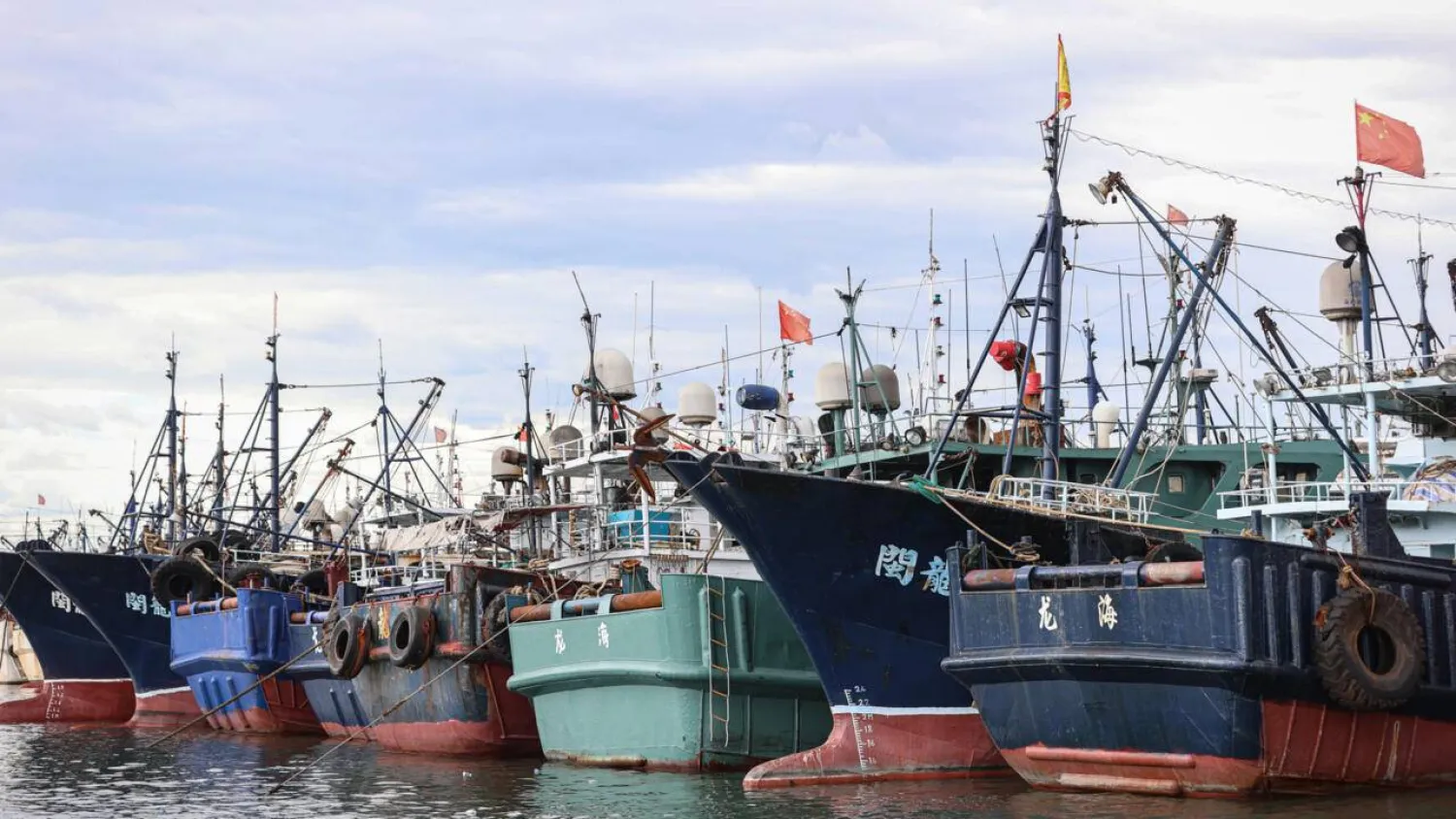

Thousands of Chinese Boats Mass at Sea, Raising Questions

China's massive fishing fleet operates in the Yellow Sea, East China Sea and the South China Sea, competing with fishers from Japan, South Korea, Taiwan, Vietnam and the Philippines. (AFP)
TT

Thousands of Chinese Boats Mass at Sea, Raising Questions

China's massive fishing fleet operates in the Yellow Sea, East China Sea and the South China Sea, competing with fishers from Japan, South Korea, Taiwan, Vietnam and the Philippines. (AFP)

Thousands of Chinese fishing boats have been massing in geometric formations in the East China Sea, in coordinated actions that experts believe are part of Beijing's preparations for a potential regional crisis or conflict.

Monitoring ship-tracking data on Christmas Day, Jason Wang could tell something "unusual" was underway as fishing boats swarmed into two parallel inverted Ls, each about 400 kilometers (about 250 miles) long.

Wang could see the roughly 2,000 fishing boats among the many thousands of vessels that ply the busy waterway through their automatic identification systems (AIS) -- a GPS-type signal that commercial ships use to avoid collisions.

The vessels, which were as close as 500 meters (1,640 feet) to each other, held their positions for about 30 hours in near gale-force winds and then suddenly scattered.

"Something didn't look right to me because in nature very rarely do you see straight lines," said Wang, chief operating officer of ingeniSPACE, which analyses satellite imagery and ship signals data.

"We've seen like two, 300, up to a thousand (Chinese fishing boats congregate), but anything exceeding a thousand I thought was unusual."

Maritime and military experts told AFP the massing of Chinese fishing boats on December 25, about 300 kilometers northeast of Taiwan, was on a scale they had never seen before.

Another incident detected in early January involved around 1,000 Chinese fishing vessels clustered in an uneven rectangle, about 400 kilometers long, for more than a day in the same area of the East China Sea.

Hundreds of those vessels were also detected in the December 25 event, Wang told AFP in an interview in Taipei.

Last week, around 1,200 boats massed in two parallel lines further east of the January and December events and held their positions for about 30 hours, Wang said.

China's massive fishing fleet operates in the Yellow Sea, East China Sea and the South China Sea, competing with fishers from Japan, South Korea, Taiwan, Vietnam and the Philippines.

While there is debate about why so many Chinese fishing vessels would gather in geometric formations in the open sea, experts widely agree that they were not there to fish.

Some experts said the only plausible explanation was that China was testing its ability to marshal a large number of fishing vessels that could potentially be deployed in a military operation, such as a blockade or invasion of Taiwan, or a crisis with Japan.

"I've never seen a massing of Chinese fishing boats in these numbers anywhere outside of port ever," Gregory Poling, director of the Asia Maritime Transparency Initiative at the Washington-based Center for Strategic and International Studies (CSIS), said of the December 25 event.

The maneuvers were a "demonstration with a military lens" to show those watching that the boats had the ability to coordinate their movements, said Jennifer Parker, a former Australian naval warfare officer.

"I've sailed around the entire world and I've not seen fishermen operating in that proximity to each other, in that degree of concentration," said Parker, now an Expert Associate at the National Security College of the Australian National University.

"They're definitely not fishing."

Global Fishing Watch chief scientist David Kroodsma said the Chinese fishing fleet was "highly coordinated" and it was possible that the vessels were ordered not to fish in a certain area.

"Most of the time when you see lines of boats, it's because they're right up against some boundary where they're not allowed to be. In this region that's what you see most of the time," Kroodsma said.

"If you look across the year, you see many, many examples of when there's clearly a line that they're not supposed to fish across at different time periods. We don't know why."

- 'State operation' -

AFP's reporting for this story involved the analysis of AIS data and nighttime satellite imagery, and interviews with experts from ingeniSPACE, Starboard Maritime Intelligence, CSIS and Global Fishing Watch, who also observed the December and January formations.

Unseenlabs, a French company specializing in maritime surveillance, verified the December 25 data for AFP, describing the concentration of vessels as "surprising and unusual".

The experts were confident that the majority of the vessels were real and not spoofed, which is when AIS data is manipulated to give misleading information about a vessel's location or identity.

"We've had enough other corroborating data... to confirm that those vessels were clearly out there," Poling said.

As part of his efforts to verify the data, Mark Douglas, a former New Zealand naval officer and now a maritime domain analyst at Starboard, said he examined fishing patterns in the same area over the previous two years.

"At no time has the behavior been the same as this," Douglas said. "During other periods of adverse weather the vessels returned to port, rather than massing offshore in these kinds of formations."

"I can't speak to the why... but the how certainly seems to be that there was direction provided to these vessels that this is what they needed to do," Douglas said.

The number of vessels involved indicated a "state operation", said Thomas Shugart, a former US Navy submarine warfare officer and now an Adjunct Senior Fellow with the Defense Program at the Center for a New American Security.

"There's no commercial entity that controls that many fishing boats that I know of," Shugart said.

- 'Maritime militia' -

China's navy ranks number one in the world in terms of the number of warships and submarines on the Global Firepower list.

Beijing is also tapping its huge civilian fleet, including fishing boats, ferries and cargo ships, as part of its preparations for a regional crisis or conflict, including over Taiwan, experts say.

China has threatened to use force, if necessary, to seize Taiwan, which it claims is part of its territory, and US officials have flagged 2027 as a possible timeline for an attack.

In its 2025 report to Congress on China's military power, the US Department of Defense said: "The PLA continues to make steady progress toward its 2027 goals" and "China expects to be able to fight and win a war on Taiwan" by the end of that year.

Beijing has stepped up military pressure on Taiwan in recent years, deploying fighter jets and warships around the island on an almost daily basis.

China has also held multiple large-scale exercises around Taiwan that are often described as rehearsals for a blockade and seizure of the territory.

Civilian vessels were "absolutely central" to Chinese military planning for an operation against Taiwan, said Shugart.

China's navy does not have enough landing vessels to deliver the troops and equipment it would need to make an invasion of Taiwan feasible.

"In the absence of that dual-purpose, civil-military maritime mass, I don't think they can invade Taiwan," Shugart said. "With that, (it) turns into a 'maybe they can'."

Many of the fishing boats involved in the December and January massing events were likely part of China's maritime militia, some experts said.

The maritime militia is made up of fishing boats trained to support the military and the fleet has been used to assert China's territorial claims, including in the South China Sea where they have swarmed contested reefs.

AIS data showed the "vast majority" of vessels congregating in the East China Sea appeared to be from the eastern province of Zhejiang, where several maritime militia ports are located, said Poling.

"Like militia on land in China, they get called up from time to time for reserve service," Poling said.

"My guess is that this was an effort to just see if the militia could muster. These are civilians, these are not the professional militia in the South China Sea, they're fishermen," he said.

Maritime militia would have a "range of roles" in a military operation, said Parker, such as harassing warships or acting as decoys for missiles fired by opposing forces, though she noted their presence could also interfere with China's own ability to hit targets.

"It's clear that China's operations planning in the South China Sea and around Taiwan include the maritime militia as a force multiplier," she said.

"It's reasonable to assume that this would also be the case in the event of a military crisis with Japan."

- Threats of retaliation -

The maritime militia's role in the South China Sea has expanded beyond swarming reefs to helping the Chinese coastguard in "blocking and harassing" Philippine fishing boats and even using water cannon against Filipino fishermen, Philippine Coast Guard spokesman Jay Tarriela said.

"They don't have covert roles anymore," Tarriela said.

"They're actually part of the (Chinese) government, a flotilla, advancing their illegal interests in the South China Sea."

Beijing has not publicly commented on the fishing boat formations in the East China Sea.

Japan's coast guard declined to comment when contacted by AFP. Tokyo is involved in a deepening spat with Beijing after Prime Minister Sanae Takaichi suggested that Japan would intervene militarily if China sought to take Taiwan by force.

Responding to China's grey zone activities -- coercive actions that fall short of an act of war -- or military operations in the region is "really hard", a diplomat told AFP on the condition of anonymity.

"China often threatens or implies retaliation -- what is often unclear," the diplomat said.

Experts said the fishing boat maneuvers were consistent with Chinese President Xi Jinping's overall aim of preparing the military so it could potentially seize Taiwan.

"I can't tell you if Xi Jinping's going to decide to pull the trigger or not," said Shugart.

"But as an analyst, it sure looks like the PLA is, as directed, developing the capabilities required to credibly threaten an invasion in 2027."



Islamic Nations D-8 Summit Postponed Due to Middle East War

People gather at the site of an airstrike, amid the US-Israeli conflict with Iran, in Tehran, Iran, March 12, 2026. (Reuters)
TT

Islamic Nations D-8 Summit Postponed Due to Middle East War

People gather at the site of an airstrike, amid the US-Israeli conflict with Iran, in Tehran, Iran, March 12, 2026. (Reuters)

An April summit of the D-8 bloc of Muslim-majority developed countries that includes Iran has been postponed due to the war in the Middle East, host Indonesia said Friday.

No new date was announced for the meeting that was to have stretched over four days, culminating in a leaders' summit on April 15.

Fresh strikes rocked Iran and several Gulf countries Friday as Israel and Iran unleashed a new wave of attacks in a war that has ignited the Middle East and threatens to torpedo the world economy.

Apart from Iran and Indonesia, the D-8 Organization for Economic Cooperation also includes Azerbaijan, Bangladesh, Egypt, Malaysia, Nigeria, Pakistan and Türkiye.

Referring to "developments since February 28" when the US-Israeli attacks on Iran started, Indonesian foreign ministry official Tri Tharyat said it was decided to hold the D-8 meeting at a later date.

"It is regrettable that there are still no visible signs of de-escalation," he told reporters in Jakarta.

"Last night, the foreign minister signed a letter addressed to his counterparts announcing the postponement of the D-8 summit," added Tri.


US Braces for Potential Iranian Retaliatory Operations within its Borders

US President Donald Trump speaks with the media as Defense Secretary Pete Hegseth (R) and special envoy Steve Witkoff (C) look on aboard Air Force One during a flight from Dover, Delaware, to Miami, Florida, on March 7, 2026. (AFP)
TT

US Braces for Potential Iranian Retaliatory Operations within its Borders

US President Donald Trump speaks with the media as Defense Secretary Pete Hegseth (R) and special envoy Steve Witkoff (C) look on aboard Air Force One during a flight from Dover, Delaware, to Miami, Florida, on March 7, 2026. (AFP)

Fears have grown in the US that Tehran could activate “sleeper cells” or carry out unconventional retaliatory attacks on American soil as Washington and Tel Aviv continue their war against Iran.

President Donald Trump warned on Wednesday that his administration knows where the Iranian sleeper cells are and is monitoring all of their members. The statement appeared aimed both at reassuring the public and sending a warning to Iran.

Still, the tone contrasts with more cautious assessments from US security agencies, which say the threat remains potential rather than imminent or specific.

Security agencies on alert

Trump’s remarks followed earlier comments in which he said the situation was “under control” and that authorities were “watching everyone” of the suspected sleeper cells.

While the president sought to link the issue to immigration, security agencies have adopted a more measured approach. A US intelligence assessment issued after the killing of Iran’s Supreme Leader Ali Khamenei warned that Iran and its proxies could resort to selective attacks inside the United States, though large-scale assaults are considered less likely.

Officials see a higher probability of cyberattacks or smaller operations carried out by limited networks or sympathetic individuals.

The Department of Homeland Security has similarly assessed that Iran and its proxies could pose a threat through targeted attacks inside the United States.

Against that backdrop, Kash Patel, director of the Federal Bureau of Investigation, announced on Feb. 28 that the bureau had placed its counterterrorism and intelligence teams on “maximum alert.”

The move included mobilizing additional security resources and emphasizing that the FBI’s Joint Terrorism Task Forces nationwide are working around the clock to detect and disrupt potential threats. Such measures typically involve heightened surveillance of high-priority suspects, expanded use of confidential sources, reviews of technical intelligence tools and closer coordination between federal and local authorities.

Drone concerns in California

One development that drew attention in recent days was the disclosure of a confidential FBI bulletin circulated through the Los Angeles Joint Regional Intelligence Center before the outbreak of the war.

The notice warned that Iran might attempt to retaliate for US attacks by launching drones from ships at sea targeting California.

According to a security bulletin reviewed by Reuters, the FBI distributed the warning last month to law enforcement agencies, citing information collected in late February suggesting Iran could plan a surprise drone attack launched from a vessel offshore if Washington carried out strikes against it.

The bulletin, however, contained no specific information on timing or targets and described the scenario more as a potential ambition than a confirmed operational plan. It also said no further details were available regarding how such an attack might be carried out or who might be involved.

Details of the bulletin emerged publicly as the war, which began with US and Israeli strikes on Iran on Feb. 28, entered its twelfth day.

Vigilance but no imminent threat

California authorities sought to balance caution with reassurance. Governor Gavin Newsom said the state was aware of the warning and was coordinating closely with federal and local agencies while preparing for worst-case scenarios. He stressed that no credible or imminent threats had been identified.

Los Angeles Mayor Karen Bass and San Francisco Mayor Daniel Lurie delivered similar messages, saying no specific threat had been detected but that coordination with federal authorities was ongoing.

Local police departments across the state said they had been informed of a higher risk environment and urged residents to report suspicious activity.

Past incidents

Previous cases have heightened US concerns. In July 2021, the Justice Department revealed a plot linked to an Iranian intelligence network to kidnap journalist and activist Masih Alinejad from New York and forcibly take her to Iran.

In March 2025, a federal court convicted two leaders of an Eastern European organized crime network in a murder-for-hire scheme targeting Alinejad on behalf of actors linked to Iran’s Revolutionary Guard Corps.

They were sentenced in October that year to 25 years in prison each. Another defendant involved in surveilling Alinejad and planning her killing in New York was sentenced in January 2026 to 15 years in prison.


Turkish-Owned Ship Allowed to Pass Through Strait of Hormuz, Minister Says

A man walks along the shore as oil tankers and cargo ships line up in the Strait of Hormuz, seen from Khor Fakkan, United Arab Emirates, Wednesday, March 11, 2026. (AP)
TT

Turkish-Owned Ship Allowed to Pass Through Strait of Hormuz, Minister Says

A man walks along the shore as oil tankers and cargo ships line up in the Strait of Hormuz, seen from Khor Fakkan, United Arab Emirates, Wednesday, March 11, 2026. (AP)

A Turkish-owned ship that had been waiting near Iran was allowed to pass through the Strait of Hormuz after authorities received permission from Tehran, Turkish Transport and Infrastructure Minister Abdulkadir Uraloglu said. 

In comments to Turkish media on Thursday that were released on Friday, Uraloglu said Ankara had declared the highest-level security warning ‌for the strait ‌and continued contacts with Iranian ‌officials ⁠regarding the situation ⁠of the remaining 14 Turkish-owned vessels there. 

"Fifteen ships (with Turkish owners) were there; we obtained permission from the Iranian authorities for one of them, which had used an Iranian port, and it passed," Uraloglu said. 

The ministry said the ⁠ship that passed the strait was ‌the Rozana. It added ‌that Turkish-owned vessels had a total of 171 personnel ‌in the area. 

The US-Israeli war on Iran ‌has effectively shut the Strait of Hormuz, leaving tankers and other ships stranded, which has stoked concerns about global energy supply. 

Separately, the ministry said Turkish ‌Airlines and Ajet had cancelled flights to Iraq, Syria, Lebanon, Jordan, Doha, Dubai, ⁠Abu ⁠Dhabi, Kuwait, Bahrain and Dammam until March 19, while flights to Iran were cancelled until March 20. 

Pegasus Airlines cancelled flights to Kuwait, Bahrain, Doha, Amman, Beirut, Iraq, Dubai, Abu Dhabi, and Sharjah until March 23, while cancelling Iran flights until March 28, it added. 

Turkish Airlines has added flights to Oman, it said, adding that 76 flights had been diverted to Türkiye since the start of the war on February 28.