


Israeli Defense Minister Says War with Iran Entering 'Decisive Phase'

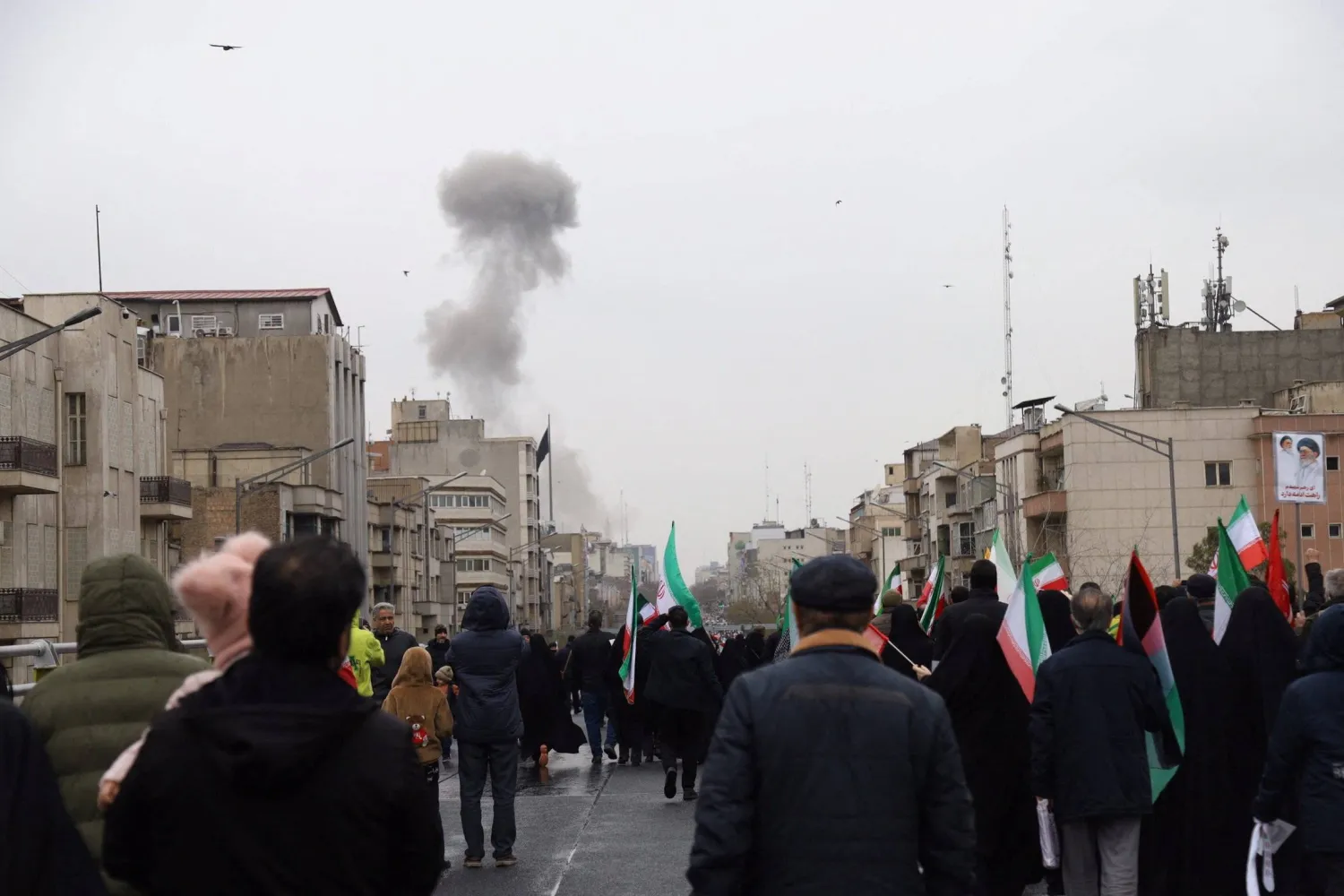
Smoke rises following an explosion during a protest marking the annual al-Quds Day (Jerusalem Day) on the last Friday of the holy month of Ramadan, amid the US-Israeli conflict with Iran, in Tehran, Iran, March 13, 2026. Elahe Asiabai/Fars News/WANA (West Asia News Agency) via REUTERS
TT

Israeli Defense Minister Says War with Iran Entering 'Decisive Phase'

Smoke rises following an explosion during a protest marking the annual al-Quds Day (Jerusalem Day) on the last Friday of the holy month of Ramadan, amid the US-Israeli conflict with Iran, in Tehran, Iran, March 13, 2026. Elahe Asiabai/Fars News/WANA (West Asia News Agency) via REUTERS

Israel said the war against Iran was entering its "decisive phase" on Saturday, as explosions rocked cities across the Middle East, with strikes on the US embassy in Baghdad and a major Emirati energy facility.

Washington's embassy in Iraq was hit by a drone, security sources told AFP, the second time it has been targeted since February 28, when the United States and Israel attacked Iran and plunged the Gulf into a conflict that has sent shockwaves through the global economy.

Millions have been displaced by waves of drone, missile and aerial bombing, while more than 1,200 people have reportedly been killed in Iran, with little sign of the conflict slowing as it entered its third week.

Oil prices have surged by 40 percent as Iran chokes off the vital Strait of Hormuz with threats to shipping and strikes on Gulf energy facilities.

Clouds of black smoke rose Saturday over Fujairah, home to a major Emirati oil storage and export terminal, shortly after Iran's military warned UAE civilians to avoid port areas.

President Donald Trump said Friday that US forces had struck Iran's Kharg Island, its biggest oil export hub, and "obliterated every MILITARY target", though sparing its energy facilities.

Iranian media confirmed the island's oil facilities were unaffected. Iran had threatened US-linked oil and energy firms would be "turned into a pile of ashes" if they were hit.

The strike could be a "turning point" with both sides escalating in a bid to force a surrender, said analyst Vali Nasr of John Hopkins University in a social media post. "The end will likely not be Iranian backing off but inflaming the Gulf."

Trump said the US Navy would start escorting tankers through the Strait of Hormuz "very soon", but governments around the world fear a prolonged blow to their economies.

Israel's Defense Minister Israel Katz said the strikes on Kharg showed the war was entering a "decisive phase", though he cautioned it would "continue as long as necessary".

Yet, despite facing superior US and Israeli firepower, Iran appears determined to fight on.

Blasts were heard by AFP journalists over Jerusalem on Saturday after the army detected missiles fired from Iran.

Iran has launched missile and drone attacks against at least 10 of its neighbors.

The Palestinian Islamist movement Hamas urged Iran to refrain from targeting Gulf neighbors.

Qatar said it intercepted two missiles over the capital's downtown area on Saturday and evacuated key areas after blasts were heard by AFP journalists in Doha.

Strikes continue in Iran, with heavy blasts shaking Tehran late Friday and local media reporting strikes in several provinces through Saturday.

Israel's army warned people in an industrial zone of Tabriz in northern Iran to evacuate, signalling an imminent attack.

Iran's health ministry says more than 1,200 people have been killed by US and Israeli attacks, numbers that could not be independently verified.

Up to 3.2 million people have been displaced inside Iran, according to the UN refugee agency.

Trump described Iran as "totally defeated" and in search of a deal he was unwilling to consider.

More than 15,000 targets in Iran have been hit by the US and Israel in two weeks, the Pentagon said.

A report this week said the first six days alone cost the US $11.3 billion and it has lost 13 military personnel.

US media raised the possibility of a ground invasion, with the New York Times and Wall Street Journal reporting the Pentagon had dispatched the Japan-based amphibious assault ship USS Tripoli to the region with some 2,500 Marines.

Iran's rulers appear intent on showing they will survive the war and maintain control, despite their supreme leader Ali Khamenei being killed on day one.

Khamenei's son Mojtaba Khamenei was named the new supreme leader, but has been absent from public view and is reportedly wounded.

Reza Pahlavi, the US-based son of Iran's last shah, said on social media Saturday that he was ready to lead a transition "as soon as the Islamic Republic falls".

But Iran's Revolutionary Guards have threatened a heavy crackdown on any anti-government protests. Thousands were killed in mass demonstrations in January, and a near-total internet blackout has been imposed since since the war began.


Netanyahu Party in Uproar as Far-Right Refuses Pleas to Unite

 Israeli National Security Minister Itamar Ben-Gvir whispers into the ear of Prime Minister Benjamin Netanyahu during the last Knesset session in Jerusalem before its dissolution, on July 16, 2026. (Reuters)
Israeli National Security Minister Itamar Ben-Gvir whispers into the ear of Prime Minister Benjamin Netanyahu during the last Knesset session in Jerusalem before its dissolution, on July 16, 2026. (Reuters)
TT

Netanyahu Party in Uproar as Far-Right Refuses Pleas to Unite

 Israeli National Security Minister Itamar Ben-Gvir whispers into the ear of Prime Minister Benjamin Netanyahu during the last Knesset session in Jerusalem before its dissolution, on July 16, 2026. (Reuters)
Israeli National Security Minister Itamar Ben-Gvir whispers into the ear of Prime Minister Benjamin Netanyahu during the last Knesset session in Jerusalem before its dissolution, on July 16, 2026. (Reuters)

Israeli Prime Minister Benjamin Netanyahu's Likud party on Friday upbraided a far-right cabinet member for refusing to run on a joint slate with another ultranationalist, warning a split vote risked tanking their coalition in upcoming elections.

National Security Minister Itamar Ben-Gvir, who recently drew international condemnation for saying Israel should kill "30 to 40" Palestinians nightly in Gaza, has rejected Netanyahu's pleas to join forces with Finance Minister Bezalel Smotrich.

"What does Ben-Gvir want? A broad national government led by Prime Minister Netanyahu... or because of personal considerations, to burn right-wing votes in order to put a left-wing government in power?" the Likud's official account wrote on X.

Netanyahu's calls for unity among his hard-right allies ahead of the October 27 vote come amid a surge in the polls for a new far-right party outside his coalition, founded by former general Ofer Winter.

Analysts say Winter's rising star could siphon votes from Smotrich's base, potentially preventing his Religious Zionism party from clearing the electoral threshold of 3.25 percent unless it joins a list with another party.

Winter, himself from the religious right, has been a vocal critic of the governing coalition, which relies on ultra-Orthodox parties, for allowing men of that community to avoid military service.

In a video posted on X on Thursday night, Netanyahu said Smotrich and Ben-Gvir "must unite. Every time we ran united, we won. When we ran separately, we lost."

"In 1992, the Right had more votes than the Left, like today, but because we were running separately, we got the disaster of Oslo, Arafat, Hamas and recurring catastrophes," he said, referring to the peace process launched with the 1993 Oslo Accords between slain center-left Israeli premier Yitzhak Rabin and late Palestinian leader Yasser Arafat.

Smotrich appeared receptive to the proposal. "It's time for unity and responsibility in the national camp," he wrote on X Thursday evening.

On Friday morning, Netanyahu invited Ben-Gvir and Smotrich to a meeting on Sunday. "We must not waste a single vote; we must unite to save the right-wing bloc!" he wrote on X.

But Ben-Gvir accused Netanyahu of seeking to weaken his right-wing populist Jewish Power party, which consistently polls at around seven to eight parliamentary seats -- comfortably above the threshold.

"According to all polls, a joint run between me and Smotrich would set Jewish Power back by three to four parliament seats," Ben-Gvir wrote on X.

Both ultranationalist parties, once shunned by mainstream politicians, have been keen to maintain independence, allowing them to be kingmakers and to promote uncompromising positions rather than follow the lead of the historically secular Likud.

Ben-Gvir suggested Netanyahu instead push for a joint slate between Winter and Smotrich.

Smotrich and Ben-Gvir have run together twice before. Their joint list won six seats in 2021, then doubled its tally to 14 in the 2022 election that produced the current parliament, before splitting into Smotrich's Religious Zionism and Ben-Gvir's Jewish Power, with seven seats each.


Senior Ukrainian Official Expects 'Technical Talks' on Russia's War Soon

Parts of a shot-down kamikaze drone at a site of a Russian strike, amid Russia’s attack on Ukraine, in the town of Vyshneve in Kyiv region, Ukraine, August 28, 2026. (Reuters)
TT

Senior Ukrainian Official Expects 'Technical Talks' on Russia's War Soon

Parts of a shot-down kamikaze drone at a site of a Russian strike, amid Russia’s attack on Ukraine, in the town of Vyshneve in Kyiv region, Ukraine, August 28, 2026. (Reuters)

Ukraine's top presidential adviser said on Friday that technical talks on Russia's war would likely take place in the near future but added that he did not expect any swift agreement.

"I think everyone will see the negotiations happening very soon. But this will mainly concern the technical side of things and preparations for something big, which I hope we will eventually get to," Kyrylo Budanov said in an interview for YouTube project "Moseichuk+".

US-backed peace talks have so far led to no tangible results to end a war now in its fifth year. The last round of trilateral negotiations took place in February.

Asked if fighting would drag on through the winter, Budanov said it was "unrealistic" to expect the war to end now.

In recent months, both sides have significantly stepped up attacks on logistics, port infrastructure and energy facilities. Russia is also expected to renew its relentless campaign against Ukraine's power grid as winter approaches.

Ukraine and Russia need to reach a point where they are ready to simultaneously take a step toward each other, said Budanov, who is his country's representative at the talks, adding that Kyiv was open to this.

"And as of now, the Russian Federation — and I'm telling you this as someone who is deeply involved in this process — is saying outright, 'we might want to but no'."

Russia's key demand is Ukraine's withdrawal from the eastern Donbas area, which Russian troops have not managed to fully occupy during their more than four-year full-scale invasion. Kyiv says it will not cede territory it still controls.


EU Pledges Two Million Euros in Nepal Flood Aid

A general view shows houses lying deluged in sludge after flash floods at Trishuli in Nepal's Nuwakot district on August 27, 2026. (AFP)
TT

EU Pledges Two Million Euros in Nepal Flood Aid

A general view shows houses lying deluged in sludge after flash floods at Trishuli in Nepal's Nuwakot district on August 27, 2026. (AFP)

The European Union on Friday promised two million euros ($2.3 mn) in aid for Nepal after devastating floods on the country's border with Tibet swept away entire villages, killing hundreds of people, AFP reported.

European Commission chief Ursula von der Leyen wrote on X that the "immediate humanitarian aid" would help "deliver life-saving assistance to families and communities hit hardest."
