


Israeli Military Claims Brother of Man Who Attacked Michigan Synagogue Was Hezbollah Commander

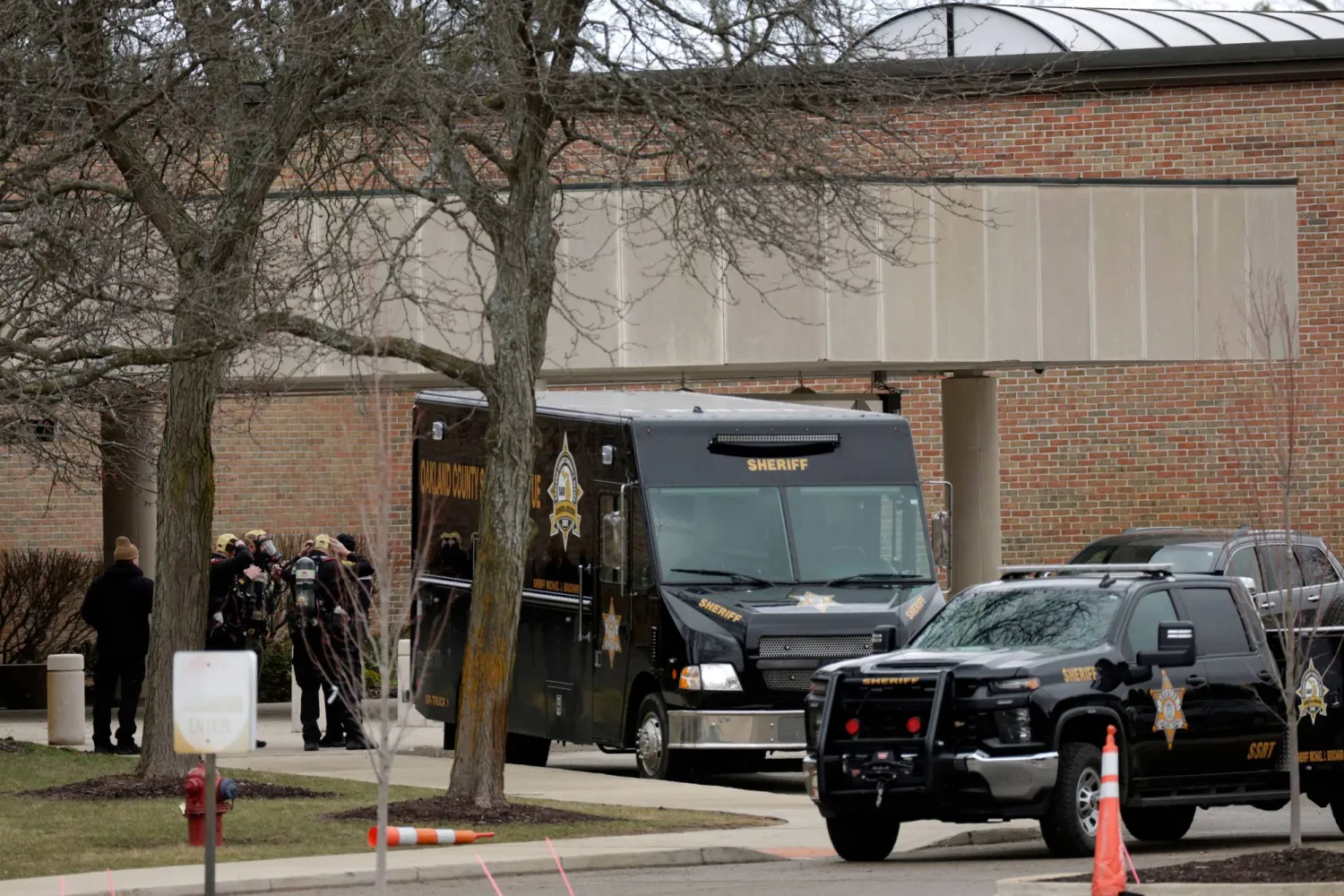
Oakland County Sheriff Deputies prepare to enter Temple Israel synagogue in West Bloomfield, Michigan, on March 13, 2026, after a person drove a vehicle into the synagogue a day earlier. (AFP)
TT

Israeli Military Claims Brother of Man Who Attacked Michigan Synagogue Was Hezbollah Commander

Oakland County Sheriff Deputies prepare to enter Temple Israel synagogue in West Bloomfield, Michigan, on March 13, 2026, after a person drove a vehicle into the synagogue a day earlier. (AFP)

The brother of a man who attacked a Michigan synagogue last week, who was killed earlier this month in an Israeli airstrike, was a Hezbollah commander, Israel’s military claimed Sunday.

Ibrahim Ghazali was killed in Lebanon along with three other of the attacker’s relatives on March 5 — a week before authorities allege Ayman Mohamad Ghazali drove his car into a major synagogue outside Detroit and killed himself after security fired at him.

The FBI's Detroit office, which is investigating the attack, declined to comment on the claims by Israel's military about Ibrahim Ghazali.

“Out of respect for the ongoing investigation, we will continue to refrain from commenting on its substance,” FBI spokesman Jordan Hall said in an email Sunday.

The AP was not immediately able to verify the claim that Ibrahim Ghazali was a militant.

The Israeli military alleges Ibrahim Ghazali was a Hezbollah commander who managed weapons for a unit that fired rockets at Israel.

A Lebanese official, who requested anonymity because he could not publicly discuss details of the airstrike, has confirmed Ibrahim Ghazali’s death, telling the AP that Ghazali’s children, Ali and Fatima, and brother, Kassim, were also killed in the strike that hit their home just after sunset.

Authorities have said that Ayman Ghazali, 41, carried out the synagogue attack after learning that four of his family members were killed in the Israeli strike.

Israel has stepped up attacks on the Iranian-backed Hezbollah party in Lebanon as the war with Iran has spread violence across the Middle East.

On Thursday, Ayman Ghazali waited in his car outside Temple Israel, near Detroit, for about two hours with a rifle, commercial grade fireworks and jugs of liquid believed to be gasoline, before crashing into the building full of dozens of children, according to authorities.

He started firing his gun through the windshield, exchanging fire with an armed security guard. Ghazali fatally shot himself after he got stuck in his vehicle and the engine caught fire, said Jennifer Runyan, the special agent in charge of the FBI’s Detroit field office. No staffers or children inside the synagogue were hurt, likely due to beefed up security in recent months.

The FBI, which is leading the investigation, described the attack on one of the nation’s largest Reform synagogues as an act of violence targeting the Jewish community, but said that they didn’t have enough evidence yet to call it an act of terror.

Ghazali came to the US in 2011 on an immediate relative visa as the spouse of a US citizen and was granted US citizenship in 2016, according to the Department of Homeland Security.

He lived in a single-story brick home in the Detroit suburb of Dearborn Heights about 38 miles (61 kilometers) south of the synagogue.

The attack on the Michigan synagogue took place on the same day as a former Army National Guard member who served years in prison for attempting to aid the ISIS opened fire on a classroom at Old Dominion University in Virginia, killing one person and wounding two others.



Trump Says the US Will Give License to Ukraine to Produce Patriot Defense Systems

US President Donald Trump meets with Ukraine's President Volodymyr Zelenskyy on the sidelines of the NATO summit in Ankara, Türkiye, Wednesday, July 8, 2026. (AP)
TT

Trump Says the US Will Give License to Ukraine to Produce Patriot Defense Systems

US President Donald Trump meets with Ukraine's President Volodymyr Zelenskyy on the sidelines of the NATO summit in Ankara, Türkiye, Wednesday, July 8, 2026. (AP)

President Donald Trump said Wednesday that the US will give a license to Ukraine to manufacture Patriot air defense systems to help counter Russian missile attacks, a huge coup for Ukraine which has badly needed the technology for the war now in its fifth year.

“We’ll give them the right to make Patriots. We’ll show them how to do it,” Trump said as he met with Ukrainian President Volodymyr Zelenskyy at a NATO summit in Türkiye. “I think they can produce them pretty quickly.”

Patriots are expensive, in high demand and take a long time to produce. Zelenskyy has for years been asking for more of them, and more recently for a license so that Ukraine can manufacture its own.

The tone of Trump's meeting with the Ukrainian leader was a break from earlier encounters which ended in acrimony, and Trump praised Zelenskyy's willingness to reach a deal on ending the fighting in Ukraine.

He said the Ukrainian president has “done an amazing job” and “been very effective” in the war.

“We’ve actually developed a good relationship. It’s hard to believe,” Trump said, adding he believed a deal on ending the war was on the horizon and that the US would “work on some kind of security package” to provide to Ukraine.

Trump takes aim at NATO partners

Trump wasn't as friendly with some of his NATO partners, saying he was unhappy with the alliance for pushing back against his efforts to take control of Greenland and for not supporting his war in Iran.

NATO's European members plus Canada have scrambled to meet the increased defense spending targets Trump has demanded, as the US draws down the number of troops it has in Europe and insists the continent take more responsibility for its own security.

But Trump reopened old wounds as he arrived at the meeting of 32 NATO leaders by insisting again that the United States should control Greenland, a semiautonomous Danish territory. He blasted some European countries for refusing to participate in the Iran campaign, singling out Spain as “a terrible partner in NATO” and renewing his threats to cut off trade.

Ahead of the summit, Trump said Greenland “is very important” for the US but not for Denmark, declaring, “We need it for protection of the world, not just the United States.”

But Denmark's Prime Minister Mette Frederiksen said her country is “ready to defend every inch of NATO including our own territory” in the event of an attack, and would rely on NATO allies to honor their commitment to defend each other.

Trump’s criticisms have in the past drawn European countries closer together as they confront wars in Ukraine and Iran, a ballooning trade deficit with China, and threats from Russia.

The president's renewed interest in Greenland could put at risk the entire future of NATO, which was founded in 1949 to counter the threat to European security posed by the Soviet Union during the Cold War.

NATO Secretary-General Mark Rutte sought to tamp down the president's ire by giving him credit for recent increases in defense spending from NATO allies.

“Grab the win. It’s there,” Rutte told Trump on Wednesday.

NATO chief backs latest US strikes on Iran

Ahead of the summit, Rutte praised Trump for the series of US strikes on Iran overnight, after Tehran struck three merchant ships in the Strait of Hormuz.

“I think what you did last night was absolutely necessary,” Rutte said to Trump. “It was a very strong response, and I’m with you on this.”

The US strikes, as well as the revoking of a license allowing Iran to sell its oil on global markets, underscored the fragility of an interim deal to end months of fighting.

Trump said of the interim agreement with Iran: “For me, I think it’s over” — but added he will allow talks to continue.

“It’s just a waste of time dealing with them,” he said.

NATO leaders sought to show Trump they were boosting defense

Rutte has dedicated a huge amount of energy to keeping Trump's support for NATO and to holding the summit together.

The NATO chief pointed to countries including Estonia, Latvia, Poland and Denmark that are investing more in defense, but noted the Trump administration expects “the Europeans and Canadians will equalize their spending with the United States.”

Last month Rutte went to Washington to hail the “Trump Trillion” — the $1.2 trillion that European allies and Canada have added to defense spending since Trump came to power in 2017.

As leaders converged on Ankara, Rutte hosted a “big reveal” event to showcase the many deals planned for the increased spending — much of it to be spent on US companies, creating thousands of jobs for Americans.

At last year's summit, the allies agreed to invest 5% of their gross domestic product on defense — 3.5% on their defense budgets and 1.5% on infrastructure so troops and equipment can move faster in times of conflict.

Yet figures released by NATO on Tuesday showed that Slovenia, Belgium, Spain and the Czech Republic have struggled to meet the alliance’s old spending target of 2% of GDP.

The Trump administration wants to see a leaner “NATO 3.0,” with Europe taking responsibility for its own security, including Ukraine, with conventional weapons while America would continue to provide its nuclear umbrella.

The Pentagon has launched a six-month review of US military presence in Europe, leaving allies to seek clarity on just how deeply Trump intends to cut US force numbers.

Zelenskyy pushes for NATO entry

Zelenskyy made a fresh appeal Tuesday for Ukraine to be allowed to join the alliance, saying Ukrainian armed forces are highly experienced and would only boost NATO’s defense capabilities.

He's highlighted Ukraine’s adaptability and its ability to strike deep inside Russia. He said Ukraine’s armed forces are “eliminating” on average 30,000 Russian troops every month.

In a declaration following Wednesday's summit, NATO leaders pledged to provide Ukraine with $80 billion to help meet its defense needs this year and next, noting “the long-term threat Russia poses to Euro-Atlantic security.”

Concern has been mounting among some countries with borders near Russia that Moscow might be preparing a hybrid attack — a combination of conventional warfare with tactics like cyberattacks — on the continent as President Vladimir Putin struggles to secure victory in Ukraine.


Trump Says He Thinks He Will Remove Syria from US Terrorism Sponsor List

US President Donald Trump receives his Syrian counterpart Ahmed Al-Sharaa at the White House (Archive - Reuters)
TT

Trump Says He Thinks He Will Remove Syria from US Terrorism Sponsor List

US President Donald Trump receives his Syrian counterpart Ahmed Al-Sharaa at the White House (Archive - Reuters)

US President Donald Trump on Wednesday said he thought he would remove Syria from the United States' list of designated state sponsors of terrorism. 

"I think I will," Trump told reporters in response to a question during a meeting with Syrian President Ahmed al-Sharaa in Türkiye. 

The US has previously said it is reviewing Syria's designation as ‌a state ‌sponsor of terrorism, which carries restrictions on ‌US ⁠foreign assistance, defense ⁠exports and certain financial transactions. 

Last month Trump signed an executive order terminating a US sanctions program on Syria, allowing an end to the country's isolation from the international financial system and building on Washington's pledge to help it rebuild after a devastating ⁠civil war. 

Several Saudi firms are planning ‌billion-dollar investments as part of ‌Riyadh's efforts to support its recovery, while other Gulf states ‌have also pledged financial assistance. 

The United States ‌has dismantled most of its Syria sanctions regime and repealed the Caesar Act, which imposed sweeping measures on individuals, companies and institutions linked to former President Bashar al-Assad. 

But ‌Washington says sanctions will continue to target Assad and his associates, as well as ⁠alleged ⁠human rights abusers and other actors it says are destabilizing the region. 

Trump complimented Sharaa. "He's respected by everybody, including me," Trump said, who has encouraged Sharaa's actions against the ISIS militant group in the region.  


EU Aviation Agency Tells Operators to Avoid Iran, Iraq and Lebanon Airspaces Until August 31

Motorbikes and cars pass through an intersection in downtown Tehran, Iran, May 17, 2026. (AP)
TT

EU Aviation Agency Tells Operators to Avoid Iran, Iraq and Lebanon Airspaces Until August 31

Motorbikes and cars pass through an intersection in downtown Tehran, Iran, May 17, 2026. (AP)

The European Union Aviation Safety Agency said on Wednesday that airlines should not operate within the airspace of Iran, Iraq, and Lebanon, amid ongoing tensions and the potential for further military action, as the US and Iran exchanged fresh attacks.

The EASA said its bulletin for the airspaces of ‌Iran, Iraq ‌and Lebanon was valid until ‌August ⁠31.

The ‌agency's latest advisory comes after Iran's Revolutionary Guards ‌said they targeted US military sites ‌in Bahrain and Kuwait on Wednesday.

Those attacks followed a wave of US military strikes on Iran after tankers were hit in the Strait ‌of Hormuz.

President Donald Trump had said on Monday that the US ⁠would either ⁠reach a deal with Iran or "finish the job," renewing his threat of military action.

EASA said the implementation of the US-Iran ceasefire remained fragile, and its advisory decision was based on "ongoing high level of tensions and the potential for further military action."

The European agency also added that should the existing truce break down, Iranian airspace was likely to be exposed to "imminent threats".