


Israel Launches New Strikes on Tehran and Lebanon as Iran Hits Back and Fires on Gulf Neighbors

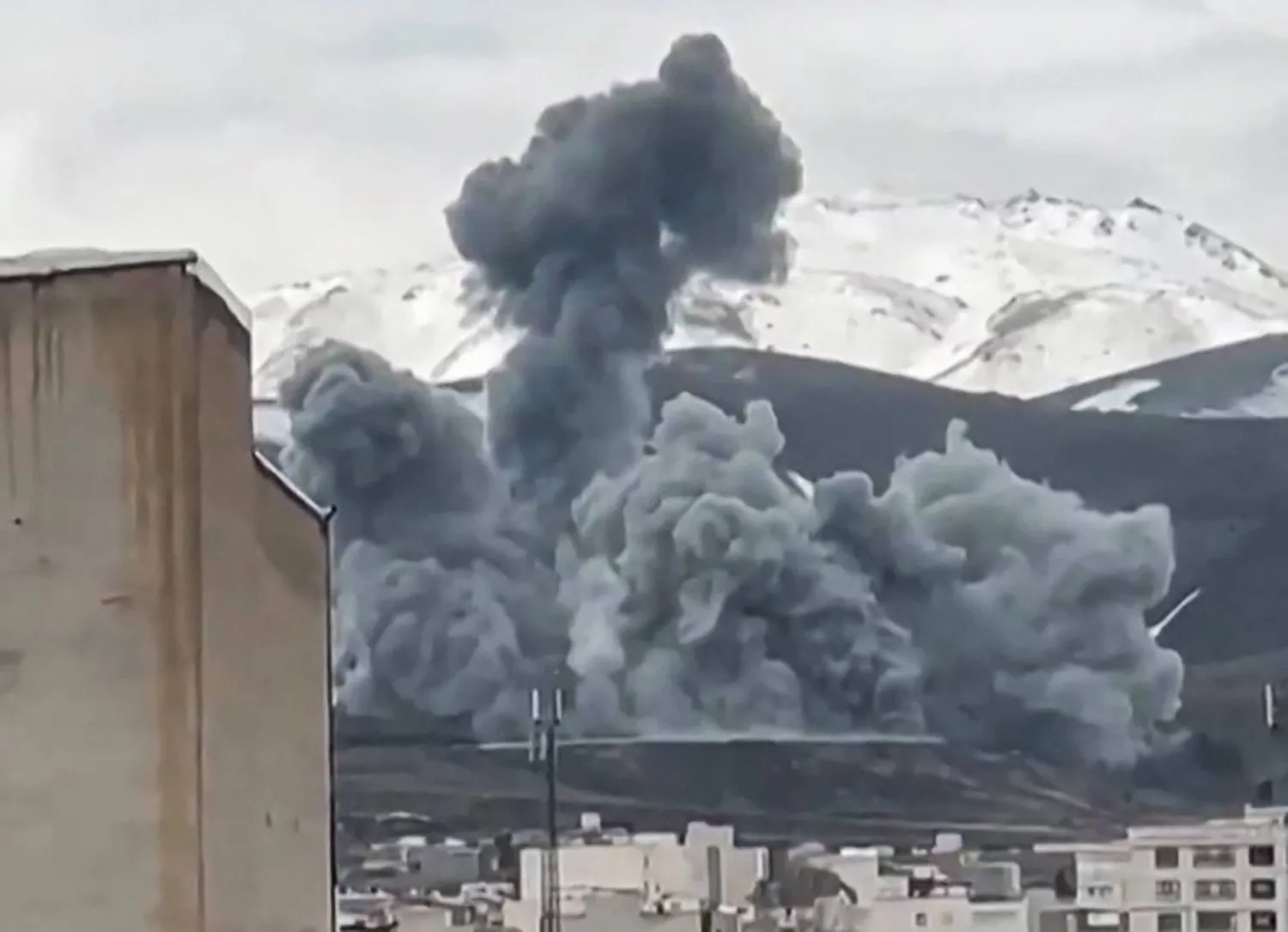
This video grab taken from UGC images posted on social media and verified by AFPTV staff on March 16, 2026, show smoke rising from the side of a mountain in Hamedan, in Hamedan Province, western Iran. (Photo by UGC / AFP)
TT

Israel Launches New Strikes on Tehran and Lebanon as Iran Hits Back and Fires on Gulf Neighbors

This video grab taken from UGC images posted on social media and verified by AFPTV staff on March 16, 2026, show smoke rising from the side of a mountain in Hamedan, in Hamedan Province, western Iran. (Photo by UGC / AFP)

Residents of Dubai and Doha, Qatar, awoke to the sound of explosions Tuesday as air defenses worked to intercept new waves of incoming Iranian fire, and Israel launched new strikes on Iran and Lebanon, as the war in the Middle East showed no signs of abating.

Dubai, a major transit hub for international travel, briefly shut its airspace as the military said it was “responding to incoming missile and drone threats” around the city, The Associated Press said.

The Israeli military said early Tuesday it had begun a “wide-scale wave of strikes” across Iran’s capital and was also stepping up strikes on Iran-backed Hezbollah militants in Lebanon. Israel also reported two incoming salvos before dawn from Iran at Tel Aviv and elsewhere, and said Hezbollah targeted Israel's north.

Iranian strikes pressure neighbors and oil markets

Iran kept up the pressure on the energy infrastructure of its Gulf Arab neighbors, hitting an oil facility in Fujairah, a UAE emirate on the country’s east coast with the Gulf of Oman that has been repeatedly targeted. State-run WAM news reported that no one had been injured in the blast from the drone strike.

Iran's attacks on Gulf nations and its stranglehold on the Strait of Hormuz, through which a fifth of the world's oil is transported, has given rise to increasing concerns of a global energy crisis. Early Tuesday it hit a tanker anchored off the coast of Fujairah, one of about 20 vessels hit since Israel and the United States started the war with an attack on Iran on Feb. 28.

With Washington under increasing pressure over rising oil prices, Brent crude, the international standard, remained over $100 a barrel, up more than 40% since the war started.

US President Donald Trump said he had demanded that roughly a half-dozen countries send warships to keep the Strait of Hormuz open. But his appeals brought no immediate commitments, with many saying they are hesitant to get involved in a war with no defined exit plan and skeptical that they could do more than the US Navy.

UAE briefly closes airspace as Iran launches new attacks on Gulf neighbors

The UAE shut down its airspace early Tuesday as its military reported it was “responding to missile and drone threats from Iran." The closure was soon lifted, and not long after the sounds of explosions could be heard as the military worked to intercept incoming fire.

The snap announcement on its airspace showed the balancing act Emirati authorities face in trying to keep their long-haul carriers, Emirates and Etihad, flying as Iranian attacks continue to target the country.

Saudi Arabia’s Defense Ministry reported intercepting a dozen drones Tuesday morning over the country’s vast Eastern Province, home to oil infrastructure.

In Qatar, the sounds of explosions boomed over the capital early in the day as defenses worked to intercept incoming fire. Qatar's Defense Ministry said later that it had successfully thwarted a missile attack on the city, though a fire broke out in an industrial area from a downed projectile.

Attacks from Iran-linked proxy forces continued in Iraq, as the US Embassy in Baghdad was hit with shrapnel from drones that had been intercepted.

The embassy's air defenses were able to shoot down all four drones targeting the facility, according to two Iraqi security officials, speaking on condition of anonymity to discuss intelligence matters.

A separate strike targeted a house in the heavily fortified Presidential Compound in Baghdad’s al-Jadriya area, the officials said. It wasn’t clear who carried out either attack but Iran-allied militias have regularly been attacking American targets inside Iraq since the conflict began.

Israel launches new attacks on Tehran and steps up strikes on Beirut

The Israeli military early Tuesday said it had launched new attacks across Tehran in addition to the Lebanese capital targeting Hezbollah militants.

More than 1,300 people have been killed in Iran since the start of the conflict, according to the Iranian Red Crescent.

Israel’s strikes have also displaced more than 1 million Lebanese — or roughly 20% of the population — according to the Lebanese government, which says some 850 people have been killed.

Some Israeli troops have pushed into southern Lebanon, and there are fears Israel is preparing a large-scale invasion.

The military's chief of staff, Lt. Gen. Eyal Zamir, said Monday on a visit to the northern border that Israel's army is “determined to deepen the operation until all of our objectives are achieved” and that the military's Northern Command is being reinforced with additional soldiers.

Israel reported two Iranian salvos early Tuesday fired toward Tel Aviv and an area south of the Sea of Galilee. More launches from Lebanon were also reported.

In Israel, 12 people have been killed by Iranian missile fire. At least 13 US military members have been killed.

Trump seeks allies' help to police the Strait of Hormuz

The virtual shutdown of the Strait of Hormuz is unnerving the world economy, driving up energy prices, threatening food shortages in poor countries, destabilizing fragile states and complicating efforts by central banks to drive down prices for consumers.

There have been a handful of ships getting through, primarily Iranian but also from other countries including India and Türkiye, and Iranian Foreign Minister Abbas Araghchi said: “from our perspective it is open” — just not for the United States, Israel and its allies.

Underscoring the danger of even getting close to the strait, a tanker anchored off the eastern coast of the United Arab Emirates was hit by a projectile early Tuesday morning.

The United Kingdom Maritime Trade Operations center, run by the British military, reported the attack, saying the vessel was in the Gulf of Oman off Fujairah. It said the tanker sustained “minor structural damage” and no one was hurt.

On Monday, Trump said “numerous countries” have told him “they’re on the way” to help police the Strait of Hormuz but there was no sign of that actually happening.

Europeans have been critical of the US and Israel for failing to provide clarity on their objectives in the war and have suggested that they are more interested in a diplomatic solution than getting dragged into the conflict.

Japan and Australia said Monday they had not been asked to help protect the strait and had no current plans to do so, and Italy's Foreign Minister Antonio Tajani said his country favors strengthening anti-piracy and defensive missions in the Red Sea, but not expanding their role in the Strait of Hormuz.

British Prime Minister Keir Starmer said his country might deploy mine-hunting drones already in the region, but “will not be drawn into the wider war.”



Poland Will Not Send Its Troops to Iran, PM Tusk Says

Polish Prime Minister Donald Tusk attends the government meeting at the Chancellery of the Prime Minister in Warsaw, Poland, 13 March 2026. (EPA)
TT

Poland Will Not Send Its Troops to Iran, PM Tusk Says

Polish Prime Minister Donald Tusk attends the government meeting at the Chancellery of the Prime Minister in Warsaw, Poland, 13 March 2026. (EPA)

Poland ‌will not send troops to Iran as the conflict does not directly affect its security, Prime Minister Donald Tusk said on Tuesday, adding that the United States and other powers understood Warsaw's decision.

US President Donald Trump called on allies over the weekend ‌to help ‌secure the Strait of ‌Hormuz ⁠as Iranian forces continue ⁠attacks on the vital waterway amid the US-Israeli war on Iran, now in its third week.

Poland's government "does not plan any expedition to Iran, and this ⁠does not raise any ‌doubts on ‌the part of our allies," Tusk said ‌before a government meeting.

He said ‌this covered Poland's land, air and naval forces, which are still being built up in the face ‌of the conflict over the border in Ukraine.

Tusk said securing ⁠the ⁠Baltic Sea remained a central element of Poland's strategy.

A number of other US allies, including Germany, Spain and Italy, have said they have no immediate plans to send ships to help reopen the Strait of Hormuz, which Iran has effectively shut with attacks and threats of attacks.


Oil Tankers ‘Starting to Dribble Through’ Strait of Hormuz, Says White House

Luojiashan tanker sits anchored in Muscat, as Iran vows to close the Strait of Hormuz, amid the US-Israeli conflict with Iran, in Muscat, Oman, March 7, 2026. (Reuters)
TT

Oil Tankers ‘Starting to Dribble Through’ Strait of Hormuz, Says White House

Luojiashan tanker sits anchored in Muscat, as Iran vows to close the Strait of Hormuz, amid the US-Israeli conflict with Iran, in Muscat, Oman, March 7, 2026. (Reuters)

Oil tankers are crossing the Strait of Hormuz and Iran's actions to choke traffic through the shipping route have not hurt the US economy, White House economic adviser Kevin Hassett told CNBC on Tuesday, reiterating the Trump administration's position that the war should be over in weeks, not months.

"Already you're seeing tankers are starting to dribble through the straits, and I think ‌it's a ‌sign of how little Iran has ‌left," ⁠he said.

"We're very ⁠optimistic that this is going to be over in the short run, and then there will be price repercussions when it is over for a few weeks, as the ships make it to the refineries."

Hassett said there ⁠is concern that Asia may not ‌be exporting as much ‌refined oil to the US to handle a decrease in ‌supply from the Middle East.

"We're seeing ‌some signs that they might be pulling that back to make sure that they have enough energy for themselves. And we've got a plan for that," ‌he said.

Trump on Monday postponed his meeting with Chinese President Xi Jinping ⁠to focus ⁠on the war in Iran.

Hassett said the US action in Iran is in China's interest.

"This is one case where the objectives of both countries are aligned, that we want, you know, a stable world oil market," he said. "When this war is over, which will be sometime soon, I'm sure they'll get together and have a lot to talk about, and hopefully when the Chinese will express some gratitude."


Albania Designates Iran’s Revolutionary Guard as ‘Terrorist’

Iranians attend the funeral of Iran's Revolutionary Guards Corps (IRGC) commanders, army commanders and others killed in the early days of the United States and Israeli strikes on Iran, at Enghelab Square in Tehran on March 11, 2026. (AFP)
TT

Albania Designates Iran’s Revolutionary Guard as ‘Terrorist’

Iranians attend the funeral of Iran's Revolutionary Guards Corps (IRGC) commanders, army commanders and others killed in the early days of the United States and Israeli strikes on Iran, at Enghelab Square in Tehran on March 11, 2026. (AFP)

Albania on Tuesday designated Iran's Revolutionary Guards a "terrorist organization" and Iran as a state "supporting terrorism" as the Middle East war raged on.

The Balkan nation's ruling Socialist party used its parliamentary majority to adopt a resolution to designate the ideological arm of the Iranian military despite an opposition boycott.

"The Albanian parliament declares the Islamic Republic of Iran a state that supports terrorism and a state that uses terrorist means in the pursuit of its foreign policy objectives," the resolution said.

The document also condemned cyberattacks believed to be carried out by Iran-linked hackers against its institutions, including an incident earlier this month targeting its parliamentary IT system.

A cyberattack in 2022 triggered Tirana to sever diplomatic ties with Iran.

Albania has for years hosted several thousand members of the People's Mujahedin of Iran (MEK), an exiled Iranian opposition group considered as "terrorist" by Tehran.

The United States has already designated the Guards as a "terrorist organization".

The European Union followed in January after the deadly crackdown carried out by the authorities against Iranian protesters.