
At Least 66 Killed in Military Plane Crash in Colombia

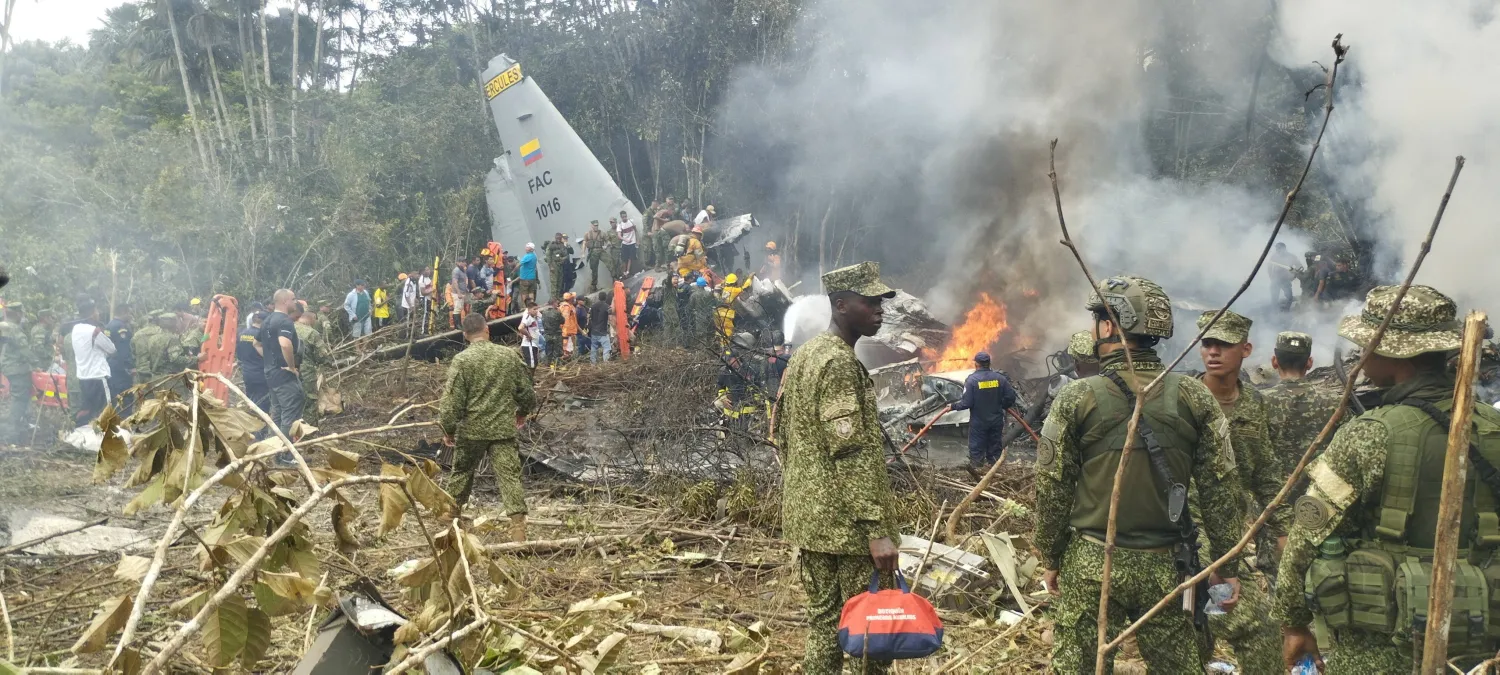
Members of the military gather at the site of a Colombian military plane crash in Puerto Leguizamo, Putumayo, Colombia March 23, 2026. La Voz de Amazonia/Mare Rafue/Handout via REUTERS
TT

At Least 66 Killed in Military Plane Crash in Colombia

Members of the military gather at the site of a Colombian military plane crash in Puerto Leguizamo, Putumayo, Colombia March 23, 2026. La Voz de Amazonia/Mare Rafue/Handout via REUTERS

A military transport plane with 128 people on board, mostly soldiers, crashed shortly after taking off Monday in Puerto Leguizamo, Colombia, killing at least 66 people and leaving dozens injured, the head of Colombia’s armed forces said.

General Hugo Alejandro López Barreto said that four military personnel were still missing.

“Sadly, as a consequence of this tragic accident, 66 of our military elements died,” The Associated Press quoted him as saying.

“At the moment, we have no information, or indications, that it was an attack by an illegal armed group,” Barreto added.

In a video posted on social media, Deputy Mayor Carlos Claros said that the bodies of the victims were taken to the small town's morgue, and that the only two clinics in town treated the injured before they were flown to larger cities. Puerto Leguizamo is located in Putumayo, an Amazonian province that borders Ecuador and Peru.

“I want to thank the people of Puerto Leguizamo who came out to help the victims of this accident,” Claros told Colombian television station RCN.

Defense Minister Pedro Sánchez said on X that the plane that crashed Monday was transporting troops to another city in Putumayo.

Images shared online by Colombian media outlets showed a black cloud of smoke rising from a field where the plane crashed and a truck with soldiers rushing to the site.

The airplane had 128 people on board, including 115 were from the Army, 11 crew members and 2 from the National Police. Baretto said 57 people were evacuated.

Media outlets shared videos of soldiers being rushed from the site on motorcycles driven by local residents, while another group of residents tried to put out the fire that the plane crash had created in a field surrounded by dense foliage.

Carlos Fernando Silva, the commander of Colombia’s air force, said details of the crash were not yet known, "except that the plane had a problem and went down about two kilometers from the airport.”

The air force commander added that two planes, with 74 beds, were sent to the area to fly the injured back to hospitals in the capital, Bogota, and elsewhere.

Petro seized on the accident to promote what he called his longtime campaign to modernize planes and other equipment used by his country’s military, saying those efforts have been blocked by “bureaucratic difficulties” and suggesting that some officials should be held accountable.

“If civilian or military administrative officials are not up to the challenge, they must be removed,” Petro said.

Critics of the president pointed out that military aircraft have been given less flight hours under the Petro administration due to budget cuts, which leads to less experienced crews.

Erich Saumeth, a Colombian aviation expert and military analyst, said that the Hercules C-130 that crashed Monday had been donated by the United States to Colombia in 2020. Three years later, it went through a detailed revision known as an overhaul, in which its engines were inspected and key components were replaced.

“I don't think this plane crashed because of a lack of good parts,” Saumeth said. He said that investigations will have to determine why the engines of the Hercules, which has four propellers, failed so quickly after takeoff.

In a message on X Monday, Defense Minister Sánchez said that so far there were no signs indicating that the plane was attacked by rebel groups that operate near Puerto Leguizamo.

Sánchez wrote that the accident was “profoundly painful for the country,” adding that: “We hope that our prayers can help to relieve some of the pain.”

Before Iran Attacks, Netanyahu Persuaded Trump for Joint Killing


US Carries Out 'Self-defense' Strikes in Iran, Rubio Says Deal Still Possible Within Days

A woman walks next to a huge billboard in a street in Tehran, Iran, 25 May 2026. EPA/ABEDIN TAHERKENAREH
TT

US Carries Out 'Self-defense' Strikes in Iran, Rubio Says Deal Still Possible Within Days

A woman walks next to a huge billboard in a street in Tehran, Iran, 25 May 2026. EPA/ABEDIN TAHERKENAREH

The US military has said that it carried out “self-defense” strikes in southern Iran, including on missile launch sites and boats placing mines, even as President Donald Trump said on social media that negotiations with Tehran were “proceeding nicely.”

The strikes were done “to protect our troops from threats posed by Iranian forces,” but the military was “using restraint during the ongoing ceasefire,” Capt. Tim Hawkins, the spokesman for the US military's Central Command, said in a statement on Monday.

Further details were not immediately available, including more specifics on the threats from Iran and what this means for negotiations. There was no official response from Iran, which had sent its parliament speaker Mohammad Bagher Qalibaf to Qatar for negotiations over the possible deal with the US.

In Iran, the news website Tabnak, believed to be close to former Revolutionary Guard chief Mohsen Rezaei, identified four dead Guard troops it said had been killed in American strikes on boats.

Iranian state television separately reported blasts around Bandar Abbas, a city on the Strait of Hormuz home to a military port and a dual-use airport.

The strikes were the latest attacks to shake the weekslong ceasefire in the war. The Strait of Hormuz, through which a fifth of all crude oil and natural gas traded once passed, remains effectively in Iran's chokehold, disrupting global energy markets.

US Secretary of State Marco Rubio said on Tuesday that a deal with Iran was still possible despite the new American strikes.

"There were some talks going on in Qatar today, so we'll see if we can make progress. I think it's a lot of talking back and forth going on about specific language in the initial document, so it'll take a few days," Rubio told reporters in Jaipur during a visit to India.

"The president's expressed his desire to make it. He's either going to make a good deal or no deal," he said.

Rubio told reporters that "the straits have to be open.”

"They're going to be open one way or the other, so they need to be open. What's happening there is unlawful, it's illegal, it's unsustainable for the world, it's unacceptable."


WHO Urges DR Congo's Neighbors to Act Immediately on Ebola Risk

Response team members are helped to wear protective suits before burying a person suspected of having died from Ebola in Bunia, in the eastern Democratic Republic of the Congo, on May 25, 2026. (AFP)
TT

WHO Urges DR Congo's Neighbors to Act Immediately on Ebola Risk

Response team members are helped to wear protective suits before burying a person suspected of having died from Ebola in Bunia, in the eastern Democratic Republic of the Congo, on May 25, 2026. (AFP)

States neighboring the Democratic Republic of Congo are at great danger from Ebola and should act immediately to counter the deadly virus, the head of the World Health Organization said on Monday.

"Countries bordering DRC are at especially high risk and should take immediate action," said WHO director-general Tedros Adhanom Ghebreyesus, adding that he would travel on Tuesday to the DRC, the vast, central African country at the epicenter of the current outbreak.

"The outbreak is spreading rapidly," Tedros told a virtual ministerial meeting on the viral hemorrhagic fever, which spreads through direct contact with bodily fluids. It can cause severe bleeding and organ failure.

He said the current outbreak was "especially challenging".

"First, the delay in detecting the outbreak means that we are now playing catch-up with a very fast-moving epidemic. We are urgently scaling up operations but at the moment, the epidemic is outpacing us," he said by video link from Geneva.

Secondly, the eastern provinces of the DRC, where the outbreak was first detected in mid-May, "are highly insecure, with intensified fighting in recent months (and) there is also significant distrust of outside authorities among the local population".

Thirdly, he pointed out, there were "no approved vaccines or therapeutics" for the Bundibugyo strain of Ebola behind the current outbreak.

The WHO has recorded 10 confirmed Ebola deaths and 220 suspected deaths in the DRC since mid-May, while also recording a further 900 suspected cases since Kinshasa declared the outbreak on May 15.

The United Nations agency said the true spread of the virus -- which experts suspect was circulating under the radar for some time -- was probably much wider.

One person is confirmed dead in neighboring Uganda with a further six confirmed infected after Monday saw the health ministry confirm two new cases.

Ten other African countries are "at risk" of infection, the African Union's health agency, Africa CDC, warned on Saturday.

These are Angola, Burundi, the Central African Republic, the Republic of Congo, Ethiopia, Kenya, Rwanda, South Sudan, Tanzania and Zambia.

- Building trust -

Africa CDC head Jean Kaseya said "high mobility and insecurity" contributed to the regional spread of the outbreak, which the WHO has declared an international emergency.

Insecurity is a huge obstacle in the eastern DRC, which has been plagued for three decades by conflict involving a litany of armed groups.

State services in rural areas of Ituri province have been largely absent for decades.

South Kivu province is controlled by the M23 armed group, which has never managed an epidemic like Ebola.

Tedros said it was vital to address the trust deficit in Ebola-affected communities.

Two hospitals in Ituri have been attacked by suspicious locals in the past five days -- one in Mongbwala, where the outbreak was initially detected, and the other in Rwampara, where tents used to isolate Ebola patients were torched.

The violence in Rwampara erupted after a deceased man's family was prevented from taking his body away for burial because of contamination risks.

"Loved ones are throwing themselves at the bodies, touching the corpses... while organizing mourning rituals bringing together loads of people," Jean Marie Ezadri, a civil society leader in Ituri, told AFP last week.

Tedros said the WHO was pouring money, medical supplies and staff into the DRC to support the authorities and speeding up clinical trials on potential treatments.

"It will get worse before it gets better," he said. "But we know this virus and we know how to stop it."


Iran’s Top Envoys Discussing Potential Peace Deal in Qatar

 A drone view shows vessels sailing through the Strait of Hormuz, as seen from Musandam, Oman, May 25, 2026. (Reuters)
A drone view shows vessels sailing through the Strait of Hormuz, as seen from Musandam, Oman, May 25, 2026. (Reuters)
TT

Iran’s Top Envoys Discussing Potential Peace Deal in Qatar

 A drone view shows vessels sailing through the Strait of Hormuz, as seen from Musandam, Oman, May 25, 2026. (Reuters)
A drone view shows vessels sailing through the Strait of Hormuz, as seen from Musandam, Oman, May 25, 2026. (Reuters)

Iran's top negotiator and its foreign minister were in Doha for talks with Qatar's prime minister on a potential deal with the US to end the three-month-old war, an official briefed on the visit said on Monday, after Washington and Tehran played down hopes for an imminent breakthrough.

US Secretary of State Marco Rubio told reporters in New Delhi earlier that the US would give diplomacy every chance to succeed before considering whether to deal with Iran in "another way".

There was a "pretty solid thing on the table in terms of their ability to open up the strait (of Hormuz), get the strait open, enter into a very real, significant, time-limited negotiation on the nuclear matter, and hopefully we can pull it off," Rubio said.

In a lengthy post on Truth Social on Monday, US President Donald Trump said talks with Iran were going "nicely", but warned of fresh attacks if they failed. It "will only be a Great Deal for all, or no Deal at all," he wrote.

Iran's foreign ministry spokesperson Esmaeil Baghaei said ‌in a briefing that conclusions ‌had been reached on many topics but that did not mean the sides were close to agreement.

The ‌official briefed ⁠on the Iranians' ⁠Doha visit told Reuters the discussions focused primarily on the Strait of Hormuz and Iran's stockpile of highly enriched uranium while Iran's central bank governor attended to discuss the potential release of frozen Iranian funds as part of a final deal.

Baghaei said earlier that nuclear issues would only be negotiated on if the framework accord is agreed first.

Trump has said his key aim in the war is to prevent Iran from developing a nuclear weapon with its highly enriched uranium. Tehran has consistently denied it has plans to do that.

The two sides remain at odds on several other issues, such as Israel's war in Lebanon with the Iranian-backed Hezbollah and Tehran's demands for the lifting of sanctions and the release of tens of billions of dollars of Iranian oil revenues frozen in foreign banks.

As efforts to reach a deal ⁠continued, Iran said it had downed a "hostile" stealth drone using a new air defense system, Iranian news agencies reported, ‌without saying where it had come from.

"This is a sign from us that no more stealth ‌drones can penetrate the skies of the Gulf," Fars quoted unnamed officials as saying.

IRAN DEAL STICKING POINTS

Baghaei said the potential Iran deal contained no specific details on management of the Strait of Hormuz, through which about a fifth of the world's oil and liquefied gas usually flows.

Iran will not charge tolls for ships to pass through but there will be a cost for services offered such as navigation and steps to protect the environment, he said, under a protocol to be agreed with Oman, which lies on the opposite shore of the waterway.

Since the US and Israel first launched strikes on Iran on February 28, only a handful of vessels have been passing through the Strait of Hormuz compared with 125 to 140 daily previously.

Iran's state TV said on Monday that 32 vessels and five oil tankers passed through the strait in the past 24 hours with the authorization of Iran's Revolutionary Guards naval forces.

The standoff has caused a spike in oil prices and driven up the costs of fuel, fertilizer and food. On Monday, oil prices fell more than 4% to two-week lows amid optimism that a deal might come soon.

Trump, whose approval ratings have been hit by the impact on US energy prices, and who has faced congressional efforts to curb his war powers, has repeatedly played up the prospect of a deal to end the war.

Separately, two sources said Israeli Prime Minister Benjamin Netanyahu has told his confidants that Israel now has little ability to influence Trump's decision-making over the conflict.