

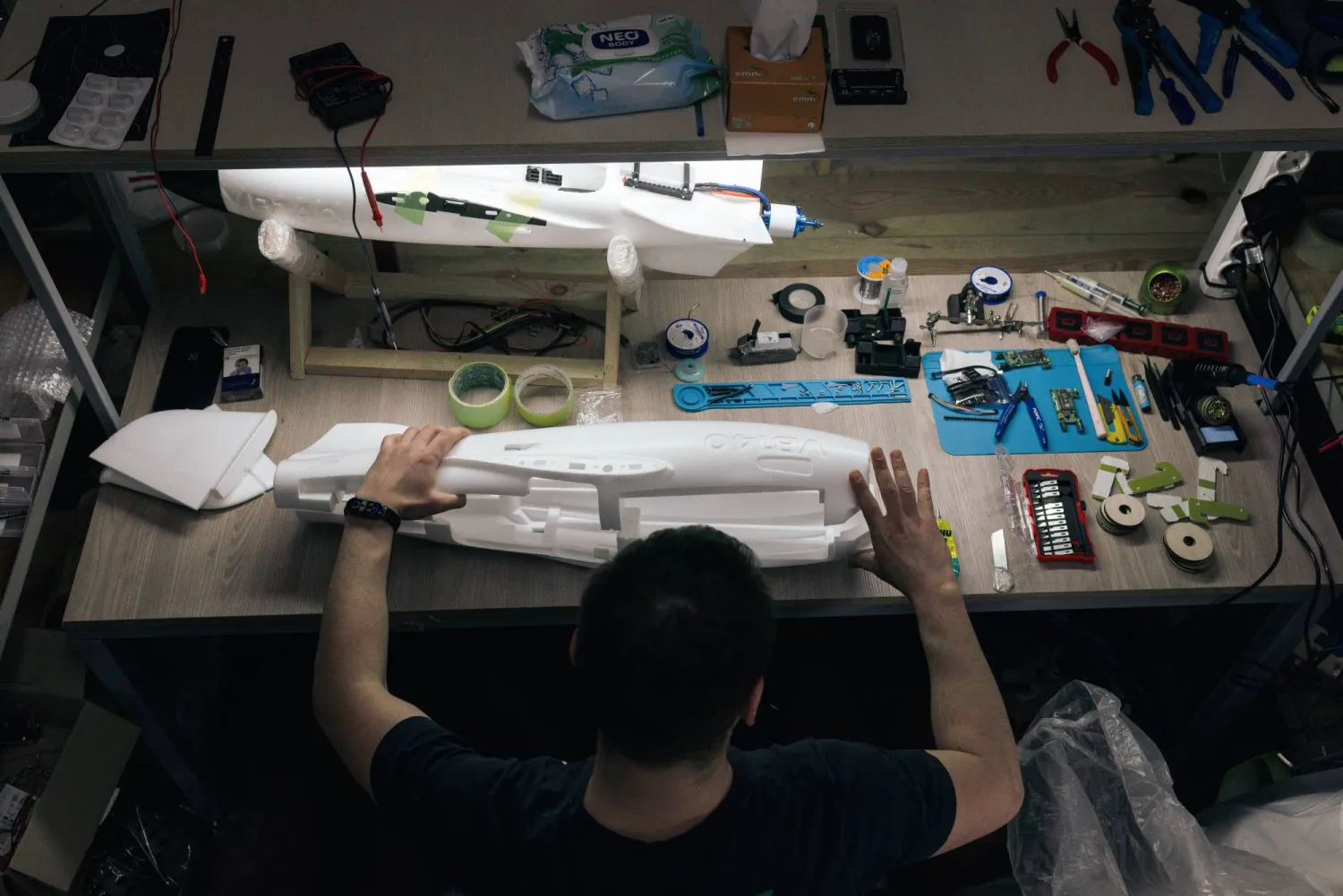

Ukraine's Front Line… A Laboratory for Drone Innovation

A soldier of the 127th Separate Territorial Brigade mounts a drone at a workshop on the front line in the Kharkiv region Friday, March 13, 2026. (AP Photo/Nikoletta Stoyanova)
TT

Ukraine's Front Line… A Laboratory for Drone Innovation

A soldier of the 127th Separate Territorial Brigade mounts a drone at a workshop on the front line in the Kharkiv region Friday, March 13, 2026. (AP Photo/Nikoletta Stoyanova)

The night air in eastern Ukraine is crisp, and a myriad of stars scatter above a small crew of soldiers watching for Iranian-designed Shahed drones that Russia launches in waves.

Such teams are deployed across the country as part of a constantly evolving effort to counter the low-cost loitering munitions that have become a deadly weapon of modern warfare, from Ukraine to the Middle East.

While waiting, the crew from the 127th Brigade tests and fine-tunes their self-made interceptor drones, searching for flaws that could undermine performance once the buzzing threat appears, according to a report published by The Associated Press.

When Shahed drones first appeared in autumn 2022, Ukraine had few ways to stop them. Today, drone crews intercept them in flight with continually adapting technology.

In recent years, Ukraine's domestic drone interceptor market has burgeoned, producing some key players who tout their products at international arms shows.

But it's on the front line where small teams have become laboratories of rapid military innovation — grassroots technology born of battlefield necessity that now draw international interest.

“It’s not like we sat down one day and decided to fight with drones,” said a pilot with Ukraine’s 127th Brigade, sitting at his monitor after completing a preflight check. “We did it because we had nothing else.”

Moments earlier, the pilot carefully landed his interceptor drone to avoid damaging it. He spoke on condition of anonymity because military rules did not allow him to be quoted by name.

Though designed to be disposable, limited resources mean Ukrainian crews try to preserve every tool they have, often reusing even single-use drones to study their weaknesses and improve them.

“Just imagine — a Patriot missile costs about $2 million, and here you have a small aircraft worth about $2,200,” the pilot said. “And if it doesn’t hit the target, I can land it, fix it a bit and send it back into the air. The difference is huge. And the effect? Not any worse.”

How the Drone War Began

Ukraine’s 127th Brigade is building an air defense unit centered on interceptor drone crews — a model increasingly adopted across the military.

Leading the brigade's effort is a 27-year-old captain, who previously served in another formation where he had already helped organize a similar system. He also spoke on condition of anonymity because military rules did not allow him to be quoted by name.

He clearly remembers the moment about two years ago when everything changed. He said he was assigned to lead a group of soldiers ordered to intercept Russian reconnaissance drones using shoulder-fired air-defense missiles.

The approach quickly proved ineffective. Agile drones equipped with cameras could easily maneuver away from the slower, less-flexible weapons, he said.

Determined to find a better solution, the young officer began searching for alternatives, asking fellow soldiers and volunteers supporting the front.

The answer turned out to be simple: another drone.

The captain still remembers the day a Russian Orlan reconnaissance drone hung above a Ukrainian position, transmitting coordinates to guide Russian artillery. A pilot from his unit downed it by using another drone, he added.

“That’s when I realized — this is a drone war. It had begun,” he said. “We had been moving toward it for some time, but that was the moment I saw it with my own eyes.”

They never found the wreckage of the Orlan, which burned as it fell to the ground.

Downing Shaheds

Another challenge soon emerged: how to intercept the hundreds of fast, durable Shahed drones flying far beyond the front line.

The young captain's search for a solution led him to the 127th Brigade in Kharkiv and to cooperation with a local defense company. Their joint efforts resulted in aircraft-style interceptor drones capable of matching the speed of the Shaheds.

Kharkiv is not only where they work — it's where their families live, a city that regularly comes under Shahed attacks.

Working with the company allows soldiers to test interceptor drones in real conditions and quickly refine the technology through direct feedback.

The company's Skystriker drone differs from more widely known interceptor systems such as Sting or P1-Sun, which are based on modified first-person view, or FPV, drones. Instead, it resembles a small aircraft with wings, allowing it to stay aloft longer.

“Yes, this is a joint effort,” said the director of the company, who spoke on condition he not disclose the name of the firm or his own identity for security reasons.

“It’s not enough just to build it. It has to work — and work properly — and perform real combat tasks,” he said. “That’s why communication with the military is so important. They give us feedback and help us improve it every time.”

In Ukraine, cooperation often goes beyond the military and manufacturers. Volunteers frequently act as intermediaries between the two, sometimes even helping them find one another.

The Come Back Alive Foundation, a nonprofit think tank and charity that raises money to equip Ukraine’s forces, launched a project called “Dronopad,” loosely translated as “Dronefall,” in summer 2024.

The idea grew from battlefield reports that FPV drone pilots were occasionally able to track and intercept aerial targets — early cases that helped shape efforts to counter the Shaheds.

“At that moment it wasn’t clear whether this was even a scalable solution or just isolated incidents,” said Taras Tymochko, who leads the project. “Our goal was to turn it into a system — to help units that already had their first successful cases build the capability and scale what they had achieved.”



German President Calls Iran War a Disastrous Mistake, in Rare Rebuke of Trump

FILE PHOTO: German President Frank-Walter Steinmeier delivers a speech at his Bellevue Palace residency in Berlin, Germany, November 9, 2025. Maryam Majd/Pool via REUTERS/File Photo
TT

German President Calls Iran War a Disastrous Mistake, in Rare Rebuke of Trump

FILE PHOTO: German President Frank-Walter Steinmeier delivers a speech at his Bellevue Palace residency in Berlin, Germany, November 9, 2025. Maryam Majd/Pool via REUTERS/File Photo

The Iran war is a "disastrous mistake" that breaches international law, Germany's president said on Tuesday in an unusually blunt rebuke of US President Donald Trump's foreign policy, which he said marked a rupture for German ties with its biggest post-war ally.

In a scathing verbal attack, Frank-Walter Steinmeier, whose largely ceremonial role allows him to speak more freely than politicians, took a far more critical line than Chancellor Friedrich Merz, who has skirted questions on the war's legality.

"Our foreign policy does not become more ⁠convincing just because we ⁠do not call a breach of international law a breach of international law," Steinmeier, a former foreign minister from the center-left Social Democratic Party, said in a speech at the foreign ministry.

"We must address this with regard to the war in Iran. For, in my view, this war is contrary to international law," he said, adding he had little doubt that the ⁠justification of the imminent nature of an attack on US targets did not hold water.

Calling the war unnecessary and a "politically disastrous mistake", Reuters quoted Steinmeier as saying that Trump's second term marked a rupture in German foreign relations as profound as Russia's invasion of Ukraine.

"Just as I believe there will be no going back in relations with Russia to before February 24, 2022, so too do I believe there will be no going back in transatlantic relations to before January 20, 2025," said Steinmeier.

Germany had to apply lessons it learned in extricating itself from "excessive dependencies" on Russia and apply them to the US, ⁠particularly in ⁠defense and technology, which translate to power, he said.

Germany has stressed the importance of creating alternatives to US-dominated technology as concerns grow over US access.

China returned to being Germany's top trading partner in the first eight months of 2025, overtaking the US as higher tariffs weighed on German exports. Trade between the US and Germany amounted to more than 163 billion euros ($190 billion) over that period.

The recent spat between the Pentagon and Anthropic over safety guardrails surrounding the latter's artificial intelligence could be a wake-up call, or even an opportunity, for Europe, said Steinmeier.

"Europe as a technology hub has talent, markets, opportunities and, importantly, ethical standards. We should build on these," he said.


Iran Arrests 466 People Accused of Online Activity Undermining National Security

A resident looks at the damage to a destroyed apartment block in northern Tehran as he stands next to a dust-covered car with the words "Down with the USA" written on its rear window on March 23, 2026. (AFP)
TT

Iran Arrests 466 People Accused of Online Activity Undermining National Security

A resident looks at the damage to a destroyed apartment block in northern Tehran as he stands next to a dust-covered car with the words "Down with the USA" written on its rear window on March 23, 2026. (AFP)

Iranian police arrested 466 people accused of online activities aimed at undermining national security, state media reported on Tuesday, in one ‌of the biggest ‌security sweeps ‌since ⁠the start of ⁠the war with Israel and the United States.

Iranian media have reported more ⁠than 1,000 ‌arrests ‌over the course of ‌the month, pertaining ‌to individuals accused of filming sensitive locations, sharing anti-government content online, ‌or "cooperating with the enemy".

A police statement ⁠said ⁠the arrests followed intelligence and technical monitoring in recent days, alleging the individuals were connected to “enemy” networks seeking to create internal instability.


Iran Media Says Energy Infrastructure Attacked

A UGC image posted and shared on social media on March 14, 2026, shows smoke plumes rising over the Iranian city of Isfahan after strikes. (Photo by UGC / AFP)
TT

Iran Media Says Energy Infrastructure Attacked

A UGC image posted and shared on social media on March 14, 2026, shows smoke plumes rising over the Iranian city of Isfahan after strikes. (Photo by UGC / AFP)

Iranian media reported on Tuesday that Israeli-US strikes targeted two gas facilities and a pipeline, hours after US President Donald Trump stepped back from his threat to attack power infrastructure.

"As part of the ongoing attacks carried out by the Zionist and American enemy, the gas administration building and the gas pressure regulation station on Kaveh Street in Isfahan were targeted," said the Fars news agency.

The facilities in central Iran were "partially damaged", added Fars, which was Iran's only news outlet to report the incident.

It said an attack also targeted the gas pipeline of the Khorramshahr power plant, in the country's southwest.

"A projectile hit the area outside the Khorramshahr gas pipeline processing station," Fars reported, quoting the governor of the city bordering Iraq.

It did not specify the extent of the damage.

Trump told AFP on Monday that "things are going very well" with Iran, shortly after announcing talks with Tehran and a five-day pause on targeting the country’s power plants.

Trump's abrupt shift on Iran came hours before the expiration of a two-day ultimatum under which he threatened to attack Iranian power plants if Tehran did not reopen the strategic Strait of Hormuz.

Iranian media however said on Monday that there were no negotiations underway towards ending the war.